
How to choose a trustworthy pastoral support ministry is ultimately a question about stewardship and spiritual care: who is being strengthened, by what means, and with what accountability. Pastors carry a weight that is both ordinary and spiritual, and the ministries that serve them can either clarify that calling or quietly distort it.
Christian donors often arrive at this question after hearing of burnout, moral failure, financial strain, or quiet loneliness in the lives of church leaders. Scripture does not romanticize ministry. Elijah asks to die under a broom tree. Paul catalogs pressures “beyond our ability to endure.” The church is called to honor those who labor in preaching and teaching, and also to test what is presented as “good” (1 Thessalonians 5:21; 1 Timothy 5:17). Donors do well to bring that same spiritual seriousness to pastoral support.
Begin with a clear theology of pastoral care and pastoral accountability
A pastoral support ministry should be able to articulate what it believes about the pastorate itself: calling, character, authority, suffering, and accountability in the local church. Without that foundation, programs can drift into personality-based leadership culture, therapeutic reductionism, or celebrity insulation.
Look for ministry aims that are explicitly ecclesial
Trustworthy pastoral support is not merely “help for leaders.” It is service to the church by strengthening shepherds for faithful, long obedience. Ministries worth funding usually describe outcomes in terms of perseverance, holiness, and healthy church life, not merely “influence,” “platform,” or “reach.”
We recommend asking whether the ministry is designed to strengthen a pastor’s fidelity to Christ and faithfulness to the local congregation. When support efforts bypass the church, they can unintentionally train pastors to seek stability outside the covenant relationships that are meant to sustain them.
Expect both compassion and moral seriousness
Pastors are not a protected class. They are sinners called to a stricter stewardship. A mature pastoral support ministry offers help without erasing accountability. It has clear boundaries for counseling, coaching, and restoration, and it can describe when it refers a situation to a local elder board, denominational authority, or qualified clinical care.
Christians genuinely disagree about the best models for restoration after disqualifying sin. What should not be disputed is that a ministry serving pastors must not redefine “grace” as the avoidance of consequences. A donor’s due diligence should include asking how the organization understands repentance, restitution, and the safeguarding of congregations.

Evaluate whether the ministry reduces isolation without creating dependency
Many pastoral failures begin with isolation: secrecy, unmanaged stress, or a slow drift from ordinary Christian friendship. Pastoral support ministries can be a corrective, but they can also create dependency if the pastor’s primary circle becomes a parachurch network rather than local, accountable relationships.
Healthy support structures strengthen real community
Look for models that prioritize peer cohorts, elder teams, spiritual direction, and spouse and family support where appropriate. Effective ministries usually have a defined theory of care: who provides support, with what training, for how long, and with what safeguards for confidentiality and mandated reporting.
Across our verification work at Most Trusted, we observe that stronger ministries distinguish between confidential care and secrecy. They articulate what is kept private for pastoral dignity and what must be escalated for safety, legality, or ecclesial accountability. That clarity matters for donors because it shapes whether the ministry protects pastors at the expense of congregations.
Watch for celebrity insulation and conference-only ministry
Some organizations primarily provide inspiration: events, content, and charismatic leaders who “get pastors.” Encouragement has a rightful place, but encouragement without durable structures often fades quickly. Donors should ask how support is delivered in ordinary weeks, not only at peak moments.
If a ministry’s credibility depends on prominent names rather than verifiable practices, it becomes difficult for donors to assess outcomes and hard for pastors to receive care that is not subtly transactional.
Insist on governance and financial integrity that matches the moral stakes
Pastoral support often involves access: to leaders, to stories of crisis, to counseling contexts, and sometimes to donor-funded benevolence. That access requires unusually strong governance and financial controls.
Governance should be independent, competent, and transparent
A trustworthy pastoral support ministry is not governed as a private platform. It should have an active board with meaningful independence, written conflict-of-interest policies, and a credible approach to executive accountability. If the founder or primary public figure controls the board, sets compensation without independent review, and defines success without external scrutiny, donors should pause.
We recommend reading IRS Form 990s for U.S.-based ministries and looking for basic signals: a functioning board, reasonable executive compensation processes, and consistent reporting. When organizations resist ordinary disclosure, donors are being asked to substitute trust in personality for trust in verifiable practices.
Financial reporting should serve clarity, not spin
Donors sometimes over-focus on overhead ratios, but the sector has rightly cautioned against simplistic conclusions. The “Overhead Myth” statement—endorsed by GuideStar, Charity Navigator, and BBB Wise Giving Alliance—argues that overhead percentages alone do not indicate effectiveness and can pressure nonprofits into under-investing in accountability and infrastructure. See the joint statement on GuideStar’s site: GuideStar.
What this means in practice is that donors should ask different questions: Are audited financial statements available when scale warrants it? Are restricted gifts handled properly? Does the ministry disclose how benevolence funds are distributed and monitored? Mature ministries understand that financial clarity is part of their pastoral ethic.
Assess transparency and effectiveness in ways appropriate to pastoral care
Pastoral support is not as easy to quantify as distributing meals or building clinics. Outcomes are often qualitative, longitudinal, and protected by confidentiality. That reality does not remove the obligation to demonstrate effectiveness; it changes what evidence looks like.
Look for credible proxies for effectiveness
Healthy ministries can describe who they serve, how they select participants, what services are delivered, and what follow-up looks like. They can report participation and retention, the nature of care provided (coaching, counseling referrals, retreats, peer cohorts), and the safeguarding practices that protect counselees and families.
They also tend to name limitations candidly: when their model is not appropriate, when a pastor needs clinical mental health treatment, when a case involves domestic abuse, addiction, or criminal conduct, and when the right action is immediate involvement of civil authorities and church leadership. Donors should be wary of ministries that present themselves as a complete solution for every crisis.
Do not treat confidentiality as an excuse for opacity
Confidentiality is a moral obligation in pastoral care. Opacity is not. Donors can reasonably ask for anonymized reporting, independent program evaluation where feasible, and clear safeguarding policies. Where a ministry provides counseling, donors should ask about licensure, supervision, referral networks, and documentation standards.
If a ministry claims remarkable “life change” but cannot describe even basic mechanisms of care, donors are being asked to fund a story rather than a practice. The church has suffered enough from organizations that traded in spiritual language without structural accountability.
Use The Most Trusted Standard to compare ministries consistently
Christian donors often evaluate pastoral support ministries through personal impressions: a moving testimony, a respected speaker, a friend who attended a retreat. Those signals can be meaningful, but they are not adequate on their own. A consistent framework helps donors honor both compassion and prudence.
What a verification lens adds
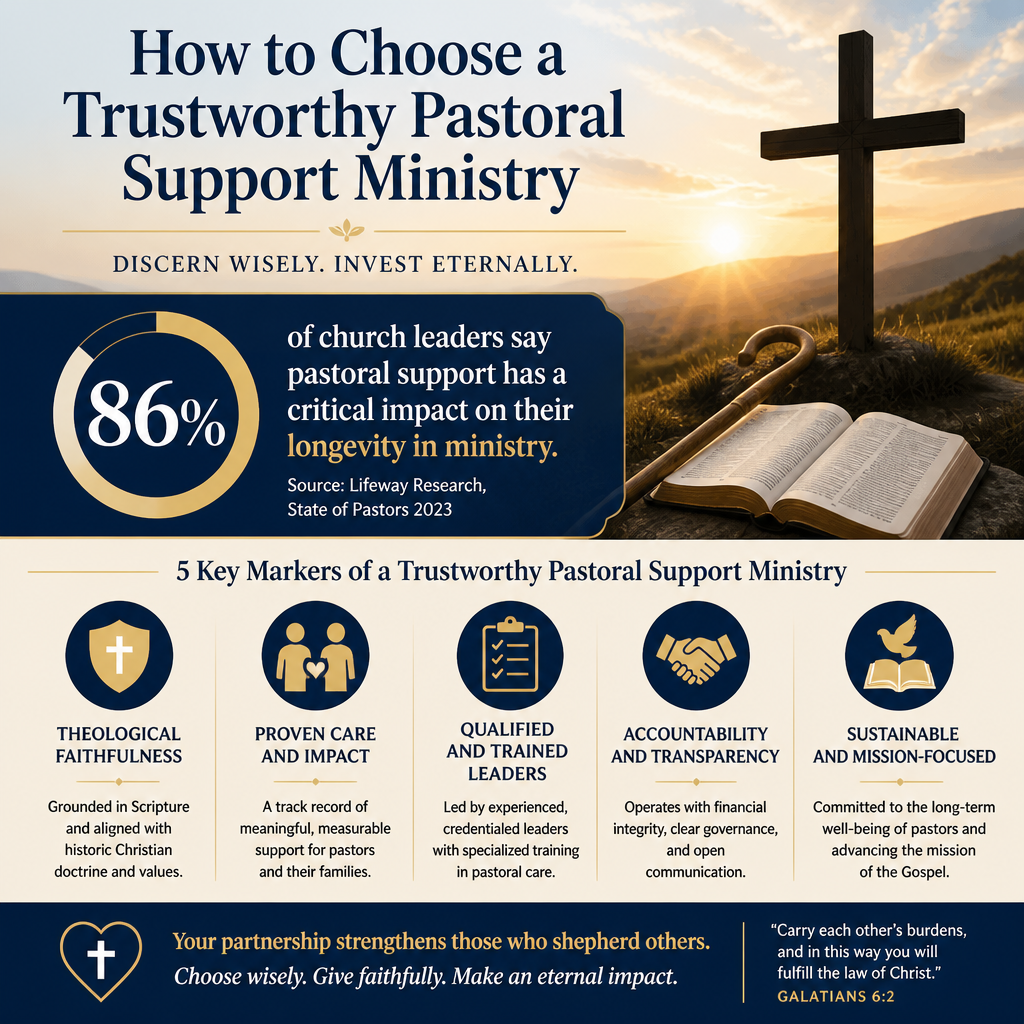
Most Trusted exists to help donors give with confidence by evaluating Christian nonprofits against The Most Trusted Standard, a 15-criteria framework across Faith Foundation, Financial Integrity, Governance and Leadership, and Transparency and Effectiveness. When donors apply a consistent standard, two outcomes tend to follow: strong ministries are rewarded for doing quiet, disciplined work, and weaker ministries are less able to rely on charisma, urgency, or reputational borrowing.
For donors wanting broader context on the field itself, our coverage of Pastoral Support Ministries is designed to help donors see the range of models and the questions that recur across organizations.
A short due diligence checklist donors can use
- Theology and ecclesiology: Clear commitments about pastoral calling, holiness, accountability, and the local church.
- Safeguarding and escalation: Written policies for abuse, self-harm risk, mandatory reporting, and coordination with church leadership.
- Governance integrity: Independent board, conflicts-of-interest policy, and real executive accountability.
- Financial clarity: Accessible Form 990, clear restricted-fund practices, and audited statements when scale warrants.
- Program credibility: Defined services, trained providers, referral networks, and evidence of consistent delivery beyond events.
Donors exploring how to direct gifts within this space—benevolence funds, counseling subsidies, cohort programs, or denominational care structures—can also consult How to Give to Pastoral Support Ministries for giving considerations that tend to matter at the decision point.
FAQs for How to choose a trustworthy pastoral support ministry
Should donors prioritize pastoral counseling, retreats, or leadership development?
Different needs call for different interventions. Counseling and clinical referrals are often most appropriate for acute distress, trauma, addiction, or marital crisis, while peer cohorts and spiritual direction can be better for long-term resilience and vocational faithfulness. Leadership development can be valuable, but donors should ensure it does not substitute platform-building for pastoral formation. Trustworthy ministries can explain why their model fits the needs they claim to address and when they refer pastors elsewhere.
What red flags suggest a pastoral support ministry may be unsafe to fund?
Common red flags include governance that is functionally controlled by a founder, vague or missing safeguarding policies, refusal to provide standard financial documents, and programs that promise restoration without clear accountability to local church authority. Donors should also be cautious when confidentiality is used to prevent any meaningful external review or when a ministry’s public communications trade in urgency and scandal rather than careful truth-telling.
Choosing trustworthiness as an act of Christian stewardship
The church needs pastoral support that is tender toward the weary and uncompromising about truth. Donors are not called to cynicism, but we are called to discernment. The most trustworthy pastoral support ministries typically combine a clear ecclesial theology, disciplined governance, financial integrity, and transparent care practices that protect both pastors and the people they serve.



