
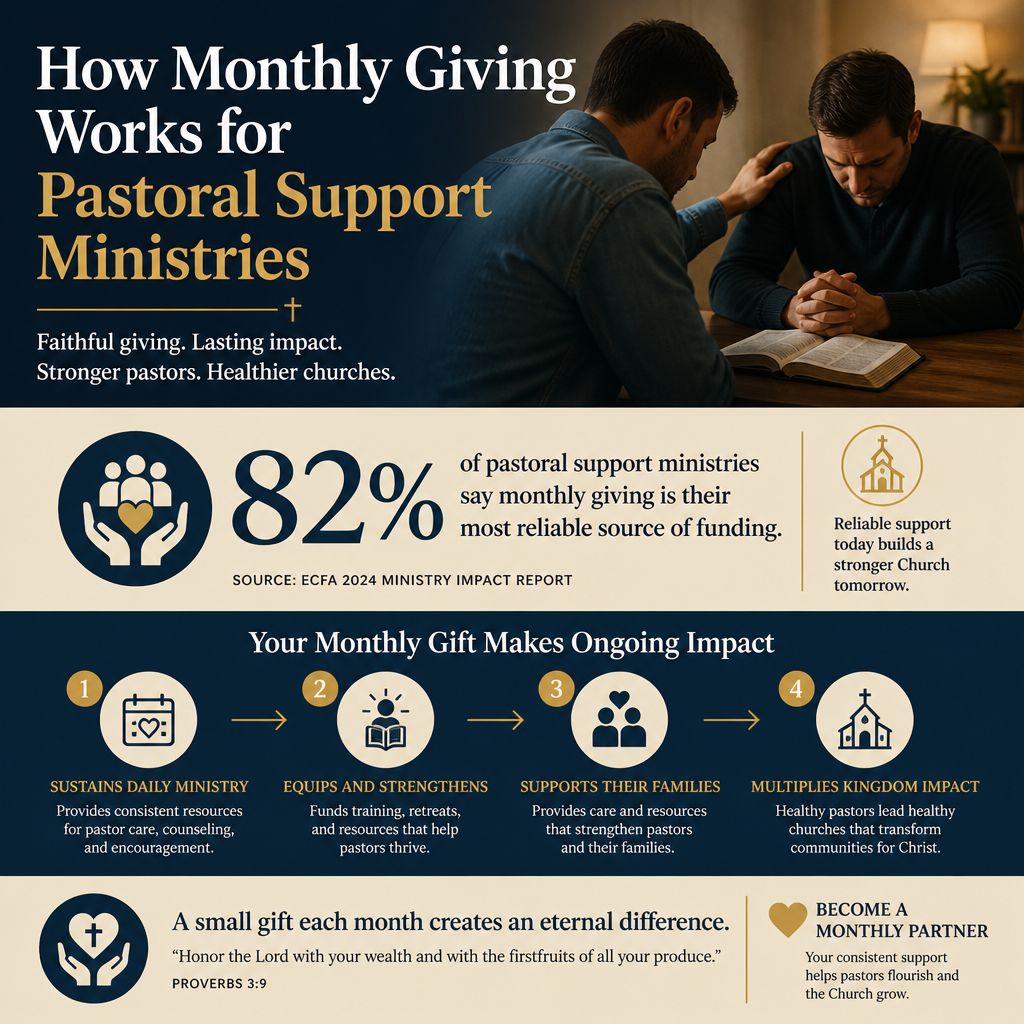
How monthly giving works for pastoral support ministries is ultimately a question of stability: whether the people who labor in the Word and doctrine can serve without living under constant financial uncertainty. Many donors care about pastoral health because they have seen what fatigue, isolation, and money anxiety can do to a family and to a church. Monthly giving is one of the simplest ways to turn that concern into durable care.
The New Testament assumes a moral seriousness about material support for spiritual work. Paul argues that “the Lord commanded that those who proclaim the gospel should get their living by the gospel” (1 Corinthians 9:14), and he praises the Philippians for a pattern of repeated partnership rather than a one-time gesture (Philippians 4:15–16). Monthly giving is not a virtue on its own, but it can embody that kind of steady partnership when it is practiced with clarity, accountability, and a commitment to the long-term good of the pastor and the church.
Monthly giving provides predictable support for volatile ministry realities
Pastoral support ministries often exist because local systems do not always absorb the full weight of a pastor’s needs. Some serve bi-vocational pastors in rural settings; others provide counseling subsidies, sabbaticals, emergency aid, or retreats for clergy families. In every case, the underlying challenge is predictability: ministry needs arrive on a timetable that rarely matches annual banquets or seasonal campaigns.
What predictability changes for a pastoral support ministry
Predictable revenue lets a ministry plan care instead of merely reacting. A fund that is replenished month by month can underwrite counseling sessions without waiting for a special appeal; it can schedule retreats with confidence rather than hoping a year-end surge covers deposits. It also allows staff to spend more time on pastoral care and less time managing cash-flow gaps.
From the donor’s perspective, this predictability is not primarily about convenience. It is about aligning the form of our giving with the nature of the need. Pastoral exhaustion does not only spike in December. A marriage crisis does not wait for a pledge drive. Monthly giving acknowledges that pastoral care is a steady, ordinary burden in a fallen world, and therefore requires steady, ordinary provision.
The hard question of dependency and local responsibility
Christians genuinely disagree about how much responsibility should rest with a pastor’s local church versus external support organizations. The concern is reasonable: external funding can become a substitute for local discipleship, local generosity, or difficult governance decisions. A thoughtful pastoral support ministry will treat monthly gifts as a supplement that strengthens pastoral sustainability, not as an excuse for churches to neglect their own obligations.
Donors can ask directly how the ministry avoids creating unhealthy dependency: Does it require church involvement in care plans? Does it set time-bound limits for certain kinds of aid? Does it provide coaching that helps churches improve compensation practices over time? These questions are not cynical. They are the kind of stewardship that honors both the pastor and the church.

Monthly giving typically funds a portfolio of care rather than a single expense
Many donors assume their monthly gift will “pay for” a particular item: a counseling session, a retreat scholarship, or a pastor’s grocery bill. Sometimes that is true. More often, monthly giving goes into a general fund that supports multiple forms of care, because needs are uneven and difficult to forecast.
Common ways pastoral support ministries apply monthly gifts
Across the field, recurring gifts frequently sustain a mix of direct and indirect support. That mixture can be wise when it is transparent and when the ministry can explain why each component serves pastoral health.
- Direct relief for emergencies such as medical bills, housing shortfalls, or crisis travel
- Clinical care such as counseling subsidies for pastors and spouses
- Rest and renewal through retreats, sabbaticals, or spiritual direction
- Formation and coaching for resilience, leadership development, or marriage strengthening
- Assessment and referral so pastors receive competent, confidential care rather than improvised help
The most important question is not whether every dollar is earmarked. The more important question is whether the ministry can show a credible theory of care and verifiable practices that protect vulnerable people.
Why designated giving is not always the most faithful option
Donors often prefer designation because it feels concrete. Yet pastors’ needs can be complex. A pastor asking for emergency rent may also need counseling, financial coaching, or church mediation. Restricting gifts too tightly can force ministries to address symptoms without addressing root causes.

At the same time, unrestricted funds can be misused when governance is weak. Mature donors do not choose between “designated” and “unrestricted” as if one is always moral and the other always suspect. They ask whether the organization has the internal controls, oversight, and transparency to steward flexible funds well.
Healthy monthly giving depends on governance, transparency, and pastoral safeguards
Pastoral support is high-trust work. It involves confidential stories, uneven power dynamics, and situations where families are under stress. That combination can produce serious risks: favoritism, conflicts of interest, inadequate safeguarding, and quiet financial mismanagement. Monthly giving is appropriate only when the ministry is structurally worthy of sustained trust.
What to look for before committing recurring support
We recommend beginning with simple, verifiable indicators. Does the ministry publish current financial statements and an annual report? Does it have an independent board with documented oversight? Does it explain how decisions are made about who receives aid and under what conditions? The more discretionary the assistance, the more critical the controls.
Where formal audits are not required, donors can still ask for evidence of disciplined financial practice, including third-party reviews or clear accounting policies. The IRS expects tax-exempt organizations to make core governance information available through Form 990, and donors can often review filings through established nonprofit databases. The IRS outlines Form 990 expectations and public disclosure rules on its website at irs.gov.
Pastoral care requires ethical boundaries, not only compassion
Many pastoral support ministries are founded by leaders with real compassion and lived familiarity with ministry pain. Compassion is necessary; it is not sufficient. The ministry should have policies that address confidentiality, mandatory reporting, counseling referrals, and conflicts of interest. A board should be able to say “no” when a request is outside mission, unsafe, or financially irresponsible.
When donors want to understand how to assess these issues, it can help to review the broader landscape of Pastoral Support Ministries and the distinct forms of care ministries claim to provide. The categories are not merely semantic; they reflect different risk profiles and different kinds of evidence a donor should expect.
Monthly giving is stewardship: it should be examined, not sentimentalized
Recurring giving can feel spiritually uncomplicated: a quiet monthly act of faithfulness. Yet Scripture treats money as a revealing matter of the heart, and therefore as something we should examine with sobriety. A disciplined monthly commitment should be paired with disciplined attention.
Why recurring gifts can deepen a donor’s formation
Steady giving cultivates patience. Pastoral health rarely changes in dramatic, public ways. Many of the most meaningful outcomes are hidden: a marriage that stabilizes, a leader who does not quit, a congregation spared the trauma of a moral collapse. Monthly giving forms donors to value the long obedience of faithful service rather than only visible “wins.”
At the same time, donors should not confuse longevity with fruitfulness. A ministry can receive monthly gifts for years without measuring whether its care practices are actually effective. Evidence can include utilization rates of counseling grants, follow-up practices, wait times, referral quality, and clearly defined criteria for assistance. If outcomes cannot be measured precisely, the ministry can still be transparent about what it knows and what it cannot yet prove.
Three tensions donors should name directly
Mature stewardship names tensions rather than ignoring them. Pastoral support work commonly raises at least three.
First, confidentiality versus accountability. The ministry must protect pastors from unnecessary exposure while still providing donors with meaningful transparency about how funds are used.
Second, care versus enabling. Some situations require firm boundaries and a plan that involves local leadership, not indefinite external subsidies.
Third, compassion versus competence. A ministry should be able to show that it works with qualified counselors and appropriate clinical or pastoral professionals, not only sincere volunteers.
These tensions are one reason many donors seek independent verification. Most Trusted exists to help donors give with confidence by evaluating ministries against The Most Trusted Standard, a 15-criteria framework that examines faith commitments, financial integrity, governance and leadership, and transparency and effectiveness. Verification does not remove the need for discernment, but it can reduce guesswork.
How to start monthly giving without surrendering due diligence
Monthly giving should be easy to begin and easy to reevaluate. The aim is not perpetual commitment to a brand. The aim is durable partnership in faithful care.
Practical steps that honor both trust and caution
Begin with a meaningful but measured amount, then increase as confidence grows. Ask for the ministry’s most recent annual report, its governance information, and a clear explanation of how pastoral aid decisions are made. Confirm whether your gift is unrestricted or restricted, and whether it is revocable at any time.
Donors can also watch for signals of healthy communication. Ministries that respect donors tend to provide regular reporting that is neither manipulative nor vague. They avoid pressure tactics, disclose limits candidly, and explain how administrative costs relate to real pastoral outcomes. For donors who want to compare approaches, the category of How to Give to Pastoral Support Ministries can clarify different giving models, including direct aid, scholarship funds, and program-based support.
What to do if a ministry’s claims feel strong but evidence is thin
Some ministries are doing sincere work but lack mature infrastructure. If evidence is thin, donors can respond in several responsible ways: give a smaller monthly amount while requesting clearer reporting, designate a gift to a more measurable program area, or support a ministry that has already developed robust oversight. It is not unloving to expect adult-level accountability. It is one way we honor the pastors we want to protect.
FAQs for How monthly giving works for pastoral support ministries
Is monthly giving better than a one time gift for supporting pastors?
Monthly giving is often better for stability because it helps a pastoral support ministry plan care, maintain reserves for emergencies, and commit to longer-term interventions like counseling support. One-time gifts can still be highly valuable, especially for capital needs, crisis appeals, or a designated scholarship fund. The more important issue is whether the ministry can steward either type of gift with transparency and credible safeguards.
What should we expect a pastoral support ministry to report to monthly donors?
Donors should expect clear financial reporting, basic governance transparency, and program reporting that connects spending to specific forms of care. Because confidentiality is central in pastoral support, ministries may not be able to share detailed stories, but they can share aggregate information such as the kinds of aid provided, utilization levels, referral partnerships, and decision criteria. Where possible, they should also make required public filings accessible, including IRS Form 990 documentation referenced by the IRS at irs.gov.
Monthly giving as long obedience in pastoral care
Monthly giving works when it matches the steady nature of pastoral burdens with steady provision, and when the ministry receiving those gifts is governed in a way that deserves long-term trust. Christian donors are not merely funding a service; we are participating in a moral economy shaped by the gospel, where those who labor for the church are not left to carry their load alone. The best monthly giving is not sentimental or automatic. It is faithful, examined, and anchored in truth.



