
How pastoral care ministries measure pastor wellbeing is not a peripheral question for Christian donors. It is one of the few ways a ministry can demonstrate that it is strengthening the long obedience of shepherds who are called to “keep watch over yourselves and all the flock” (Acts 20:28).
Yet pastor wellbeing is difficult to measure with integrity. The inner life cannot be reduced to a dashboard, and confidentiality is not a public-relations strategy but a moral obligation. At the same time, donors are right to ask for evidence that pastoral care is doing more than offering sympathetic conversation. The mature posture holds both truths: pastors are not projects, and ministries still owe the church clear accountability for outcomes.
Why measuring pastor wellbeing requires theological clarity
Pastoral care is not a wellness program with Bible verses attached. Christian ministry begins with the conviction that human beings are embodied souls, accountable to God, and sustained by grace. A credible measurement approach therefore starts by naming what “wellbeing” means in pastoral vocation: not perpetual calm, but resilient faithfulness under real burdens.
Wellbeing is not the absence of hardship
Scripture does not promise leaders an untroubled interior life. Paul describes “pressure” and “anxiety for all the churches” as part of apostolic ministry (2 Corinthians 11). Pastoral care ministries should not imply that distress is always a failure of faith. Their metrics should distinguish between ordinary grief, acute risk, chronic burnout, moral compromise, and vocational unsuitability.
What this means in practice is that the best measurement systems include both symptom indicators (sleep, exhaustion, depressive symptoms) and formation indicators (prayer, Sabbath, trusted relationships, confession, emotional regulation, vocational clarity). Donors should be wary of reporting that treats any negative emotion as “bad outcomes.”
Wellbeing must account for the church, not only the individual
Pastors do not suffer in isolation; congregations and systems can create conditions that erode or support health. Pastoral care that measures only the individual can unintentionally hide structural problems: unrealistic workloads, governance dysfunction, or chronic conflict dynamics. Healthy measurement asks how the pastor is functioning in community—marriage and family stability, peer support, spiritual friendships, and the presence of wise oversight.

What strong ministries actually measure
Across our verification work at Most Trusted, the ministries that meet The Most Trusted Standard tend to define a limited set of outcomes and measure them consistently, rather than claiming they can quantify everything. The goal is not maximal data collection; it is disciplined evidence that care is producing durable fruit.
Core outcome domains that can be measured responsibly
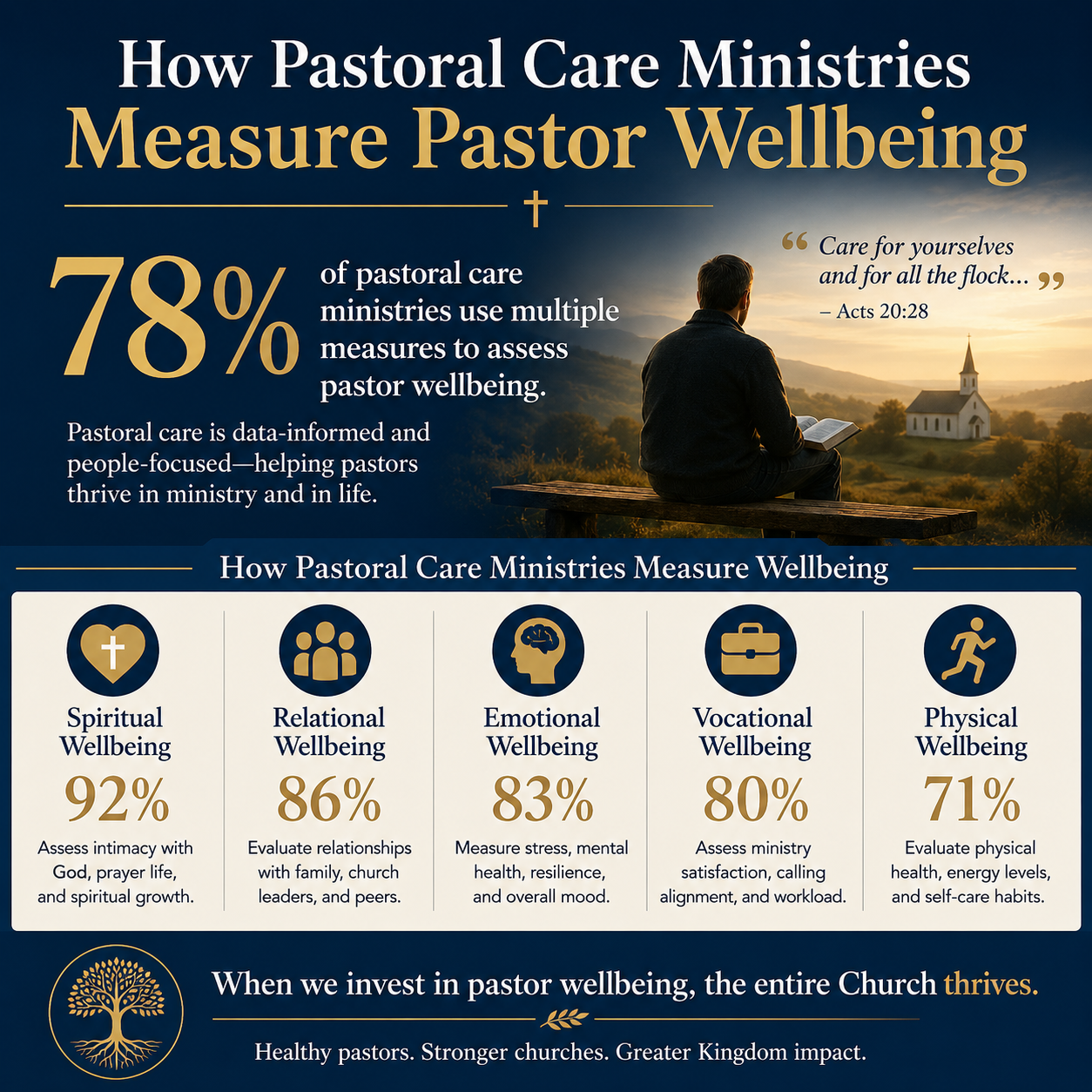
While approaches vary, pastoral care ministries often measure wellbeing across several recurring domains:
- Psychological distress and risk: indicators of depression, anxiety, trauma symptoms, and suicidality, typically assessed through validated screening tools administered by trained professionals.
- Relational stability: spouse and family strain, isolation, conflict patterns, and the presence of supportive friendships or mentoring.
- Vocational sustainability: intention to remain in ministry, clarity of calling, functional capacity to preach, lead, and shepherd without persistent impairment.
- Spiritual practices: consistency of prayer, Scripture meditation, worship, confession, and Sabbath rhythms, measured as patterns rather than performances.
- Boundaries and workload: weekly work patterns, rest, and realistic expectations, especially where governance permits overreach.
Validated tools and why donors should ask about them
When ministries claim measurable mental-health outcomes, donors should ask whether they use validated instruments and qualified staff. Common examples in the counseling world include the PHQ-9 for depression and the GAD-7 for anxiety, both developed and widely studied within clinical research communities; the U.S. Department of Veterans Affairs provides public information on these measures and their intended use (U.S. Department of Veterans Affairs). A credible ministry will also explain who administers tools, how results are interpreted, and what referral pathways exist when risk is identified.
The harder question is whether the ministry treats “spiritual wellbeing” as a separate, unmeasurable category, or whether it tries to quantify spirituality in shallow ways. The best work we see does not attempt to score holiness. It does, however, track meaningful proxies: whether pastors return to ordinary means of grace, re-engage truthful relationships, and regain vocational steadiness.
How ministries collect data without betraying trust
Pastors disclose what they would not disclose elsewhere. That is why measurement can easily become coercive: if a pastor suspects that a donor report will capture details, candor evaporates. A sound measurement practice is therefore an ethics practice, not merely a technical one.
Confidentiality is part of effectiveness
Donors sometimes assume that more transparency means more detail. In pastoral care, transparency is often better expressed as clear policies rather than granular stories. Ministries should be able to articulate who can access records, how data are stored, how de-identified reporting works, and what mandatory reporting rules apply. They should also describe how they obtain informed consent when collecting outcome measures.
This is one reason many ministries report outcomes in aggregate: pre/post changes across cohorts, retention in care, engagement rates, and satisfaction indicators—without exposing case details. Done well, aggregation protects dignity while still allowing verifiable accountability.
Independent evaluation can strengthen credibility
Internal surveys can be useful, but they are not the same as independent evaluation. Some pastoral care organizations partner with outside clinicians, researchers, or evaluators to review instruments, interpret results, and audit process integrity. This is not always feasible for smaller ministries, but donors should treat outside review as a meaningful marker of seriousness when budgets allow.
When donors are exploring the broader landscape of Pastoral Support Ministries, it is reasonable to ask whether a ministry’s outcome claims have been reviewed by anyone beyond its own staff and board.
Interpreting results with realism and moral seriousness
Even well-designed measures can mislead if donors interpret them simplistically. Pastoral distress is shaped by personality, church culture, crisis exposure, finances, family systems, and sometimes clinical illness. Metrics should guide stewardship decisions, not produce false certainty.
Beware of vanity metrics and overconfident claims
High satisfaction scores are not the same as meaningful change. Pastors may be grateful for kindness even when underlying dysfunction persists. Likewise, “number of coaching sessions delivered” says little about whether a pastor is safer, steadier, and more rooted in Christ.
Donors can ask for outcomes that reflect depth: sustained engagement over time, movement from acute crisis to stable functioning, and appropriate referrals when needed. Ministries that claim rapid, universal improvement across all participants should be questioned. Human lives are more complicated, and sanctification is not linear.
Attrition and selection effects matter
Pastors who stay in a program long enough to complete follow-up surveys may differ from those who drop out early. Programs that serve only self-referred pastors may be missing those in greatest danger, including leaders in isolating church cultures. A mature ministry will acknowledge these limitations in reporting, explaining what its data can and cannot conclude.
The broader context is also sobering. A Barna report conducted in partnership with Pepperdine University found that many pastors have considered quitting full-time ministry; Barna’s public research summaries and related findings are available through its research portal (Barna Group). While donors should not treat any one study as definitive, the cumulative evidence suggests that pastor stress is widespread enough that rigorous measurement is a pastoral necessity, not a luxury.
What donors should look for when evaluating pastoral care ministries
Donors are not responsible to do clinical assessment. But donors are responsible to fund ministries that handle money, people, and truth with integrity. In our work at Most Trusted, we encourage donors to ask questions that connect outcomes to governance, financial stewardship, and candor.
Signals of a ministry that is measuring wellbeing with integrity
As donors evaluate organizations within How Pastoral Support Ministries Measure Impact, several markers are particularly meaningful:
Clear definitions. The ministry defines what it means by “wellbeing” and differentiates between coaching, spiritual direction, counseling, and clinical care.
Appropriate tools. Where clinical claims are made, validated tools and licensed oversight are present, with clear boundaries and referral protocols.
Ethical data practices. Confidentiality policies are explicit; outcome reporting is aggregated; informed consent is practiced.
Honest limitations. Reports acknowledge selection effects, attrition, and the fact that not every case resolves quickly.
Governance and financial clarity. The organization can show how programs are funded, how leaders are supervised, and how donor dollars support care rather than institutional self-protection.
How The Most Trusted Standard fits
Most Trusted exists because donors deserve more than marketing language when evaluating Christian nonprofits. The Most Trusted Standard is a 15-criteria framework that examines theological clarity, financial integrity, governance, and public transparency, alongside evidence of effectiveness. For pastoral care ministries, this often means looking at whether promised outcomes match actual capacity, whether leadership is accountable, and whether the ministry’s reporting practices strengthen trust rather than trading on sentiment.
FAQs for How pastoral care ministries measure pastor wellbeing
Should pastoral care ministries publish detailed wellbeing data publicly?
Generally, no. Pastoral care depends on confidentiality, and detailed public reporting can pressure pastors to perform or conceal. Donors should expect transparent policies, clear aggregate outcomes, and honest limitations, while accepting that protecting privacy is part of faithful care.
What is a reasonable impact claim for a pastoral care ministry to make?
A reasonable claim is specific, bounded, and matched to expertise. For example, a ministry may credibly claim improved functioning and reduced distress among participating pastors, increased connection to supportive relationships, or stronger vocational sustainability, supported by aggregate pre/post measures and documented referral pathways. Claims of universal transformation, rapid resolution, or quantifiable “spiritual growth” should be treated carefully.
Funding measurable care without reducing pastors to metrics
Christian donors can insist on evidence without demanding exposure. The faithful question is whether a pastoral care ministry is using disciplined measurement to serve pastors, protect the vulnerable, and steward resources truthfully. When wellbeing is measured with theological clarity, ethical restraint, and credible tools, donors can give with confidence that care is strengthening those who bear the church’s burdens.



