
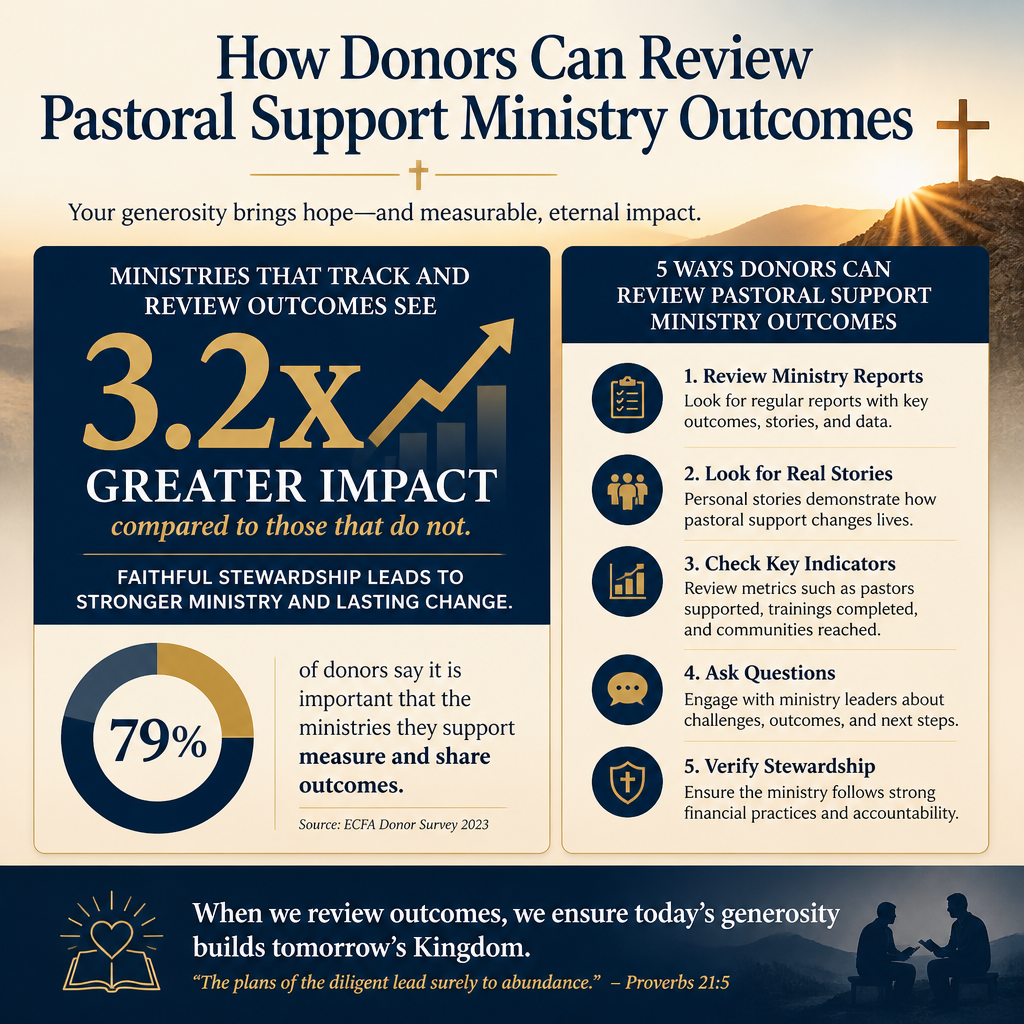
How donors can review pastoral support ministry outcomes is ultimately a question of theological stewardship, not spreadsheet vigilance. Pastors are entrusted with souls, and donors are entrusted with resources; both callings require discernment that is serious enough to handle what cannot be quantified and sober enough to demand evidence where it can be gathered.
Pastoral care does not lend itself to the tidy metrics donors may expect from disaster relief or food distribution. Yet the absence of perfect measurement is not permission for vagueness. The New Testament assumes accountable leadership, truthful speech, and pastoral watchfulness exercised “as those who will have to give an account” (Heb. 13:17). A mature outcomes review holds compassion and verification together.
Begin with clarity about what pastoral support ministry is accountable for
Pastoral support ministries vary widely: counseling and care for clergy, marriage intensives, sabbatical support, peer cohorts, coaching, crisis response after moral failure or burnout, and resourcing for congregational health. Donors cannot evaluate “impact” until a ministry names the specific burdens it is addressing and the concrete services it provides.
Ask for a theory of care that matches the reality of pastoral life
Many ministries default to generic wellness language that sounds plausible but does not describe pastoral reality: loneliness in leadership, secondary trauma, chronic conflict exposure, and the spiritual strain of sustained ministry without adequate friendship or rest. A credible ministry should articulate how its services address these dynamics and how it differentiates pastoral exhaustion, depression, marital distress, and moral crisis—without collapsing them into the same category.
Christians genuinely disagree about how much ministry outcomes should be expressed in clinical terms. Some donors are wary of importing therapeutic categories into pastoral life; others rightly insist that trauma, depression, and addiction are not resolved by spiritual language alone. The sound approach is not to choose a side but to insist on conceptual coherence: pastoral care that honors Scripture and also treats embodied and psychological realities truthfully.
Distinguish between outputs, outcomes, and faithfulness
Pastoral support work includes measurable outputs (sessions delivered, retreats hosted, scholarships distributed) and more complex outcomes (improved marital stability, reduced burnout symptoms, increased pastoral retention). There is also the category Scripture emphasizes most directly: faithfulness—integrity, repentance, reconciliation, perseverance in ministry, and a life that “keeps watch” over the flock (1 Pet. 5:2–3). Donors can seek evidence for all three, but should not confuse them.

Review outcomes in layers rather than demanding one definitive number
The most responsible way to evaluate pastoral support outcomes is layered: first confirm the ministry is serving the people it claims to serve, then examine evidence of change, then test whether the ministry is learning and improving. This avoids two common errors: treating personal transformation as unmeasurable mysticism, or treating it as if it were a manufacturing process.
Layer one is reach and access
Start by asking who is being served and whether access is fair and intelligible. A pastoral support ministry should be able to describe eligibility, referral pathways, geographic reach, and barriers to entry (cost, travel, denominational alignment, language, stigma). If the ministry is primarily helping senior pastors of large churches while presenting itself as serving “the church,” donors should know that.
Some ministries should also be prepared to explain why confidentiality limits what they can disclose. Wise confidentiality protects pastors and families from unnecessary exposure. But confidentiality should not become a blanket excuse for not reporting anything beyond anecdotes.
Layer two is evidence of change
Evidence may include pre- and post-assessments, validated mental health instruments used appropriately, follow-up interviews, or structured pastoral self-report with clear limitations. Donors should not demand invasive disclosure, but can require that the ministry has a disciplined approach to understanding whether its work is helping.
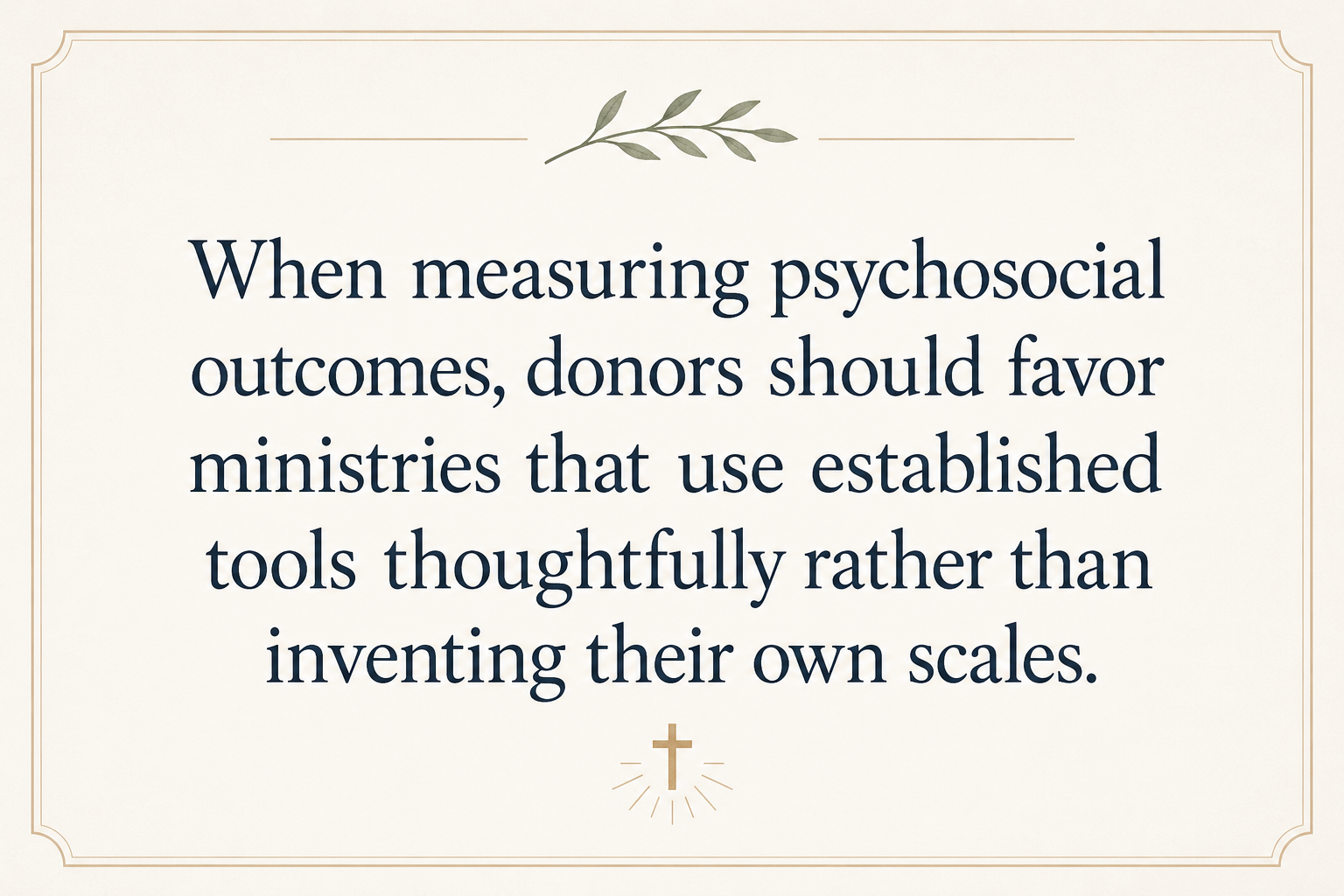
When measuring psychosocial outcomes, donors should favor ministries that use established tools thoughtfully rather than inventing their own scales. Measures should be appropriate to the intervention and interpreted with humility. A retreat weekend may reduce acute stress; it will not, by itself, resolve entrenched marital patterns or long-term depression.
Ask for indicators of integrity, not just stories of transformation
Personal stories matter in pastoral support because the work is personal. Yet donors should be cautious about ministries that rely almost entirely on testimonies. Powerful stories can be true and still be unrepresentative. Mature review asks for indicators of integrity in how stories are gathered, framed, and used.
Examine how confidentiality and consent are practiced
Pastors and spouses are often vulnerable: ashamed, fearful of denominational consequences, uncertain about employment, and concerned for their children. Donors should expect written consent processes for any story shared publicly, clear privacy practices, and a refusal to trade in salacious narratives. Ministries that meet this expectation tend to communicate with restraint, treating pastoral suffering as a trust rather than content.
Look for evidence of learning from failure
Pastoral support ministries work in territory where outcomes can be ambiguous and setbacks are common. A credible ministry should be able to name what has not worked, what it has changed, and how it makes decisions when outcomes conflict—for example, when a pastor reports improved wellbeing but ongoing marital crisis persists.
We have also seen ministries strengthen over time by building feedback loops that protect pastors from being used as performance proof. The goal is not an unblemished narrative; it is faithful service under the light.
Evaluate the ministry against a trust framework donors can defend
Donors often feel the tension between wanting to trust Christian leaders and needing to exercise discernment. Scripture does not commend cynicism, but it does assume prudent oversight, especially where money, authority, and vulnerability intersect. Pastoral support is a high-trust domain; precisely for that reason, donors should evaluate it with a clear framework.
Use The Most Trusted Standard as a verification lens
Most Trusted exists to help donors give with confidence by evaluating ministries against The Most Trusted Standard, a 15-criteria framework that examines faith commitments, financial integrity, governance and leadership, and transparency and effectiveness. In pastoral support work, those criteria become practical questions: Is the ministry’s theology coherent and publicly stated? Are counseling and care services delivered by qualified staff with accountable supervision? Is the board independent enough to address misconduct? Are financial statements and key policies accessible?
What this means in practice is that outcomes review is not only about participant change. It is also about whether the organization is structured to tell the truth, handle risk, and sustain care over time. Many donor disappointments could have been avoided if governance, financial practices, and transparency had been examined before a compelling story carried the day.
Ask for the specific documents that support accountability
Donors should expect pastoral support ministries to provide clear, written information without defensiveness. A short list of items often reveals whether a ministry is prepared for accountable partnership:
- Current audited financials or reviewed statements, as applicable, and an IRS Form 990 where required
- A board list with roles and independence, plus conflict-of-interest and whistleblower policies
- A program description that defines services, eligibility, and confidentiality boundaries
- A summary of outcomes reporting methods, including limitations and learning priorities
- Safeguarding policies for counseling, retreats, and crisis response
The nonprofit field has had to reckon with the “overhead” fixation that can punish healthy infrastructure and incentivize underinvestment in accountability. The joint statement commonly referred to as the Overhead Myth—signed by GuideStar, Charity Navigator, and the BBB Wise Giving Alliance—argues that administrative ratios are a poor proxy for performance and can mislead donors away from what actually matters in organizational health GuideStar.
Know the common failure modes in pastoral support and how outcomes reviews can address them
Pastoral support ministries face distinct risks: the misuse of authority, the temptation to substitute charisma for competence, the minimization of clinical realities, and the drift toward protecting reputations rather than souls. A donor outcomes review should be alert to these failure modes, because they often show up before a crisis becomes public.
Beware of ministries that confuse loyalty with spiritual maturity
Some programs implicitly reward leaders who protect institutional image. Donors can ask whether the ministry has clear reporting pathways for misconduct, whether it cooperates with denominational processes appropriately, and whether it resists the subtle pressure to “keep things quiet” for the sake of donor confidence. A ministry can affirm forgiveness and still insist on truth-telling, restitution, and protective boundaries.
Account for the relational complexity of outcomes
Pastoral flourishing is rarely an individual-only outcome. A pastor may report renewed spiritual vitality while a spouse remains wary or exhausted. A pastor may return to the pulpit with new habits while the congregation’s conflict dynamics remain unchanged. Donors should favor ministries that acknowledge these relational layers and, where appropriate, incorporate spouse support and family care rather than treating them as secondary.
When donors ask for evidence of pastoral wellbeing, it can help to remember that many pastors operate under chronic role expectations that keep them from admitting struggle. Barna has reported extensively on pastoral stress and burnout in recent years, underscoring both the prevalence of strain and the complexity of defining and measuring “burnout” across contexts Barna Group. Ministries that treat this complexity seriously are more likely to report outcomes with honesty rather than exaggeration.
For donors seeking broader context on how impact is approached across this field, How Pastoral Support Ministries Measure Impact provides additional framing for what responsible evidence can and cannot claim.
FAQs for How donors can review pastoral support ministry outcomes
What outcomes should we reasonably expect a pastoral support ministry to report?
We should expect a combination of reach (who was served and how), program delivery (what services were provided), and evidence of change using appropriate tools and follow-up. For some interventions, that may include pre- and post-assessments or structured qualitative evaluation. We should also expect clear reporting on limitations, since confidentiality and the pastoral context constrain what can be publicly shared.
How can we evaluate outcomes without pressuring ministries to violate confidentiality?
We can ask for aggregated reporting, anonymized evaluation methods, and clear consent practices for any story shared. We can also emphasize organizational accountability: policies, governance, financial transparency, qualified staffing, and documented safeguarding practices. Those indicators often tell us more about whether a ministry is safe and credible than personal details ever could. For a wider view of how this ministry category is defined and evaluated, Pastoral Support Ministries offers additional context.
A defensible outcomes review honors both stewardship and pastoral dignity
Pastoral support ministries serve in a sacred and sensitive space where donors should neither demand simplistic proof nor accept unaccountable claims. The strongest outcomes reviews are layered, grounded in Scripture’s call to truth and faithful oversight, and supported by an organizational framework that donors can explain without embarrassment. When ministries are structured to tell the truth, protect the vulnerable, and learn over time, donors can give with confidence that compassion is being practiced with wisdom.



