
How orphan care ministries support foster families is one of the clearest tests of whether our compassion is shaped by Scripture’s priorities rather than by sentiment. The biblical mandate is not merely to feel for vulnerable children, but to defend their place in stable, covenantal community: “God… is father of the fatherless” and “sets the lonely in families” (Psalm 68:5–6). Foster care is not identical to adoption, and it is often temporary by design. Yet it is frequently the most immediate way a church can stand beside children who have already lost much.
For Christian donors, the question is rarely whether foster families deserve support. The harder question is what kind of support actually strengthens families and protects children, without substituting charity for the public responsibilities of the state or creating incentives that distort good practice. Across our verification work at Most Trusted, we observe that the healthiest orphan care ministries treat foster care as part of a wider ecosystem: child safety, family preservation when possible, trauma-informed caregiving, and patient, accountable partnership with local churches and public agencies.
Foster care is a public system with spiritual stakes
Why foster families are under real strain
Foster families are asked to welcome children in crisis while navigating court timelines, agency requirements, birth family dynamics, and the practical burdens of appointments, schooling changes, and behavioral volatility. This is not a theoretical need. The U.S. foster care population is substantial, with hundreds of thousands of children in care at any given time, according to the federal Adoption and Foster Care Analysis and Reporting System maintained by the Children’s Bureau at the U.S. Department of Health and Human Services (ACF Children’s Bureau).
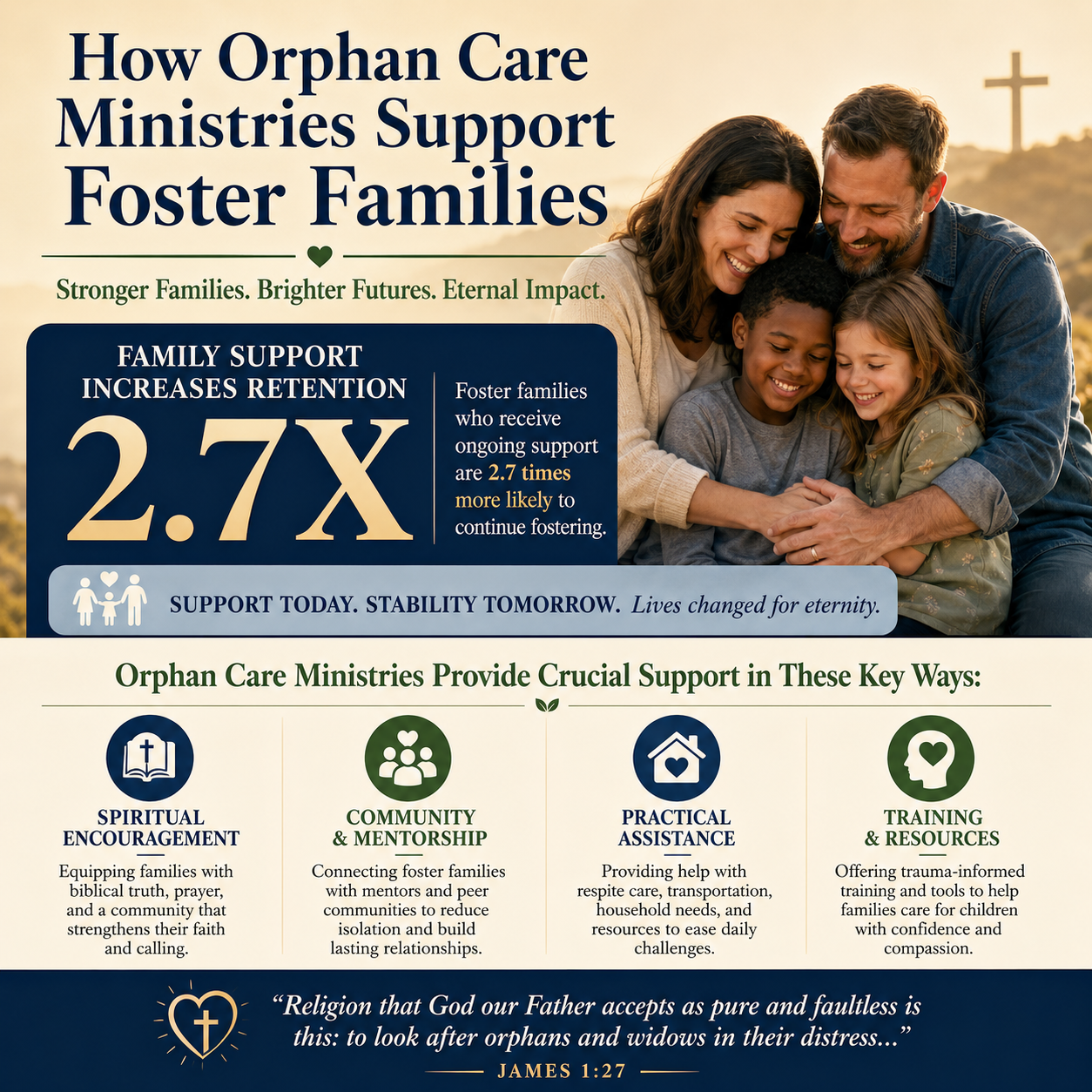
Scripture’s moral logic does not ignore the administrative realities. James’s “pure and undefiled religion” is explicitly tied to embodied, sustained care for those without protection (James 1:27). In foster care, that often means a family’s willingness to keep saying yes after the first emergency placement, after the first disruptive night, after the first court date that does not resolve cleanly. The church’s duty of mercy meets a system where outcomes can be slow and ambiguous.
What orphan care ministries can do that government cannot
Government agencies can fund services and enforce minimum standards, but they cannot supply the covenantal companionship that fatigued families need. Healthy orphan care ministries provide relational scaffolding: meals, prayerful presence, respite, practical advocacy, and a community that holds grief and joy together without romanticizing either. In the long run, these are not “extras.” They are part of what keeps a foster family from collapsing under cumulative stress.
Christians genuinely disagree about how directly ministries should interact with the state, particularly around training requirements, licensing, and policy advocacy. But most can agree on a baseline: foster parents should not be isolated. When ministries function as an extension of the local church—bearing burdens without replacing lawful authority—they often serve foster families with both humility and strength.

Effective support begins with family preservation and wise permanence
The goal is safety, not an outcome donors prefer
Christian compassion can drift toward a single preferred narrative: the heroic rescue through adoption. Yet the foster care system is, at least formally, oriented toward reunification when it can be done safely. Many children enter care because their families are in acute crisis—substance use, domestic violence, untreated mental illness, or severe economic instability. Supporting foster families well includes supporting the work that helps birth families heal when possible.
That conviction is not sentimental. It aligns with the principle that children thrive in stable family settings and that disruptions compound trauma. For young children, extended instability can be especially costly. When the state removes a child, the church should resist simplistic binaries—either “reunify at all costs” or “terminate quickly.” Safety and long-term flourishing are the moral center, and those require discernment, evidence, and lawful process.
How ministries strengthen the whole continuum of care
Strong orphan care ministries often support foster families by resourcing the wider continuum:
- Family preservation services that reduce removals when risk can be addressed responsibly
- Wraparound care for foster parents facing frequent appointments and school disruptions
- Support for kinship caregivers who step in with little preparation and limited resources
- Pathways to permanency when reunification is not safe, including ethical adoption support
- Post-permanency care so families are not abandoned after an adoption or guardianship is finalized
For donors, this is a crucial shift: the highest-impact giving is often less dramatic. It funds the unglamorous work that prevents breakdown, stabilizes placements, and reduces re-traumatization. It also helps churches avoid the implicit message that children are most valuable when they fit a donor’s preferred story.
Trauma-informed care is not optional, and it is not merely clinical
What trauma means for foster families in daily life
Children entering foster care often carry histories of neglect, abuse, or chronic instability. Those experiences shape attachment, emotional regulation, and behavior. Foster parents may face aggression, withdrawal, hoarding food, sexualized behavior, or intense fear of abandonment—often within the same child. Ministries that treat these realities as mere “discipline issues” can inadvertently deepen harm.
Trauma-informed practice is sometimes framed as a secular import. Yet Christians have theological categories for it: the pervasive effects of sin, the vulnerability of embodied creatures, the long work of restoration, and the patience of God with wounded people. Trauma-informed care is not an excuse for harmful behavior; it is a framework for truthful interpretation so that correction, protection, and nurture are properly ordered.
What credible ministry support should include
Support that strengthens foster families tends to include training, peer mentoring, and access to specialized help. Ministries may offer evidence-informed caregiver training, coordinate with licensed clinicians, and help families advocate for appropriate school services. Donors should not confuse “spiritual” with “unprofessional.” In most contexts, spiritual care and clinical competence should reinforce each other.
At the same time, donors should be cautious about ministries that overpromise therapeutic outcomes or imply that faith alone will resolve complex developmental and mental health needs. Some children will need long-term services. Some families will experience placement disruption despite faithful effort. Responsible ministries speak candidly about these limits while remaining committed to compassionate, lawful care.
Respite, practical aid, and church-based community are often the difference
Why small interventions can prevent collapse
Foster parenting is often a marathon of ordinary interruptions: last-minute visitation changes, new school meetings, medical evaluations, a call from the caseworker, a sleepless night that becomes a sleepless week. Ministries that know this world do not only offer inspirational messaging. They offer calendars, carpools, meals, childcare coverage, and a plan for when a foster parent is depleted.
Respite care is a sensitive category because it intersects with licensing, safeguarding, and the child’s attachment needs. Done poorly, it can feel like another rotation of unfamiliar adults. Done well—with trained, approved caregivers and consistent relationships—it can keep a placement intact. For donors, funding respite infrastructure is often high-leverage giving precisely because it prevents crises rather than merely responding to them.
Connecting donors to ministries that serve with accountability
Many donors want to help but worry about scandals, mission drift, or programs that unintentionally create perverse incentives. This is one reason we built Most Trusted: to help donors give with confidence by evaluating Christian nonprofits against The Most Trusted Standard, a 15-criteria framework spanning faith foundation, financial integrity, governance and leadership, and transparency and effectiveness.
Within How Orphan Care Ministries Serve Children and Families, we regularly see that the strongest organizations can explain not only what they do for foster families, but how they measure whether that help is actually stabilizing homes and protecting children. They do not treat transparency as a marketing decision. They treat it as part of Christian truthfulness.
What discerning donors should ask before funding foster family support
Five questions that reveal whether a ministry is prepared
Foster care is a field where good intentions can collide with hard realities: child safety requirements, legal processes, and the risk of retraumatization. The ministries that are prepared for this work welcome rigorous questions. We recommend asking:
- How do you coordinate with public agencies and comply with safeguarding requirements?
- What training do you provide, and what is your theological posture toward trauma and mental health?
- How do you support reunification when it is safe, and how do you engage birth families ethically?
- What does respite look like, and how do you ensure consistency and child protection?
- What outcomes do you track that indicate family stability and child well-being?
Donors should also ask about money in plain terms. Not because overhead is inherently suspicious, but because inadequate infrastructure can be its own form of negligence. The sector has broadly rejected simplistic overhead ratios as a proxy for impact, including through the “Overhead Myth” letter signed by Charity Navigator, GuideStar, and the BBB Wise Giving Alliance (Charity Navigator). A foster family support program without appropriate staffing, training, and safeguarding is not “efficient.” It is underprepared.
The place of verification in faithful giving
Christian donors often carry a double burden: the desire to respond quickly to need and the responsibility to steward resources with discernment. Verification is not a substitute for love of neighbor, but it can be an expression of it. The ministries that meet The Most Trusted Standard tend to show consistent patterns: clear doctrinal commitments that shape practice, financial reporting that can be tested, governance that is not merely nominal, and program claims that are not exaggerated.
Within Orphan Care Ministries, the strongest organizations usually share another mark: they treat foster families not as props in a fundraising story, but as neighbors to be served with steadiness. They respect the child’s story, honor lawful process, and build the slow capacities that keep families from breaking apart.
FAQs for How orphan care ministries support foster families
Should donors prioritize foster care support over international orphanage funding?
Many donors are re-evaluating international orphanage funding because decades of research and field experience have raised serious concerns about institutionalization and harmful incentives. The better question is not “domestic versus international,” but “institutional care versus family-based care.” We recommend prioritizing ministries that strengthen families, pursue ethical permanency, and can demonstrate safeguarding and accountability—whether their work is domestic foster care, kinship support, or international family preservation and reintegration.
What is the most practical way to support foster families if our church is not equipped to foster?
Most churches can begin with structured, predictable support: a trained respite pipeline compliant with local requirements, a meal and transportation system tied to actual placement timelines, and a benevolence fund for immediate needs that does not burden foster parents with complicated applications. Donors can strengthen this work by funding ministries that coordinate these supports with clear safeguarding, documented policies, and measurable outcomes rather than ad hoc goodwill.
Faithful support is measured by stability, truthfulness, and love
Foster families rarely need admiration. They need the church to be dependable. Orphan care ministries support foster families most effectively when they are honest about trauma, rigorous about safeguarding, committed to family-based solutions, and humble enough to work within lawful systems without surrendering spiritual conviction.
For Christian donors, the aim is not to fund the most emotionally compelling story. The aim is to participate in God’s steadfast care for vulnerable children by strengthening the families and communities that can hold them. That kind of giving is often quieter, but it is closer to the grain of Scripture and more likely to endure.



