

How memorial and honor gifts work in Christian senior care is not merely a question of donation mechanics. It is a pastoral question about how grief and gratitude can be translated into tangible love for older neighbors who bear God’s image and often carry hidden loneliness. Done well, these gifts become an act of worship and a form of witness, joining the church’s historic concern for widows, the frail, and the forgotten.
Yet the very moments that prompt memorial and honor giving—funerals, anniversaries, milestone birthdays, medical crises—also create vulnerability. Families are under emotional strain; friends want to help quickly; ministries may feel pressure to meet urgent needs. Mature Christian donors serve both the grieving family and the ministry best when giving is both compassionate and clear-eyed.
Memorial and honor gifts are designated to a person and directed to a mission
What the gift is and what it is not
A memorial gift is made in remembrance of someone who has died. An honor gift is made to celebrate or thank someone who is living. In both cases, the recipient of the donation is the ministry, not the individual. The person’s name is the occasion; the ministry’s work is the beneficiary.
This distinction matters spiritually and administratively. Spiritually, Christian giving is an offering to God for the good of neighbor, not a payment for recognition. Administratively, the ministry must deposit and receipt the gift according to nonprofit rules. The donor can receive a charitable contribution receipt; the person being honored generally cannot, because they did not make the gift and did not receive a qualifying charitable benefit.
What families typically expect
Families usually hope for three outcomes: first, that the person’s name is treated with dignity; second, that someone in the family receives timely notice of the gifts; and third, that the gifts genuinely serve the type of work the person cared about. Those expectations are reasonable, but they require clarity. A ministry can acknowledge a memorial or honor gift and report it to a designated contact without creating a quid pro quo or disclosing private donor details beyond what the donor permits.

How the process works in practice at Christian senior care ministries
The basic flow donors should understand
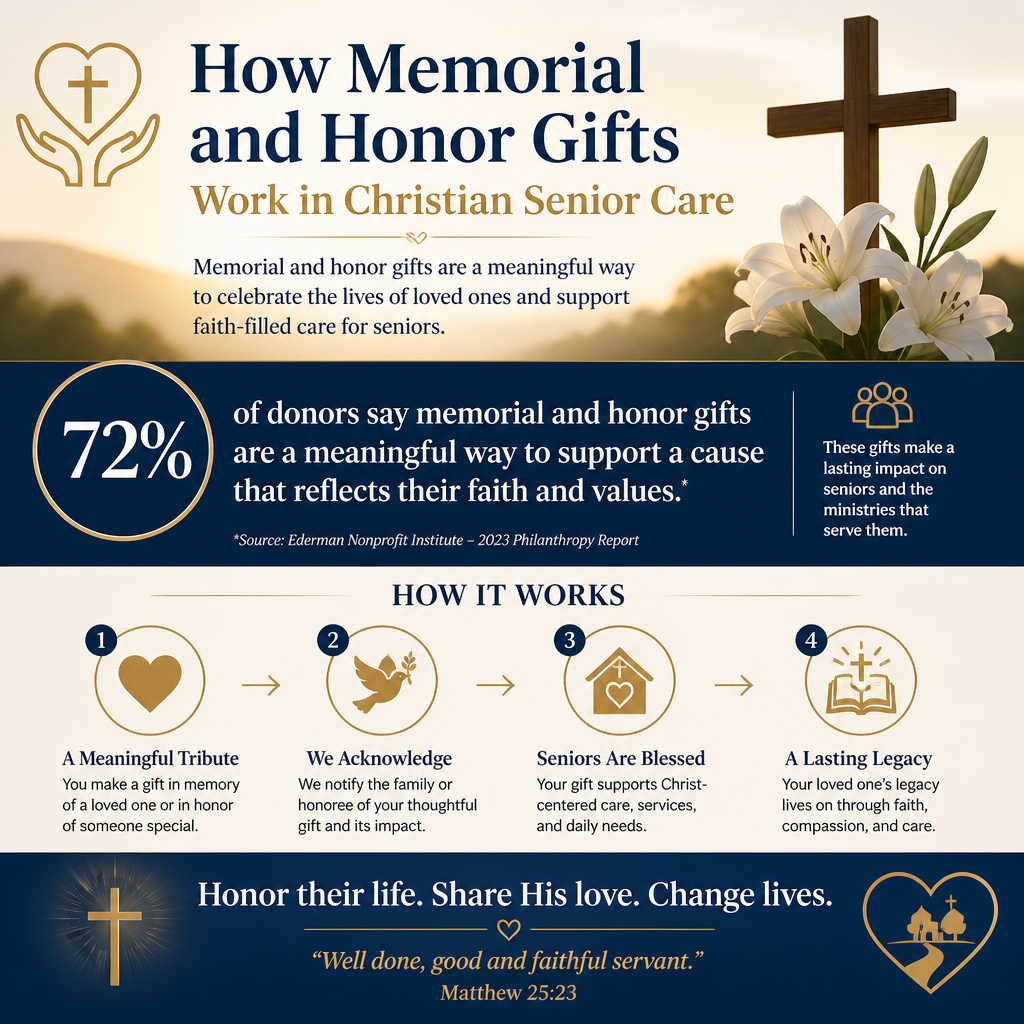
Most Christian senior care ministries follow a similar process: the donor gives online or by check; the donor indicates “in memory of” or “in honor of” and provides notification details; the ministry sends a tax receipt to the donor; and the ministry sends an acknowledgment letter or email to the honoree or to a family contact. When the giving volume is high—common after a funeral—ministries may send a consolidated list periodically rather than a separate notice for every gift.
Donors often ask whether the ministry can tell the family the amount given. Many ministries do not disclose gift amounts in the notification unless the donor explicitly authorizes it. That is usually wise. It protects donor privacy, reduces social pressure, and keeps the focus on gratitude rather than comparison.
When gifts are restricted and when they are not
Not every memorial fund is the same. Some gifts are unrestricted, allowing leadership to apply the funds where need is greatest. Others are restricted to a purpose, such as benevolence support for residents who cannot afford care, a chaplaincy program, dementia care, or capital improvements.
Restrictions can be a form of stewardship, but they can also create long-term strain if they do not align with actual needs. The tension is well known in philanthropy: highly restricted funds can accumulate while urgent operational needs go unmet. Christian donors can avoid this by restricting only when the ministry has clearly presented a feasible purpose, a timeline, and a plan for handling excess funds if the purpose is fulfilled.
The biblical logic of memorial giving is remembrance that bears fruit
Honoring the dead without turning gifts into a monument
Scripture treats memory with moral weight. God commands Israel to remember his works; the church remembers Christ’s death in the Lord’s Supper; believers are urged to “remember your leaders” and imitate their faith. Christian memorial giving fits this pattern when it moves beyond sentiment into mercy. The aim is not to construct a private monument, but to let a life of faith prompt continued good for others.
That requires restraint. Some families are tempted to treat memorial gifts as a kind of spiritual brand—an attempt to preserve a name through public recognition. Ministries can feed that temptation through excessive naming practices, but donors and families can also demand it. A Christian approach is simpler: gratitude, prayer, and a gift that strengthens the church’s care for the vulnerable.
Why senior care is a fitting context for honor gifts
Christian senior care sits close to the heart of biblical mercy. Older adults often face layered losses—health, mobility, friends, independence. Honor gifts can acknowledge a faithful spouse, a long-serving volunteer, a pastor’s retirement, or a parent’s quiet perseverance. When directed to ministries that provide housing, nursing, memory care, pastoral care, and community, the gift becomes a practical way of “not growing weary of doing good.”
For donors exploring where to direct this kind of giving across the field, Christian Senior Care Ministries is where we keep our broader editorial work and verification context connected to this category.
Stewardship questions discerning donors should ask before recommending a memorial fund
Questions that protect both the family and the ministry
Memorial giving can mobilize meaningful generosity quickly, but speed can hide governance and accountability issues. Across our verification work at Most Trusted, we observe that ministries that meet The Most Trusted Standard tend to be unusually clear about restricted funds, gift acceptance, receipting, and how donor intent is honored over time. That clarity is not bureaucratic. It is a form of truth-telling that protects trust.
Before listing a ministry in an obituary or circulating a memorial request, mature donors often look for answers to a short set of questions:
- Does the ministry provide a clear description of how memorial and honor gifts are used and acknowledged?
- Is there a written gift acceptance policy, including how restricted gifts are handled if needs change?
- Does the ministry publish current financial statements, leadership names, and contact information?
- Is the ministry’s faith identity stated plainly, without evasiveness or marketing haze?
- Can the ministry explain how it measures care outcomes that matter in senior care, including spiritual care?
Why transparency matters more than grief-driven urgency
Grief can create an unspoken assumption: “Any Christian ministry must be safe.” The Christian donor community has learned, painfully, that this assumption is not always warranted. Governance failures, financial opacity, and unclear accountability harm beneficiaries and donors alike. Senior care adds additional complexity because the vulnerable population is not abstract. Residents are often dependent on consistent, competent care, and disruptions carry serious consequences.
We also recommend resisting simplistic evaluation cues. The sector has had to reckon with the “Overhead Myth”—the insight that administrative and fundraising ratios do not, by themselves, indicate effectiveness. Charity Navigator, Candid, and the BBB Wise Giving Alliance have argued publicly that overhead ratios can mislead donors and incentivize unhealthy underinvestment in systems and staff necessary for real impact; their joint statement is widely cited in philanthropic practice Charity Navigator.
Tax receipting, privacy, and the details that can quietly undermine trust
Receipts, benefits, and what can be acknowledged
In the United States, memorial and honor gifts follow the same charitable contribution rules as other donations. Donors should receive a contemporaneous written acknowledgment for gifts of $250 or more, and the receipt should state whether any goods or services were provided in exchange for the donation Internal Revenue Service. Ministries that handle this well reduce risk for donors and signal operational seriousness.
Families sometimes ask whether a memorial gift can “pay for” a resident’s care. If the gift is made to a nonprofit and is earmarked for a specific resident in a way that functions like a personal bill payment, it may not qualify as a charitable contribution. Ministries commonly maintain benevolence or scholarship funds that support multiple residents according to established criteria. That structure better aligns with charitable purpose and protects both donor and ministry.
Privacy and pastoral sensitivity
Senior care is often intertwined with medical details, family conflict, and financial strain. Ministries should never disclose resident information as part of a memorial campaign. Donors can support that boundary by keeping requests simple: name of the person being remembered, the ministry name, and where to send acknowledgments. If a family wants a broader narrative, it should come from the family, not from the ministry’s development office.
When donors want to compare ministries or understand common giving channels and safeguards, How to Give to Christian Senior Care Ministries provides the larger giving context that surrounds memorial and honor gifts.
FAQs for How memorial and honor gifts work in Christian senior care
Should we ask for memorial gifts to a general fund or to a specific program in senior care?
Both can be faithful stewardship, depending on the ministry’s clarity and needs. Unrestricted gifts often serve residents best because senior care costs are complex and not easily separated into neat categories. Program-restricted gifts can be appropriate when the ministry has clearly defined the purpose, can report how funds were used, and has a written plan if the purpose becomes impractical or fully funded.
Can the family receive a list of who gave and how much?
Most ministries can provide a list of donor names and mailing addresses if donors permit it, which helps families send thank-you notes. Disclosing gift amounts is typically avoided unless donors explicitly authorize it, since amounts can create social pressure and unnecessary comparison at a time when the family needs pastoral care more than financial information.
A memorial gift is strongest when it serves the living with integrity
Memorial and honor gifts in Christian senior care are most faithful when they hold two commitments together: tenderness toward a person’s life and death, and disciplined stewardship toward the ministry receiving the funds. Christian donors do not need to choose between heart and rigor. When a ministry treats donor intent seriously, receipts gifts properly, safeguards privacy, and applies funds to real care for older adults, memorial giving becomes what it should be: remembrance that bears fruit in mercy.



