
How major gifts shape Christian camp ministry is not primarily a question of scale. It is a question of formation: what a camp becomes when substantial resources arrive, and whether those resources are stewarded in a way that deepens discipleship rather than subtly displacing it. Major gifts can strengthen a camp’s spiritual life, expand access for families who could never afford a week away, and preserve gospel witness for future generations. They can also create fragility, distort program priorities, and tempt leaders to confuse fundraising success with ministry faithfulness.
Christian camps sit at a distinctive intersection of church life. They are often places where Scripture is taught with clarity, worship is unhurried, and students are removed from the constant noise of their ordinary patterns. Those conditions can bear lasting fruit, and many donors give because they want that fruit to remain. The harder question is whether the financial architecture supporting camp ministry matches the spiritual claims camps rightly make.
Major gifts shape what a camp can promise and what it must sustain
When a donor funds a new dining hall, a waterfront upgrade, or a cluster of cabins, a camp’s capacity changes overnight. But the more durable change is the set of commitments that follow. Buildings require ongoing maintenance, insurance, staffing, utilities, and reserves. A camp that grows its physical plant faster than its governance and operating discipline often discovers that generosity can create a long-term cost structure that future donors must subsidize.
Capital expansion is rarely only a capital decision
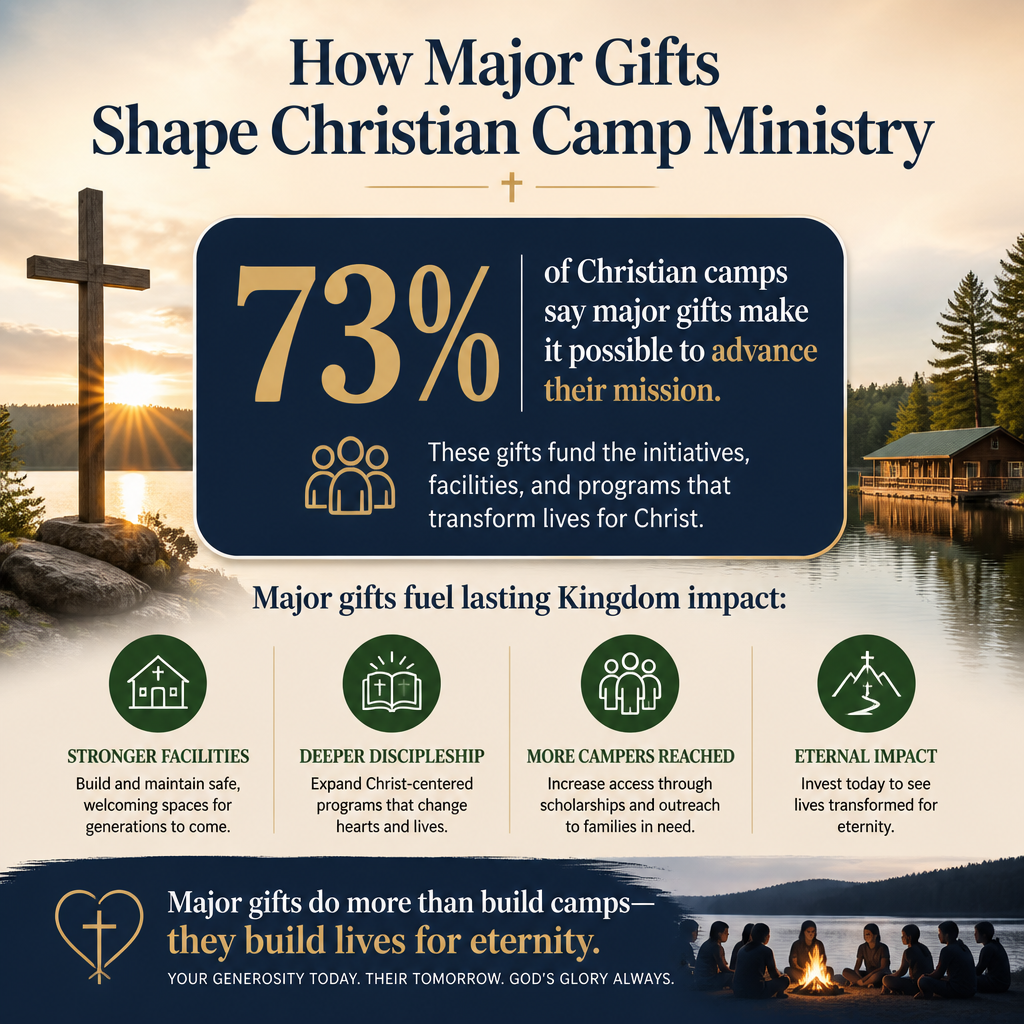
Capital projects frequently feel clean because they are tangible: donors can see the result, name it, and celebrate it. Yet the ministry impact of a facility is mediated by the daily systems around it: child protection, staff training, discipleship curriculum, kitchen standards, emergency planning, and pastoral oversight. Major gifts can accelerate all of those investments, but only when leaders resist the common temptation to treat construction as the finish line rather than the beginning of a larger stewardship obligation.
The operating model must match the spiritual mission
Christian camps typically operate on seasonal cash flow, unpredictable weather, and a staffing pipeline that includes young adults still learning professional maturity. That reality is not a moral failure; it is the nature of the work. It does mean that major gifts should be evaluated not only for what they build but for how they stabilize operations: adequate staff-to-camper ratios, training time before campers arrive, and reserves that keep leaders from making spiritually costly decisions under financial pressure.

Major gifts can widen access or quietly narrow it
Many donors are drawn to camps because they have seen what a week of concentrated Christian community can do for a child’s faith. The question then becomes: who gets to come? Major gifts can underwrite scholarships and transportation, expand bilingual programming, and strengthen partnerships with churches that lack resources. But gifts can also unintentionally push camps toward a premium experience that prices out the very families donors hope to serve.
Scholarship funding is most credible when it is designed, not improvised
Scholarships work best when they are predictable, dignifying, and paired with clear eligibility criteria. The goal is not merely to fill beds but to remove barriers without turning need into a marketing tool. Camps that do this well typically treat scholarship funds as a core ministry commitment, not as leftover money after capital goals are met.
Donors and camps face a real tension on pricing
Camps have experienced genuine inflation in food, insurance, and labor. Donors should not romanticize a cost structure that no longer exists. At the same time, Christian ministry must be honest about what it signals when pricing drifts upward without a commensurate scholarship strategy. Pew Research Center has documented the long-term decline of religious affiliation in the United States, a context in which access to formative Christian environments matters, not less but more.Pew Research Center
Donors who care about this space often follow the broader landscape of Christian Camps and Conferences and ask a simple question that deserves a serious answer: is this camp structurally committed to welcoming families across socioeconomic lines, or does it depend on occasional generosity to correct the drift?
Major gifts influence discipleship outcomes through staff culture
Facilities and scholarships are visible; staff culture is less so. Yet the staff team is the primary instrument through which camp ministry forms students. Major gifts that prioritize staff recruitment, training, and pastoral care frequently produce deeper spiritual outcomes than gifts that simply improve aesthetics. The donor’s aim should be to strengthen the camp’s capacity to disciple with integrity: clear teaching, wise counseling, and consistent practices of spiritual care.
Training is a theological investment, not a compliance exercise
Child safety, trauma awareness, and counselor supervision are sometimes discussed as operational necessities. They are also expressions of love of neighbor and a refusal to treat students as a means to an end. Scripture’s insistence that leaders must be above reproach is not limited to the pulpit; it applies to any ministry entrusted with the vulnerable. Where major gifts fund meaningful training time, higher-quality supervision, and sufficient staffing, they shape the moral ecology of the entire camp.
A sustainable staff pipeline often requires donor patience
Christian camps frequently rely on young seasonal staff, and donors sometimes assume that spiritual fervor is a substitute for maturity. It is not. A camp that wants to disciple well must build repeatable systems that develop staff over multiple summers and provide year-round leadership capable of consistency. Major gifts can underwrite year-round discipleship directors, program leadership, and staff housing that reduces churn. This kind of giving is less visible than a new building, but it often strengthens the camp’s ministry more directly.
Major gifts test governance and accountability at the moments that matter
The presence of major donors can either strengthen governance or strain it. Wise donors do not seek to control ministry; they seek to ensure it is healthy. Wise boards do not resist accountability; they welcome it because they understand that a ministry’s credibility is hard won and quickly lost. The point is not suspicion. The point is stewardship shaped by the biblical reality that money reveals what we love and how we lead.
Restricted gifts can clarify purpose or create distortion
Restricted giving is not inherently problematic. It can be an act of careful stewardship when restrictions serve the camp’s mission and long-term health. But restrictions can become distorting when they fund what the donor finds compelling while leaving the camp unable to pay for less glamorous necessities: maintenance, insurance, staff care, compliance, and reserves. Donors should expect leadership to articulate the true total cost of programs and facilities, and to say no when a restriction would harm the ministry.
Due diligence should be treated as discipleship, not bureaucracy
Across our verification work at Most Trusted, we observe that ministries that meet The Most Trusted Standard tend to treat governance, financial integrity, and transparency as spiritual disciplines expressed through good systems. Donor confidence grows when camps publish clear financials, maintain meaningful board oversight, document child protection policies, and describe program outcomes without exaggeration. What this means in practice is that a major gift decision should include questions about independent audits or reviews, conflict-of-interest policies, board independence, and how the camp evaluates spiritual and developmental outcomes.
- Ask how the camp budgets for maintenance, reserves, and long-term capital replacement.
- Confirm that child protection policies are documented, trained, and audited for compliance.
- Review whether the board has real oversight, including conflict-of-interest safeguards.
- Clarify whether the gift is restricted and whether the restriction supports operational health.
- Request plain-language reporting that connects dollars to ministry outcomes without inflated claims.
Major gifts can preserve legacy without freezing a ministry in time
Some of the most meaningful camp gifts are motivated by memory: a conversion, a call to ministry, a friendship that endured. That gratitude can be holy. Yet camps also operate in a changing pastoral and cultural context: rising mental health needs among adolescents, increasing complexity in family systems, and shifting patterns of church attendance. Major gifts should help camps remain faithful to their mission in the present, not merely preserve a beloved version of the past.
Endowments and planned gifts can protect camps from short-term volatility
Endowment funds, bequests, and other planned gifts can provide stability in a ministry with uneven cash flow. They can also tempt leaders to treat endowment income as a substitute for operational discipline. The healthiest pattern is when planned giving strengthens resilience while boards maintain careful budgeting and clear accountability. Donors exploring this path often benefit from resources specific to Planned Giving and Major Gifts for Christian Camps, because the practical details of restrictions, spending policies, and governance determine whether legacy gifts become a blessing or a burden.
Transparency protects both donor intent and ministry witness
Christian donors are right to expect honesty about what gifts accomplish and what they cannot accomplish. Camps should not promise that a facility expansion will generate revival, nor should donors demand a kind of spiritual quantification that treats the Holy Spirit as a metric. But camps can report responsibly on what they can observe: camper retention, staff return rates, scholarship distribution, safety incidents, and the concrete practices that support gospel teaching and pastoral care. Independent evaluators and credible third-party frameworks help maintain clarity when enthusiasm is high.
FAQs for How major gifts shape Christian camp ministry
Should a major gift to a Christian camp be restricted or unrestricted?
Both can be faithful stewardship, depending on the camp’s needs and governance maturity. We generally view unrestricted giving as healthier when a camp has strong leadership and transparent financial practices, because it funds the true total cost of ministry. Restricted gifts can serve well when the restriction aligns with strategic priorities and the camp has demonstrated that it can sustain the ongoing operating costs that follow.
What should donors verify before making a major gift to a camp?
Donors should confirm the camp’s theological clarity, child protection practices, financial integrity, and governance oversight. Practical indicators include whether the camp provides clear financial statements, maintains independent board oversight, documents safety and reporting procedures, and offers credible reporting on outcomes. In our work at Most Trusted, alignment with The Most Trusted Standard is a useful way to organize this due diligence without reducing ministry to a checklist.
Major gifts should strengthen what camps exist to do
Major gifts shape Christian camp ministry by shaping what is built, who is welcomed, how staff are formed, and whether governance remains clear-eyed under pressure. The most faithful giving strengthens the camp’s ability to preach the gospel, care for the vulnerable, and steward resources without confusion about what money can and cannot do. When donors and leaders share that seriousness, major gifts become not merely generous, but spiritually consequential in the best sense.



