

How estate attorneys can structure apologetics giving is ultimately a question of faithful stewardship under law. Donors want their final witness to be coherent: their resources should strengthen gospel persuasion without drifting into avoidable risk, family conflict, or unclear charitable outcomes.
Apologetics ministries occupy a distinctive place in the Christian ecosystem. Their work often funds public-facing communication, digital media, campus outreach, publishing, and the long horizon of intellectual discipleship. That long horizon makes planned giving unusually fitting—and unusually susceptible to vague restrictions, mission drift, and governance weaknesses that do not show up in a single annual gift.
Begin with biblical stewardship and legal clarity
Stewardship is spiritual, but it is not sentimental
Scripture treats wealth as morally consequential and spiritually revealing, not neutral. Jesus’ warning that “where your treasure is, there your heart will be also” (Matthew 6:21) does not flatten prudence into distrust; it establishes that giving decisions belong to discipleship. Estate planning is one of the last opportunities to align long-term assets with long-term obedience.
For many Christian donors, apologetics giving expresses a particular burden: strengthening confidence in the truth of Christ for skeptical neighbors and wavering children. That burden can be faithful. It can also become reactive. Estate attorneys serve donors well by translating sincere intent into documents that are clear enough to be executed and flexible enough to remain charitable when circumstances change.
Clarity protects both heirs and ministries
Planned gifts fail more often from ambiguity than from bad motives. A bequest that names “the apologetics program” can become contested when staff changes, branding shifts, or a ministry merges. The legal task is to make the gift unmistakably charitable while protecting the donor’s intent against preventable disputes.
Two principles generally serve donors well. First, name the legal entity precisely (including any “doing business as” name). Second, pair specificity of purpose with a practicable variance power—language that allows the nonprofit’s governing board to apply funds as near as possible to the donor’s intent if the original purpose becomes impossible or impracticable. Attorneys will recognize the logic from cy pres doctrine; donors recognize it as practical wisdom.

Choose the planned giving instrument that matches the apologetics objective
Different assets preach different sermons
Apologetics work is often content-heavy and audience-sensitive. Some donors want immediate impact: underwriting a campus season, a translation project, or a media series. Others want endurance: endowing future research, sustaining a scholar-in-residence, or building a durable digital library. The estate instrument should match the time horizon and the asset type.
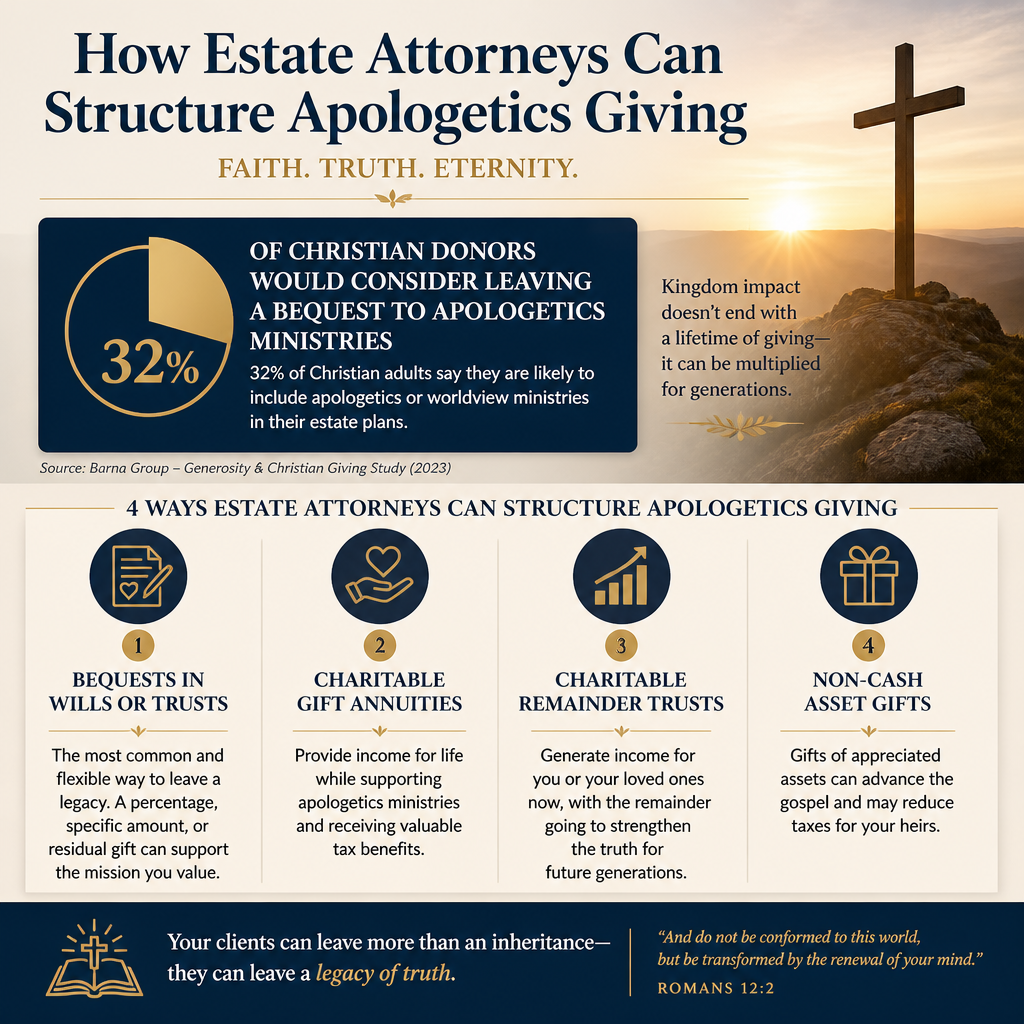
In practice, estate attorneys most often see these instruments used for Christian charitable goals:
- Bequests in a will or trust for flexible support, often expressed as a percentage of the residual estate.
- Beneficiary designations on retirement accounts, which can be tax-efficient for heirs and charitable for the ministry.
- Charitable remainder trusts for donors who want lifetime income with a remainder that strengthens ministry work.
- Charitable gift annuities when simplicity and predictable payments matter more than customization.
- Donor-advised funds when donors want to involve family in recommending grants over time.
The harder question is not which tool is “best,” but which tool expresses the donor’s convictions without creating obligations the donor cannot explain to heirs. Sophisticated families tend to respond well to documents that are both principled and intelligible.
Match restrictions to the ministry’s operating reality
Restrictions can honor donor intent, but overrestriction can burden the ministry and reduce impact. Apologetics ministries in particular may need to adjust platforms, distribution, and curriculum as culture shifts. A restriction written for a radio era can hinder a podcast era. The best restrictions tend to be purpose-based (“for evangelistic apologetics and disciple-making content”) rather than tactic-based (“for radio airtime”).
For donors seeking a deeper overview of the landscape, we maintain a topic page on Christian Apologetics Ministries that reflects our verification work and the kinds of evidence mature donors should expect.
Test the ministry’s trustworthiness before locking in an estate gift
Planned gifts magnify governance strength or weakness
A current-year gift can be redirected next year. A bequest cannot. That asymmetry is why planned giving should be preceded by serious due diligence, particularly on governance, financial integrity, and transparency. Donors are not being cynical when they ask hard questions; they are recognizing that the future will include leadership transitions, economic cycles, and reputational tests.
Across our verification work at Most Trusted, the ministries that meet The Most Trusted Standard tend to share a pattern: doctrinal clarity without drift, boards that can exercise real oversight, clean financial reporting, and communications that do not manipulate donors. Those are not luxuries. They are safeguards for legacy gifts.
What to examine beyond marketing claims
Apologetics ministries often publish high-quality content while remaining thin on public accountability. A donor’s estate attorney is not expected to perform a full nonprofit audit, but donors should be encouraged to request verifiable documentation, not only testimonials. Relevant signals include IRS filings, audited financial statements when appropriate, board composition, conflict-of-interest policies, and clarity on how impact is measured.
For context, nonprofits generally file annual information returns that are public and searchable. The IRS explains the public-disclosure expectation for exempt organizations, including access to Form 990 series filings, at IRS disclosure requirements. That transparency does not prove faithfulness, but a refusal to provide basic governance and financial documents should raise questions.
Christians genuinely disagree about what “effective” means for apologetics. Some prioritize measured conversions; others emphasize removing intellectual obstacles; others prioritize equipping believers to endure. The point is not to impose a single metric, but to insist that a ministry can articulate its theory of change and show responsible stewardship within it.
Draft gift language that is durable under ministry change
Avoid gifts that become impossible to administer
Gift agreements can inadvertently create a future legal problem: narrowly defined projects, named staff roles, or fixed platforms that become obsolete. Durability requires legal precision and strategic humility. Attorneys serve donors best by drafting language that can survive leadership changes and shifts in the apologetics field while remaining faithful to the donor’s intent.
Common durability features include: a clear charitable purpose, a preference hierarchy (primary purpose, then secondary purposes), and a variance clause that authorizes the board to apply the gift as close as possible if circumstances change. Donors also do well to keep administrative requirements proportionate; if the gift requires specialized reporting beyond the ministry’s capacity, the ministry may need to decline it or incur costs that reduce mission work.
Consider family dynamics as part of the spiritual task
Planned giving can become a flashpoint when heirs feel surprised or sidelined. That is not merely a legal risk; it is a relational and spiritual risk. Some donors will choose confidentiality for wise reasons, but many families are better served when donors can articulate, in plain terms, why apologetics is part of their legacy.
A well-crafted letter of intent, separate from the dispositive documents, can help. It can explain the donor’s burden for truth, their hope for grandchildren, and the reasons a particular ministry was chosen. It can also signal that the bequest is not a verdict against the family but an expression of confidence that the gospel deserves public witness.
Coordinate the attorney, the donor, and the ministry without compromising integrity
Healthy ministries welcome orderly process
Some donors hesitate to involve a ministry in planned giving discussions for fear of pressure. That concern is understandable. Yet a ministry’s willingness to coordinate professionally—answering questions, providing legal names and tax IDs, confirming gift acceptance policies—often distinguishes organizations that are prepared for long-term stewardship from those that are not.
When donors ask about planned giving policies, they are also asking about maturity. The National Association of Charitable Gift Planners has long emphasized ethical standards for gift planning practice, including clarity, donor intent, and avoidance of undue influence; its overview of the field is available at the National Association of Charitable Gift Planners. Donors should not expect ministries to mirror every professional norm, but they should expect basic integrity.
Keep giving aligned with verified accountability
Donors are often selecting between ministries that appear equally compelling in content quality. In those cases, verified accountability becomes decisive. Our work at Most Trusted exists to reduce the information asymmetry donors face, especially with planned gifts that may be executed years from now. The question is not whether a ministry is charismatic, but whether it is verifiably trustworthy across theology, finances, governance, and transparency under The Most Trusted Standard.
For donors and advisors working specifically on long-horizon gifts, our work on Planned Giving for Christian Apologetics Ministries frames the due-diligence questions that tend to matter most when a gift is intended to last.
FAQs for How estate attorneys can structure apologetics giving
Should a donor restrict an estate gift to a specific apologetics project or keep it unrestricted?
Broadly stated purposes are usually more durable than project-level restrictions. If a donor’s intent is to strengthen apologetics over decades, restricting funds to a specific platform or short-term initiative can create future administrative and legal complications. Purpose-based language with a variance clause often honors intent while allowing responsible adaptation.
What due diligence is most important before naming an apologetics ministry in an estate plan?
Governance and transparency tend to matter most because they determine whether a ministry can handle leadership transitions and steward funds responsibly. Donors should request the legal entity name and confirmation of tax-exempt status, review publicly available IRS filings where applicable, and examine board oversight, conflict-of-interest policies, and financial reporting practices. Where donors want independent confirmation, Most Trusted’s verification process evaluates ministries against The Most Trusted Standard.
A legacy that serves truth with integrity
Apologetics giving in estate plans is not simply a funding decision; it is a statement about what a donor believes will outlast them. Estate attorneys help translate that conviction into language that courts can enforce and ministries can honor. When donors combine careful instruments, durable drafting, and verified accountability, a planned gift can strengthen the church’s public witness without compromising the trust that Christian stewardship requires.



