

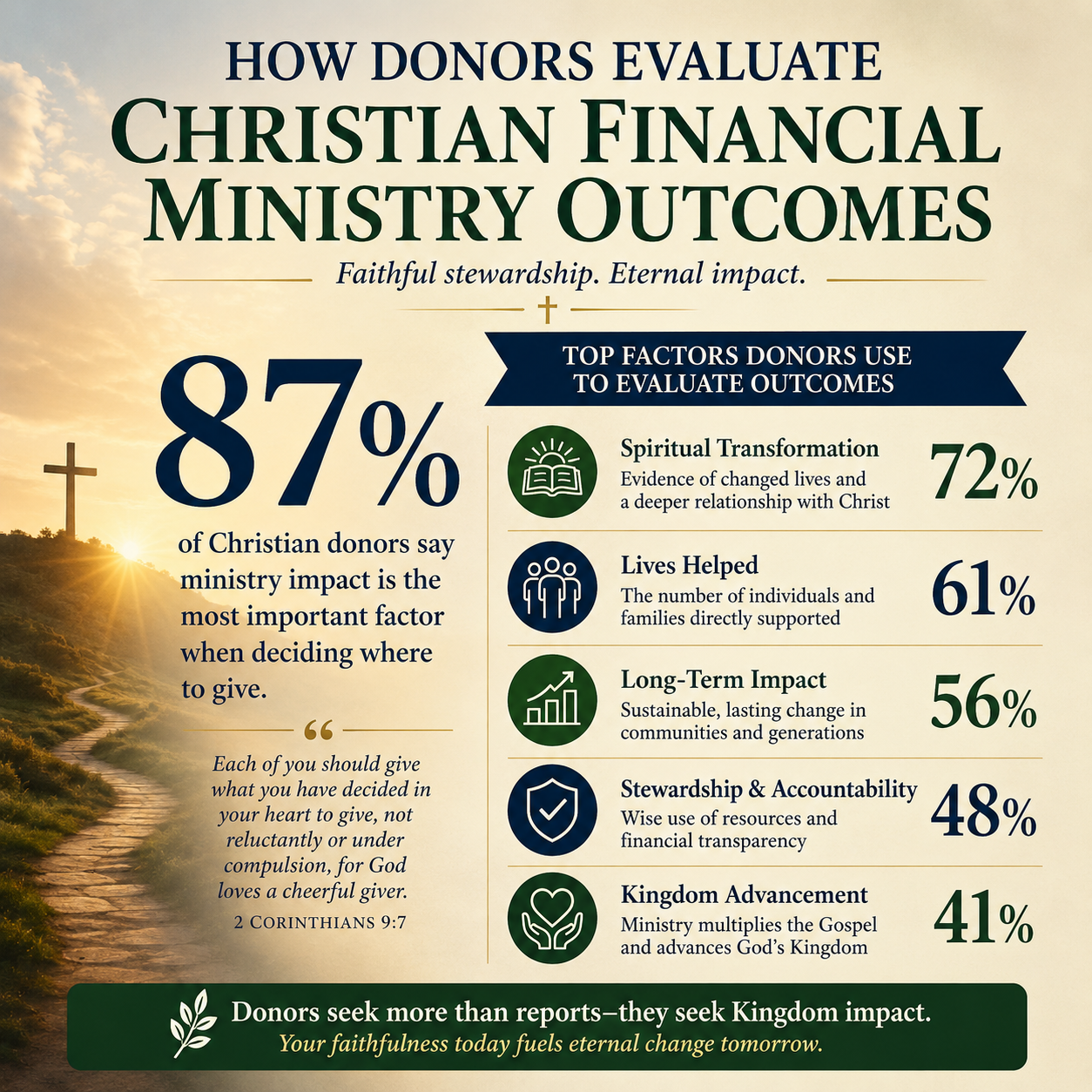
How donors evaluate Christian financial ministry outcomes is ultimately a discipleship question before it is a metrics question. A ministry can report impressive activity and still miss the spiritual and human ends that Scripture holds together: truth and love, justice and mercy, repentance and restoration.
Christian donors tend to feel a particular tension in financial ministries. Money is both intensely practical and deeply spiritual. Jesus warned that mammon seeks mastery (Matthew 6:24), and Paul described the love of money as “a root of all kinds of evil” (1 Timothy 6:10). Outcomes, therefore, cannot be reduced to “dollars moved” or “budgets balanced.” The faithful question is whether a ministry helps people live more freely under Christ’s lordship, with integrity, agency, and durable hope.
Outcomes begin with a theology of money and neighbor love
Christian financial ministries operate in a space where secular definitions of “success” are often insufficient. “More wealth” is not automatically a Christian outcome, and “less spending” is not necessarily repentance. Donors evaluating outcomes should first ask whether the ministry’s aims are recognizably Christian: ordered loves, honest work, care for family, restitution where needed, generosity toward neighbor, and a refusal to make finances an identity.
Across our verification work at Most Trusted, the ministries that meet The Most Trusted Standard tend to articulate outcomes that are both measurable and morally coherent. They can explain, in plain terms, what change they expect to see in a participant’s life and why that change is consistent with Scripture rather than with consumer financial ideology.
What faithful outcomes sound like
Language matters. A mature ministry will speak about financial health without baptizing materialism, and it will speak about generosity without manipulating donors or shaming participants. The most credible outcomes are described as movement toward stability and stewardship, not as triumphal promises.
What donors should resist
Christians genuinely disagree about how closely financial stability should be tied to spiritual maturity, and there is room for wisdom in pastoral application. Still, donors should be cautious when ministries imply a simple formula: “follow our plan and God will reward you financially.” That approach is less a doctrine of providence than a rebranded prosperity gospel, and it often collapses complex realities—disability, predatory lending, local labor markets—into moral accusation.

Good financial outcomes are measurable, but never merely transactional
Financial ministry outcomes should have clear indicators, yet the indicators must serve the mission rather than replace it. Donors do not need ministries to claim certainty about every spiritual dimension of change. But donors should expect candor about what can be measured, what cannot, and what is being used as a proxy.
Program outputs are not outcomes
Many organizations report outputs: the number of classes taught, counseling sessions held, or budgets created. These may show activity, but they do not show durable change. A serious outcomes conversation asks what happened after the class ended: whether debt decreased, whether emergency savings appeared, whether housing stabilized, whether predatory financial products were avoided, and whether participants sustained new practices over time.
Choose measures that match the ministry model
Not every Christian financial ministry has the same theory of change. Some are counseling-centered; others combine coaching with job placement, matched savings, credit building, or legal assistance. Donors should evaluate outcomes against the model itself. A coaching ministry that claims “income growth” as its primary outcome may be over-claiming; a workforce ministry that never reports employment retention may be under-measuring.

When donors ask for evidence, the goal is not to burden staff with paperwork. It is to ensure the ministry knows whether it is helping. The most mature teams use measurement to learn, not to market.
Evaluate whether outcomes protect dignity and avoid unintended harm
Financial vulnerability is a high-risk context for spiritual and material harm. People in crisis are susceptible to coercive promises, public shame, and solutions that “work” short-term while destabilizing families long-term. Donors evaluating outcomes should ask not only, “Did something change?” but also, “Was that change achieved in a way that honors the person?”
Outcome claims should include safeguards
For example, if a ministry reports high repayment rates in a microloan program, donors should ask about borrower screening, repayment pressure, and what happens when a borrower encounters illness or job loss. If a ministry reports reduced spending, donors should ask whether participants are skipping medical care or food to meet a financial target. Outcomes that ignore trade-offs can unintentionally reward harm.
When helping hurts applies in financial work too
The When Helping Hurts framework, articulated by Steve Corbett and Brian Fikkert, has reshaped Christian poverty-alleviation practice by emphasizing dignity, agency, and the dangers of paternalism. Their work has been widely discussed in evangelical missions and development circles, including at the Chalmers Center. Financial ministry outcomes that treat participants as projects, rather than neighbors with responsibility and calling, tend to produce dependence or quiet resentment even when the numbers look strong.
What this means in practice is that donors should value outcomes that reflect participant ownership: people setting their own goals, making informed decisions, and building skills they can use without the ministry’s ongoing control.
Donors should read financial integrity and governance as outcome enablers
Outcomes are often discussed as if they float above organizational life. In reality, outcomes depend on whether a ministry is financially disciplined, well-governed, and transparent enough to be held accountable. A program can have a strong curriculum and still fail participants if leadership turnover is constant, cash flow is unstable, or decision-making is opaque.
Why overhead ratios are not an outcomes shortcut
Many donors were trained to equate low “overhead” with high impact. The nonprofit field has corrected that assumption over the last decade, warning that simplistic overhead fixation can punish healthy investment in systems, evaluation, and staff development. Charity Navigator, Candid, and the BBB Wise Giving Alliance jointly explained this in their “Overhead Myth” letter, available via Charity Navigator.
Donors can still ask hard questions about spending, but the more faithful question is whether the ministry’s financial choices plausibly support its mission outcomes: competent counselors, safe data systems, appropriate safeguarding, and a realistic plan for serving people without creating a dependency on donor volatility.
Governance signals whether outcomes are trustworthy
Boards that take fiduciary responsibility seriously tend to insist on outcome clarity. They ask for evidence, challenge overly broad claims, and require leaders to report both successes and failures. Conversely, when a board is largely symbolic, outcomes reporting often becomes a public-relations exercise.
Donors looking for a broader view of this field may find it helpful to situate individual ministries within Christian Financial Service Ministries, where the outcomes question is inseparable from the kinds of services being offered and the theological commitments behind them.
Practical questions donors can ask without becoming adversarial
Many Christian donors want to be both discerning and charitable. There is a difference between skepticism and seriousness. The best ministries welcome serious questions because they share the same aim: honesty before God and neighbor.
A short outcomes diligence checklist
- Definition: What does the ministry mean by “success” for a participant, and how does that definition align with biblical stewardship?
- Evidence: What indicators are tracked after the program ends, and what is the follow-up period?
- Attribution: How does the ministry distinguish what it caused from what it influenced alongside a church, employer, or family network?
- Equity and access: Who is most likely to benefit, and who is being missed due to language, work schedules, disability, or digital access?
- Safeguards: What protections prevent coercion, shame-based coaching, or unrealistic promises to vulnerable participants?
How Most Trusted approaches outcomes verification
Most Trusted exists to help donors give with confidence through independent verification of Christian nonprofits. Under The Most Trusted Standard, outcomes are considered alongside faith foundation, financial integrity, governance and leadership, and transparency and effectiveness. The purpose is not to turn ministry into a laboratory. It is to ensure that claims made to donors are accountable, that financial practices are coherent with stated aims, and that leadership structures support long-term faithfulness.
For donors who want to think beyond a single organization and understand how outcomes vary by ministry type, The Mission and Impact of Christian Financial Service Ministries provides a wider frame for what responsible impact can look like in this category.
FAQs for How donors evaluate Christian financial ministry outcomes
Should Christian donors prioritize spiritual outcomes or financial outcomes?
Christian donors should refuse the false choice. Financial stability is not the gospel, but it often affects a family’s ability to remain housed, avoid exploitation, and participate in church and community life. A faithful ministry will describe outcomes that are financially concrete while remaining theologically disciplined: money as a tool of stewardship, not a measure of worth, and generosity as a fruit of grace rather than a fundraising tactic.
What outcome metrics are most credible for Christian financial ministries?
The most credible metrics match the model and include time-bound follow-up. Examples include savings accumulation, reduction in high-interest debt, sustained budgeting behavior, credit repair milestones where appropriate, employment retention for workforce-connected programs, and stability indicators such as reduced eviction risk. Credibility increases when a ministry explains limitations, avoids overstated attribution, and can show that measurement is used for learning rather than for promotional certainty.
A faithful outcomes posture for Christian donors
Christian donors evaluate outcomes best when we combine mercy with truth: a willingness to fund slow, relational work, and a refusal to accept vague claims in place of evidence. Financial ministry is a domain where the heart is often revealed and where harm can be done under spiritual language. Donors who ask for clear definitions, durable measures, and dignity-protecting practice are not hindering ministry; we are helping align it with the God who loves justice, commands honesty, and calls his people to stewardship that endures.



