
How Christians can give beyond the tithe is not a question of religious arithmetic. It is a question of discipleship: whether our money is being trained to serve the Kingdom of God rather than the kingdom of self. Scripture treats that question as spiritually decisive, not optional.
Christians genuinely disagree about how the Old Testament tithe applies under the New Covenant. Yet the broad contour is not contested: God lays claim to all we have, and generosity is meant to be glad, intentional, and sacrificial. The early church did not argue believers down to ten percent; it formed a people whose possessions were held with open hands (Acts 2:44–45). For mature donors, the harder question is not whether ten percent is a floor or a ceiling, but whether giving has become an afterthought in a life otherwise shaped by affluence.
Tithe and beyond is a covenant question before it is a budget question
The tithe in Scripture is real and complex
The tithe was not a single, simple line item in Israel’s life with God. It functioned within a covenant economy that provided for worship, communal life, and the vulnerable (Leviticus 27:30; Deuteronomy 14:28–29). The New Testament does not reissue the tithe as law to the church, but it intensifies the moral claim beneath it: “You are not your own… you were bought with a price” (1 Corinthians 6:19–20). The decisive shift is not toward less, but toward a life wholly claimed by Christ.
New Testament giving is proportionate and willing
Paul’s most sustained teaching on giving resists both coercion and sentimentality. Giving should be “in keeping with income” and planned (1 Corinthians 16:2), and it must be free from manipulation: “not reluctantly or under compulsion, for God loves a cheerful giver” (2 Corinthians 9:7). Those texts can be misused to excuse minimal giving, as though cheerfulness were the opposite of sacrifice. In Paul’s framing, cheerfulness is the fruit of trust, and sacrifice is often the evidence that trust is real.
Many Christian households underestimate how directly their giving reflects the spiritual formation of their desires. If a family’s largest “automatic” commitments are mortgage, retirement, travel, and entertainment, while giving floats at the end of the month, the pattern itself is a kind of catechesis. Beyond-the-tithe giving begins when giving is treated as a first commitment rather than an aspirational remainder.

Beyond the tithe begins with formation, not with a fundraising appeal
What beyond means in practice
For some donors, “beyond the tithe” will mean moving from sporadic gifts to consistent, proportionate giving. For others, it will mean rethinking what counts as “need,” and therefore what counts as “excess.” Jesus’s warnings to the wealthy were not aimed at villains; they were aimed at ordinary people insulated by possessions. The rich young ruler walked away sad because he could not imagine freedom without his wealth (Mark 10:17–22). That sorrow remains recognizable.
The contemporary American context makes this formation harder. Consumer debt, lifestyle inflation, and the moral plausibility structures of a market culture all normalize private abundance. Christian donors often feel two honest pressures at once: the duty to provide for family and the call to radical generosity. Wisdom is required, and so is courage.
Planned generosity is a spiritual discipline
One dependable step toward giving beyond the tithe is to treat generosity as planned rather than reactive. That means writing giving into the budget, setting policies for what kinds of needs receive spontaneous gifts, and establishing a pace of increase over time. Mature donors sometimes resist this because they fear “planning” will extinguish compassion. In practice, planning often protects compassion by keeping urgent requests from hijacking long-term faithfulness.
When we review ministries and donor practices across our verification work, we see that disciplined giving tends to correlate with disciplined discernment. Donors who plan are more likely to ask hard questions about outcomes, governance, and theological integrity, and less likely to be steered by emotion or urgency alone.
Give beyond the tithe with a theology of impact, not a theology of overhead
Integrity matters because giving is worship
Beyond-the-tithe giving should not mean indiscriminate giving. Christian donors are stewards, not merely benefactors. Scripture repeatedly condemns crooked scales and hidden dealings because God cares about truth in the public square (Proverbs 11:1). When donors ignore financial controls, independent oversight, and transparent reporting, they unintentionally reward opacity.
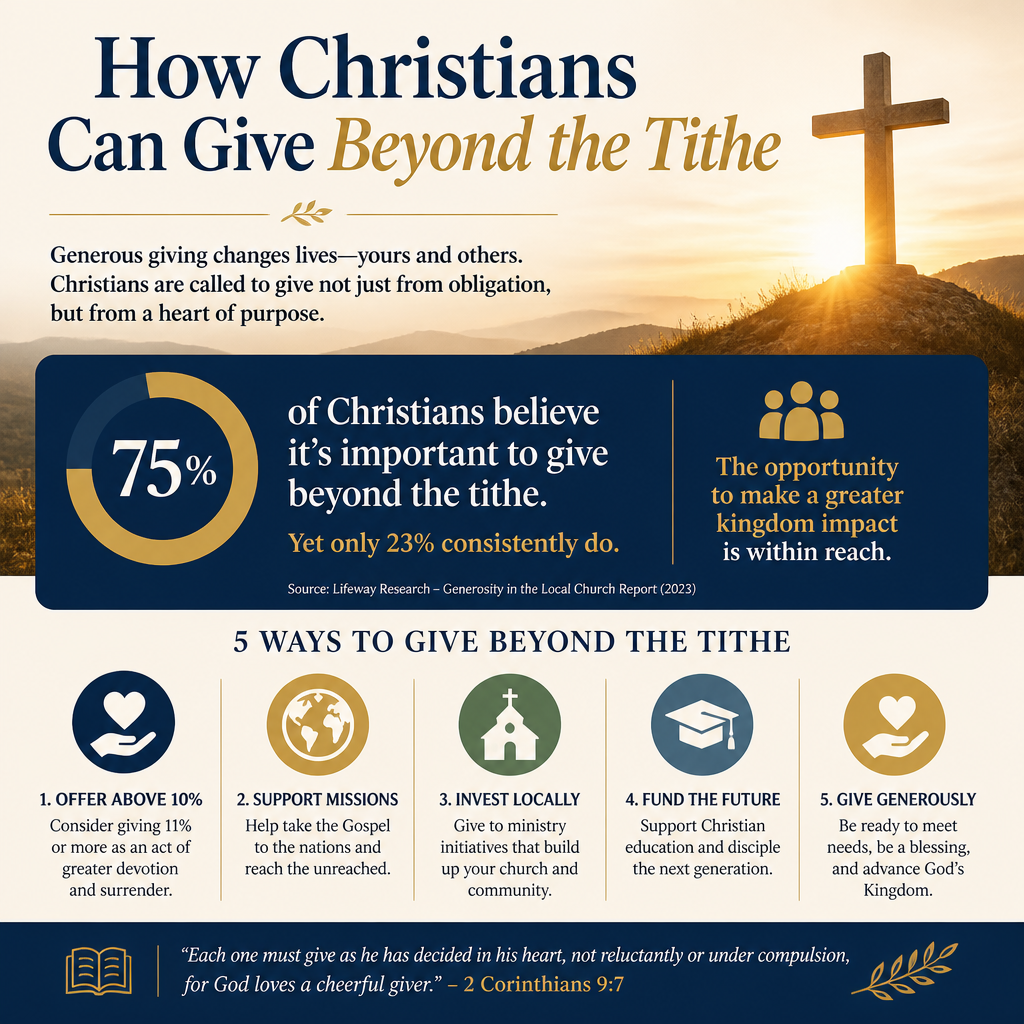
The nonprofit sector has had to reckon with simplistic thinking about “overhead.” Donors often demand low administrative costs without recognizing that governance, audit, safeguarding, and evaluation are real work. Charity Navigator has documented how overhead fixation can distort decision-making and reduce effectiveness rather than increase it Charity Navigator. The question for serious Christian donors is not, “How little does this ministry spend on administration?” but, “Are the controls and capacities appropriate to the mission and scale?”
Wise giving asks about both faithfulness and competence
Christian financial service ministries often occupy a complicated space: they may be explicitly evangelical, implicitly Christian, or simply adjacent to Christian communities through marketing and partnerships. Donors should ask two categories of questions with equal seriousness. First, is the ministry spiritually and theologically faithful in its public commitments and actual practice? Second, is it operationally competent and accountable in the way it handles money, staff, and claims of impact?
This is one reason Most Trusted exists. We help donors give with confidence by evaluating ministries against The Most Trusted Standard, a 15-criteria framework spanning faith foundation, financial integrity, governance and leadership, and transparency and effectiveness. Verification does not replace discernment, but it does reduce the avoidable risks that undermine donor intent.
Beyond the tithe often means broadening the kinds of generosity we practice
Consider portfolios rather than one-off gifts
Many donors already give generously but do so in a narrow band: a local church, one favored missionary, and a year-end appeal. There is nothing wrong with focused giving. Yet the needs Scripture highlights are diverse—local and global, spiritual and material, immediate mercy and long-term justice.
One practical approach is to develop a giving portfolio that reflects biblical priorities and your real stewardship constraints. A portfolio approach also helps donors resist the volatility of the news cycle and the emotional pull of the loudest campaigns.
- Local church: ordinary ministry, sacraments, shepherding, and the poor in your own community
- Gospel proclamation: missions, Bible translation, church planting, and theological education
- Works of mercy: hunger relief, refugee support, foster care and family preservation, medical missions
- Institutional strengthening: training leaders, strengthening governance, and building durable local capacity
- Strategic reserves: a designated fund for unexpected crises so urgent needs do not destabilize planned giving
Give in ways that strengthen dignity
Some giving genuinely helps; some giving unintentionally harms. The When Helping Hurts framework, articulated by Steve Corbett and Brian Fikkert, has shaped Christian development practice by naming how aid can reinforce dependency or undermine local agency when it is not designed with dignity and capacity in view When Helping Hurts. Donors do not need to become development specialists, but they should learn to ask whether a program strengthens families, local leadership, and long-term resilience.
This question is especially important in orphan care, poverty alleviation, and disaster relief, where the emotional stakes are high and the risk of unintended consequences is well documented. Responsible generosity is not colder generosity; it is love that refuses to be naïve.
Beyond the tithe requires disciplined discernment about which ministries deserve trust
Christian donors face a real information problem
Many donors assume that a ministry’s Christian branding is a proxy for accountability. It is not. The charitable sector includes faithful organizations with exemplary controls, and it also includes ministries that are under-governed, personality-driven, or unclear about how funds are used. Donors who want to give beyond the tithe often increase their giving volume; without better vetting, they also increase their exposure to preventable misuse.
Across Christian Financial Service Ministries, donors should pay close attention to how ministries handle restricted gifts, conflicts of interest, independent board oversight, audited financials, and transparency about program results. In our verification work, the ministries that meet The Most Trusted Standard tend to treat these disciplines as part of their Christian witness, not as regulatory necessities.
Discernment should be proportionate to the gift
Not every donation requires the same level of due diligence. A modest one-time gift may call for basic checks. A recurring commitment or a large designated gift warrants deeper review. Mature donors can also collaborate: families, churches, and Christian foundations can share research, coordinate site visits, and reduce duplicated work.
Within Biblical Stewardship and Christian Financial Service Ministries, we encourage donors to treat verification as a form of stewardship. The goal is not suspicion; it is faithfulness. Donors are accountable before God for the resources entrusted to them, and ministries are accountable for the trust they solicit.
FAQs for How Christians can give beyond the tithe
Is giving beyond the tithe required for faithful Christians?
Scripture does not give a universal New Testament percentage that binds every Christian conscience. It does, however, require generosity that is willing, proportionate, and shaped by the sacrificial pattern of Christ (2 Corinthians 8:9). For many believers in affluent contexts, giving “beyond the tithe” is not an extra-credit exercise; it is a realistic response to the scale of need and the spiritual dangers of wealth.
Should donors prioritize the local church before giving to other ministries?
For most Christians, consistent giving to a faithful local church should be a primary commitment because the church is the ordinary means God uses for preaching, pastoral care, discipline, and mercy in a community. That priority does not eliminate other giving. It clarifies order: donors can support broader ministries without treating the church as one charitable option among many.
A serious generosity aims at freedom, not mere compliance
Giving beyond the tithe is best understood as a pursuit of freedom under Christ’s lordship. The question is not whether donors can be persuaded to part with more money, but whether money is losing its power to command imagination, confer identity, and soothe fear. Christians give because God has given, and because our giving becomes a credible public witness when it is both generous and trustworthy.
As donors increase generosity, discernment must deepen alongside it. The moral beauty of Christian giving is diminished when funds are mishandled or when ministries demand trust without evidence. Verified faithfulness, transparent governance, and measurable effectiveness do not replace the work of the Spirit, but they do honor the God of truth.



