

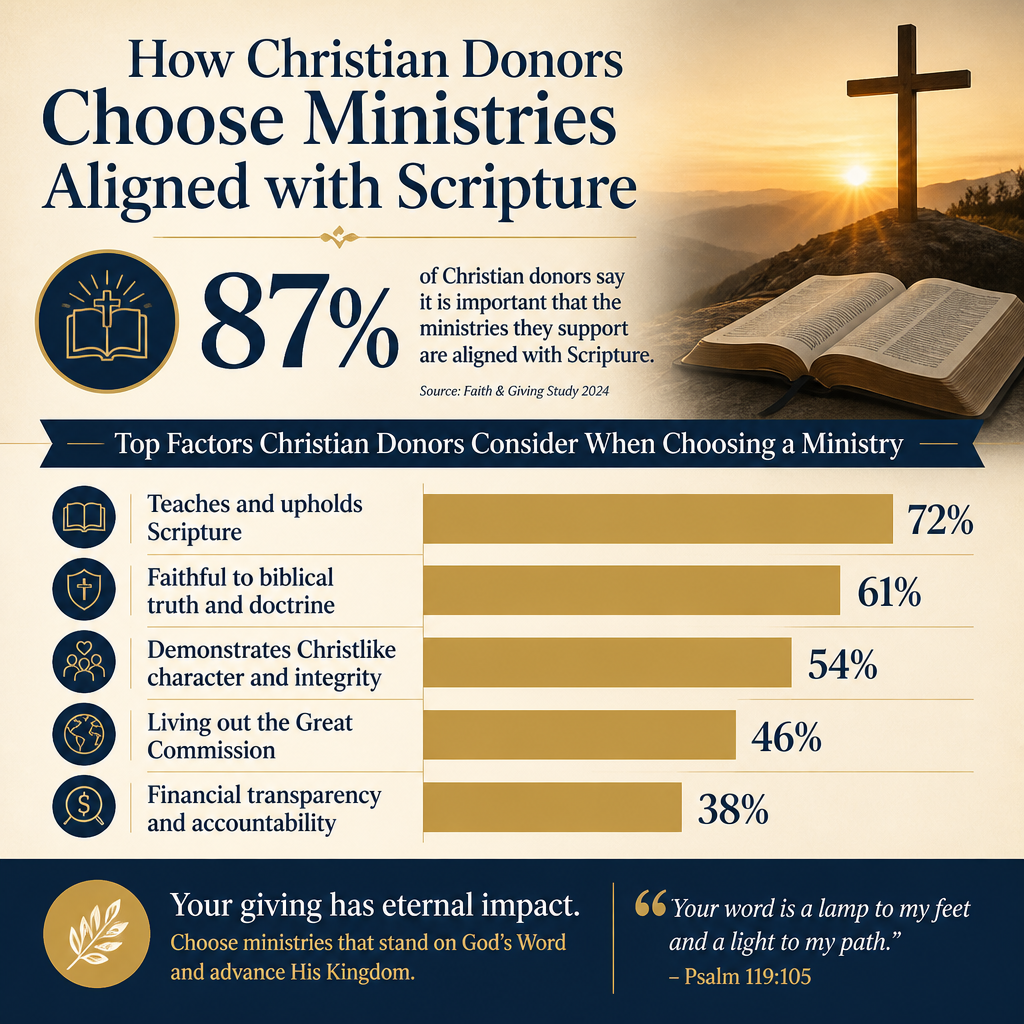
How Christian donors choose ministries aligned with Scripture is not primarily a question of preference. It is a question of obedience, formed conscience, and credible evidence. Many of us have learned that heartfelt stories and sincere language can coexist with weak doctrine, careless stewardship, and results that do not withstand scrutiny.
Scripture places weight on both faithfulness and integrity. Jesus commends generosity that is costly and hidden from applause (Matthew 6:1–4), but he also warns against wolves who speak in religious language while exploiting the flock (Matthew 7:15). Mature Christian giving therefore asks two questions at once: Is this ministry truly Christian in confession and practice, and is it trustworthy in the way it handles people and money?
Start with a biblical definition of alignment
“Aligned with Scripture” can become a slogan unless it is anchored to concrete commitments. The New Testament ties faith to discernible markers: fidelity to apostolic teaching, the fruit of the Spirit, and conduct that commends the gospel. Donors are not responsible to resolve every secondary theological dispute, but we are responsible to avoid underwriting teaching and practice that contradict the plain center of Christian confession.
Clarify what must be nonnegotiable
At minimum, doctrinal alignment involves the gospel itself: the triune God, the incarnation, the atoning death and bodily resurrection of Christ, salvation by grace through faith, and the authority of Scripture. Many ministries state these commitments, but careful donors also watch for functional theology. A ministry can affirm orthodox language while operating with a different practical center—celebrity, political power, prosperity promises, or therapeutic self-actualization.
One useful test is whether the ministry’s teaching and communications sound like Scripture or like the surrounding culture with Bible words attached. Paul’s warning to Timothy about people accumulating teachers to suit their passions remains perennial (2 Timothy 4:3–4). What donors fund shapes what gets repeated.
Distinguish between disagreement and drift
Christians genuinely disagree about baptism, church polity, spiritual gifts, and other matters. Donors should not confuse denominational distinctives with unfaithfulness. The harder discernment is drift: slow movement away from biblical authority, moral clarity, or the scandal of the cross. Drift often shows up first in what a ministry stops saying—sin, repentance, judgment, and the unique saving work of Christ—and in what it starts elevating instead.
When evaluating ministries in the broader space of Christian Financial Service Ministries, this distinction is especially important. Financial language easily absorbs secular assumptions. A ministry can speak confidently about “biblical stewardship” while quietly redefining success as personal affluence rather than faithful discipleship.

Attend to money as a discipleship issue, not a side issue
Jesus treated money as spiritually diagnostic because it reveals allegiance and exposes self-deception (Matthew 6:19–24). Donors often want to focus on the emotional urgency of a cause, but Scripture presses us to examine the moral and spiritual shape of the means as well as the ends. The integrity of fundraising, compensation, and financial controls is not administrative trivia; it is part of a ministry’s witness.
Ask whether fundraising practices are truthful and temperate
Christian appeals should be earnest without manipulation. Pressure tactics, exaggerated claims, and selective storytelling are not merely “marketing style.” They train donors toward either cynicism or credulity, neither of which serves the church. The ministry’s communications should reflect the biblical pattern of truthful speech, refusing to “practice cunning” or “tamper with God’s word” (2 Corinthians 4:2).
In practice, donors can review whether appeals use verifiable descriptions, whether restricted gifts are honored, and whether crises are presented with proportion rather than perpetual emergency. A consistent posture of urgency can be a sign of real need; it can also be a business model.
Do not treat overhead as the moral scorecard
Sophisticated donors have largely absorbed the “overhead ratio” debate. The field has acknowledged that simplistic overhead thresholds can punish investment in accountability and skilled staff. The joint “Overhead Myth” letter from Charity Navigator, Candid (GuideStar), and the BBB Wise Giving Alliance cautioned donors against using overhead ratios as the primary measure of nonprofit performance and urged attention to transparency, governance, and outcomes.Charity Navigator
What this means for Christian donors is not that spending patterns are irrelevant, but that faithfulness is not measured by austerity theater. The question is whether resources are governed wisely, reported honestly, and deployed toward the mission without private enrichment.
Look for governance that can withstand temptation
Scripture assumes that leaders will face real temptation and that systems of accountability matter. The New Testament includes concrete practices for financial integrity—such as avoiding blame by sending multiple trusted representatives to administer gifts (2 Corinthians 8:20–21). Modern ministries need the functional equivalent: independent oversight, conflict-of-interest controls, and governance that is more than a formality.
Independent boards and clear lines of authority
Many ministry failures are not primarily doctrinal. They are failures of unchecked power—founders who cannot be questioned, boards made up of family and close friends, or leaders who control both the message and the money. Donors should expect a board that is meaningfully independent, that meets regularly, and that can hire and fire the chief executive without retaliation or theatrical crisis.
For donors, this is not suspicion masquerading as wisdom. It is a recognition of the biblical doctrine of sin. Strong governance is one way a ministry confesses, in institutional form, that no leader is above correction.
Compensation and related-party transactions require daylight
Executive compensation can be appropriate; secrecy is the red flag. Donors should look for clear disclosure and board-approved processes, especially for founder-led organizations. Related-party transactions—payments to companies owned by insiders, family employment, or rented property—are not automatically corrupt, but they must be disclosed, competitively priced, and governed with documented recusal. Hidden arrangements erode trust quickly because they contradict the Christian call to walk in the light.
- Is the board independent and active, not symbolic?
- Are financial statements reviewed or audited by a qualified third party?
- Are conflicts of interest disclosed and managed in writing?
- Are restricted gifts tracked and honored?
- Does the ministry report outcomes with clarity rather than slogans?
Require transparency that respects donors and protects the vulnerable
Christian donors often carry two responsibilities at once: to give generously and to give carefully. Transparency serves both. It allows donors to assess credibility, and it protects beneficiaries from becoming props in someone else’s fundraising narrative.
Financial and program transparency should be normal, not exceptional
At a minimum, donors should be able to find current leadership names, board information, financial reporting, and a plain description of programs. In the United States, many nonprofits are required to make their IRS Form 990 available, and donors can often access filings through Candid.Candid While a Form 990 does not prove virtue, it can reveal governance patterns, compensation, related-party transactions, and revenue concentration that merit further questions.
Program transparency also matters. Donors should be able to see what the ministry actually does: what services are delivered, to whom, with what safeguards, and with what evidence of effectiveness. Some outcomes are inherently difficult to quantify—discipleship, local church strengthening, long-term cultural change. Even then, a ministry can still report with integrity: defining its aims, naming its limits, and describing what it is learning.
Ethical storytelling is part of Christian witness
Many donors give because they are moved by images and testimonies. Ministries therefore face constant pressure to tell stories that raise funds. The ethical question is whether those stories honor the image of God in the people being served. When beneficiaries are children, trauma survivors, refugees, or the poor, the obligation is higher. Consent, privacy, and dignity are not secular add-ons; they reflect the biblical insistence that people are not merchandise.
In some sectors—international aid, orphan care, anti-trafficking work—the field has had to reckon with how easy it is to do harm while trying to do good. The When Helping Hurts framework, articulated by Steve Corbett and Brian Fikkert, has shaped many organizations’ thinking about dependency, dignity, and the difference between relief, rehabilitation, and development.When Helping Hurts Donors should regard that kind of learned humility as a strength, not a weakness.
Use a verification framework that integrates doctrine and evidence
Christian donors are often forced into artificial choices: either focus on theological alignment and ignore governance, or focus on financial data and ignore doctrine. Scripture refuses that separation. Faithfulness is not merely right confession; it is also conduct befitting the gospel. Conversely, administrative competence without theological integrity is not Christian ministry, even if it does real social good.
What The Most Trusted Standard is designed to test
At Most Trusted, we evaluate ministries against The Most Trusted Standard, a 15-criteria framework across four areas: Faith Foundation, Financial Integrity, Governance and Leadership, and Transparency and Effectiveness. The point is not to replace discernment with a score, but to make core questions verifiable: Is the ministry anchored in historic Christian faith? Are funds handled with documented controls? Is leadership accountable? Do claims match evidence?
Across our verification work, we observe that ministries capable of sustained trust tend to share a set of habits: they define doctrine with specificity rather than vagueness, they welcome independent oversight, they document controls before a crisis forces them to, and they communicate results without inflating them. Those habits are not glamorous, but they align with the biblical call to be “above reproach” (1 Timothy 3:2).
Where donors should expect complexity
Some realities are contested. Measuring “spiritual fruit” is not the same as measuring vaccines delivered. Donors should resist the temptation to demand laboratory-grade metrics from ministries whose primary work is pastoral, evangelistic, or relational. At the same time, donors should not accept spiritual language as a substitute for accountability when a ministry claims concrete results—graduates trained, clinics staffed, churches planted, families housed.
In the domain of Biblical Stewardship and Christian Financial Service Ministries, complexity often appears in the category of “financial guidance.” Some organizations are explicitly charitable. Others resemble financial services firms with a Christian ethos. Donors should look for clarity on what is being sold, what is being subsidized, who benefits, and whether the ministry’s financial incentives could distort its counsel.
Giving that honors Scripture and the people we serve
How Christian donors choose ministries aligned with Scripture finally comes down to a unified moral vision: love of God expressed in truthful confession, and love of neighbor expressed in accountable practice. Donors are not called to cynicism, but neither are we called to naivete. We can insist that ministries speak with theological clarity, govern with integrity, and report with honesty, because the gospel deserves a witness that can bear scrutiny.
FAQs for How Christian donors choose ministries aligned with Scripture
Should donors avoid ministries that do not publish audited financial statements?
Not automatically. Smaller ministries may not be able to fund a full audit every year, and an audit is not a guarantee of spiritual health. Donors can still expect appropriate third-party financial review, clear internal controls, and accessible reporting. As a ministry grows in revenue and complexity, the expectation of an independent audit becomes more reasonable, especially when the ministry solicits large gifts or manages restricted funds.
How can donors evaluate doctrinal alignment without becoming divisive?
Start with what Scripture and the historic creeds treat as central, and distinguish those essentials from secondary distinctives. Ask whether the ministry’s statement of faith is specific, whether its teaching is accessible for review, and whether its practices reflect the gospel it proclaims. Charity does not require doctrinal vagueness, and conviction does not require suspicion. Discernment can be both clear-eyed and peaceable.



