
How Christian senior care ministries measure impact is not a secondary question for donors; it is a stewardship question. The same Scriptures that command honor for fathers and mothers also call God’s people to truthfulness, sober judgment, and careful use of resources entrusted for mercy (Exodus 20:12; Proverbs 12:22; Luke 14:28).
Senior care is also a category where outcomes can be easy to sentimentalize and hard to quantify. A resident may be safer and less lonely, yet still decline physically. A family may express deep gratitude, yet the ministry may be overextended or under-supervised. The donor’s task is not to demand impossible certainty, but to discern whether a ministry is faithful, competent, and honest about what can and cannot be measured.
1) Impact begins with a defined promise of care
Senior care ministries often serve across a wide range: independent living communities, assisted living, skilled nursing, memory care, home-based support, adult day services, pastoral care, respite, and caregiver support. If the ministry’s “impact” claim is not explicit about which needs it is addressing, measurement becomes vague by necessity.
What this means in practice is that credible ministries start with a defined promise: whom they serve, what services they provide, what “good” looks like, and what risks they refuse to ignore. A ministry cannot responsibly measure “dignity” without also attending to safety; it cannot claim “holistic care” without naming spiritual care practices and their boundaries in medically complex settings.
Clarity protects both residents and donors
Across our verification work at Most Trusted, we observe that the strongest ministries are specific about their service model and constraints. They describe staffing ratios and clinical capacities without exaggeration. They name who they cannot safely serve, especially in memory care and high-acuity contexts where needs escalate and families are understandably desperate.
Donors should ask for a theory of care, not slogans
When a ministry articulates a straightforward theory of care, measurement becomes more than a marketing exercise. Donors can evaluate whether the ministry’s work aligns with Christian obligations to honor, protect, and tell the truth about human frailty rather than promising outcomes no one can guarantee.
2) Better measurement distinguishes outputs from outcomes
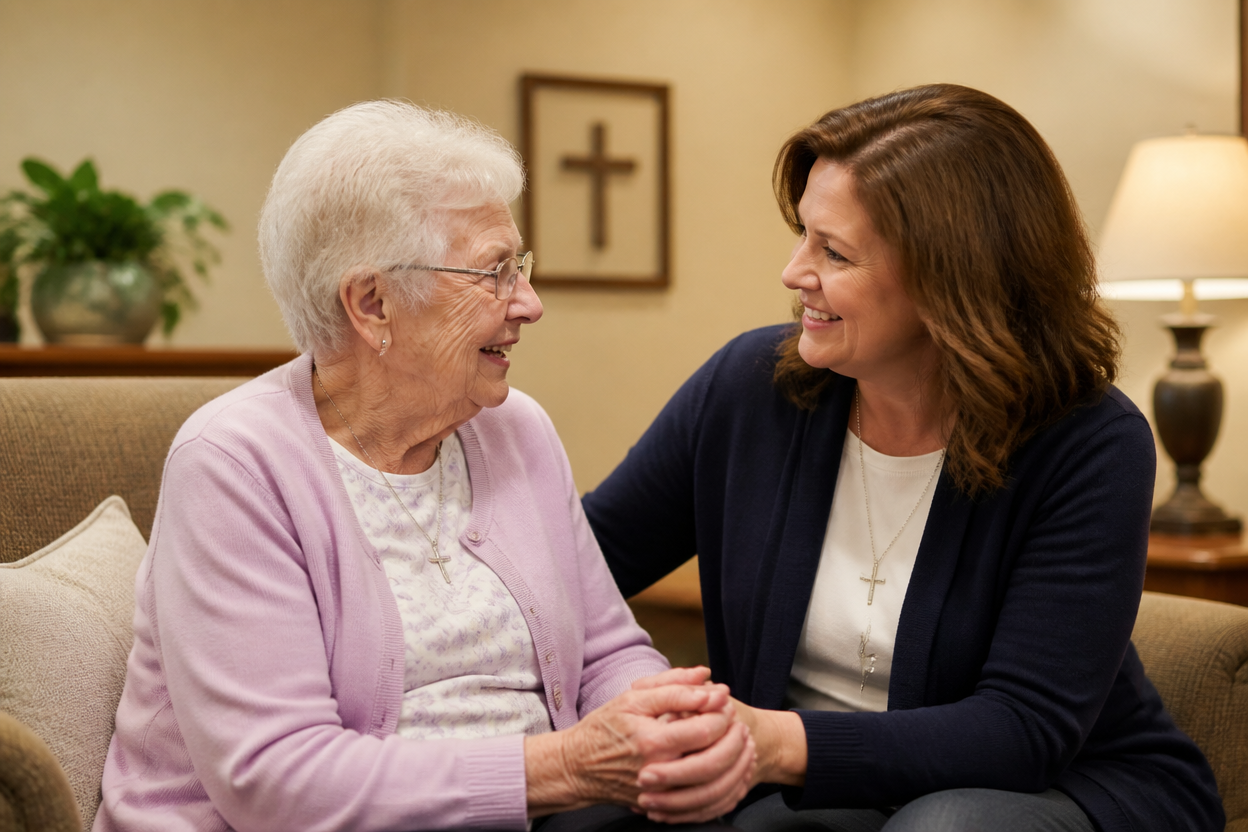
Senior care ministries should report both what they did and what changed because they did it. Outputs matter—how many residents served, home visits made, meals delivered, caregiver support groups held—but outputs are not the same as resident well-being.
The harder question is how ministries assess whether care is improving daily life for older adults and their families. In a field where decline is often inevitable, outcomes must be measured as risk reduction, comfort, stability, and faithful presence as much as improvement.
Examples of outputs that should be straightforward
- Number of residents served by level of care
- Hours of nursing or aide coverage delivered
- Pastoral visits, chaplaincy encounters, or spiritual care touchpoints
- Family conferences and care planning meetings completed on schedule
- Caregiver respite hours provided
Examples of outcomes that require disciplined methods
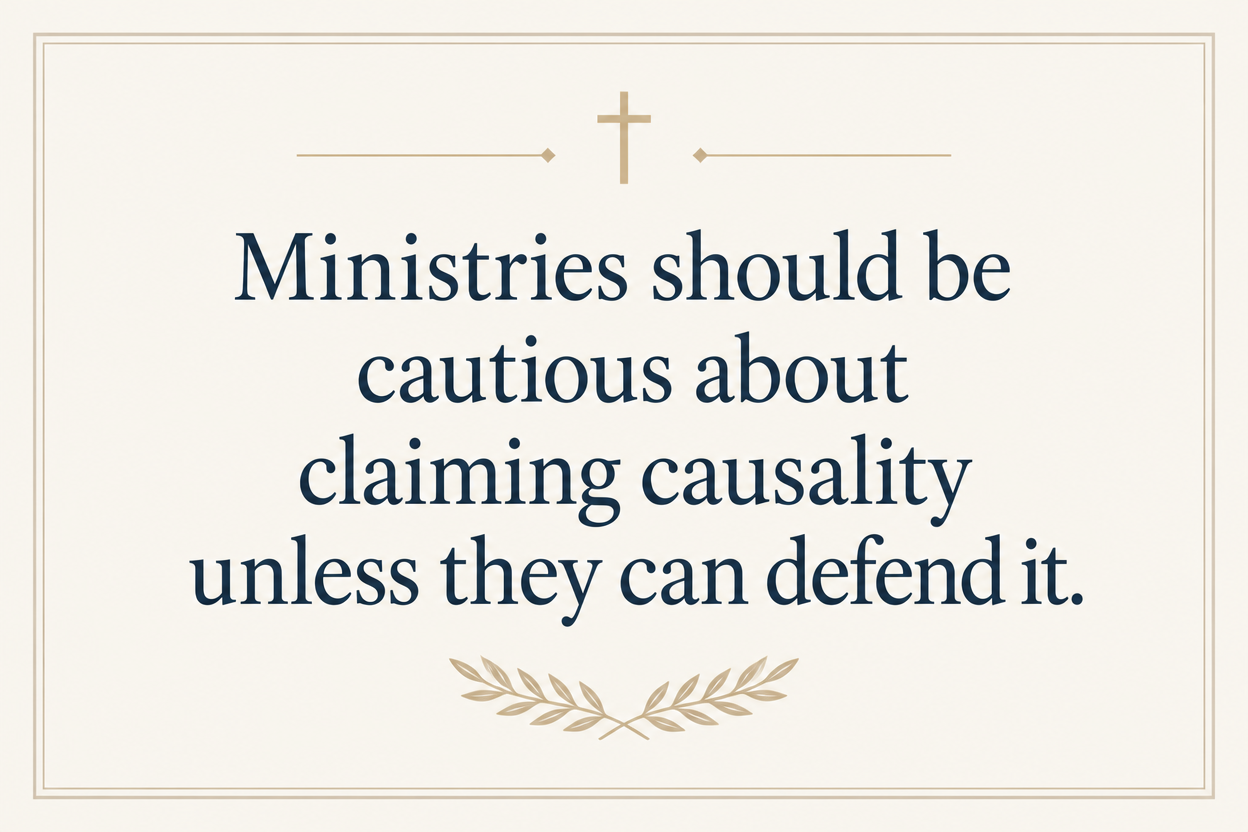
Outcomes in senior care can include reduced falls, fewer preventable hospitalizations, improved pain management, lower caregiver burden, and greater resident engagement. Ministries should be cautious about claiming causality unless they can defend it. Even so, they can responsibly track trends over time and compare against benchmarks.
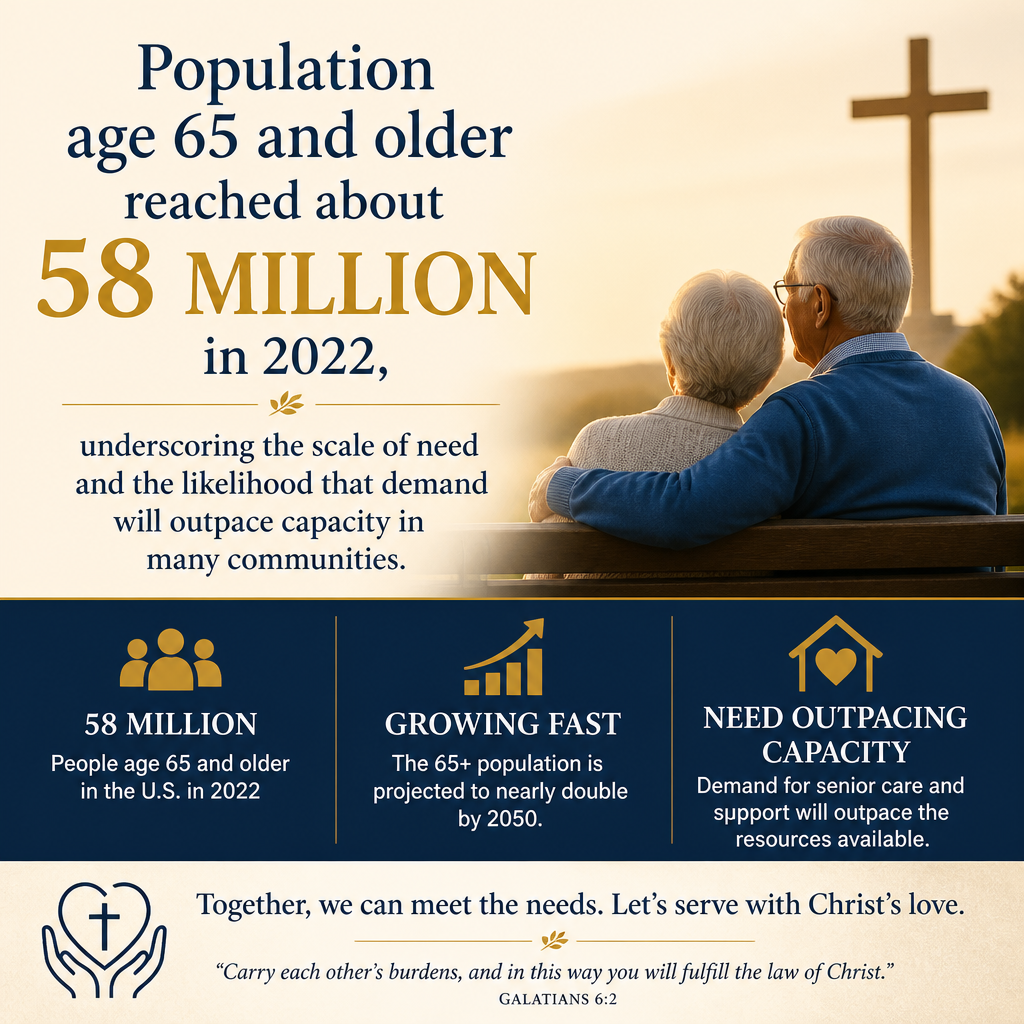
Donors should remember that the American eldercare system is under material strain. The U.S. population age 65 and older reached about 58 million in 2022, underscoring the scale of need and the likelihood that demand will outpace capacity in many communities (U.S. Census Bureau).
3) Resident dignity and safety require measurable safeguards
Christian senior care is often described in the language of dignity, honor, and compassion. Those are essential, but they can become abstractions if a ministry cannot demonstrate concrete safeguards. In eldercare, dignity is protected through good staffing, transparent incident reporting, careful documentation, and a culture where families can raise concerns without fear of retaliation.
Safety metrics are not unspiritual
In skilled settings, ministries should track clinical quality indicators such as falls, pressure injuries, medication errors, infections, and avoidable emergency transfers. For home-based and community programs, the relevant measures may include missed visits, timeliness, case management follow-through, and referral completion. The specific indicators differ, but the underlying principle is the same: love of neighbor includes competent protection from foreseeable harm.
Regulatory accountability plays a real role
Christians genuinely disagree about how much weight donors should place on government ratings or compliance records, especially given legitimate critiques of bureaucratic systems. Still, public oversight provides some non-negotiable signals. For nursing homes, the Centers for Medicare and Medicaid Services publishes inspection and quality information through Care Compare (Centers for Medicare and Medicaid Services). A ministry does not need a perfect record to be faithful, but patterns of serious deficiencies demand scrutiny.
For donors seeking context on how ministries structure care models and operational responsibilities, the broader landscape is addressed across How Christian Senior Care Ministries Work.
4) Spiritual care is real impact, but it must be handled with integrity
Many Christian donors rightly hope senior care ministries will offer more than competent services. They want a setting where older adults are not treated as problems to manage but as image-bearers to honor, where prayer is offered without coercion, and where the gospel is present without manipulation.
Measuring spiritual care is difficult, and simplistic counts can mislead. Counting chapel attendance is not the same as measuring pastoral faithfulness. At the same time, refusing to measure anything at all invites vagueness and, sometimes, spiritual overclaim.
What credible spiritual-care measurement can look like
Responsible ministries often track pastoral contact rates, response time to spiritual-care requests, and family satisfaction with end-of-life support. They may use structured qualitative feedback from residents and families, while protecting privacy and avoiding pressure on vulnerable people. Strong ministries also document staff formation: training in compassionate presence, grief care, dementia-related communication, and ethical boundaries.
Guardrails against performative spirituality
Donors should listen for theological sobriety. A faithful ministry does not treat frailty as a failure of faith or suggest that a resident’s decline is solved by inspirational programming. The Psalms give language for weakness, lament, and enduring trust without denial. Mature senior care ministries make space for that reality.
5) The most trustworthy ministries submit impact claims to governance and transparency
Impact reporting is only as reliable as the systems that stand behind it. In senior care, where families make high-stakes decisions and donors fund vulnerable populations, the credibility of measurement depends on financial integrity, governance, and transparency as much as it depends on program sophistication.
Across our work applying The Most Trusted Standard, we find that ministries with credible impact reporting tend to share a few disciplines: board oversight of quality and risk, audited financial statements when feasible, clear conflict-of-interest practices, and public communication that does not hide hard realities. They also resist the donor temptation to reduce everything to “overhead.” The 2013 Overhead Myth statement, signed by GuideStar, BBB Wise Giving Alliance, and Charity Navigator, warned donors that overhead ratios are a poor proxy for effectiveness and can even encourage unhealthy underinvestment in capacity (Candid GuideStar).
What transparency should include in senior care
Because eldercare settings vary, transparency will look different across ministries. Still, donors can reasonably expect plain-language information about leadership, decision-making, financial stewardship, and how the ministry handles incidents, complaints, and remediation. A ministry’s willingness to disclose limitations often signals maturity rather than weakness.
Where verification serves donors
Most Trusted exists because even sophisticated donors can struggle to compare ministries operating in different regulatory environments and care models. Verification cannot remove every risk, and it should not be treated as a substitute for prayerful discernment. It can, however, provide a disciplined assessment of whether a ministry’s faith commitments, governance, finances, and claims of effectiveness align in a coherent, verifiable way.
For donors evaluating organizations across this field, the broader topic of Christian Senior Care Ministries provides helpful orientation to the ministry landscape and the questions that deserve sustained attention.
FAQs for How Christian senior care ministries measure impact
What impact measures matter most when seniors are declining anyway?
In late-life care, impact is often measured as safety, comfort, stability, and reduced crisis rather than improvement. Credible ministries track preventable harms, responsiveness to changing needs, continuity of relationships, and family confidence in care planning. Spiritual care can be measured through documented access and responsiveness without implying that faithfulness always produces physical recovery.
Should donors trust testimonials and family stories as evidence of impact?
Testimonials are meaningful but incomplete. They can reflect genuine gratitude and still be unrepresentative, especially if feedback is collected selectively. Donors should treat stories as qualitative evidence that must be paired with verifiable reporting: service volumes, quality and safety indicators appropriate to the setting, transparent incident handling, and governance structures that can withstand stress and scrutiny.
Measuring impact with reverence and rigor
Christian senior care ministries are caring for people who carry decades of God-given dignity and, often, the vulnerabilities of age. Donors honor that dignity when they ask for impact measurement that is specific, honest about limits, attentive to safety, and accountable through transparent governance. The ministries most worthy of trust do not treat measurement as a public relations project; they treat it as an extension of truthfulness and love.



