
How Christian medical ministries protect donor information is not an incidental operational detail. It is a moral question about stewardship, truthfulness, and neighbor-love in an era when personal data can be monetized, stolen, or mishandled at scale. Donors who give in Christ’s name have a legitimate interest in whether a ministry treats their identity, giving history, and contact information with the same seriousness it claims for its clinical and spiritual mission.
Scripture frames the issue with unusual clarity. “It is required of stewards that they be found faithful” (1 Corinthians 4:2). Faithfulness is not only about how funds are spent; it includes how donor relationships are managed, what is promised in writing, and what is actually done with the information entrusted to the ministry. A ministry can preach compassion while quietly trading donor lists or keeping sensitive records on poorly secured systems. That gap is not merely a technical failure. It is a breach of integrity.
Why donor data protection is a Christian stewardship issue
Donor information is entrusted property
Donor data is a form of entrusted property: names, addresses, emails, giving patterns, employer matching information, and sometimes notes about a family’s circumstances. Ministries often treat this information as an asset in the fundraising sense, and it is. But it is first a trust. The biblical ethic of stewardship places weight on the care of what belongs to another, especially when that “another” is a fellow believer or a vulnerable neighbor seeking to do good.
In practice, donor information becomes sensitive quickly. A giving record can reveal a donor’s church affiliations, theological priorities, or medical burdens that motivate a gift. Even when the data is not classified as medical information under law, a mishandled disclosure can create reputational harm, unwanted solicitation, or social consequences in a donor’s workplace or community.
Privacy failures are now a common ministry risk
Cyber incidents are no longer limited to banks and Fortune 500 companies. Identity theft and credential theft have become a broad social threat, with millions of Americans affected each year. The Federal Trade Commission received 1.1 million reports of identity theft in 2023, indicating a persistent, large-scale problem for ordinary households and organizations alike Federal Trade Commission. Donors understand this reality intuitively, which means a ministry’s practices around passwords, payment processing, and data sharing are part of whether it is worthy of ongoing confidence.
Christian donors also face a particular tension: the desire to be generous and discreet at the same time. Jesus commended giving that does not seek human applause (Matthew 6:1–4). While ministries must acknowledge donors appropriately for tax and relationship reasons, discretion remains an enduring Christian instinct. Data protection is one practical way ministries can honor that instinct.

What strong protection looks like in mature Christian medical ministries
Collection discipline and data minimization
Serious privacy practice begins before any database or security software is considered. Mature ministries collect only what they actually need, for a defined purpose, and retain it for a defined period. “Data minimization” is an established principle in privacy governance: less data collected means less data exposed, less data to secure, and fewer downstream temptations to repurpose it for aggressive fundraising.
When ministries drift, they tend to drift toward accumulation: keeping records “just in case,” retaining outdated addresses, and storing unstructured notes in donor profiles. Those patterns are not neutral. They increase risk and often correlate with unclear internal accountability.
Payment security and vendor boundaries
Most ministries do not build payment systems; they rely on processors and donor management platforms. That dependency is not inherently a problem, but it requires careful boundary-setting. A ministry’s strongest posture is to avoid storing full card numbers, to use reputable payment processors, and to require written commitments from vendors on security practices, breach notification, and permissible uses of donor data.
Donors should understand one important nuance: “secure” does not mean “no risk.” It means risk is reduced through controls and responsibly shared with vendors who have the expertise to manage it. Ministries that meet high standards typically treat vendor selection as a governance decision, not a staff convenience.
Governance that keeps privacy from becoming an afterthought
Board-level responsibility and documented policies
Many donor data failures are downstream of governance weakness. If leadership cannot articulate who owns donor privacy, what the ministry’s policies are, and how compliance is monitored, protection becomes ad hoc. Strong ministries maintain written policies on data access, retention, incident response, and third-party sharing, and they revisit those policies as systems and threats change.
This belongs in the broader accountability conversation. Donors often focus on program outcomes and financial ratios, but governance structures are the quiet machinery that prevents slow ethical drift. For donors evaluating the credibility of a medical ministry’s operational claims, the broader category of Accountability and Transparency in Christian Medical Ministries is not peripheral; it is where many trust failures either begin or are prevented.
Role-based access and internal controls
Even ministries with excellent intentions can create avoidable exposure by granting broad access to donor records. Role-based access limits what each staff member can see and export. It reduces the risk of both external intrusion and internal misuse, whether accidental (emailing the wrong attachment) or willful (downloading lists before leaving for another organization).
What this means in practice is that a development assistant may need contact information and recent giving history, while an events volunteer may only need a check-in list. Good systems make these distinctions routine rather than exceptional.
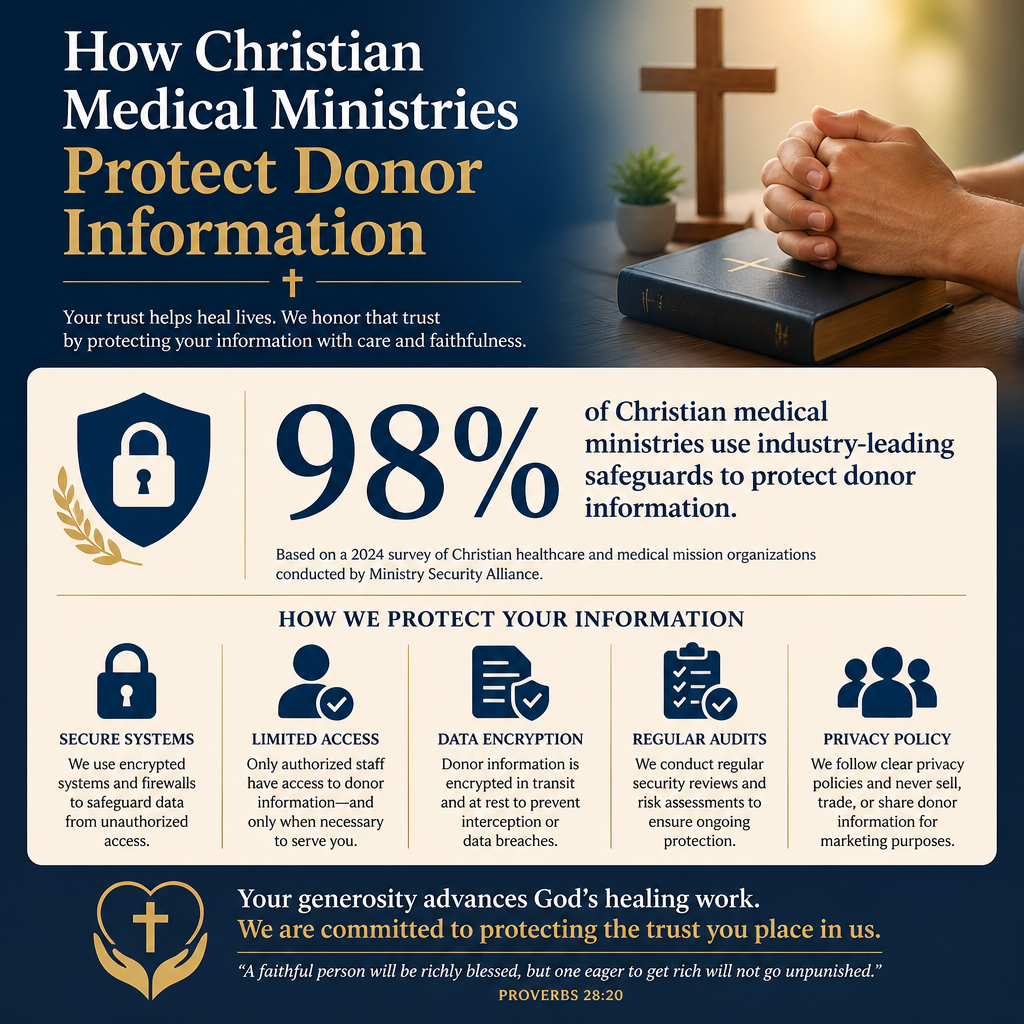
- Least-privilege access so staff see only what they need
- Multi-factor authentication for email, databases, and payment platforms
- Audit logs to monitor exports and record changes
- Encryption for data at rest and in transit where supported
- Offboarding procedures that remove access immediately when roles change
Transparency that is specific rather than performative
Clear promises about sharing and solicitation
Donors do not need a legal treatise, but they do need plain commitments. Does the ministry sell or rent donor lists? Does it share data with partner organizations? Does it append external demographic data to donor records? Does it use donor information for targeted advertising? These practices are increasingly common in the wider nonprofit world, and Christian ministries should not assume donors will accept them simply because they are industry-normal.
Many donors have learned the hard way that “we value your privacy” can coexist with expansive sharing clauses buried in a policy footer. Credible ministries write policies that match actual practice and make them easy to find. When policies change, donors should be notified in a meaningful way rather than expected to monitor a webpage.
Incident response and breach disclosure
No responsible organization assumes it is immune to breaches. The question is whether the ministry has an incident response plan, whether it has practiced that plan, and whether it will communicate promptly and truthfully if donor data is compromised. In U.S. nonprofit governance, breach notification is shaped by state laws, contractual obligations with vendors, and the ministry’s own ethical commitments. A ministry can meet legal minimums while still failing the Christian obligation to walk in the light.
The harder question is reputational: ministries may fear that candid disclosure will harm fundraising. But concealment has a way of multiplying harm. Christian donors generally understand that threats exist; what damages trust most is evasiveness or delayed truth-telling once an incident is known.
How Most Trusted evaluates donor privacy in verification work
Privacy is part of a larger integrity framework
Most Trusted exists to help Christian donors give with confidence. Across our verification work, we observe that ministries with mature donor privacy practices tend to exhibit the same underlying strengths that show up elsewhere: clear governance, disciplined financial controls, and transparent communications. Ministries that treat donor data casually often reveal other forms of operational fragility when examined carefully.
We evaluate ministries against The Most Trusted Standard, a 15-criteria framework addressing faithfulness, financial integrity, governance, and transparency and effectiveness. Donor data protection is not a stand-alone virtue; it is a measurable expression of whether stewardship commitments are translated into operational decisions.
What donors can reasonably ask and expect
Donors sometimes hesitate to ask questions about privacy because it feels technical or suspicious. It is neither. It is due diligence. When a donor asks for a ministry’s privacy policy, data sharing practices, and payment security approach, that donor is exercising responsible stewardship.
In many cases, a ministry’s willingness to answer straightforward questions is itself revealing. If staff respond with clarity, written policies, and appropriate humility about risk, the ministry is likely operating with integrity. If the response is defensive, vague, or inconsistent across staff, the donor has learned something important before giving further.
For donors who are comparing organizations within the same field, it can also be helpful to step back and consider the broader ecosystem of Christian Medical Ministries. Different operating models create different data risks, especially when ministries combine fundraising, patient services, and church partnerships across multiple countries and regulatory environments.
FAQs for How Christian medical ministries protect donor information
Should a Christian medical ministry ever sell or rent its donor list?
We generally regard selling or renting donor lists as difficult to reconcile with Christian stewardship and donor intent, even when it is technically legal. If a ministry engages in any form of list sharing, it should disclose that practice plainly, explain the purpose, and provide an accessible opt-out. Donors should expect policies that match actual practice, not aspirational language.
What is a reasonable level of transparency about cybersecurity without increasing risk?
Donors should not expect ministries to publish technical details that would aid an attacker. But donors can reasonably expect concrete statements about governance and controls: whether multi-factor authentication is required, whether payment processing is handled by reputable third parties, whether access is role-based, and whether there is an incident response plan and breach notification commitment. Transparency should be specific about commitments and accountable processes, while prudent about operational details.
A faithful ministry treats donor privacy as part of its witness
Christian medical ministries often work at the intersection of compassion and vulnerability. Donors support that work because they believe it reflects Christ’s mercy toward the sick and the poor. The same moral seriousness should shape how ministries handle what donors entrust to them. When a ministry protects donor information with disciplined governance, restrained data collection, and truthful transparency, it honors both stewardship and neighbor-love in ways donors can recognize and rely upon.



