

How Christian conflict resolution ministries use donor funds is not a peripheral question for serious Christian giving. These ministries deal in moments where truth, repentance, and costly forgiveness meet the real pressures of litigation, reputational damage, and spiritual trauma. Donors are not merely purchasing a service; we are funding a form of peacemaking that Scripture treats as a visible sign of the Kingdom.
Jesus blesses the peacemakers, and Paul commands the church to pursue peace and mutual upbuilding. Yet Christian conflict work is also vulnerable to predictable failures: coercive “reconciliation” without justice, confidentiality used as cover, and underinvestment in safeguards that protect victims and the accused alike. Financial stewardship becomes a theological matter because money determines whether a ministry can pursue truth patiently, or whether it must rush to outcomes that keep the lights on.
The work requires more than good intentions
Why conflict ministry is expensive in the ways donors rarely see
Christian conciliation, mediation, and restorative processes are labor-intensive. A single complex case can involve intake, screening for abuse and power imbalances, multiple interviews, document review, facilitation sessions, follow-up, and careful recordkeeping. When ministries do this well, a significant portion of donor funds is paying for trained people to spend time in slow, careful work rather than producing an immediately visible “program output.”
Healthy ministries also carry costs that do not photograph well: legal counsel to ensure their processes do not create foreseeable harm, secure data systems to protect sensitive information, and policies that prevent conflicts of interest when leaders are implicated. Those expenditures can feel administrative, but they often represent a ministry’s seriousness about truthfulness and protection of the vulnerable.
The contested question of what success looks like
Christians genuinely disagree about what “resolution” should mean in practice. Some contexts prioritize restoring relationships; others require formal discipline, restitution, or separation for safety. The danger is turning reconciliation into an outcome that can be marketed to donors. Biblically, peace is not the same as quiet, and unity is not achieved by suppressing testimony. Funds that support careful discernment—especially screening and accountability—are not overhead; they are moral architecture.

Where donor dollars typically go
Core categories of spending in credible ministries
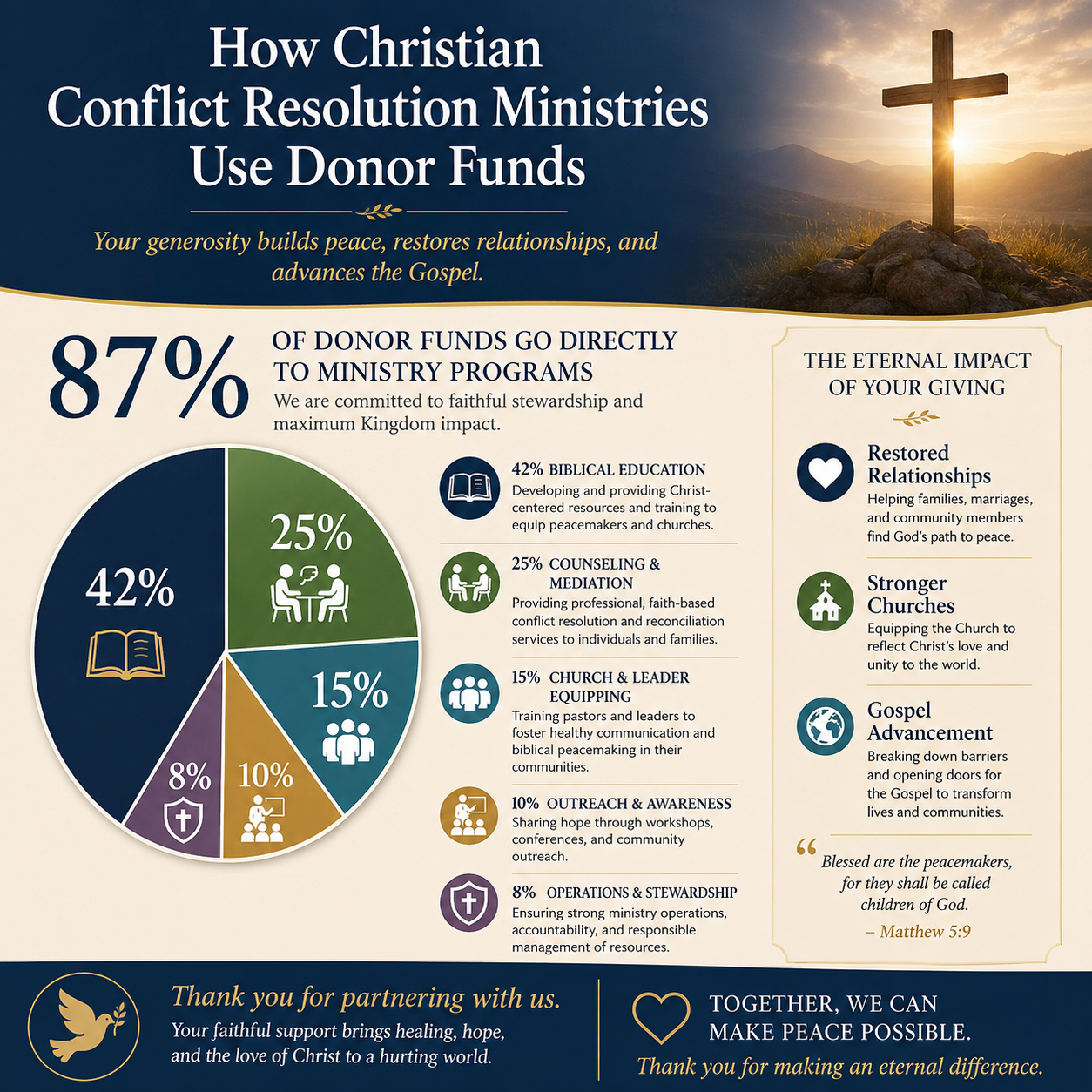
Across our verification work at Most Trusted, the ministries that meet The Most Trusted Standard tend to show spending patterns that align with the actual demands of the field. Donors should expect most budgets to be concentrated in personnel and casework-related capacity, with supporting investments that keep the work safe, lawful, and spiritually responsible.
- Personnel for casework: conciliators, mediators, intake specialists, and case administrators with appropriate training and supervision
- Training and formation: continuing education, certification pathways, and theological preparation for staff and volunteer mediators
- Safeguarding and risk management: screening protocols, secure documentation systems, and outside counsel when needed
- Field-facing education: church training on Matthew 18 processes, grievance procedures, and leadership accountability
- Organizational accountability: independent board governance, audit and finance functions, and credible complaint mechanisms
Donors sometimes ask for a simple “program vs. overhead” ratio. The sector has learned that this can distort incentives. Charity Navigator, Candid, and the BBB Wise Giving Alliance have publicly cautioned against overemphasizing overhead ratios because it can pressure nonprofits to underinvest in the very infrastructure that prevents misuse and failure.Charity Navigator
What this means for donors evaluating transparency
Transparency is not the same as publicity. Conflict ministries often must protect confidentiality, especially when allegations are unresolved or when disclosure would endanger people. Mature transparency focuses on what can be disclosed responsibly: governance structures, financial statements, safeguarding policies, conflicts-of-interest controls, and outcome reporting that avoids sensationalizing the harmed.
Donors who want to think more broadly about the space these ministries occupy within the wider field of Christian Conflict Resolution Ministries should look for clarity about what the ministry does and does not handle. A ministry that claims competence in every kind of conflict, from interpersonal disputes to clergy abuse, should prompt careful questions about training, scope, and referral practices.
Common budget pressures and the spiritual risks they create
The temptation to fund outcomes rather than truth
When donors implicitly reward quick settlements and “restored unity,” ministries can be pushed toward premature closure. In church settings, that can look like pressuring victims to reconcile without restitution, or urging complainants to remain silent “for the sake of the witness.” Those are spiritual harms. Christian peacemaking cannot be purchased by donors, and it cannot be achieved by bypassing confession, accountability, and repair.
Financially, this pressure can show up in underfunded intake and screening. A ministry that cannot afford careful triage may treat every situation as a mediation problem when some situations require reporting, legal counsel, or removal from leadership. Donors should not assume that “more cases served” is always the best metric if the ministry’s intake is not designed to identify coercion and danger.
The quieter risk of underinvesting in governance
Some of the most consequential spending in conflict ministries happens at the level of governance and controls: independent board oversight, documented disciplinary processes, and credible channels for complaints about staff conduct. These are not luxuries. They are part of what distinguishes a ministry that is accountable to Christ and his church from one that is accountable primarily to its own brand.
Government data underscores why donors should care about these controls. The IRS requires most tax-exempt organizations to file Form 990 with governance, compensation, and financial disclosures that can reveal basic accountability practices.Internal Revenue Service
What strong financial integrity looks like in practice
Clarity on restricted gifts and fee models
Conflict resolution ministries often blend donor funding with fees from churches or individuals. That is not inherently problematic, but it introduces predictable ethical tensions: who is the client, who controls the process, and how does the ministry avoid financial bias? Responsible ministries document their fee structures, explain scholarship policies, and maintain clear boundaries so that the party paying the invoice does not control the outcome.
Restricted giving requires equal clarity. If a donor gives to subsidize cases for low-income parties, the ministry should be able to track those funds and report their use. Mature accounting does not treat donor intent as a marketing tool; it treats it as a trust to be honored.
Independent review and credible reporting
Donors should look for external validation appropriate to size and complexity: reviewed or audited financial statements where feasible, board-level finance oversight, and policies on related-party transactions. The goal is not to burden small ministries with requirements they cannot sustain, but to ensure that financial reporting matches the moral weight of the work.
For donors comparing ministries across the broader landscape of Accountability and Transparency in Christian Conflict Resolution Ministries, a useful question is whether the ministry can explain its controls without defensiveness. Transparency offered only under pressure is not a healthy sign in a field built on truth-telling.
How donors can give with discernment
Questions that reveal stewardship and spiritual seriousness
Donors can ask questions that go beyond ratios and slogans. The aim is to discern whether a ministry has built structures that support truth, protect the vulnerable, and resist the financial incentives that distort peacemaking.
Consider asking:
- How do you screen cases for abuse, coercion, or criminal conduct, and when do you refer out?
- What training and supervision do mediators receive, and how is competence evaluated?
- What safeguards exist when allegations involve senior leaders or major donors?
- How do you handle confidentiality while still reporting outcomes and learning responsibly?
- What does your board oversight look like, and how are conflicts of interest managed?
How Most Trusted fits into a donor’s diligence
Most Trusted exists because donors should not have to choose between naïve trust and corrosive suspicion. Our verification work evaluates ministries against The Most Trusted Standard, a 15-criteria framework that examines faith commitments, financial integrity, governance, transparency, and effectiveness. In a field where confidentiality is often necessary, third-party verification can help donors see whether the ministry’s hidden structures are worthy of support.
Not every faithful ministry will look the same. Some focus on training churches, others take direct cases, and others provide coaching and policy development. The question is whether the ministry’s use of funds matches its stated theology and practice: truthfulness without partiality, compassion without sentimentality, and peace that does not bypass justice.
FAQs for How Christian conflict resolution ministries use donor funds
Should Christian conflict resolution ministries spend a high percentage on administration?
Some administrative spending is a feature of integrity in this field, not a defect. Secure recordkeeping, legal counsel, proper intake procedures, and governance controls can be essential to protecting people and ensuring cases are handled lawfully and ethically. Donors should evaluate whether those costs are tied to safeguards and accountability rather than assuming a low administrative line is always virtuous.
How can a ministry be transparent while keeping cases confidential?
Responsible transparency focuses on what can be disclosed without harming parties: financial statements, board composition and independence, conflicts-of-interest policies, safeguarding protocols, and aggregate outcome reporting that avoids identifying details. Donors can also ask whether the ministry has an external review process or verification that assesses these practices without requiring public disclosure of sensitive case information.
Funding peacemaking that can bear the weight
Donors who fund Christian conflict resolution ministries are funding more than meetings and mediation sessions. We are funding the patient pursuit of truth, the protection of the vulnerable, and the slow work of rebuilding trust where sin has fractured relationships and institutions. The responsible use of donor funds is one of the clearest indicators that a ministry’s peacemaking is not merely aspirational, but disciplined enough to bear spiritual and ethical weight.



