

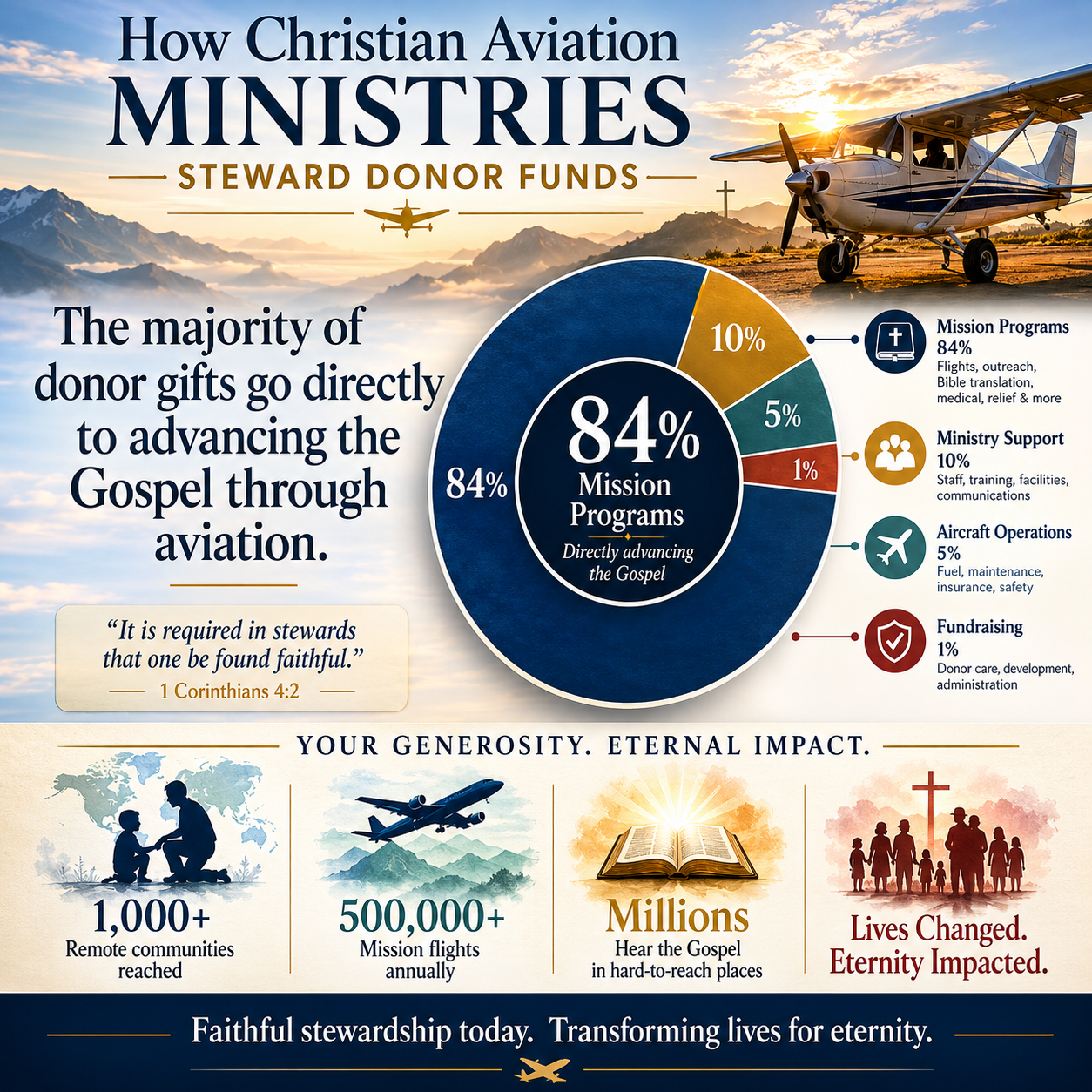
How Christian aviation ministries steward donor funds is not a peripheral question for serious Christian givers. These ministries operate at the intersection of costly equipment, unforgiving safety requirements, and urgent gospel and mercy needs in places where roads do not exist and time matters.
Scripture does not treat stewardship as a technical issue reserved for accountants. It treats it as a moral and spiritual reality before God: “Moreover, it is required of stewards that they be found faithful” (1 Corinthians 4:2). For aviation work, faithfulness shows up in budgeting discipline, maintenance rigor, governance strength, and honest reporting when outcomes are hard to measure and costs are high.
Why aviation ministry stewardship is uniquely complex
Aviation is capital-intensive, and the costs are not optional
Aircraft acquisition is only the beginning. The true cost of aviation ministry includes inspections, overhauls, avionics, hangar costs, insurance, fuel, training, and the specialized staff required to keep operations safe. Unlike many program models, an aviation operation cannot “make do” by postponing maintenance without creating moral risk. In Christian ministry language, cutting corners becomes a form of presumption.
Donors sometimes carry a well-intentioned instinct to treat administrative and infrastructure spending as suspicious. The nonprofit sector has had to correct that instinct. The “Overhead Myth” statement, signed by major evaluators, argues that overhead ratios are a poor proxy for impact and can incentivize underinvestment in essential systems that protect beneficiaries and strengthen outcomes Charity Navigator.
Safety is a stewardship obligation, not a luxury
The moral logic is straightforward: if a ministry flies, it assumes a duty of care toward pilots, passengers, local partners, and communities on the ground. Safety management systems, incident reporting cultures, and independent oversight may look costly, but they are part of loving one’s neighbor. Ministries that spiritualize risk or treat accidents as an unavoidable cost of obedience often fail to distinguish between faithful courage and avoidable negligence.

What healthy financial stewardship tends to look like
Budgets that separate mission urgency from financial realism
Across our verification work at Most Trusted, the strongest aviation ministries do not confuse bold vision with unfunded obligation. They build budgets that distinguish between sustaining operations and expanding capacity, then communicate those distinctions clearly to donors. In practice, this often means multi-year replacement plans for aircraft and engines, not only annual fundraising targets.
Donors should expect to see clean financial statements, an annual independent audit for organizations of meaningful size, and governance that reads the audit rather than filing it away. Audited financial statements are not a guarantee of excellence, but they are a basic discipline of accountability in a high-risk, high-cost environment.
Reserves that reflect aviation realities
Christian donors sometimes hear “reserves” and assume hoarding. In aviation, reserves can be the difference between a grounded fleet and continuity of ministry. The more appropriate question is not whether reserves exist, but whether they are proportionate, governed by policy, and transparently explained. A ministry that can articulate why reserves exist—engine overhaul schedules, seasonal access windows, fuel volatility, emergency response readiness—treats donors as partners rather than as a cash stream.
A disciplined approach to restricted gifts
Aviation donors frequently designate gifts for aircraft purchases, medical flights, or a specific region. Restricted giving can be a meaningful way to align donor intent with mission strategy, but it can also distort a budget if restrictions pile up around visible assets while underfunding training, maintenance, and local capacity. Stewardship includes the courage to say no to funds that create long-term liabilities the ministry cannot responsibly sustain.
How ministries should report impact when flights are the means, not the end
Counting flights is necessary but not sufficient
Aviation ministries can easily report outputs: flights completed, hours flown, patients transported, deliveries made. Those metrics matter. They also risk reducing mission to activity. Mature reporting shows how aviation service strengthens local church and community capacity over time: reliable access to Scripture translation teams, consistent support for remote clinics, strengthened disaster response networks, and improved supply chain reliability for local partners.
In the broader aid and development field, donors have learned that good intentions do not automatically yield good outcomes. The When Helping Hurts framework, articulated by Steve Corbett and Brian Fikkert, pressed Christian ministries to evaluate whether assistance reinforces dependency or strengthens dignified local agency Moody Publishers. Aviation ministries face the same question, simply with propellers and runways added.
Transparency should include setbacks and constraints
Weather grounds planes. Mechanical issues change schedules. Political instability closes airspace. Partner capacity varies. Stewardship reporting that only celebrates wins trains donors in unreality. The ministries most worthy of long-term trust are candid about constraints and setbacks without turning transparency into a performance of self-criticism.
What this means in practice is that donors should look for communications that explain why a region received fewer flights than expected, how safety decisions were made, what was learned, and what will change. That is the tone of stewardship rather than marketing.
Governance and leadership that can bear the weight of aviation
Boards must understand aviation risk and ministry purpose
Board oversight is where many stewardship failures begin. A board that is spiritually sincere but operationally uninformed can drift into either rubber-stamping leadership or pressuring staff toward unsafe expansion. Aviation governance requires a sober understanding of risk management, regulatory compliance, and the true cost of ownership.
At the same time, governance cannot collapse into technical management. The board’s responsibility is to protect mission clarity and integrity: why the ministry flies, whom it serves, how it partners with the local church, and what theological commitments guide decision-making. For donors evaluating the space, our Christian Aviation Ministries coverage is designed to keep both dimensions in view.
Compensation and conflicts of interest should be plainly addressed
Christians genuinely disagree about what constitutes “reasonable” compensation in nonprofit leadership, particularly for highly specialized roles like chief pilots, mechanics, or safety directors. The donor’s task is not to demand artificially low pay, but to ask whether compensation is governed, benchmarked, and transparently disclosed.
Conflicts of interest also require explicit policies. Aircraft transactions, vendor relationships, and related-party dealings can create subtle temptations. Ministries should disclose governance safeguards, recusal practices, and independent review processes in language that ordinary donors can understand.
What donors should look for when evaluating stewardship
Questions that respect both faith and operational reality
Discernment is not suspicion. It is love ordered by truth. Donors who want to support aviation ministry without being naïve can ask questions that reveal whether the organization is building for faithfulness over decades rather than fundraising momentum over quarters. Within our work, The Most Trusted Standard is designed for exactly this: a coherent set of verification criteria that treats faith commitments, financial integrity, governance, and transparency as mutually reinforcing rather than competing priorities.
- Is there an annual independent audit, and does leadership explain material notes plainly?
- Does the ministry publish meaningful program and safety information beyond promotional stories?
- Are aircraft acquisition and maintenance plans presented as multi-year obligations, not one-time wins?
- How does the ministry handle restricted gifts, and does it communicate funding gaps honestly?
- Is governance structured to prevent conflicts of interest in aircraft and vendor decisions?
Interpreting overhead, fundraising, and “cost per flight” with wisdom
Donors often ask for a single efficiency metric—overhead ratio, cost per hour, cost per patient—because it feels objective. Aviation resists simplistic ratios. A higher cost per flight may reflect safer aircraft, more rigorous maintenance, difficult terrain, or more complex medical transport. A lower number may reflect deferred maintenance, undertrained staff, or thin safety margins. Stewardship is not the cheapest flight; it is the faithful flight.
For donors who want a more complete framework for accountability questions in this sector, our work on Accountability and Transparency in Christian Aviation Ministries addresses common reporting patterns, gaps, and best practices we routinely see.
FAQs for How Christian aviation ministries steward donor funds
Should a Christian aviation ministry have significant reserves?
Often, yes, though the appropriate level depends on fleet size, overhaul schedules, geographic constraints, and revenue volatility. The stewardship question is whether reserves are governed by policy, transparently explained, and aligned with known obligations such as engine overhauls, insurance, and safety training rather than functioning as an unexamined accumulation.
How can donors evaluate “impact” when aviation is only a support function?
Donors can look for reporting that connects aviation outputs to mission outcomes: strengthened access for local churches and partners, continuity for remote health services, reliable logistics for translation or discipleship work, and credible learning from setbacks. Flight counts matter, but mature impact reporting shows how flying serves durable local capacity rather than replacing it.
Stewardship that honors the gospel and the people served
Christian aviation ministries carry a particular burden of trust because their work is expensive, technically demanding, and often hidden from public view. Donors need more than inspiring stories; they need evidence of faithfulness in the mundane decisions that prevent tragedy and sustain mission.
When ministries treat safety as neighbor-love, governance as accountability before God, and financial clarity as a form of truth-telling to the church, they honor both the gospel they proclaim and the people they serve. That is the kind of stewardship donors can support with confidence.



