

How Christian adoption ministries work with adoption attorneys often determines whether a family’s generosity serves a child’s best interest or unintentionally funds confusion, delay, or even coercion. Adoption is both a sacred commitment and a heavily regulated legal act; ministries that treat law as an afterthought put children, birth parents, and adoptive families at risk.
Scripture holds together zeal and sobriety. “Defend the cause of the fatherless” is not a call to bypass due process; it is a call to pursue justice with integrity (Psalm 82:3). For donors, the question is not whether a ministry “cares,” but whether its care is disciplined by lawful, transparent practices that protect the vulnerable and honor God in the details.
Why attorneys are central to ethical adoption work
Adoption is pastoral work with legal force
Christian adoption ministries typically operate in a space where discipleship and documentation meet. A ministry may provide counseling, home-study coordination, post-placement support, or fundraising assistance. Yet the act of creating or transferring legal parentage is governed by statutes, courts, and (in intercountry cases) treaties and federal regulations.
Attorneys translate that reality into action: they interpret state adoption codes, file petitions, ensure consents are executed correctly, and keep timelines aligned with court requirements. When a ministry collaborates well with counsel, it signals a commitment to both compassion and lawful order—an echo of the biblical insistence that righteousness is not merely heartfelt but enacted.
Complexity is not a defect in the system
Christians genuinely disagree about how much friction is “too much” in adoption. Some interpret regulation as needless red tape; others see it as a hard-won guardrail after documented abuses. The stronger reading is that complexity is often the cost of protecting rights: birth parents’ informed consent, children’s legal identity, and adoptive families’ stability.
Intercountry adoption underscores this. The Hague Adoption Convention framework, implemented in the United States through the Intercountry Adoption Act and administered in part by the U.S. Department of State, imposes specific process requirements intended to prevent trafficking and improper financial inducements U.S. Department of State. Ministries that respect this framework tend to collaborate proactively with attorneys rather than improvising around them.

How ministries and attorneys divide responsibilities without blurring lines
The ministry’s role is support and formation
Healthy ministries understand what they are, and what they are not. They can prepare families spiritually and practically, provide trauma-informed training, coordinate care teams, and offer pastoral counseling for birth parents and adoptive families. They may also help families understand the pathway ahead: home studies, documentation, travel, post-placement reporting, and the emotional toll adoption can exact.
What this means in practice is that ministries should not present themselves as legal authorities unless they are, in fact, licensed law firms. When ministry staff offer legal “advice” rather than legal information, confusion follows. The result is often avoidable: families act on incomplete guidance, and attorneys are left to repair preventable errors under deadline pressure.
The attorney’s role is legal counsel and legal accountability
Adoption attorneys do not merely “push paperwork.” They carry fiduciary and ethical obligations, including confidentiality, conflict-of-interest management, and candor to the court. They are positioned to identify legal risk early: an improperly executed consent, jurisdictional problems, missing relinquishment documentation, or misaligned timelines that could jeopardize finalization.
Donors should expect mature ministries to welcome this clarity. When law is treated as a partner rather than a threat, everyone benefits—especially the child whose long-term stability depends on a sound legal foundation.
Where legal risk concentrates and what strong collaboration looks like
Consents, counseling, and the question of coercion
The hardest moral terrain in adoption is not administrative; it is human. Birth parents may be young, economically pressured, or navigating crisis. A ministry may provide counseling or practical support, but it must do so in a way that does not compromise the voluntariness of consent or create the appearance of improper influence.
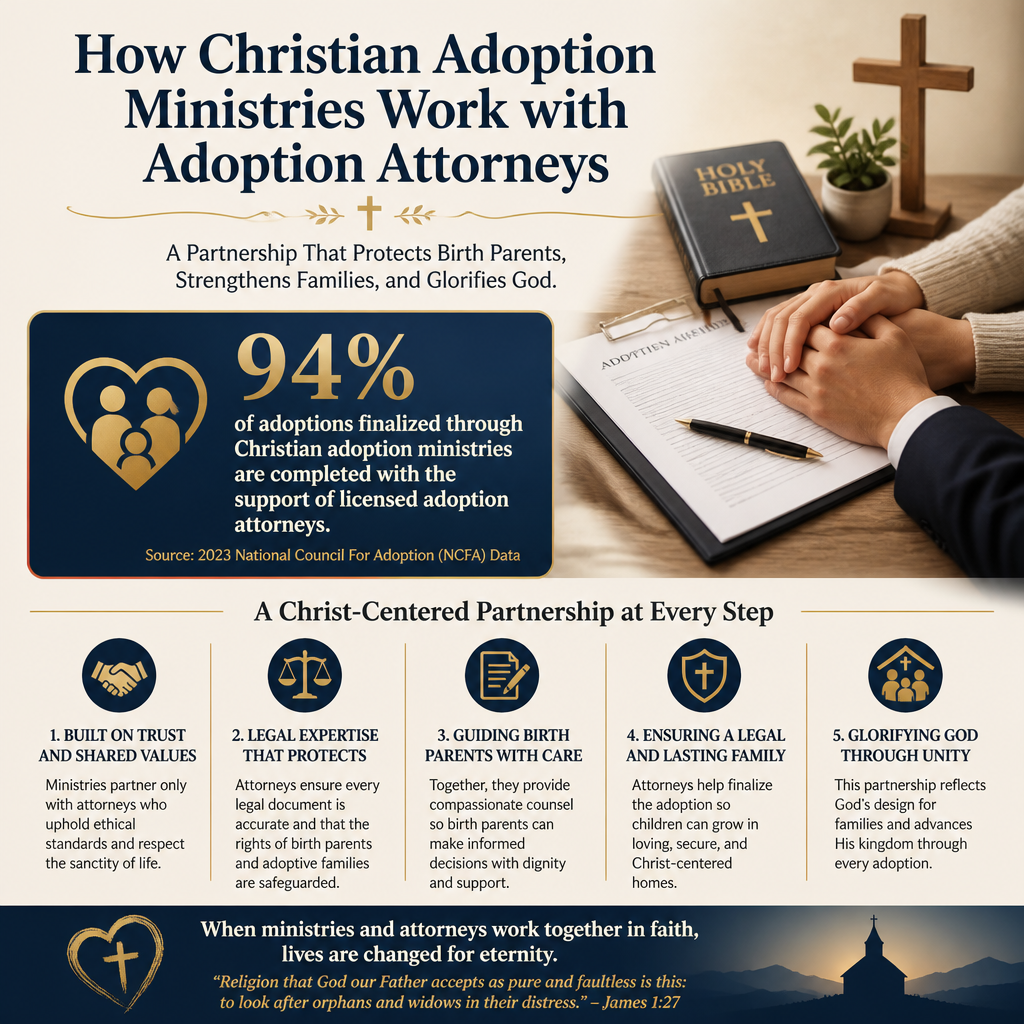
Attorneys help set boundaries: what assistance can be offered, how it should be documented, and what should be avoided. This is especially important because ethical failures in this area have led to public scandal and real harm. The United States has seen documented cases of coercion and fraud connected to adoption processes, with federal law enforcement occasionally involved U.S. Department of Justice. Donors should not interpret such reports as an indictment of adoption itself, but as evidence that vigilance is necessary.
Money is never neutral in adoption
Financial flows around adoption are a perennial source of confusion: agency fees, attorney fees, home study costs, travel, counseling, and permissible birth-parent expenses where allowed by law. Ministries sometimes help families fundraise, and donors often help close the gap. The moral danger is obvious: if money is perceived as purchasing a child, the entire witness of Christian orphan care is compromised.
Attorneys help ministries ensure compliance with state limits on birth-parent expenses and required disclosures to the court. They also help clarify what can be paid directly, what must be escrowed, and what documentation is needed. A donor should look for ministries that treat financial transparency as part of discipleship, not as a defensive posture.
What donors should ask to assess integrity and safeguards
Questions that reveal whether a ministry is governed or improvised
Across our verification work at Most Trusted, we observe that strong ministries do not rely on charisma or urgency to carry complex work. They build repeatable controls, welcome professional scrutiny, and describe their practices with precision. That posture aligns with The Most Trusted Standard, which evaluates ministries across faith commitments, financial integrity, governance, and transparency.
Donors do not need to become adoption lawyers to give wisely, but donors do need a disciplined set of questions. Here are practical indicators of whether a ministry’s relationship with adoption attorneys is protective or performative:
- Does the ministry use qualified adoption counsel with specific experience in the relevant state or intercountry pathway?
- Are legal roles clearly separated from pastoral support so families know who is giving counsel versus encouragement?
- Are conflicts of interest disclosed, including any financial relationships between the ministry and referred attorneys?
- Does the ministry document policies on birth-parent counseling, expenses, and consent timing consistent with applicable law?
- Will the ministry explain how it responds when a match disrupts or when legal risk is identified mid-process?
How to interpret vague answers
Vagueness often signals either incompetence or fear of scrutiny. There are legitimate reasons a ministry cannot share certain case details—privacy and legal confidentiality matter. But a ministry should be able to describe its general safeguards, policies, and decision-making pathways without hiding behind “it’s complicated.”
Donors who want a broader view of how ministries build credible, accountable orphan care efforts will benefit from reading Christian Adoption Ministries as a category of work with distinct ethical and legal demands.
Where verification fits and why it matters for Christian confidence
Trust requires more than heartfelt stories
Christian donors often carry two burdens at once: the desire to act quickly for children in need, and the awareness that urgent narratives can obscure harmful incentives. A ministry can be sincere and still be unsafe. Verification exists because sincerity is not the same as stewardship.
Most Trusted evaluates ministries using The Most Trusted Standard, asking for verifiable evidence of governance discipline, financial clarity, doctrinal seriousness, and meaningful transparency about outcomes and practices. When a ministry’s collaboration with adoption attorneys is healthy, it typically shows up in written policies, consistent documentation, and board-level oversight—not merely in enthusiastic testimonials.
Legal compliance is part of Christian witness
Scripture’s call to “provide things honest in the sight of all men” (Romans 12:17, KJV) has institutional implications. Honesty includes how money is handled, how rights are protected, and how claims are made publicly. Adoption ministry is a public testimony; when it is careless, the vulnerable suffer and the gospel’s credibility is diminished.
Donors evaluating ministries with legal complexity should also understand the broader accountability environment. The IRS requires tax-exempt organizations to file Form 990 with governance and financial disclosures, and those filings are a basic window into operational discipline Internal Revenue Service. A ministry’s willingness to be transparent about governance and finances often correlates with how seriously it treats legal guardrails in adoption processes.
For donors specifically focused on the regulatory dimension of this work, Legal and Regulatory Compliance in Christian Adoption Ministries is the lens through which many of these safeguards become visible.
FAQs for How Christian adoption ministries work with adoption attorneys
Should an adoption ministry refer families to a specific attorney?
It can be appropriate, especially when the attorney has specialized adoption competence in a particular jurisdiction or intercountry pathway. The integrity question is whether the ministry discloses any financial relationship, avoids exclusivity that limits a family’s freedom, and encourages families to evaluate counsel independently. Strong ministries treat referrals as a service, not as a funnel.
What are warning signs that a ministry is overstepping into legal counsel?
Warning signs include staff telling families what to do in a specific legal situation, minimizing required steps as “technicalities,” discouraging independent counsel, or handling consents and expense arrangements in ways that are not clearly governed by written policy and attorney oversight. Ministries should offer support and education, but legal strategy and advice should remain with licensed counsel accountable to professional standards.
Adoption ministry that honors both mercy and law
Christian adoption is not a contest between compassion and regulation. The church is called to love with clean hands, to pursue justice without manipulation, and to protect children without treating them as causes. Ministries that work well with adoption attorneys tend to be slower to promise outcomes and quicker to document safeguards, and that patience is often the most credible form of love donors can fund.



