

How child sponsorship ministries spend donations is not a technical curiosity for Christian donors. It is a moral question about stewardship before God, because a “sponsored child” is not a fundraising concept but a real image-bearer with a family, a church, and a community that may be strengthened or weakened by the way money is deployed.
Christians give to child sponsorship because Scripture binds us to the vulnerable and because sponsorship offers an unusually personal way to act. Yet the very features that make sponsorship compelling—photos, letters, and the promise of a direct relationship—also create pressure for simplification. Mature donors do not need simplification; they need truthful categories, verifiable practices, and clarity about what a gift actually does.
Start with the difference between designated care and community development
Why “my gift goes to my child” is rarely a complete description
Many sponsorship programs are built on a blend of direct child-focused support and wider community development. In practice, that means a monthly sponsorship gift may fund tutoring, school fees, food support, protection work, or medical access for enrolled children, while also strengthening the school, clinic, or local partner systems that make those services possible.
Christians genuinely disagree about the ideal balance. Some donors want a highly designated approach because it feels more concrete and accountable. Others are persuaded that the strongest outcomes for a child require investment in family stability, local institutions, and community resilience. Both instincts can be honorable. The ethical line is not whether a program includes community elements; it is whether the ministry represents the arrangement truthfully and can demonstrate that the child and community truly benefit.
What donor communication should say plainly
A credible sponsorship ministry does not hide behind ambiguity. Its materials should explain, in ordinary language, whether sponsorship funds are pooled for program work, how “benefits” are defined (cash transfer, services, school support, etc.), and how the ministry prevents favoritism that harms non-sponsored children.
Across our verification work at Most Trusted, we find that strong ministries can describe their spending model without defensiveness. Weak ministries often substitute sentiment for clarity, because clarity would expose either excessive administrative layering or claims that cannot be honored consistently.

Understand the real cost drivers beyond the sponsor packet
Field operations, safeguarding, and local partnerships cost real money
Donors sometimes treat “overhead” as the enemy. The sector has had to correct that assumption. Charity Navigator, Candid, and the BBB Wise Giving Alliance jointly argued that overhead ratios are a poor proxy for impact and can create perverse incentives, a point made publicly in their “Overhead Myth” statement (Charity Navigator).
For child sponsorship, several cost drivers are not optional if a ministry is serious about integrity and child protection. Field staff must be trained and supervised. Partnerships with local churches or community organizations must be monitored for quality and compliance. Safeguarding systems require vetting, reporting mechanisms, and independent review. Translation, correspondence handling, and data security are not glamorous, but they are part of treating children and donors with dignity and care.
What “fundraising” actually does in sponsorship models
Fundraising expenses in sponsorship ministries often include donor acquisition, sponsor care, payment processing, and communications. The question is not whether fundraising exists; it is whether the ministry’s fundraising practices are truthful and proportionate to mission outcomes. A ministry may spend more to recruit sponsors when it is expanding into new regions or launching new child enrollment cohorts. That may be reasonable. It becomes suspect when recruitment remains high while child outcomes remain thin, reporting remains vague, or reserves are built without a clear, board-approved rationale tied to program stability.
Follow the money through accountability systems, not marketing promises
Financial statements can tell you what stories cannot
If a donor wants to understand how a sponsorship ministry spends donations, the most reliable starting point is not a brochure but audited financial statements and the Form 990 for U.S.-based nonprofits. These documents will not answer every question—program categories can be broad—but they do show the shape of spending, related-party transactions, and governance signals.
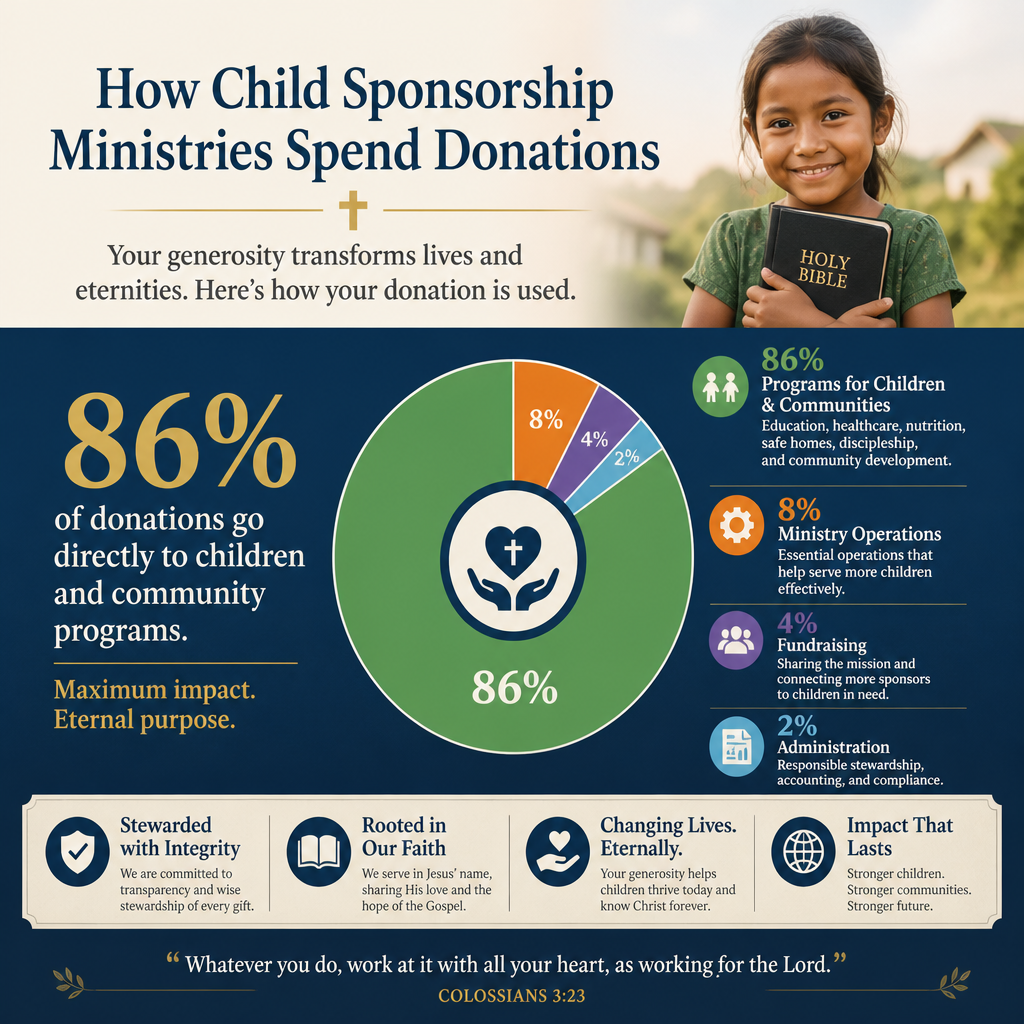
When a ministry says “most funds go to programs,” sophisticated donors should ask: What counts as program? Is international work conducted through controlled affiliates or independent partners? How are grants monitored? Are there concentration risks—one country, one partner, one revenue stream—that could disrupt the work and harm children if donor attention shifts?
Transparency is not the same as volume
Some organizations publish many photos and stories but few verifiable details. Others publish fewer stories but clear metrics, financial disclosures, and safeguarding policies. In our judgment, the second posture better aligns with biblical truthfulness. “We refuse to practice cunning or to tamper with God’s word, but by the open statement of the truth we would commend ourselves to everyone’s conscience” (2 Corinthians 4:2). Sponsorship programs that rely on emotional force rather than open statements of truth invite avoidable skepticism.
Donors who want broader context can also review how sponsorship fits within the wider landscape of Child Sponsorship Ministries, including common operating models and recurring integrity risks that mature organizations have learned to address.
Evaluate outcomes and unintended consequences, not only activity
Letters and gifts are not the same as durable change
The correspondence aspect of sponsorship can be spiritually meaningful, and it can encourage prayer. But letters are a means, not an outcome. Mature evaluation asks what has changed for children over time: educational progress, protection from abuse and exploitation, health access, family stability, and church or community capacity to sustain gains.
The research and practitioner conversation on poverty alleviation has been shaped by the “When Helping Hurts” framework articulated by Steve Corbett and Brian Fikkert, which warns that material assistance can unintentionally undermine local agency when it is not paired with healthy relationships and systems (When Helping Hurts). Sponsorship programs are not exempt from this dynamic. The higher the power imbalance between donor and recipient, the more careful the ministry must be about dignity, consent, and the messages embedded in its communications.
Red flags that should prompt specific questions
Some risks recur often enough that donors should treat them as prompts for due diligence rather than as accusations. A short list of questions can clarify whether a ministry has grown up into responsible practice:
- Does the ministry explain whether sponsorship gifts are restricted to one child, pooled for child-focused programming, or applied to broader community work?
- Are child safeguarding policies published, and are there clear reporting channels independent of local leadership?
- Does the organization provide audited financials and explain material variances year over year?
- Is there credible evidence of outcomes beyond stories, such as school completion tracking or protection metrics?
- Are local partners named and governed with clear accountability, including controls against conflicts of interest?
The aim is not to treat every ministry as suspect, but to honor the gravity of the work. Children bear the consequences of weak controls far longer than donors remember a compelling appeal.
How The Most Trusted Standard addresses sponsorship integrity
What we look for across faith, finances, governance, and effectiveness
Most Trusted exists because Christian donors deserve more than assurances. We evaluate ministries against The Most Trusted Standard, a 15-criteria framework that tests whether an organization’s public claims are supported by governance practices, financial integrity, theological seriousness, and demonstrable effectiveness.
For child sponsorship ministries, this means we examine whether the ministry’s faith commitments are more than branding, whether leadership structures prevent concentration of power, whether financial reporting is clear and independently reviewed, and whether the organization is candid about what sponsorship can and cannot promise. We also pay close attention to safeguarding and to the difference between outcomes that are measured and outcomes that are merely asserted.
Why donor questions should be specific rather than adversarial
The healthiest relationships between donors and ministries are marked by clarity and charity together. Donors can ask exact questions about fund allocation, partner accountability, and child protection without assuming ill intent. Ministries that welcome such questions often have the strongest internal cultures, because they have already learned that secrecy does not protect the mission; it erodes it.
Donors seeking a narrower view of common allocation patterns and disclosure practices may also consult How Child Sponsorship Ministries Use Donations, where the focus remains on what responsible spending tends to require in real-world operations.
FAQs for How child sponsorship ministries spend donations
Do sponsorship donations go directly to the individual child?
Sometimes a portion may take the form of direct benefits—fees paid, supplies provided, or services delivered to enrolled children. More commonly, sponsorship funds are pooled to support a defined program for sponsored children, and sometimes to strengthen the systems around them, such as schools, health access, or family support. The decisive issue is whether the ministry explains the model plainly and can show that the child genuinely benefits without misleading “direct-to-child” claims.
Is it bad if a child sponsorship ministry has significant administrative or fundraising expenses?
Not automatically. Sponsorship requires correspondence management, donor support, field oversight, safeguarding systems, and financial controls. These can be legitimate costs of responsible operations. Concern is warranted when expense patterns are paired with weak transparency, unclear program descriptions, or thin evidence of outcomes. Donors should ask for audited financials, clear allocation explanations, and evidence that spending choices prioritize child welfare and long-term effectiveness.
Giving with confidence requires clarity worthy of the gospel
Child sponsorship can be a faithful expression of Christian mercy, and it can also become a channel for avoidable confusion if ministries trade clarity for sentiment. The stronger path is sober truthfulness: clear spending models, credible controls, serious safeguarding, and outcomes that can bear scrutiny. Christian donors do not need perfect certainty, but we should insist on integrity proportionate to the dignity of the children we seek to serve.



