
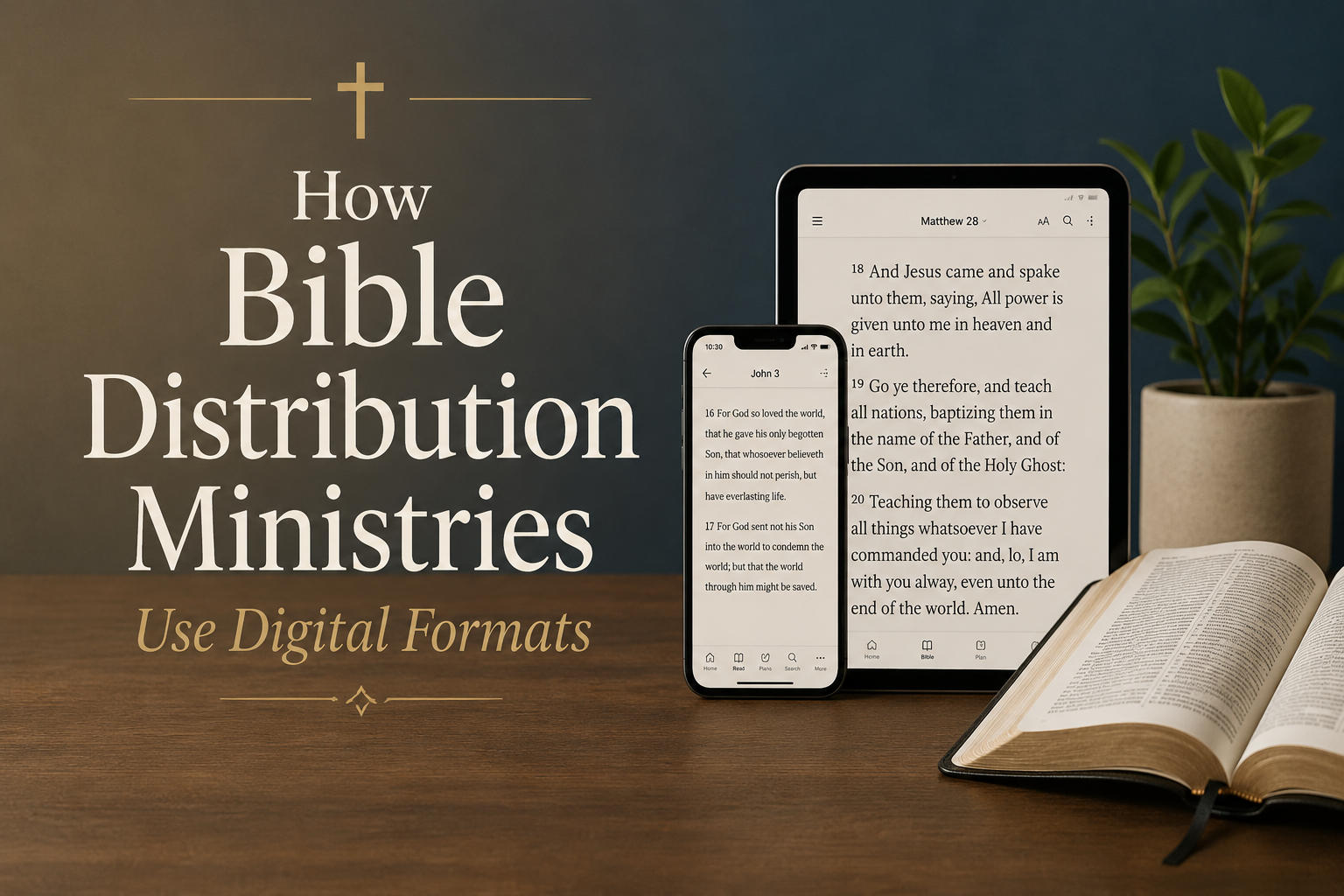
How Bible distribution ministries use digital formats has become a defining question for Christian donors who want both faithfulness and measurable reach. The opportunity is real: Scripture can travel across borders that close to print shipments, and it can reach a phone in a pocket where a printed Bible might be confiscated or stigmatizing.
The harder question is whether speed and scale can be pursued without compromising translation integrity, theological accountability, data privacy, and the local church. Digital delivery is not automatically wise or safe simply because it is modern. Donors who give as stewards have to evaluate not only what a ministry can distribute, but what it is actually delivering and at what cost.
Digital Bible distribution is not a single strategy
Formats range from simple files to full ecosystems
When donors hear “digital Bible,” many picture an app. In practice, digital distribution spans a wide spectrum: SMS verses, audio Scripture streams, offline microSD libraries, Bluetooth sharing, messaging platforms, and full-feature Bible apps with reading plans and discipleship content. Each format solves a different problem. A downloadable text file is lightweight and resilient. Audio Scripture can serve oral learners and those with limited literacy. Offline libraries matter where data is expensive or monitored.
This is also why comparisons with print distribution can become misleading. Digital is not merely “cheaper print.” Digital changes how Scripture is searched, shared, and remembered. It also changes who can alter content, how quickly updates propagate, and what data trails are created.
Access and risk vary by context
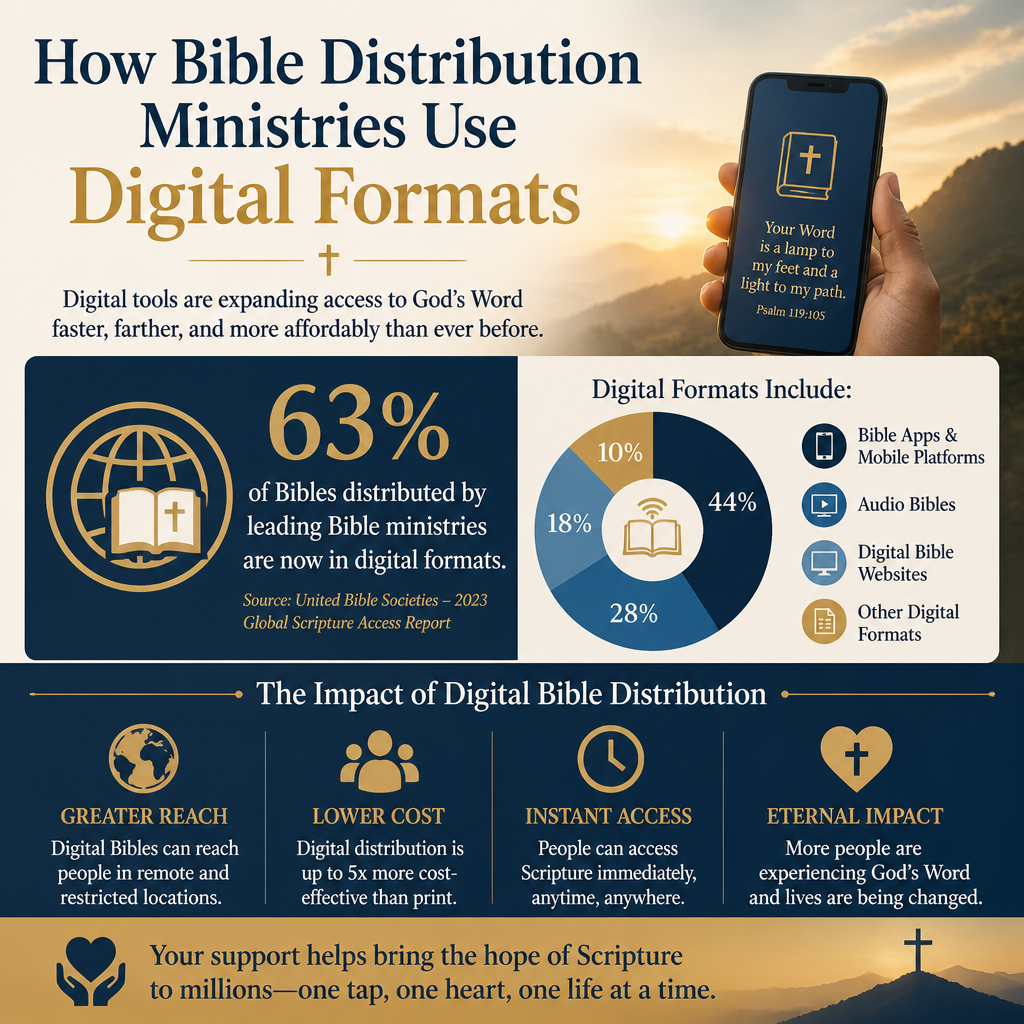
In open contexts, digital distribution can remove real friction. The majority of U.S. adults now read Scripture digitally at least some of the time, which reflects a broad normalization of Bible engagement on screens (American Bible Society). In restricted contexts, however, the same screen can be an exposure point. A phone may be searched. An app icon may be noticed. A download history may be examined. Ministries that treat digital distribution as a universal solution often underestimate the complexity of surveillance and social cost borne by local believers.
Donors should expect ministries to speak concretely about their operating environment: device prevalence, data cost, literacy rates, censorship pressures, and the local church’s role in discipling new readers. A ministry that cannot describe these factors is typically distributing content without a serious theory of ministry.
Translation integrity and doctrinal accountability still govern the work
Digital scale increases the cost of small errors
Digital distribution can spread Scripture with remarkable speed. The same speed can spread problems. A single mistaken file, a compromised update, or an ill-considered paraphrase can travel farther than a misprinted batch of books ever could. This is not merely technical; it is theological. Christians believe God’s Word is living and active (Hebrews 4:12), and therefore we treat accuracy, faithfulness, and clarity as moral obligations rather than production preferences.
Responsible ministries document what translation they are distributing, what permissions they hold, and what safeguards prevent unauthorized edits. Where content is developed in-house, donors should look for credible translation methodology, qualified linguistic oversight, and accountable doctrinal review. Christians genuinely disagree about translation philosophy, but serious ministries can explain their approach without defensiveness and without dismissing concerns.
Licensing, permissions, and partnerships shape what is possible
Many widely used translations are protected by licensing agreements that limit reproduction, offline packaging, or certain kinds of audio distribution. Digital distribution ministries frequently partner with Bible societies, publishers, and platforms to secure permissions. Some donors assume licensing is a distraction from “just getting Bibles out.” Yet licensing is one of the mechanisms that protects translation integrity and ensures long-term sustainability for the organizations that do translation work.
In our verification work at Most Trusted, we find that ministries that meet The Most Trusted Standard generally treat licensing and content provenance as part of discipleship ethics. They do not view compliance as a bureaucratic inconvenience; they view it as honoring laborers, protecting the church from confusion, and minimizing the risk of counterfeit Scripture content.
Distribution without formation can become spiritual noise
Scripture access is essential, but discipleship remains the aim
The New Testament pattern is not simply distribution; it is teaching, community, and obedience (Matthew 28:19–20). Digital formats can place Scripture in someone’s hand, but they cannot by themselves supply interpretation, pastoral care, or accountability. The best ministries treat digital distribution as a doorway into the life of the church rather than as an end point.
That conviction changes program design. Instead of measuring success only by downloads, ministries may track engagement in locally led groups, completion of structured reading plans, or connection to trusted pastors. The ministry must still be cautious about metrics. Downloads can be inflated by advertising, curiosity, or accidental installs. Time-in-app can reward distraction rather than formation. Donors should ask what the ministry believes “fruit” looks like and how it avoids confusing attention with transformation.
Digital tools can strengthen local church leadership when designed well
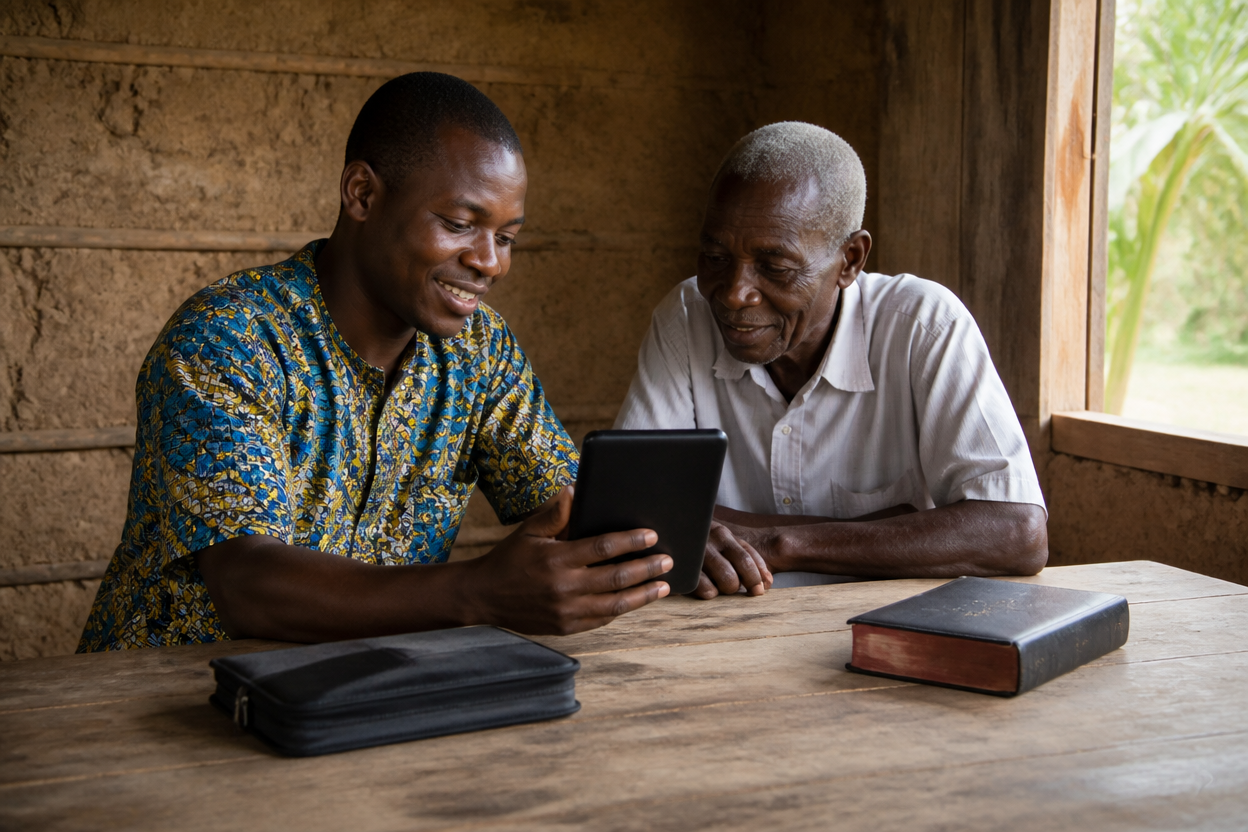
Digital distribution is often most credible when it serves local leaders: audio Bibles for village gatherings, offline libraries for pastors without formal training, or secure Scripture sharing for believers in sensitive contexts. This is where “Bible distribution ministries” often overlap with training and resourcing movements, and donors should not be surprised by that integration.
For donors who are evaluating programs across a range of approaches, it can help to see digital formats within the broader landscape of Translations, Formats, and Languages in Bible Distribution. The questions are interconnected: format choices affect accessibility, language strategy, cost, risk, and the durability of church planting and discipleship.
Digital distribution creates new stewardship and security responsibilities
Privacy and surveillance threats are not theoretical
Many ministries now operate in environments where religious content is monitored and certain forms of evangelism are criminalized. A donor’s generosity can inadvertently increase risk for local believers if a ministry collects identifiable user data, stores it insecurely, or relies on third-party ad networks that profile users.
What this means in practice is that donors should press for clarity on basic security posture: whether the ministry collects personal identifiers, how it handles location data, whether it uses end-to-end encryption in messaging contexts, and how it responds to government requests. Donors should also expect humility. Security is never perfect. The issue is whether leaders have taken sober steps to reduce exposure and whether they can explain trade-offs with candor.
Stewardship requires more than low cost per download
Digital distribution often appears inexpensive once an app exists. Yet the real costs move into other lines: cybersecurity, ongoing translation licensing, software maintenance, content moderation, and user support. Donors should be wary of simplistic “$X reaches Y people” claims when the unit being counted is not a person but a device action.
We encourage donors to ask ministries to articulate a balanced stewardship case. A short set of questions can clarify whether digital distribution is being pursued as a disciplined ministry strategy or as an unexamined growth tactic:
- What translation and permissions underpin the digital content?
- How does the ministry protect users in restricted contexts?
- What evidence shows Scripture is being read, heard, and understood?
- How is the local church involved in follow-up and discipleship?
- What ongoing costs exist for security, maintenance, and support?
Within The Most Trusted Standard, these questions touch multiple criteria at once: theological faithfulness, governance oversight of risk, financial integrity in true cost accounting, and transparency about outcomes.
What donors should look for when evaluating digital Bible distribution ministries
Evidence that programs are accountable and outcomes are intelligible
Christian donors often feel pulled between urgency and caution. The urgency is understandable. There remains substantial global need for Scripture access in languages people understand, and translation work is still unfinished. At the same time, donors have learned that compelling stories can hide weak governance, inflated reporting, or shallow impact claims.
When we evaluate ministries, we look for reporting that a thoughtful outsider can test. That includes clear definitions (what counts as a “Bible,” what counts as “reached”), a defensible methodology for engagement metrics, and an honest account of limitations. Where third-party platforms are involved, donors should expect transparency about how metrics are generated and what cannot be known.
Signals of healthy governance and ministry maturity
Digital projects can be founder-driven and technically complex, which makes governance especially important. Donors should look for boards that understand risk, approve security policies, and ask hard questions about claims. They should also look for evidence that the ministry listens to local church partners rather than forcing a product into a context because it is scalable.
For donors comparing organizations and approaches within the wider field, our coverage of Bible Distribution Ministries focuses on verifiable credibility: faith commitments stated plainly, financial reporting that matches reality, governance that restrains preventable failures, and transparency that respects both donors and beneficiaries. Mature digital distribution is rarely flashy; it is careful, accountable, and context-aware.
FAQs for How Bible distribution ministries use digital formats
Are digital Bibles replacing printed Bibles in global Bible distribution?
In most contexts, they are becoming complementary rather than purely replacing print. Digital formats can reach people quickly and discreetly, but print remains vital where devices are uncommon, literacy patterns favor print, or long-term durability without electricity matters. Donors should expect serious ministries to justify the mix they choose rather than treating digital as a universal upgrade.
What is the most responsible way to measure impact for digital Bible distribution?
Responsible measurement distinguishes access from engagement and engagement from formation. Downloads and installs can be useful operational indicators, but they are not a proxy for discipleship. Better practice combines multiple signals: sustained Scripture listening or reading, participation in locally led groups, and evidence of church connection, while remaining cautious about overclaiming outcomes that cannot be verified.
Digital distribution is a stewardship test as much as a technology choice
How Bible distribution ministries use digital formats reveals what they believe about the church, the nature of Scripture, and the responsibilities of Christian leaders. Digital tools can expand access and protect believers, or they can create shallow engagement and unnecessary risk. Donors best serve the mission when they reward ministries that can demonstrate translation integrity, thoughtful security, credible measurement, and deep partnership with local churches.



