
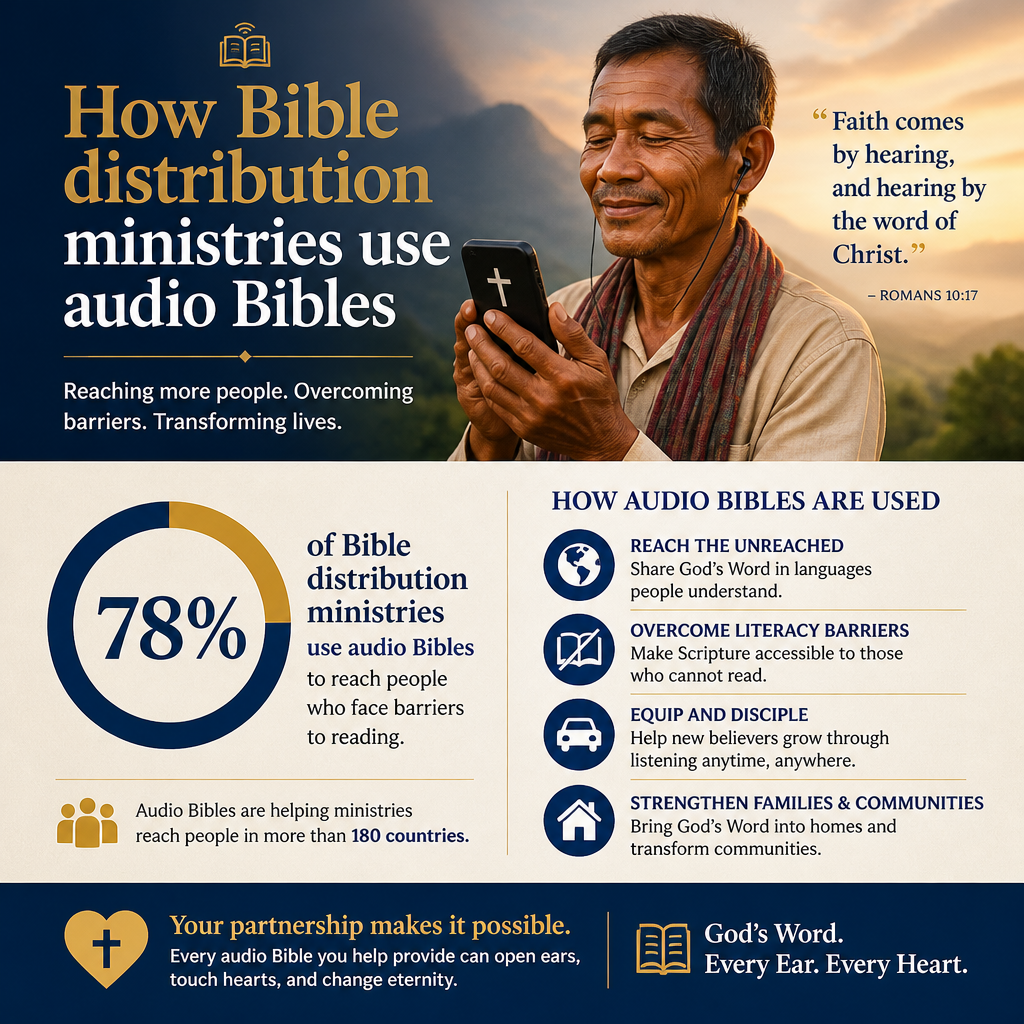
How Bible distribution ministries use audio Bibles has become a central question for donors who want both fidelity to Scripture and measurable reach. Audio Scripture is not a novelty add-on. In many contexts it is the most realistic way to place the Word of God within daily life, especially where literacy is limited, reading is culturally uncommon, or print distribution is constrained by cost and security.
Christian donors often sense both the promise and the risks. Audio can multiply access quickly, but it can also hide weak translation practices, superficial reporting, or technology-centered strategies that confuse distribution with discipleship. The ministries most worth funding treat audio as a format in service of the Church’s calling: to make disciples through the Word, not merely to move units.
Audio Bibles meet real access barriers that print cannot
Oral cultures and limited literacy change the distribution equation
Many Bible distribution strategies implicitly assume print literacy and private reading time. In reality, large portions of the world operate primarily through oral communication, communal listening, and story-based memory. Where adult literacy is limited, audio Scripture is often the first format that a new believer, a family, or an entire village can consistently receive and share.
The global literacy picture remains uneven, and donors should not assume that “a Bible in every home” means “a Bible read in every home.” UNESCO continues to report hundreds of millions of adults with low literacy worldwide, a reality that directly affects how Scripture can be accessed and retained (UNESCO). For ministries serving such contexts, audio is frequently a pastoral accommodation rather than a technological preference.
Mobility, displacement, and security constraints also favor audio
Audio Scripture can travel where print is difficult: among migrant workers, in refugee settings, and in regions where visible Christian materials create immediate risk. For some recipients, an audio device kept among ordinary belongings is safer than a printed Bible with a conspicuous cover. In other settings, the constraint is not persecution but logistics—rain, humidity, and transport challenges that destroy paper quickly.
These realities do not eliminate the need for print; they clarify why many ministries now distribute multiple formats in parallel. Serious programs think in terms of access pathways—how a person actually receives Scripture over months and years—rather than assuming one delivery mode solves every barrier.
Audio distribution is a ministry system, not a gadget
Devices, apps, and broadcasting each create different pastoral outcomes
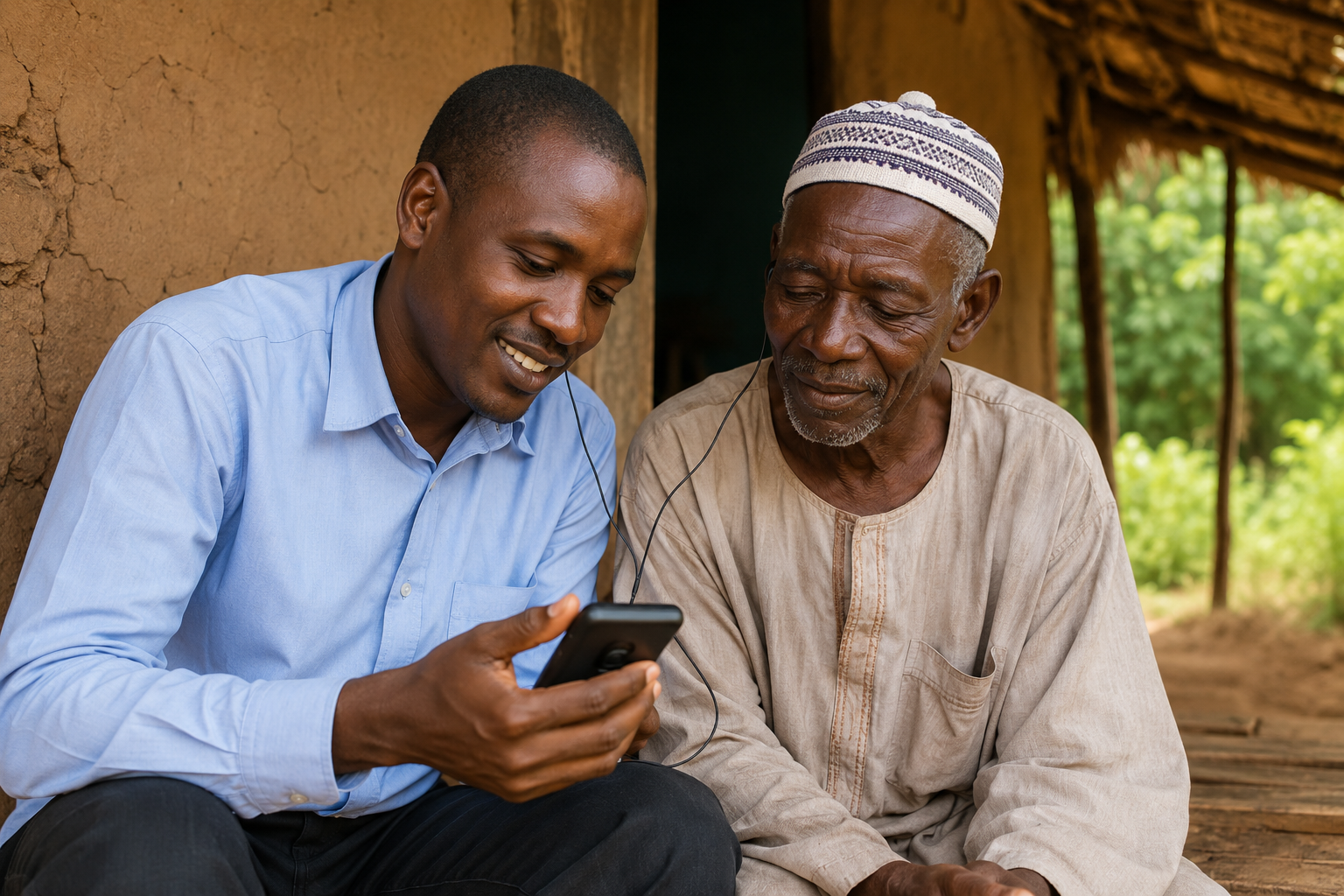
“Audio Bible” can mean several distinct channels, and each carries different assumptions about how Scripture will be heard. Dedicated audio devices can be shared in community and function without cellular networks. Smartphone apps can scale rapidly where data access is reliable. Radio broadcasting can reach large audiences but often with limited follow-up unless local churches are integrated.
Donors should ask ministries to name their channel and its underlying theory of change. A program built around solar-powered listening groups is structurally different from a program distributing SD cards or promoting an app. Neither is automatically superior; the question is whether the channel fits the local environment and whether it is paired with accountable spiritual care.
Scripture engagement requires design, not wishful thinking
Audio distribution ministries have learned that placing Scripture in a community does not automatically produce comprehension or sustained engagement. Listening is shaped by attention span, noise levels, family dynamics, and the perceived authority of the narrator. Programs that bear long-term fruit often include basic listening plans, facilitated group discussion, and simple tools for recall and obedience.
In many contexts, listening in groups is not a second-best substitute for private reading; it is how learning works. Ministries that respect this do not treat community listening as a marketing tactic. They treat it as a discipleship environment, often in partnership with local pastors and elders.
Translation integrity and theological oversight matter more with audio
Audio increases the power of a single translation decision
Because audio can spread quickly and widely, errors in translation or doctrinal ambiguity can scale with it. A donor’s first responsibility is not to fund the fastest distribution but to fund distribution that is faithful. The historic Christian conviction is that God’s Word is to be handled with reverence, clarity, and accountability. That applies as much to recorded narration as it does to printed text.
Christians genuinely disagree about some translation philosophies—formal equivalence versus functional equivalence, for example. But there is far less disagreement about the need for qualified translation teams, transparent review processes, and clear doctrinal commitments. The most credible Bible translation efforts describe their methodology and governance publicly, including how they manage community testing, consultant checks, and theological review.
Voice, narration, and dramatization can clarify or distort
Audio adds interpretive layers. Choices about pacing, emotion, character voices, and musical elements can aid understanding, but they can also tilt meaning. In highly dramatized recordings, the line between Scripture and performance can blur for new listeners, especially where biblical literacy is thin.
For donors, the practical question is whether the ministry treats narration as an extension of translation integrity. Responsible ministries can articulate why they chose a specific voice approach, how they ensure Scripture remains central, and how they avoid conflating commentary with the text itself. This is also where partnering with local church leaders is indispensable: local pastors can quickly identify whether a recording lands as Scripture or as entertainment.
What donor-grade accountability looks like for audio Bible programs
Distribution counts are easy to report and easy to misuse
Audio programs can generate impressive numbers: devices delivered, downloads, listening hours. Those metrics are not meaningless, but they are also easier to inflate than outcomes like sustained Scripture engagement, local church integration, or disciple-making fruit. Mature donors should expect ministries to distinguish between outputs and outcomes, and to speak candidly about attribution limits.
When we assess ministries against The Most Trusted Standard, we look for evidence that reporting practices are anchored in verifiable definitions and transparent methods. A credible ministry explains what counts as a “distribution,” what follow-up occurred, and what data are self-reported versus independently observed. This is particularly important when programs operate through complex partner networks where counting can become optimistic by default.
Strong programs show their work across governance, finances, and results
Audio Bible distribution also raises ordinary stewardship questions: device procurement, shipping, loss rates, local partner selection, and ongoing support costs. The ministries that inspire confidence do not hide those complexities behind uplifting stories. They publish financial statements, clarify restricted versus unrestricted funding, and explain how they evaluate partners and manage risk.
Donors can also expect clear policies on content safeguarding, especially when devices include additional teaching. The issue is not merely theological alignment; it is transparency. When a ministry distributes an audio device, it effectively curates a small theological library. Donors have a legitimate interest in knowing what is on the device and why.
- Clear definitions for “distributed,” “reached,” and “engaged,” with consistent reporting over time
- Documented translation and review processes, including who holds final authority on doctrinal questions
- Partner vetting that names selection criteria and accountability practices
- Financial transparency on device costs, shipping, replacement, and local training
- Evidence of church integration, showing how listening connects to congregational life and discipleship
How to evaluate an audio Bible ministry before you fund it
Ask questions that reveal whether the ministry serves the Church
Audio Scripture can be distributed in ways that strengthen local churches or in ways that bypass them. Because Scripture is entrusted to the people of God, donors should resist models that treat the Church as a downstream afterthought. Healthy ministries describe how local leaders are trained, how listening groups are facilitated, and how new hearers are connected to worshipping communities.
It is also reasonable to ask whether a ministry’s approach reflects a coherent theology of discipleship. Matthew’s Great Commission is not merely a command to disseminate information but to teach obedience to all Christ commanded (Matthew 28:18–20). The donor question is whether the ministry’s strategy plausibly moves from hearing to understanding to embodied faithfulness.
Use independent verification to reduce blind spots
Even experienced donors can struggle to compare ministries that use different methods and report different metrics. This is one reason Most Trusted exists. Our work is to help donors give with confidence by evaluating Christian nonprofits against The Most Trusted Standard, with attention to faith commitments, financial integrity, governance practices, and transparent evidence of effectiveness.
For donors building a portfolio of Bible access giving, it is wise to keep the broader landscape in view. Many of the most consequential questions—translation governance, partner accountability, and measurement integrity—show up across Bible Distribution Ministries, not only in audio programs. Likewise, the practical trade-offs among print, digital, and oral strategies are best understood within Translations, Formats, and Languages in Bible Distribution, where format decisions are considered as ministry decisions rather than technology trends.
FAQs for How Bible distribution ministries use audio Bibles
Are audio Bibles mainly for people who cannot read?
No. Audio Bibles often serve communities with limited literacy, but they also serve oral learners, busy workers, older adults losing eyesight, and congregations where Scripture is received primarily through communal listening. In many contexts, audio complements print by reinforcing memory and enabling family or group engagement where private reading is less common.
What should donors ask to ensure an audio Bible program is theologically responsible?
Donors should ask what translation is used, how that translation was reviewed, who holds doctrinal authority, and how the audio narration was produced and vetted. It is also prudent to ask what other content is included on devices or in apps, and whether local church leaders have meaningful oversight in how the material is introduced and used.
Audio can extend Scripture access with integrity when it is governed well
Audio Scripture can be one of the most pastorally appropriate forms of Bible access when it is designed for real listening conditions and anchored in accountable translation practices. For donors, the decisive issue is not whether the ministry uses technology, but whether it can demonstrate faithful stewardship: transparent governance, credible reporting, and a clear commitment to serving the Church’s long work of disciple-making through the Word.



