

Donor communication practices in Bible study ministries are not a cosmetic concern. They are a spiritual and fiduciary discipline: the ministry is handling funds entrusted for the work of the Word, and donors are trying to give as stewards rather than as consumers. When communication is thin, defensive, or performative, it rarely stays a marketing problem. It becomes a trust problem, and trust is a form of moral capital that is difficult to rebuild once squandered.
Scripture treats speech as weighty. Jesus warns that “on the day of judgment people will give account for every careless word they speak” (Matthew 12:36). Paul insists that “we have renounced disgraceful, underhanded ways” and refuse “to practice cunning or to tamper with God’s word” (2 Corinthians 4:2). Bible study ministries occupy a particularly sensitive space: they trade in the teaching of Scripture, and donors expect that the ministry’s communication carries the same seriousness as its teaching.
Why communication in Bible study ministries is a stewardship issue
Donors are not buying a product
Christian donors are not purchasing inspiration. They are participating, however indirectly, in the ministry of the Word. That participation carries obligations on both sides. Donors should give freely and without coercion; ministries should speak truthfully, honorably, and with clarity about what funds accomplish and what remains unresolved.
The New Testament repeatedly ties integrity to the handling of resources. When Paul organized a collection for suffering believers, he was careful to avoid even the appearance of mismanagement: “we take this course so that no one should blame us about this generous gift… for we aim at what is honorable not only in the Lord’s sight but also in the sight of man” (2 Corinthians 8:20–21). Donor communication is one of the primary ways a modern ministry “aims at what is honorable… in the sight of man.”
Bible engagement outcomes are real and difficult to measure
Many Bible study ministries do not have outcomes that fit neatly into dashboards. Spiritual growth is not reducible to a key performance indicator, and Christians genuinely disagree about how much outcome measurement is appropriate for discipleship work. Yet the difficulty of measurement is not a license for vagueness. It is a call for honesty about what is known, what is inferred, and what is hoped for.
The most credible communications we see avoid inflated certainty. They describe activity with precision, name limitations without embarrassment, and then connect the work to theological aims that are recognizably biblical: teaching sound doctrine, equipping saints, strengthening perseverance, and fostering obedience rooted in grace.

What disciplined donor communication includes and what it avoids
Four commitments donors should be able to recognize
Across our verification work at Most Trusted, the ministries that meet The Most Trusted Standard tend to communicate in ways that can be tested. They do not ask donors to substitute sentiment for evidence. They build confidence through consistent patterns over time.
Donors should expect communication that includes:
- Clarity about purpose: what the ministry is trying to accomplish in Bible engagement, and for whom.
- Specificity about activities: what was actually produced or delivered, in what languages, formats, and channels.
- Financial coherence: a plausible connection between gifts received and costs incurred, without theatrical “overhead” rhetoric.
- Integrity about results: what changed, what is uncertain, and what the ministry is doing in response.
- Consistency in tone: communication that reflects the character of Christian ministry rather than the urgency of fundraising cycles.
Common distortions that corrode trust
Some breakdowns in donor communication are unintentional. Under-resourced teams default to generic updates because they lack systems. Others are theological: a ministry may treat fundraising as a necessary evil, separating “spiritual work” from “money talk.” The result is often an unhealthy bifurcation where donors are managed rather than discipled.
Donors should be cautious when communication leans heavily on urgency without proportionate transparency: constant crisis appeals, ambiguous “God is doing something new” language untethered from concrete plans, or spiritualized pressure that implies hesitation is disobedience. Scripture commends generosity, but it does not sanctify manipulation.
Transparency with spiritual seriousness
Reporting that respects the nature of discipleship
The field has had to reckon with a real tension: donors want tangible evidence, while spiritual formation often unfolds slowly and invisibly. Mature reporting does not resolve this by pretending discipleship is easily quantified. It resolves it by distinguishing between outputs (what was delivered), reach (who engaged), and learning (what the ministry is discovering about effectiveness).
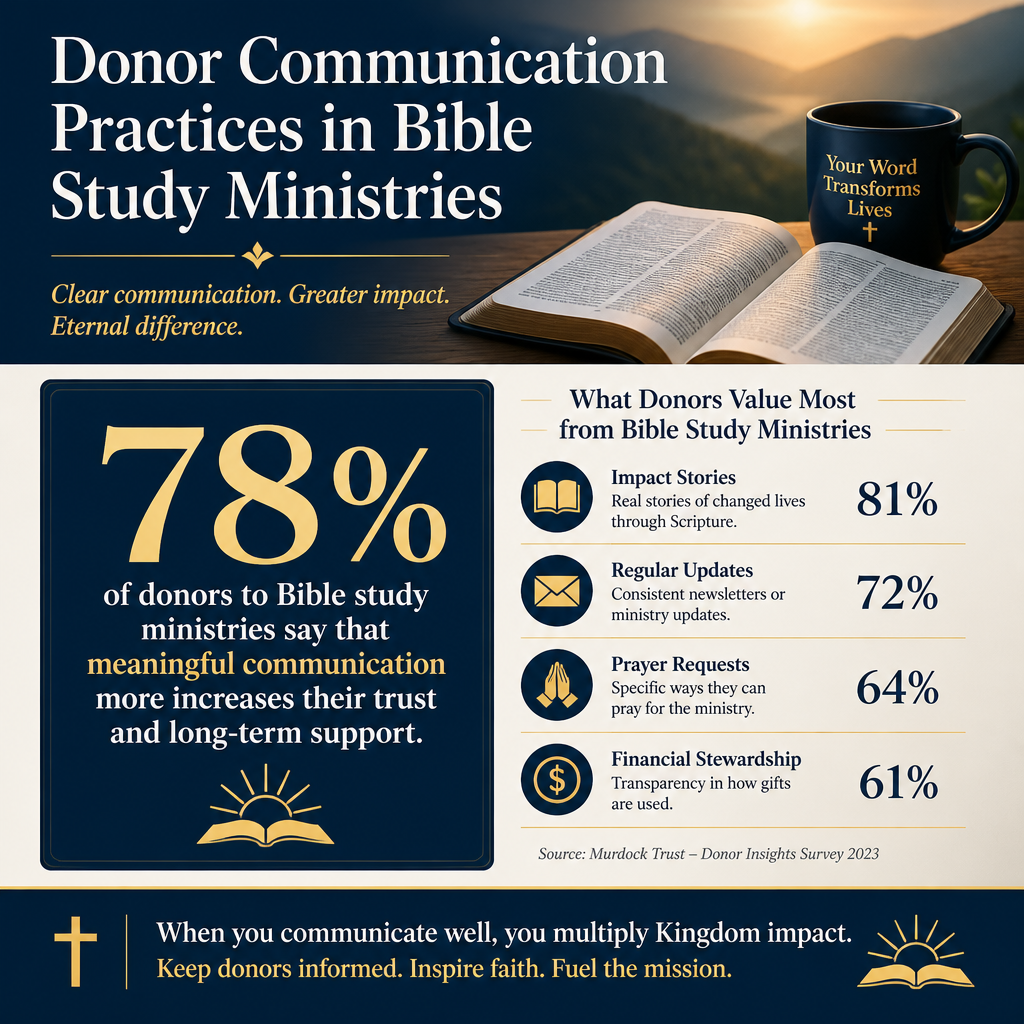
For example, a Bible study ministry can report outputs with confidence: curriculum produced, cohorts launched, facilitators trained, translations completed, digital lessons published. It can report reach with appropriate caveats: attendance, completion rates, geographic distribution, church partnerships. It can report learning with humility: where participants struggled, what content needed revision, what training gaps were identified.
Avoiding the tyranny of simplistic metrics
There is a temptation to anchor donor confidence to a single number: total participants, number of “decisions,” or content downloads. Numbers have their place, but they can become a substitute for theological discernment. A large mailing list is not the same as faithful Bible engagement. A download is not the same as understanding. Even attendance can mask disengagement.
Some ministries rely on external research to frame the stakes of biblical engagement; donors should welcome this when it is used carefully. For example, the American Bible Society’s State of the Bible research has tracked shifts in Scripture engagement over time, providing a backdrop for why some ministries emphasize first-time engagement or re-engagement among disengaged adults (American Bible Society).
How donors can evaluate communication without becoming cynical
Trust but verify as a Christian discipline
Christian giving is not suspicion dressed up as prudence. It is love governed by wisdom. The proverb is direct: “The simple believes everything, but the prudent gives thought to his steps” (Proverbs 14:15). Donors can ask careful questions without treating ministries as adversaries.
When reviewing donor communication from Bible study ministries, we recommend looking for alignment with the ministry’s public materials and governing documents, not merely the warmth of its storytelling. Mature donors often begin by understanding the broader landscape of Bible Study and Engagement Ministries and how a given organization positions itself theologically and operationally within that field.
Signals that communication is connected to governance and integrity
Strong communication is usually downstream from strong governance. Boards that review dashboards, risk, and budget variance tend to produce ministries that can speak plainly to donors. Ministries that treat communication as a fundraising function detached from leadership often drift into inconsistency: shifting priorities, unclear use-of-funds language, and reports that feel curated rather than accountable.
Independent standards can help donors maintain clarity. Most Trusted evaluates ministries against The Most Trusted Standard, a 15-criteria framework covering faith foundation, financial integrity, governance and leadership, and transparency and effectiveness. The point is not to replace discernment with a badge. It is to give donors a disciplined way to ask whether a ministry’s communication is supported by verifiable practice.
Practices that strengthen long term donor relationships in Bible engagement
Communication rhythms that honor donors and staff
Some ministries communicate frequently and still leave donors uneasy because the content is thin. Others communicate less often but with substance. Frequency is not the virtue; fidelity is. A thoughtful rhythm often includes a small number of high-quality touchpoints that donors can anticipate: an annual report grounded in audited financials when applicable, periodic ministry field updates, and a clear pathway for donors who want deeper information.
The harder question is whether the ministry can speak with the same integrity when circumstances are difficult. When a program underperforms, when a leader departs, when a budget tightens, credible ministries do not disappear. They communicate with restraint and truth, and they show donors the steps being taken.
Segmenting communication without fragmenting truth
Segmentation is often necessary. A first-time donor and a long-term major partner do not need identical detail. Yet the underlying story must remain consistent. Ministries compromise trust when they tell one audience an aspirational narrative and another audience the operational reality. Donors sense this quickly, especially those who have served in churches and have lived inside institutional constraints.
For donors who want to go deeper in this specific domain, a careful review of Donor Engagement in Bible Study and Engagement Ministries can clarify what healthy relationship-building looks like without turning donors into fundraising targets.
FAQs for Donor communication practices in Bible study ministries
What should a Bible study ministry report if spiritual growth is hard to measure?
It should report what it can know with integrity: concrete outputs, credible reach indicators with appropriate caveats, and what the ministry is learning about effectiveness. Donors should not demand false precision, but they can reasonably expect a ministry to distinguish between verified facts, informed estimates, and theological hopes.
Is it unspiritual to ask for financial clarity from a Bible study ministry?
No. Paul took pains to administer funds honorably “in the sight of man” as well as before the Lord (2 Corinthians 8:21). Asking how resources are governed and deployed is consistent with Christian stewardship, especially when the answers are sought in a posture of charity rather than accusation.
Communication that serves both the gospel and the donor
Donor communication practices in Bible study ministries should deepen confidence without manufacturing certainty. They should treat donors as partners in stewardship, not as a revenue source to be managed. The ministries most worthy of sustained support typically communicate with a recognizably Christian integrity: truthful speech, proportionate claims, and transparent accountability, anchored in the conviction that the Word of God does not need exaggeration to accomplish its work.



