

The question of big names vs. small ministries is not primarily a question of brand; it is a question of stewardship. Christian donors are not choosing between two marketing styles. We are deciding where the Lord’s resources—entrusted to us for a time—will be deployed for the good of neighbors, the strength of the Church, and the spread of the gospel.
Scripture gives no sentimental exemption from scrutiny. Jesus commends costly generosity and also condemns religious performance that devours the vulnerable. Paul celebrates sacrificial giving and also insists on careful administration “to avoid any criticism of the way we administer this liberal gift” (2 Corinthians 8:20). The mature Christian instinct is therefore twofold: give freely, and verify faithfully.
Big, established ministries and smaller, less-known works can each be faithful, effective, and worthy. They can also each drift—toward bureaucracy and distance on the large side, or toward unaccountable charisma and fragility on the small side. The harder question is not “Which size is better?” but “Which ministry can we trust to carry weight over time?”
Size is not a proxy for faithfulness
Some donors prefer big ministries because scale can mean reach: national media, sophisticated operations, and infrastructure that can endure leadership transitions. Other donors prefer small ministries because proximity can mean clarity: the founders are known, the work is tangible, and the overhead feels limited. Both instincts contain wisdom, and both can become simplistic.
Scripture does not treat “small” as automatically pure or “large” as automatically compromised. The early church held both local particularity and wider coordination together—collections for famine relief, apostolic oversight, and letters circulating among congregations. Maturity resists the reflex to canonize a size category.
Across our verification work at Most Trusted, we observe that ministries tend to become more vulnerable at the moments when growth outpaces governance. A small organization can multiply programs before it builds independent board leadership. A large organization can professionalize functions while slowly losing spiritual and missional clarity. In both cases, the donor’s responsibility is the same: to look beyond the visible work to the ministry’s underlying integrity.

The real trade-offs in large ministries
Large ministries often carry expectations that smaller works do not. They attract public scrutiny, complex revenue streams, and higher reputational risk. They also tend to have more formal controls—audits, policies, and compliance systems—because they must. The presence of controls, however, is not the same thing as trustworthy leadership.
Scale can clarify impact, or obscure it
Large ministries are often better positioned to measure outputs and sometimes outcomes across multiple sites. They may employ evaluation staff and publish annual reports. Yet scale can also produce reporting that is polished without being candid. Donors should distinguish between “activity at volume” and “mission with demonstrated fruit.” The question is not whether the ministry can tell a compelling story, but whether it can tell a truthful one.
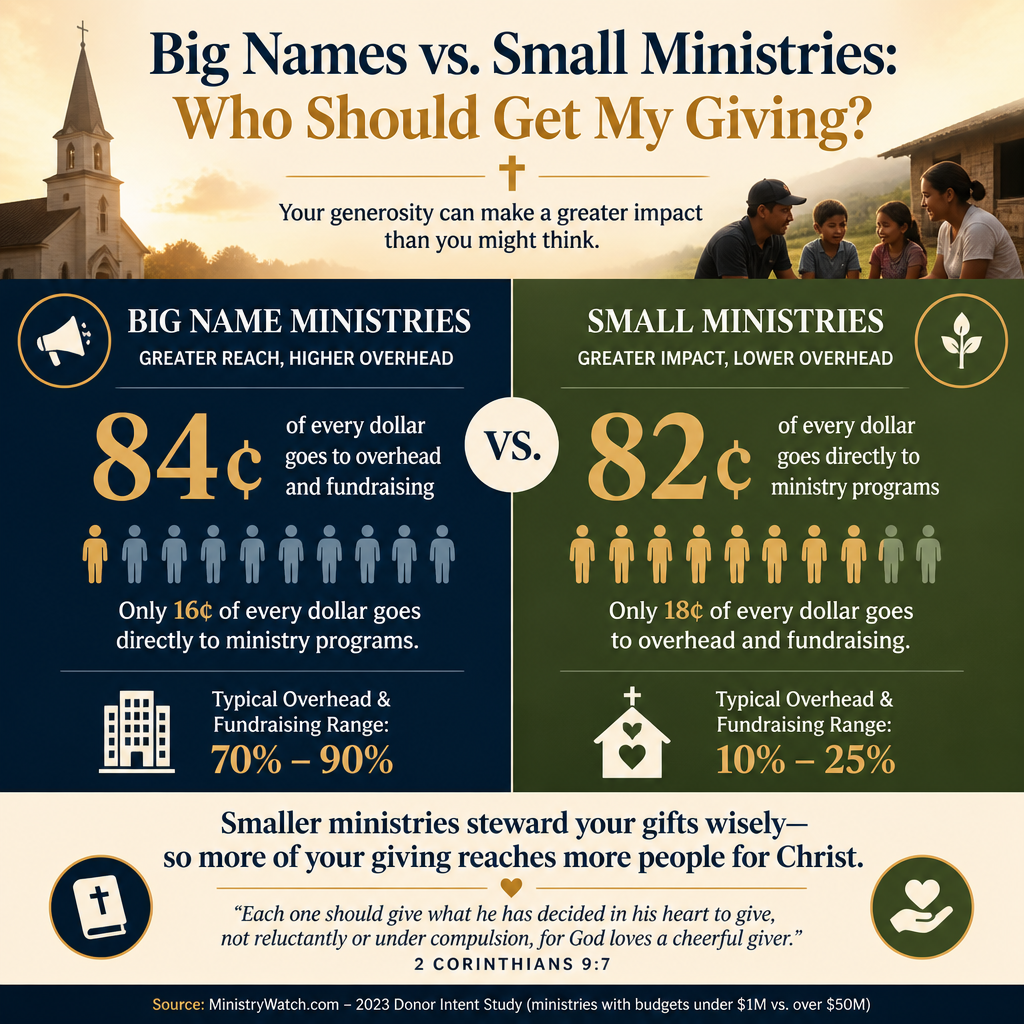
The nonprofit field has also had to reckon with the “overhead” fixation that pressures organizations to underinvest in administration, evaluation, and internal controls. A widely cited sector statement—often called the Overhead Myth—was issued jointly by GuideStar, Charity Navigator, and the BBB Wise Giving Alliance to correct the idea that low overhead is a reliable indicator of excellence GuideStar.
Brand strength can protect donors, or protect the brand
Well-known ministries can be more responsive to public accountability. When questions arise, they are often forced to answer them. At the same time, brand strength can create a subtle temptation: to manage perception rather than pursue repentance and repair. A sophisticated donor watches for the difference.
What this means in practice is that donors should look for evidence of independent governance, clear conflict-of-interest boundaries, and transparent reporting that includes hard information, not only testimonials. In the language of 2 Corinthians 8, the ministry should be eager to do what is right “in the eyes of the Lord” and also “in the eyes of man.”
Big systems can reduce risk, or distribute responsibility until nobody owns it
Large ministries may have stronger financial controls, whistleblower channels, and HR systems. They may also struggle with “diffused ownership,” where leaders are distant from frontline realities and problems are passed between departments. Donors should not confuse organizational complexity with competence. Competence is demonstrated when leaders can name problems, own them, and correct them.
The real trade-offs in small ministries
Smaller ministries often have something large ministries struggle to preserve: closeness to the work. Donors can see the community, meet leaders, and understand the program quickly. This can be spiritually and emotionally compelling, and it can be a gift. It can also create risk, especially when closeness substitutes for governance.
Proximity can deepen trust, or bypass verification
Small ministries frequently develop through relationships: a pastor’s friendship, a missions committee’s long-term partnership, or a donor’s personal encounter with need. Relationship is a Christian good. But Scripture also warns against partiality and untested confidence. A mature donor practices relational warmth with institutional clarity: friendship does not replace documentation, and admiration does not replace accountability.
Founder energy can build ministry, or centralize power
Many faithful ministries begin with a founder who carries vision, sacrifice, and entrepreneurial courage. That strength can become a liability when the founder’s authority is not bounded by independent oversight. Donors should pay attention to board independence, related-party transactions, and whether the organization can endure beyond one personality.
In our verification work, one recurring vulnerability is the “ministry-as-family-business” pattern: spouses or relatives in key roles without transparent compensation practices, vague decision-making, and boards composed primarily of friends. These structures are not automatically corrupt, but they often struggle to provide the kind of accountability that protects both donors and leaders from temptation.
Small budgets can be efficient, or brittle
Small ministries can operate with admirable frugality. Yet chronic underfunding can drive instability: delayed payroll, weak controls, poor documentation, and dependence on a few donors. Christian donors sometimes equate financial strain with spiritual authenticity. Scripture does not. Faithfulness includes wise management of resources, and wise management includes building enough capacity to handle money transparently and programs responsibly.
How mature donors decide where to give
Christians genuinely disagree about the best balance between funding proven scale and funding emerging works. There is no single “biblical portfolio.” But Scripture does give categories for wise judgment: character, accountability, truthful speech, and fruit consistent with repentance and love.
For many donors, the most faithful approach is not “either/or” but “both/and” under clear standards. A stable, verified ministry may be a long-term anchor. A smaller ministry may be funded as a convictional partnership with appropriately higher scrutiny and more defined expectations.
Start with mission clarity and theological integrity
Before asking whether a ministry is large or small, ask whether it is clear. What is the ministry’s stated purpose? What doctrine guides its work? How does it describe the gospel, the Church, and the authority of Scripture? A ministry can perform admirable humanitarian work and still be confused about the faith it claims to represent. Donors should expect theological seriousness that matches the ministry’s public claims.
Jesus’ warning about wolves in sheep’s clothing is not a counsel toward cynicism; it is a call to discernment. Discernment begins with what a ministry teaches and embodies, not with its production quality.
Ask governance questions that do not depend on size
Healthy governance looks surprisingly similar across budgets. Donors should be able to answer basic questions:
- Who governs this ministry? Is there an active board with real authority, or is governance functionally symbolic?
- Is the board independent? Are members free from conflicts of interest, and willing to evaluate leadership honestly?
- Is leadership succession considered? Is there a plan beyond the current founder or CEO?
These questions matter because sin is not size-dependent. Temptation does not wait for a ministry to become large. Structures exist because Christians are realistic about the human heart.
Follow the money with respect and seriousness
Christian donors should resist two equal errors: assuming low administrative cost proves virtue, or assuming high administrative cost proves professionalism. The question is whether the ministry’s financial practices are transparent, consistent, and honestly governed.
Some practices that merit attention include: audited financial statements when appropriate to size and complexity; a clear compensation-setting process for key leaders; policies on related-party transactions; and financial reporting that is understandable to non-specialists. Donors should also watch for fundraising language that trades on urgency without clarity. Scripture commends generosity that is eager, not manipulated.
Using The Most Trusted Standard to evaluate big and small ministries
Most Trusted exists because donors should not have to choose between cynicism and naivete. The Most Trusted Standard is a 15-criteria framework designed to evaluate ministries in a way that respects both spiritual reality and operational reality—across Faith Foundation, Financial Integrity, Governance and Leadership, and Transparency and Effectiveness.
What this means for the “big names vs. small ministries” question is that we do not begin with size; we begin with verifiable evidence. A large ministry can meet high standards of governance and still be unclear about outcomes. A small ministry can be spiritually compelling and still lack basic financial controls. The Standard helps donors ask consistent questions in both cases.
Across our verification work, ministries that meet The Most Trusted Standard tend to demonstrate a particular combination: clarity about their Christian identity, credible financial practices, governance that is more than a formality, and a willingness to disclose information that a prudent donor would reasonably request. That willingness to be examined is not a public-relations gesture. It is a moral posture.
Donors sometimes assume that small ministries cannot be evaluated with rigor. In reality, the expectations should be proportional, not absent. A small ministry may not have a national audit firm, but it can still provide clean financial statements, board minutes, conflict-of-interest disclosures, and clear reporting on what funds actually accomplish. A large ministry may publish glossy reports, but donors should still ask whether disclosures are complete, whether governance is independent, and whether the organization is forthright when results are mixed.
Paul’s collection for Jerusalem was accompanied by careful administration and trusted delegates. That was not a concession to worldly suspicion. It was Christian stewardship practiced in daylight.
FAQs for Big Names vs. Small Ministries: Who Should Get My Giving?
Is it safer to give to a large, well-known Christian ministry?
It can be safer in some respects, especially if the ministry has mature controls, independent governance, and transparent reporting. But visibility is not the same as trustworthiness. Some large ministries have suffered public failures precisely because brand strength delayed hard questions. Safety is best evaluated through governance, financial integrity, and truthful transparency, not name recognition.
Should we avoid small ministries because they lack infrastructure?
No. Many small ministries are faithful and effective, and some forms of ministry depend on local presence that never becomes large. The appropriate posture is proportional scrutiny. Donors should expect clear documentation, accountable leadership, and honest reporting even at modest scale, while recognizing that the formality of systems may differ from large organizations.
How should we think about overhead when comparing big and small organizations?
Overhead ratios can be misleading and are not a reliable proxy for impact or integrity. Sector leaders have explicitly warned donors against using overhead as the primary indicator of nonprofit performance GuideStar. Christian donors should instead examine whether spending aligns with mission, whether controls are adequate, and whether reporting is transparent and intelligible.
Is it wise to split giving between a major ministry and a local or smaller work?
Often, yes. Many donors find it faithful to support both: a proven ministry with durable capacity and a smaller ministry with proximate, relational work. The key is to apply consistent standards to both. The goal is not equal distribution by size, but responsible stewardship shaped by mission clarity, integrity, and verifiable fruit.
Giving that honors both conviction and accountability
Big names and small ministries each present distinct temptations and distinct strengths. The Christian donor’s task is not to reward scale or romanticize scarcity, but to give in a way that reflects the character of God: generous, truthful, and just.
When donors ask better questions, ministries are strengthened. The Church is protected from scandal and disillusionment. And those served by Christian compassion are less likely to bear the cost of our assumptions. This is why we evaluate ministries against The Most Trusted Standard: not to replace trust with suspicion, but to place trust where it can rightly bear weight.



