
What tax forms Christian donors need for gifts
What tax forms Christian donors need for gifts is not an administrative afterthought; it is part of faithful stewardship. The same Scripture that calls us to give “not reluctantly or under compulsion” (2 Corinthians 9:7) also commends honesty and order, including in the way we report and substantiate our generosity. The modern tax code can […]
How do Christian donors maximize charitable deductions
How do Christian donors maximize charitable deductions without turning generosity into a tax tactic? The question matters because Scripture treats money as spiritual formation, not a neutral tool, and yet tax law is one of the ordinary structures through which Christians can fund long-term faithfulness. Wise planning does not replace cheerful giving; it removes avoidable […]
What non-cash gifts Christian donors can consider
What non-cash gifts Christian donors can consider is not a peripheral stewardship question; it is often the difference between giving that merely feels generous and giving that is measurably wise. For many believers, non-cash giving is also the clearest way to align the whole of one’s estate, assets, and vocation with the Kingdom of God […]
How Christian donations affect capital gains taxes
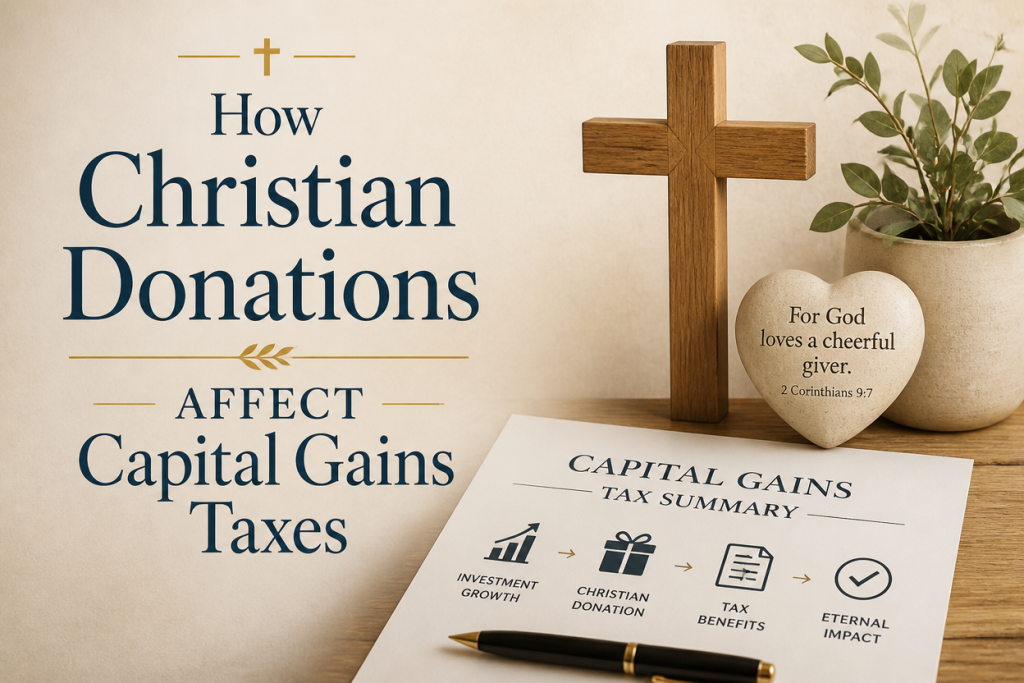
How Christian donations affect capital gains taxes is often the difference between writing a check out of cash flow and giving from abundance that has quietly accumulated. For donors holding appreciated assets, the tax code can either penalize generosity through unnecessary capital gains, or encourage it when giving is structured with care. The moral question […]
How stock gifts work through Christian stewardship services
How stock gifts work through Christian stewardship services is ultimately a question of discipleship under real financial complexity. Appreciated securities can become a disciplined way to give more, reduce tax friction, and support ministries without selling the asset first. For many Christian donors, the challenge is not whether stock gifts are permissible, but whether they […]
How Christian donors value non-cash charitable gifts

How Christian donors value non-cash charitable gifts is ultimately a question of stewardship, not merely tax strategy. The church has long understood that generosity includes more than cash, because Scripture presents wealth as a trust to be managed before God, not simply a balance to be spent. Non-cash giving can be a mature expression of […]
How Christian donors give stock to ministries

How Christian donors give stock to ministries is usually presented as a tax tactic. That framing is incomplete. For Christians who want giving to be both generous and wise, donating appreciated securities is a way to convert God’s provision into ministry impact without incurring avoidable friction for either the donor or the ministry. The question […]
How Christian donors give real estate to ministries

How Christian donors give real estate to ministries is rarely a simple transfer of property. Real estate is often a family asset, a tax-sensitive asset, and a spiritually weighty asset all at once. Many donors arrive with a clear desire to support kingdom work, yet also with understandable questions: Will the ministry handle this responsibly, […]
How Christian donors give from an IRA
How Christian donors give from an IRA is not primarily a technical question, even though it involves tax rules, custodians, and deadline-driven paperwork. It is a stewardship question: how to release resources God has entrusted to us in a way that is wise, lawful, and genuinely aimed at love of neighbor and the advance of […]
Why Christian donors create giving mission statements

Why Christian donors create giving mission statements is not a trend toward self-branding. It is a sober response to the moral weight of stewardship, where money becomes a form of discipleship and giving becomes a spiritual practice that can either clarify or confuse a household’s loyalties. Many donors already feel the pressure: a constant stream […]