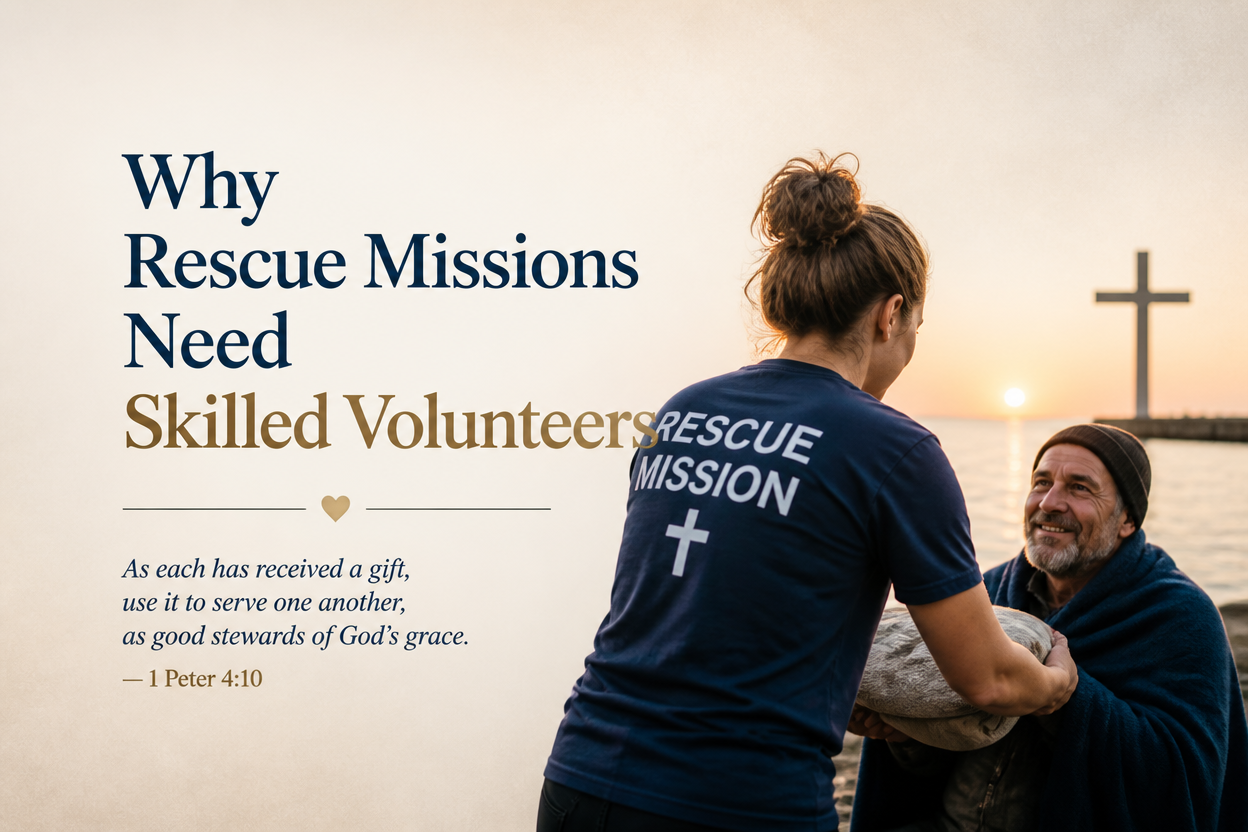
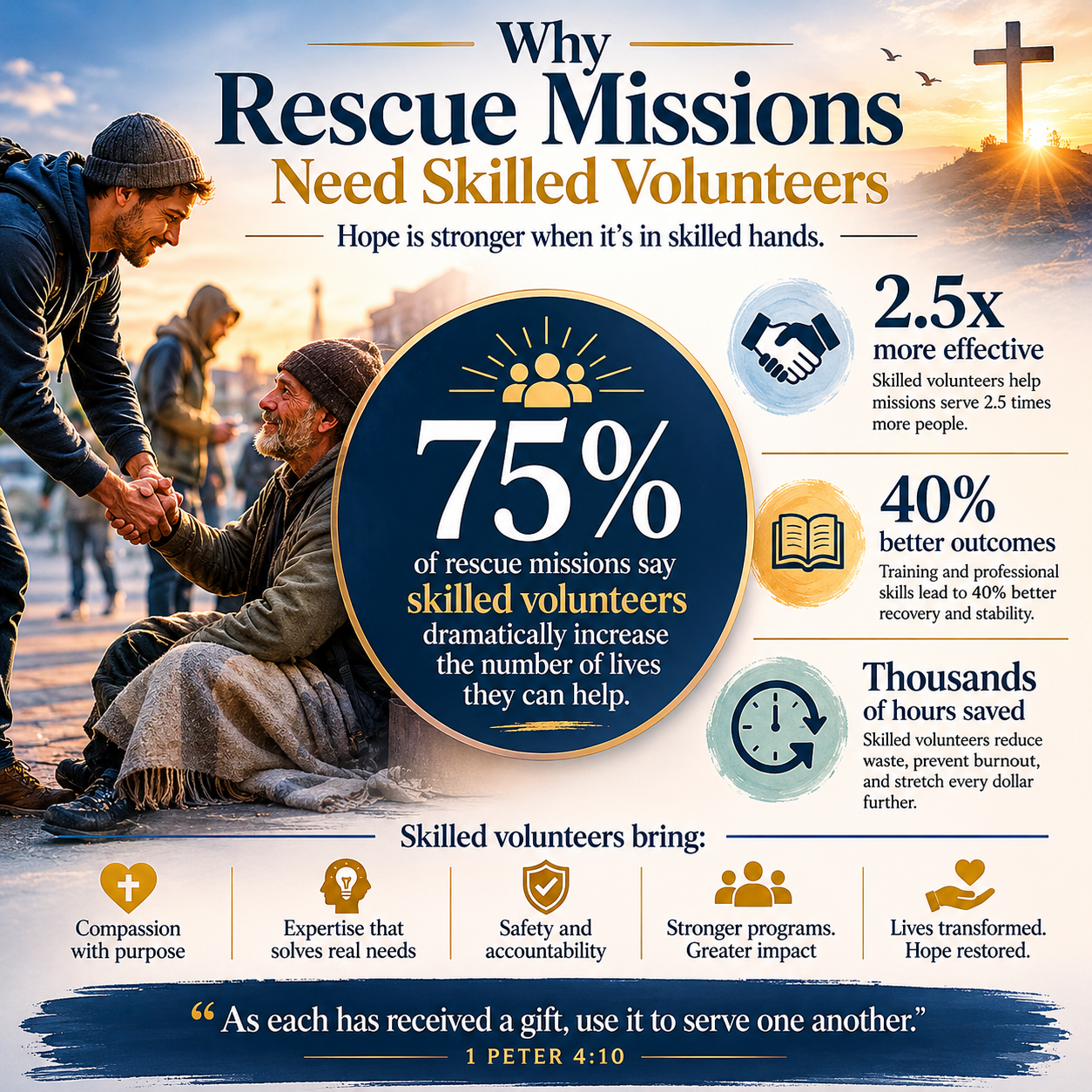
Why rescue missions need skilled volunteers is not a sentimental question. It is a stewardship question. When a mission receives men and women who have endured years of homelessness, addiction, domestic violence, incarceration, or untreated mental illness, the difference between good intentions and competent care is rarely theoretical.
Christian donors often give because Scripture leaves little ambiguity about mercy. Isaiah condemns fasting that ignores the oppressed, and Jesus places feeding the hungry and welcoming the stranger among the marks of true discipleship (Isaiah 58; Matthew 25). The harder question is how mercy is practiced when the needs are complex, safety risks are real, and spiritual care must be integrated with professional competence rather than substituted for it.
Skilled volunteers protect dignity and reduce preventable harm
Trauma is common, and it shapes what help actually feels like
Many guests who arrive at rescue missions have a trauma history, whether it is childhood abuse, street violence, or the chronic stress of unsheltered life. Trauma changes the nervous system’s threat response; it can make ordinary interactions feel unsafe. A volunteer who understands trauma-informed principles is less likely to escalate conflict, shame a guest unintentionally, or confuse compliance with healing.
We do not need to medicalize homelessness to acknowledge reality. The U.S. Department of Housing and Urban Development’s annual Point-in-Time count shows that homelessness includes both sheltered and unsheltered populations across every region of the country, with significant numbers experiencing chronic homelessness year after year. That persistence indicates that quick fixes are not the norm, and that many missions are serving people with layered barriers that require more than a meal line and a bed for the night. HUD
Safety and accountability are part of Christian love
Love of neighbor does not eliminate the need for boundaries; it clarifies why they matter. Skilled volunteers support missions in maintaining safe environments for guests, staff, and other volunteers. That includes appropriate de-escalation, mandated reporting awareness where applicable, and adherence to child protection and vulnerable adult policies. The church has learned, often painfully, that negligence in safeguarding damages the very people ministries claim to serve.
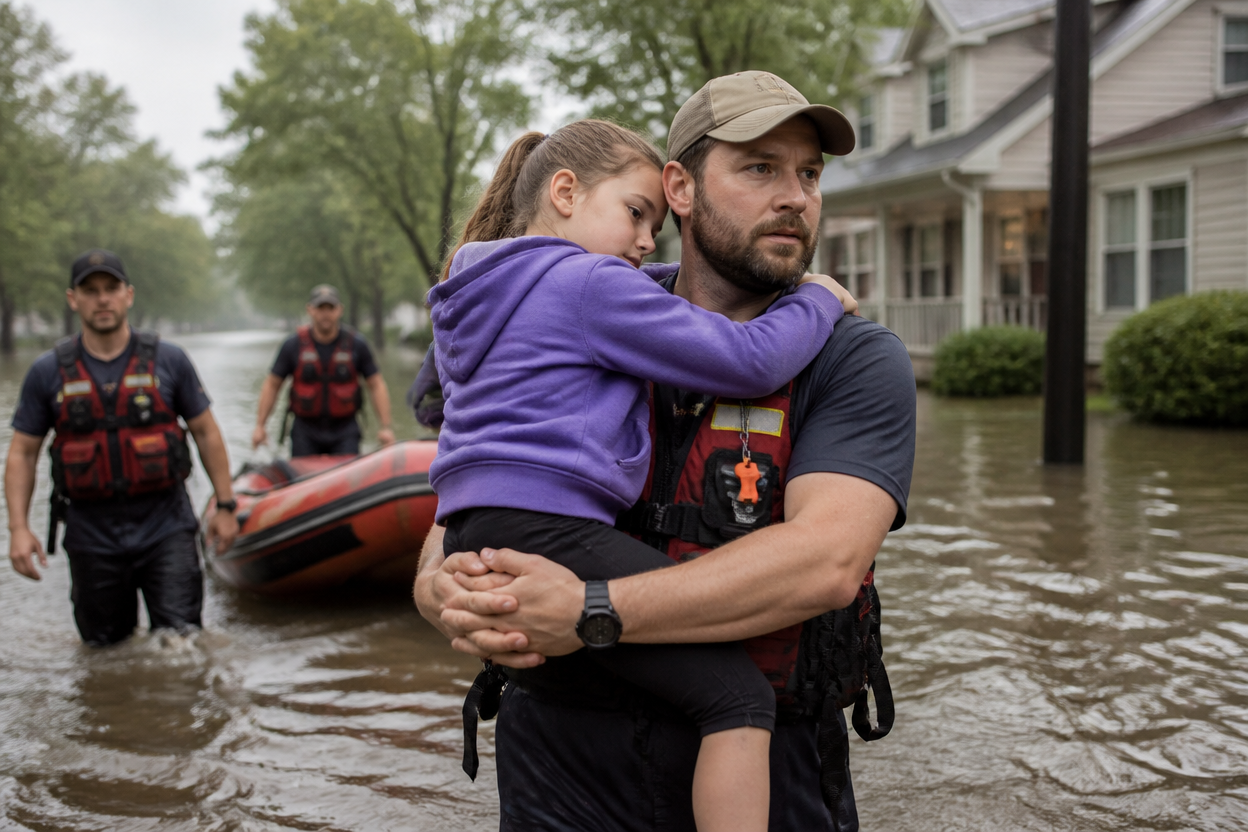
Rescue missions are ministries and human-service organizations at the same time
Spiritual care is strengthened, not threatened, by competence
Christian donors sometimes worry that professionalization will dilute gospel proclamation. The wiser concern is the opposite: when missions mishandle counseling, recovery support, or case management, the message of Christ is implicated. Scripture binds truth to integrity; the New Testament repeatedly warns against bringing reproach on the name of Christ through disorderly conduct or exploitation.
What this means in practice is that missions often need volunteers with concrete skills: licensed counseling and clinical supervision where appropriate, substance-use recovery coaching, job readiness training, budgeting instruction, legal aid, medical triage, and data management. Each can be done in a distinctly Christian way without pretending that spiritual language can replace specialized training.
The complexity donors rarely see sits behind the front door
A mission may serve a man who needs an ID to work, stable medication management to function, recovery support to remain sober, and a safe place to sleep while he rebuilds. Another guest may need help navigating protective orders and childcare while seeking housing. A third may resist help altogether because years of instability have taught her to distrust systems. These are not abstractions. They are the daily realities that determine whether a ministry’s compassion becomes a pathway to restoration or a revolving door.
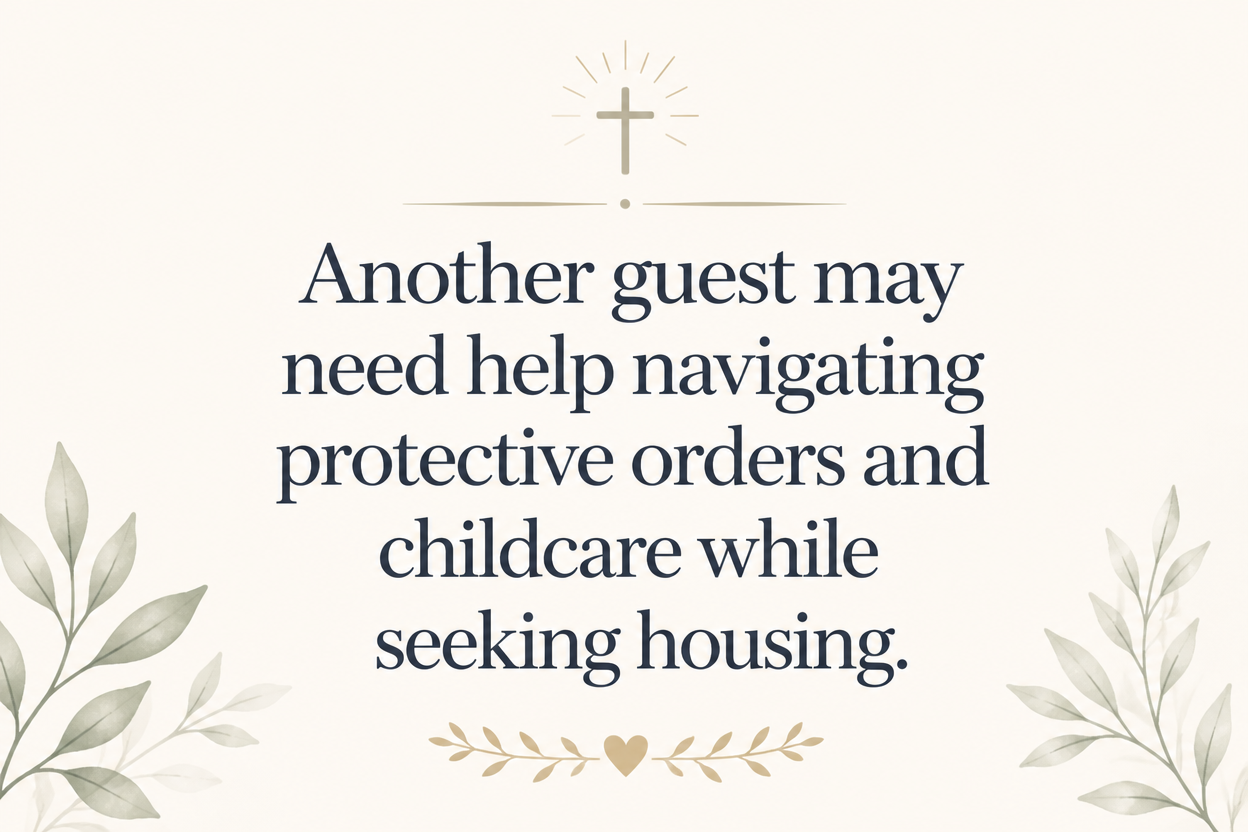
When volunteers are unskilled, missions pay the cost in burnout and churn
Staff capacity is finite, and untrained help can create more work
Many missions operate with thin staffing. When volunteers require constant supervision, disregard procedures, or bring their own agenda, staff time is diverted from direct care. Over time, this undermines the ministry’s ability to deliver consistent programming and weakens morale. The donor may still see full holiday meal events, but the mission quietly loses the stability needed for long-term outcomes.
The broader nonprofit sector has wrestled with this dynamic for years. One reason the “overhead” debate became so corrosive is that it pressured organizations to underinvest in training, systems, and accountability—precisely the infrastructure that protects people and improves results. The joint letter commonly referred to as the Overhead Myth, published by leaders at GuideStar, BBB Wise Giving Alliance, and Charity Navigator, argued that simplistic overhead ratios distort what effectiveness actually requires. Candid GuideStar
Short-term enthusiasm must be paired with durable commitments
Rescue missions depend on the steady work of ordinary faithfulness: intake at odd hours, consistent mentoring, patient paperwork, repeated reminders, and long conversations that do not end with immediate visible change. Christians genuinely disagree about the best program models—especially around harm reduction, sobriety requirements, and the sequencing of spiritual instruction—but most agree that relationships matter. Relationships, however, require continuity. Skilled volunteers are often the ones most willing to submit to a mission’s cadence and keep showing up when the work becomes less inspiring.
Skilled volunteers make programs effective, not just well attended
Housing and employment pathways require technical expertise
Donors often ask whether missions “get people off the streets.” The question is fair, and it points toward the need for expertise in housing navigation, employer partnerships, and documentation. Public systems can be difficult to access without guidance. Volunteers who understand local housing authorities, disability applications, credit repair, and workforce pipelines can accelerate progress that would otherwise take months.
The underlying national shortage of affordable housing also shapes what missions can accomplish. When rents rise faster than wages in many communities, even motivated guests can struggle to stabilize. The U.S. Government Accountability Office has reported on structural drivers of homelessness, including housing affordability pressures. That context does not excuse poor ministry practice, but it does warn against simplistic promises and demands a disciplined approach to casework. U.S. GAO
Recovery and discipleship benefit from trained mentors
Many missions blend recovery programming with spiritual formation. That integration can be deeply faithful when it respects what addiction is and how change happens. Skilled volunteers who understand relapse dynamics, co-occurring disorders, and appropriate referral practices are better prepared to walk with guests without either harshness or enabling. They also help protect missions from becoming informal counseling centers without the safeguards that counseling requires.
Across our verification work at Most Trusted, we observe that the ministries most prepared for sustained fruitfulness treat volunteer training as a form of discipleship in itself. They train volunteers to listen, to keep confidences appropriately, to honor boundaries, and to coordinate with staff rather than acting independently. Those disciplines are not bureaucratic; they are expressions of love ordered by wisdom.
Donors can strengthen missions by funding and expecting volunteer formation
What mature donor support looks like
Donors influence not only what missions can afford, but what they feel permitted to prioritize. If donors implicitly reward only visible services—meals served, nights of shelter, holiday events—missions will struggle to allocate time and funding for training, supervision, and evaluation. If donors ask better questions, missions gain room to build competence.
We recommend donors support rescue missions that can articulate how volunteers are screened, trained, and supervised, and how guest safety is protected. In many cases, the most strategic gift is not restricted to a single event but strengthens the underlying capacity that makes programs dependable. For donors seeking a broader view of the field, Rescue Missions and Homeless Outreach is a helpful starting point for comparing ministry models and the theological convictions that shape them.
Practical questions donors can ask without becoming adversarial
Serious oversight does not require cynicism. It requires clarity. The following questions tend to surface whether a mission treats skilled volunteering as essential or optional:
- How are volunteers screened, and what disqualifies an applicant from serving with vulnerable guests?
- What training is required before a volunteer has direct contact with guests, and how often is training renewed?
- How does the mission handle confidentiality, mandated reporting, and safeguarding for children and vulnerable adults?
- Who supervises volunteers in high-risk environments, and how are incidents documented and reviewed?
- How does the mission measure progress for guests beyond participation counts?
Most missions welcome these questions when asked respectfully, because they signal long-term partnership rather than short-term sentiment. Donors who want to understand volunteer roles more specifically can also review Volunteering in Homeless Outreach Ministries, where we track how responsibilities differ across shelters, street outreach, recovery programs, and transitional housing.
Most Trusted’s role is to help donors give with confidence by evaluating ministries against The Most Trusted Standard, a 15-criteria framework that examines faith foundation, financial integrity, governance and leadership, and transparency and effectiveness. Strong volunteer systems typically correlate with strength in these areas: clear leadership accountability, documented policies, realistic program claims, and an evident commitment to protect those the ministry serves.
FAQs for Why rescue missions need skilled volunteers
Are skilled volunteers only professionals with licenses and degrees?
No. Many of the most important skills are learned through training and supervision: trauma-aware communication, de-escalation, boundaries, confidentiality practices, and disciplined consistency. Licensed professionals are essential for certain functions, but missions also need trained lay volunteers who understand the ministry’s policies and can serve within defined roles.
Should donors prioritize funding staff instead of volunteer programs?
Often the right answer is both. Staff provide continuity and clinical or operational expertise; volunteers extend relational presence and practical capacity. Donors can look for ministries that fund competent supervision and training for volunteers rather than treating volunteer labor as free and therefore unmanaged.
Skilled service is part of faithful mercy
Rescue missions will always rely on compassion, hospitality, and prayer. But the biblical call to mercy never invites carelessness. When donors and missions treat skilled volunteering as a serious form of Christian service—trained, supervised, and accountable—guests are more likely to experience safety, dignity, and the steady conditions in which repentance, recovery, and restoration can take root.