
What training homeless outreach volunteers need is not primarily a question of good intentions. It is a question of whether a church or ministry is prepared to meet vulnerable neighbors with competence, spiritual maturity, and safeguards that reduce harm. Donors often ask for “more volunteers,” but in homeless outreach, the more urgent need is often better-formed volunteers—people equipped for trauma, boundaries, and the practical realities of street engagement.
Scripture is unsentimental about mercy. Jesus names feeding the hungry and welcoming the stranger as marks of fidelity (Matthew 25). Yet Proverbs also commends prudence, and the New Testament repeatedly requires accountable leadership in the household of faith. Effective outreach holds both together: compassion that moves toward suffering, and structures that protect the dignity of those served and the integrity of those who serve.
Training begins with a theology of dignity and a sober view of poverty
Imago Dei is not a slogan in street ministry
Homeless outreach volunteers must be trained to see each person first as a bearer of God’s image, not as a problem to be managed or a project to complete. That sounds basic, but it changes how volunteers speak, where they stand, what they assume, and what they promise. It also corrects a subtle donor-driven temptation: to treat visible need as a stage for generosity rather than a neighbor to be honored.
In practice, this means teaching volunteers to ask permission before offering prayer, to avoid public storytelling that exposes personal details, and to treat “no” as a meaningful answer rather than resistance to overcome. The ministries that meet The Most Trusted Standard tend to train for dignity explicitly, because dignity is the first protection against both paternalism and exploitation.
The field has had to reckon with how helping can harm
Christians genuinely disagree about the best models for street outreach—whether to prioritize immediate relief or to restrict material aid to encourage program participation. The disagreement often turns on competing goods: meeting urgent needs today versus avoiding patterns that keep someone from longer-term stabilization. Serious volunteer training names this tension rather than pretending it does not exist.
The When Helping Hurts framework, articulated by Steve Corbett and Brian Fikkert, has shaped many ministries’ volunteer formation by distinguishing relief, rehabilitation, and development and warning against “helping” that unintentionally reinforces dependency or shame Moody Publishers. Even leaders who differ with some applications of the framework generally agree with its core insistence: good motives are not enough; humility and local wisdom are required.

Safety, boundaries, and legal compliance are ministry essentials
Street outreach is not a low-risk volunteer environment
Volunteers need training in situational awareness, de-escalation basics, and team protocols. Many donors assume that the primary risk is to the volunteer. In reality, risk runs in both directions: untrained volunteers can also create danger for guests through poor boundaries, inconsistent promises, or triggering interactions. A ministry’s credibility is measured partly by whether it treats safety as a stewardship issue rather than as a public-relations concern.
What this means in practice is straightforward: no one serves alone; outreach routes and check-ins are documented; volunteers are trained to disengage rather than argue; and leadership is clear about when to call for medical help or law enforcement. The U.S. Department of Health and Human Services notes that people experiencing homelessness have higher rates of serious mental illness and substance use disorders than the general population, which increases the likelihood of complex encounters in public settings HHS.
Policies should be visible to volunteers and enforceable
Appropriate training includes the ministry’s policies on confidentiality, mandated reporting where applicable, photography and social media, transportation of guests, and cash handling. Donors should not assume these safeguards exist. A responsible ministry can articulate them plainly, reinforce them regularly, and remove volunteers who will not comply.
Across our verification work at Most Trusted, we find that ministries with strong governance tend to treat volunteer training as an extension of their broader accountability practices: clear lines of authority, documented procedures, and consistent enforcement. That alignment matters because informal ministries can drift into informal risk.
Trauma-informed formation and basic mental health literacy
Trauma changes how people interpret help
Many people living unsheltered have histories of trauma—childhood abuse, domestic violence, incarceration, or repeated losses. Volunteers do not need to become clinicians, but they do need a working understanding of how trauma can shape trust, memory, emotional regulation, and interpersonal conflict. Without that formation, a volunteer may interpret survival behaviors as personal disrespect, and the interaction deteriorates.
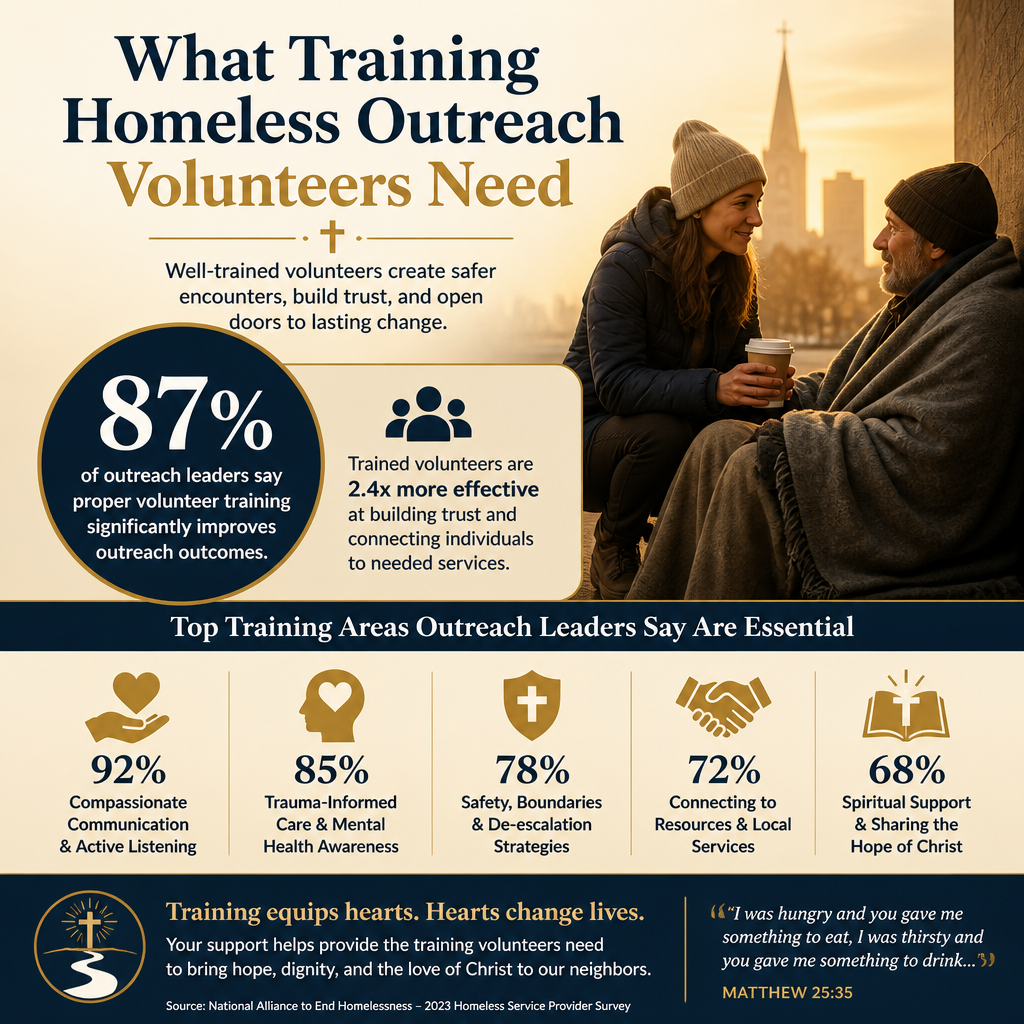
Training should cover common trauma responses, appropriate tone and body language, and the discipline of not pressing for personal stories. It should also address spiritual dynamics carefully. Some volunteers are eager to “speak truth,” but trauma-affected people often need patient presence, clear boundaries, and prayer offered without coercion. Christian witness is compromised when it is delivered as pressure.
Harm reduction and recovery pathways require clarity
Substance use is one of the most contested areas in homeless outreach. Some ministries emphasize abstinence expectations for program participation. Others incorporate harm-reduction practices to keep people alive and connected until they are ready for treatment. Volunteers need to understand the ministry’s approach and the theological and practical reasoning behind it.
For donors, the question is not whether a ministry uses the vocabulary of “harm reduction” or “recovery,” but whether its approach is coherent, supervised, and connected to real pathways: detox referrals, treatment partnerships, case management, and follow-up. SAMHSA’s treatment locator is one practical tool many outreach programs use to identify appropriate care options in a given area SAMHSA.
Practical skills that protect both guests and programs
Volunteers must know what they can and cannot promise
Few volunteer mistakes do more damage than making promises the ministry cannot keep. “We will get you housing” or “We will cover that bill” may be offered out of compassion, but they create false hope and can provoke anger toward staff when the promise collapses. Training should give volunteers approved language: what the ministry can do today, what it may be able to do later, and what it cannot do at all.
Volunteers also need a clear referral map. Street ministry is often the front door, not the full solution. Effective programs train volunteers to connect guests to coordinated entry systems, shelters, medical clinics, and legal aid, with an understanding that referral outcomes may be slow and uncertain.
A short list of core competencies is a sign of seriousness
Well-run ministries can typically articulate a small set of skills they expect every outreach volunteer to demonstrate before independent service. A concise set also helps donors evaluate whether the ministry treats volunteer involvement as formation rather than as free labor.
- Respectful engagement that preserves dignity and avoids coercion
- Boundary discipline with money, transportation, and personal contact information
- Basic de-escalation and knowing when to disengage
- Accurate documentation and handoff to staff when needed
- Understanding the ministry’s referral pathways and eligibility limits
Many donors care, rightly, about measurable outcomes. But in homelessness work, volunteer competence is an upstream driver of outcomes. A ministry that cannot train volunteers consistently is rarely positioned to deliver consistent results.
What donors should look for in volunteer training and oversight
Training reveals what a ministry believes about accountability
Donors often evaluate homeless outreach ministries by visible outputs: meals served, nights of shelter, or street contacts. Those measures matter, but they are incomplete. A ministry’s volunteer training is one of the clearest windows into its internal discipline—how it manages risk, truthfulness, and spiritual integrity when few outsiders are watching.
We recommend asking specific questions: How long is training? Is there a supervised probation period? Who has authority to remove a volunteer? How are incidents documented and reviewed? How often is training refreshed? Ministries that answer these questions clearly are usually the same ministries that treat finances, governance, and reporting with similar clarity.
Verification helps donors separate earnest ministry from mature ministry
Donors should not have to guess whether a ministry has durable safeguards. Most Trusted exists to help donors give with confidence by evaluating Christian nonprofits against The Most Trusted Standard, a 15-criteria framework spanning Faith Foundation, Financial Integrity, Governance and Leadership, and Transparency and Effectiveness. Volunteer training touches multiple criteria at once because it is where theology, leadership, and operational integrity meet on the ground.
For donors supporting the broader ecosystem of outreach, it is also worth understanding how ministries fit within Rescue Missions and Homeless Outreach. Some organizations are built to mobilize large volunteer teams for immediate relief. Others focus on residential programs, employment readiness, or clinical partnerships. Each model requires different training depth, and donors can fund accordingly.
Many supporters are also deciding where their personal time fits alongside their financial giving. For those exploring that dimension, Volunteering in Homeless Outreach Ministries is often where the practical questions sharpen: what roles are appropriate for volunteers, which require licensed staff, and how churches can partner without creating parallel systems.
FAQs for What training homeless outreach volunteers need
Should homeless outreach volunteers be required to share the gospel in every interaction?
Christian outreach should never be ashamed of the gospel, but training should distinguish between faithful witness and coerced interaction. Many street encounters are brief, emotionally charged, or complicated by trauma or intoxication. Ministries that serve well typically train volunteers to offer prayer and spiritual conversation with clarity and consent, and to avoid making assistance contingent on participation. This approach protects the integrity of Christian witness and the dignity of the person being served.
Is it better for donors to fund professional staff rather than volunteer-driven outreach?
Both can be appropriate, and the best ministries often combine them. Professional staff are essential for case management, clinical partnerships, and consistent program oversight. Volunteers can extend relational presence, provide practical support, and strengthen church-community ties when they are well trained and supervised. Donors should prioritize ministries that can demonstrate clear role definitions, documented training, and accountable leadership rather than assuming that “volunteer-led” is either inherently virtuous or inherently risky.
A mature outreach ministry treats volunteer training as discipleship and stewardship
The training homeless outreach volunteers need is ultimately about more than competence. It is about forming servants who can enter another person’s suffering without taking control, making promises they cannot keep, or confusing momentary relief with lasting restoration. Donors strengthen the work when they fund ministries that train carefully, supervise closely, and tell the truth about what it takes to serve well in public spaces where vulnerability is visible and outcomes are rarely tidy.



