When should volunteers avoid direct street outreach alone? Whenever the situation places the volunteer, the person being served, or the ministry’s public witness at unnecessary risk. Street outreach can be a faithful expression of Matthew 25 mercy, but Christian compassion is not permission to ignore prudence, policy, or the realities of trauma, addiction, and mental illness that many neighbors on the street are navigating.
For Christian donors, this is not an abstract safety debate. The question touches governance, duty of care, and the credibility of a ministry’s discipleship in public. A ministry can be earnest and still be negligent. Sound street outreach refuses the false choice between courage and caution, because love of neighbor includes love expressed through wise boundaries.
Street outreach is not only a spiritual act but a duty of care
Two responsibilities exist at the same time
Direct street outreach often happens at the intersection of evangelism, crisis response, and social service. Volunteers may encounter acute psychosis, active substance use, domestic violence dynamics, or exploitation. A volunteer also brings vulnerabilities: inexperience, physical limitations, prior trauma, or a well-intentioned tendency to promise more help than the ministry can actually provide. Sending someone alone can multiply those risks.
Scripture commends bold mercy, but it also assumes sober-minded leadership. “Be wise as serpents and innocent as doves” (Matthew 10:16) is not a clever slogan; it is a governance principle in the field. Christian ministries have a moral obligation to structure compassion so that it does not become reckless endangerment.
Donors should treat safety practices as a transparency question
Across our verification work at Most Trusted, we observe that the ministries with mature outreach practices document safety protocols, train volunteers in de-escalation and referral, and create accountability through supervision and incident reporting. These are not merely operational details. They signal whether leadership understands that “good intentions” do not substitute for competent care.
Where policies are missing or ignored, the outcomes can include volunteer harm, client harm, and legal exposure that can cripple a ministry’s long-term service. For donors, the prudent question is not whether the ministry loves the homeless; it is whether that love is governed well.

When volunteers should not go alone
Situations with predictable escalation risk
Street outreach is not uniformly dangerous, but certain conditions reliably raise the likelihood of escalation, misunderstanding, or harm. Volunteers should avoid direct street outreach alone when any of the following are present:
- After dark or in low-visibility settings, including encampments with limited exits or unclear lines of sight.
- When approaching an isolated individual in a secluded location, such as behind buildings, in alleyways, or inside abandoned structures.
- When substance intoxication or active withdrawal appears likely, especially when speech, coordination, or affect suggests impairment.
- When severe mental health symptoms are evident, including paranoia, delusions, or agitation that makes communication unstable.
- When there is any indication of coercion or trafficking, such as a controlling companion, debt references, or fear-driven silence.
These are not moral judgments about people experiencing homelessness. They are reality-based risk cues that any responsible ministry should name plainly. The Christian posture is dignity without naivete.
When the volunteer lacks training, supervision, or clear limits
Even in relatively calm settings, going alone is unwise when the volunteer is new, untrained, or unclear on what the ministry can and cannot provide. A single volunteer can be pressured into transporting someone, giving cash, sharing personal contact information, or making promises about housing and legal help. Those choices can create dependency, expose the volunteer, and erode the ministry’s integrity.
The When Helping Hurts framework, articulated by Steve Corbett and Brian Fikkert, has helped many Christian ministries recognize that harm can occur when helpers take too much control, ignore local expertise, or substitute short-term relief for long-term restoration. A volunteer alone, without oversight, is more likely to fall into those patterns because there is no peer accountability in the moment. For donors supporting outreach, this is not an argument against street ministry; it is a call for better formation and stronger guardrails.
Pairing and protocols protect the person served as much as the volunteer
Two-person teams reduce misunderstandings and increase follow-through
Some donors assume the “buddy system” is primarily a volunteer safety measure. In practice, it also protects the neighbor being served. Two-person teams reduce the risk of miscommunication, inappropriate boundaries, and allegations that can harm everyone involved. They also allow one volunteer to maintain a calm relational posture while the other tracks details: needs, referrals, next steps, and documentation that helps the ministry follow through.
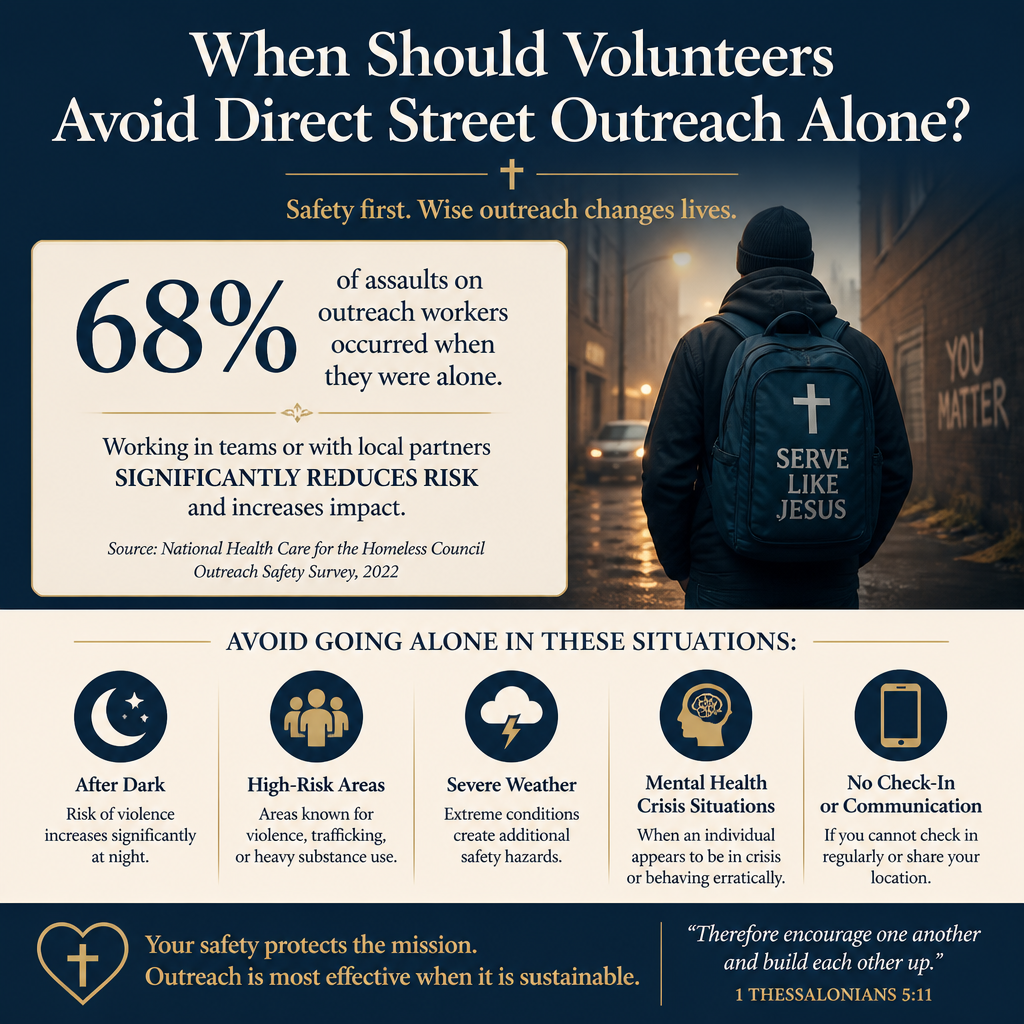
What this means in practice is that the healthiest outreach models assign roles within a pair: one person leads conversation, the other quietly monitors environmental risks and keeps an eye on timing, exits, and group movement. This is not fear-driven; it is attentive love.
Protocols are an expression of governance, not mere caution
Clear outreach protocols demonstrate that a ministry understands duty of care. They answer practical questions: Are volunteers allowed to transport guests? What constitutes an emergency? Who calls 911? When is law enforcement engagement appropriate? How is confidential information handled? These policies also reduce the likelihood that a volunteer improvises in ways that violate the ministry’s legal and ethical obligations.
For donors evaluating homeless outreach, governance matters because it determines whether compassion is sustainable. The ministries that earn trust over decades typically do not romanticize risk. They build systems that protect the vulnerable without treating them as threats.
How mature ministries structure street outreach responsibly
Street outreach works best when it is integrated with next-step services
Direct outreach becomes more volatile when it is disconnected from credible referral pathways. A volunteer alone may offer food, prayer, or a blanket, but if there is no link to shelter, detox, case management, or medical care, the interaction can unintentionally raise false expectations. Mature rescue missions and outreach ministries integrate street engagement with a defined continuum: assessment, shelter intake, recovery programming, employment services, and housing navigation.
When donors want to understand whether an outreach program is responsibly designed, it helps to ask where the ministry can actually take someone next. If the answer is vague, volunteers will feel pressure to become the plan, and that is precisely when solo outreach becomes most dangerous.
Many of the best practices in this space have been shaped by evidence-based approaches such as Housing First, which remains contested among Christians because it is often implemented in ways that downplay spiritual formation or avoid moral language around addiction. Still, the core insight is relevant: stability and continuity matter. HUD’s public materials summarize the model’s emphasis on rapid housing and supportive services, which many communities adapt in different ways (U.S. Department of Housing and Urban Development).
Training, reporting, and supervision create accountability
Responsible outreach ministries train volunteers to recognize overdose risk, de-escalate conflict, and avoid common boundary violations. They also insist on incident reporting, not because they are litigious, but because leaders cannot improve what they refuse to name. A culture of silence around “close calls” is a predictable precursor to serious harm.
Church-based outreach can be especially vulnerable here. Congregations often have strong compassion and limited operational infrastructure. That is one reason donors benefit from understanding the broader ecosystem of Rescue Missions and Homeless Outreach, including how established missions structure volunteer engagement, document outcomes, and coordinate with local agencies.
What donors should look for in volunteer safety and ministry credibility
Questions that reveal whether a ministry is governed well
Donors do not need to become risk managers, but we should not treat volunteer safety as a minor operational footnote. It is a window into whether leadership is sober-minded, teachable, and accountable. When a ministry can answer these questions directly, it often reflects broader health:
Does the ministry require two-person teams for street outreach? If not, what safeguards replace that standard?
Is there formal training before first contact? Training should cover boundaries, referral pathways, de-escalation, and emergency response.
Are volunteers prohibited from transporting guests in personal vehicles? Exceptions should be rare, documented, and supervised.
Is there a written incident reporting process? Leaders should be able to describe how reports are reviewed and acted upon.
Is outreach connected to case management or partner services? Disconnected outreach increases the likelihood of improvisation and broken promises.
How Most Trusted fits into a donor’s due diligence
Most Trusted exists to help donors give with confidence by evaluating Christian nonprofits against The Most Trusted Standard, a 15-criteria framework spanning faith commitments, financial integrity, governance and leadership, and transparency and effectiveness. Volunteer safety policies are not the only measure of trustworthiness, but they frequently correlate with other markers: clear oversight, documented procedures, and candid reporting about what the ministry can and cannot do.
In practical terms, donors can treat volunteer safety as a “leading indicator.” When leadership insists that volunteers never go alone, requires training, and documents incidents, it often signals a ministry that takes stewardship seriously. When leadership minimizes risk or relies on informal norms, donors should ask whether that same informality shows up in finances, board oversight, or outcome reporting. Many of these questions intersect directly with Volunteering in Homeless Outreach Ministries, where volunteer engagement is inseparable from governance and pastoral care.
FAQs for When should volunteers avoid direct street outreach alone
Is it ever appropriate for a volunteer to do street outreach alone?
In most contexts, we recommend that volunteers do not conduct direct street outreach alone, even in daylight and familiar neighborhoods. If a ministry allows solo outreach at all, it should be limited to highly trained staff or veteran volunteers with clear communication tools, defined routes, and immediate supervisory backup. A donor should expect written policy, not informal permission.
What if someone insists they only trust a single volunteer and refuse a team?
This can happen, and it requires both compassion and boundaries. Mature ministries do not force a dynamic that makes a person feel cornered, but they also do not abandon safety standards. A common approach is to keep the second volunteer at a respectful distance while remaining visibly present, or to shift the interaction to a safer public setting. If the person’s request is rooted in trauma, the ministry can still honor dignity without exposing either party to unnecessary risk.
Faithful street outreach is courageous and governed
The Christian call to seek the lost and serve the poor does not require volunteers to take avoidable risks alone on the street. It requires ministries to order compassion with wisdom, so that service is safe, accountable, and connected to real next steps. Donors can strengthen that kind of outreach by prioritizing ministries that treat duty of care as part of discipleship, not a barrier to it.