

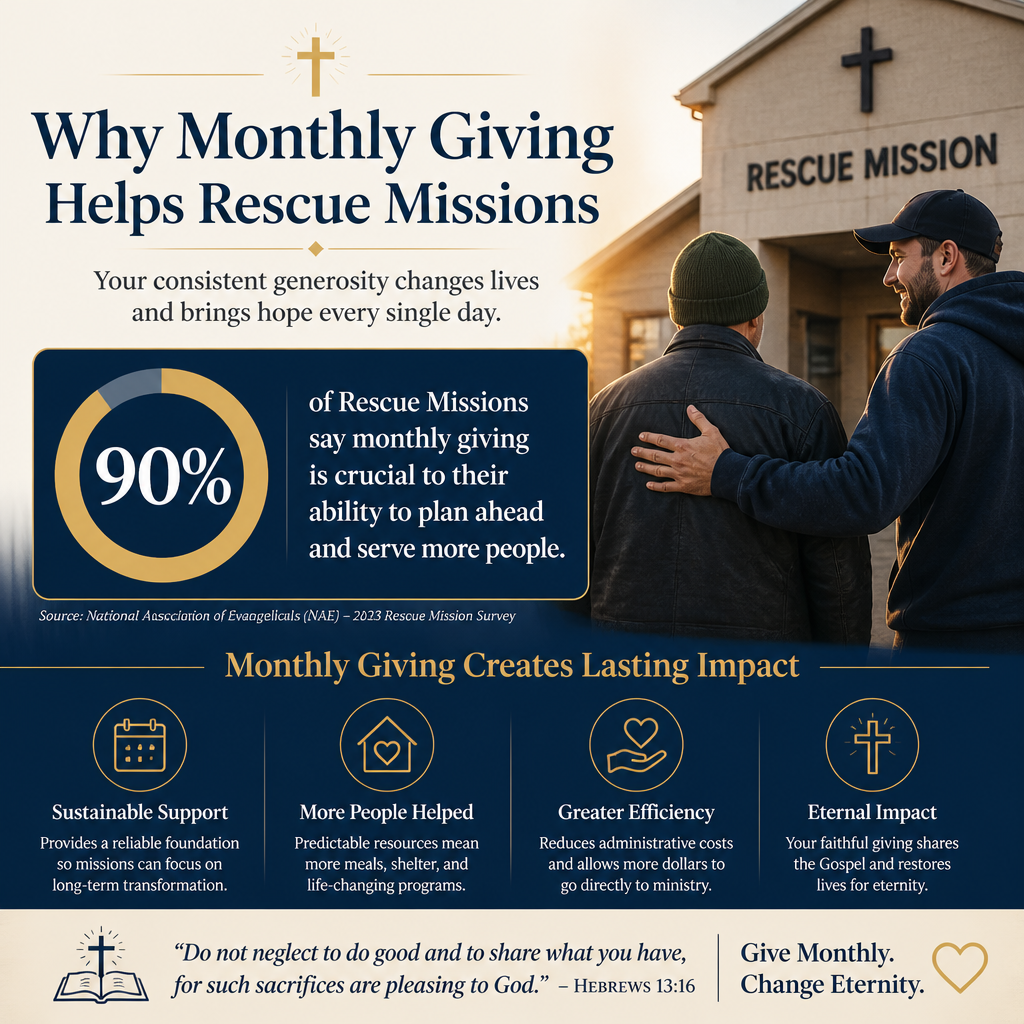
Monthly giving helps rescue missions because it turns a ministry of mercy from constant triage into steady, accountable care. When a mission knows what resources will arrive next month, it can staff wisely, plan discipleship pathways, maintain safe facilities, and keep its doors open when winter nights are long and public attention has moved on. For Christian donors, the question is not only what is compassionate in the moment, but what is faithful over time.
Scripture commends both immediate generosity and sustained stewardship. The early church responded to urgent needs, yet also organized ongoing distribution so widows were not neglected (Acts 6:1–7). Rescue missions operate in that same tension: immediate crisis meets long-term formation. Monthly giving is one of the few donor practices that directly strengthens both.
Rescue missions serve crises that do not follow donor calendars
Homelessness is persistent, and the need is not seasonal
Rescue missions rarely have the option to “pause” operations. People arrive hungry at night. Survivors of domestic violence need a safe bed without waiting for a fundraiser to finish. A man who finally agrees to enter recovery may not return if asked to come back next week. Monthly gifts underwrite the unglamorous continuity that makes emergency care possible.
Homelessness in the United States remains a large, ongoing reality. The U.S. Department of Housing and Urban Development’s Point-in-Time count reported more than 650,000 people experiencing homelessness on a single night in 2023, the highest level since HUD began using modern methods to report national estimates (U.S. Department of Housing and Urban Development).
Predictability strengthens pastoral and clinical care
Rescue missions are not only shelter providers. Many operate as Christian communities with chaplaincy, addiction recovery programming, job readiness, and relational mentoring. That work depends on staffing stability. Monthly support allows leaders to hire case managers, counselors, and resident advisors with less fear that a shortfall will force layoffs that fracture trust with guests.
What this means in practice is that monthly giving is not mainly a convenience feature. It is an operational input that affects whether the mission can keep appropriate staff-to-guest ratios, maintain safe supervision, and build consistent rhythms of prayer, meals, counseling, and accountability.

Monthly giving funds the long work of restoration, not only the first night
Discipleship and recovery require time, structure, and follow-through
Christian donors often feel the moral clarity of the first meal or the first bed. Rescue missions share that clarity, but they also know that the deeper work begins after immediate danger has passed. Addiction recovery, trauma processing, reconnection with family, mental health stabilization, and employability are rarely resolved quickly. Monthly giving supports the “middle months” where progress is real but fragile.
Christians genuinely disagree about the best models for helping people move from homelessness to stability. Some emphasize rapid rehousing with light services; others emphasize longer-term residential programs with intensive discipleship and recovery expectations. A wise donor does not flatten that debate. We recommend asking a mission to explain its theory of change and how spiritual formation and practical outcomes are held together, because funding the long work requires clarity about what “restoration” means in that context.
Relational ministry is hard to budget without recurring support
Many of the most effective interventions in homelessness ministry are relational rather than transactional: consistent mentoring, accountability groups, church integration, and pastoral presence. These are also the easiest to cut when revenue is unpredictable, because they do not always have a clean “cost per unit” narrative. Monthly gifts create a financial environment where relational ministry can remain central rather than optional.
For donors who want to keep the focus on personhood rather than programs, monthly giving often does more to protect relational care than any single designated gift.
Reliability improves accountability, stewardship, and mission resilience
Rescue missions still face overhead and infrastructure realities
Some donors hesitate at the thought that monthly giving supports “operations.” But rescue missions cannot serve guests without responsible infrastructure: safe facilities, compliant kitchens, trained staff, audited financials, and secure systems for handling sensitive client data. Christian mercy is not less spiritual because it is administered competently.
The broader nonprofit field has had to reckon with the “overhead” conversation, including the widely cited Overhead Myth letter signed by GuideStar, Charity Navigator, and the BBB Wise Giving Alliance, which argues that simplistic overhead ratios can mislead donors and penalize healthy capacity building (Candid GuideStar). In rescue mission work, chronic underinvestment in capacity can translate into staff burnout, unsafe conditions, and unstable programming.
Recurring revenue reduces crisis-mode decision making
When cash flow is volatile, leaders make defensive choices: deferring maintenance, reducing staff training, cutting recovery programming, or narrowing intake. Predictable monthly giving reduces those pressures and makes room for more measured governance. It also supports appropriate reserves, which many ministries need but hesitate to build for fear donors will misunderstand.
Across our verification work at Most Trusted, we observe that ministries with stable recurring donor bases are often better positioned to document outcomes, communicate candidly about challenges, and invest in leadership development. Stability does not guarantee faithfulness, but instability reliably creates conditions where shortcuts become tempting.
Monthly giving can be spiritually formative for donors and disciplined for ministries
It expresses steadfast mercy rather than episodic sentiment
Monthly giving aligns with a Christian understanding of perseverance. Jesus’ parable of the Good Samaritan commends mercy that pays for ongoing care, not only first aid (Luke 10:34–35). Many rescue missions operate as modern “inns” for neighbors who have been beaten down by sin, suffering, and systems. A recurring gift is a modest but real way of sharing responsibility for long-term care.
This is not a call to guilt, and it is not an argument that one-time gifts are inadequate. One-time gifts often fund capital needs, special outreach, and emergency response. But monthly giving can express a different moral posture: consistent solidarity with people whose recovery does not fit our preferred timelines.
Healthy recurring programs still require scrutiny
Monthly giving can also create complacency if donors stop paying attention. A mission can drift from its theological commitments, overstate results, or mishandle governance while recurring revenue continues. Mature donors pair consistency with vigilance: they keep reading, asking questions, and testing claims.
That is one reason our team developed The Most Trusted Standard, a 15-criteria framework that evaluates Christian nonprofits across Faith Foundation, Financial Integrity, Governance and Leadership, and Transparency and Effectiveness. Recurring giving is most powerful when it is directed toward ministries that can demonstrate both spiritual seriousness and verifiable stewardship. Many donors begin their due diligence by reviewing ministries connected to Rescue Missions and Homeless Outreach because the field includes exemplary work and real dysfunction, sometimes in close proximity.
How to practice monthly giving without funding dysfunction
What disciplined monthly support should underwrite
Monthly giving is not merely about choosing a mission you admire. It is about choosing a mission you can trust with consistent dependence. We recommend prioritizing ministries that can show integrity in both message and management, with clear guardrails around the dignity and safety of guests.
- Clear program pathways from emergency shelter to recovery, housing stability, and local church connection
- Transparent financial reporting, including audited statements when appropriate and plain explanations of major expense categories
- Governance maturity, such as an engaged board, conflict-of-interest policies, and documented decision-making
- Guest protections, including safeguarding policies, staff training, and appropriate supervision
- Outcome honesty that names limitations and setbacks rather than publishing only celebratory stories
Questions sophisticated donors should ask
Rescue missions operate under complex constraints: housing markets, addiction epidemics, mental illness, criminal justice entanglements, and local policy. Donors should not demand simplistic metrics. Still, some questions reveal whether a ministry is sober-minded.
We recommend asking: How do you define success for guests who do not “graduate”? What is your approach to substance use relapse? How do you collaborate with local churches and service providers? How do you handle restrictions that protect safety without dehumanizing guests? If your monthly giving is intended to support holistic restoration, these questions matter as much as the donation amount.
Many donors also want a framework for evaluating ministries consistently rather than reinventing the process each time. That is a central purpose of Most Trusted’s verification work and why our donors often engage with How to Give Wisely to Rescue Missions as they consider recurring commitments.
FAQs for Why monthly giving helps rescue missions
Is monthly giving to a rescue mission better than giving to my local church?
Christians order this priority differently, and faithful believers can land in different places. Many donors treat giving to their local church as foundational because it supports Word, sacrament, pastoral care, and local mission. Monthly giving to a rescue mission can be a complementary commitment, especially when the mission is closely partnered with local churches and invites congregational involvement rather than replacing it.
Should we restrict our monthly gift to a specific program at the mission?
Restricted giving can be appropriate when a donor understands the program and the mission can comply without distorting priorities. But many missions need flexible support to keep core operations healthy, staff trained, and facilities safe. A wise approach is to ask how restricted gifts affect budgeting, then consider a primarily unrestricted monthly gift alongside occasional designated gifts for capital needs or special initiatives.
Steady support is often the difference between crisis response and durable mercy
Rescue missions will always need donors who respond to emergencies. They also need donors who remain present when headlines fade, when recovery is slow, and when good governance requires boring investments in staff, systems, and accountability. Monthly giving helps rescue missions because it strengthens the ordinary conditions in which extraordinary grace is often received: a safe bed, a consistent counselor, a patient chaplain, and a community that does not leave when progress is uneven.



