
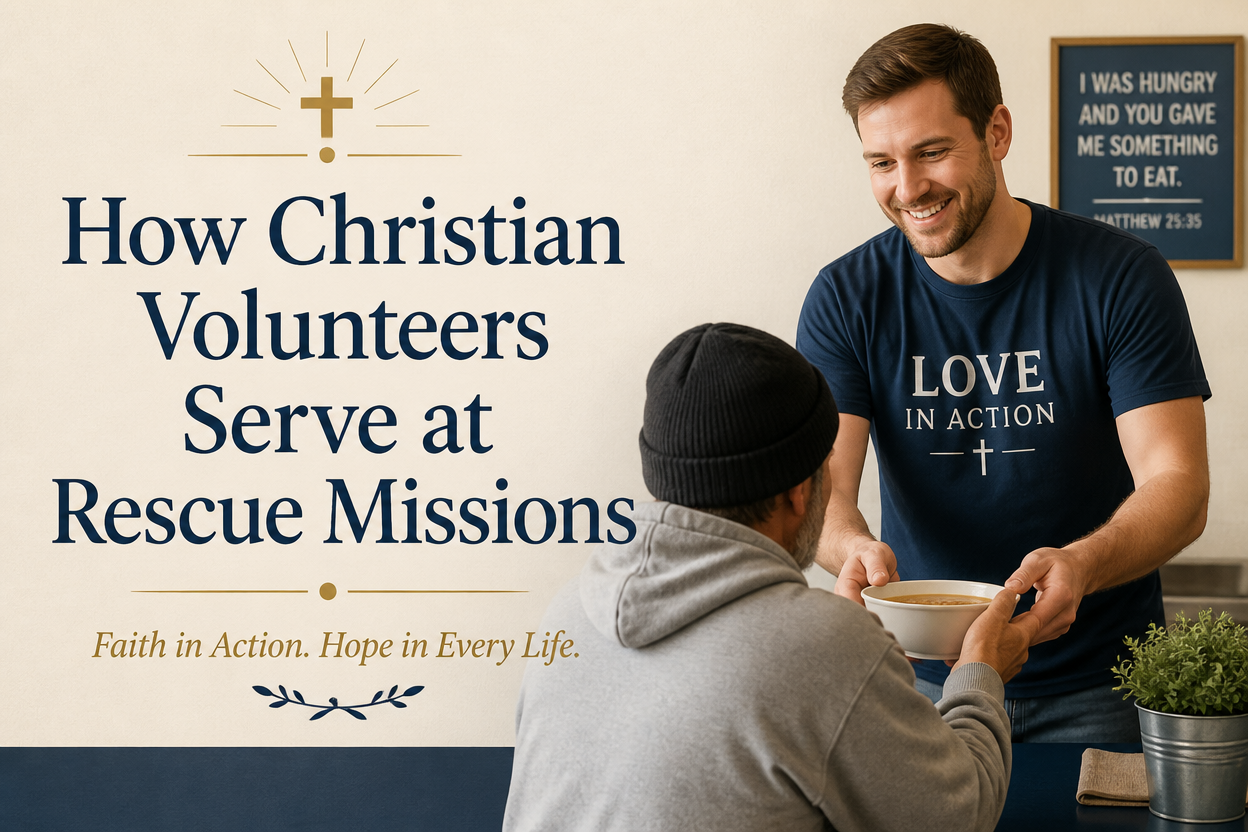
How Christian volunteers serve at rescue missions is a question of both mercy and stewardship. Donors underwrite much of the modern rescue mission movement, but volunteers often embody its daily credibility: the way guests are welcomed, boundaries are kept, and hope is spoken with integrity.
At their best, rescue mission volunteers make visible what Scripture insists is true: God’s people do not outsource compassion. Yet the field has also had to reckon with hard realities—trauma, addiction, mental illness, and the risk that well-intentioned service becomes paternalism or performance. Mature Christian donors increasingly ask not only whether a mission is busy, but whether it is faithful, safe, and measurably effective.
Rescue mission volunteering is a ministry of presence under authority
The calling is proximate love, not rescue fantasies
Christian volunteers are often drawn to missions because the need feels immediate: hunger, exposure, and instability are visible. The temptation is to imagine the volunteer as the primary agent of change. Most missions that serve well resist that framing. They ask volunteers to practice “presence under authority”—showing up consistently, following staff direction, and honoring the dignity and agency of the guest.
This is not a retreat from compassion. It is a recognition that homelessness is rarely a single problem with a single solution. Research consistently shows that homelessness and housing instability are shaped by intertwined drivers: housing costs, income volatility, behavioral health, domestic violence, and local policy environments. Many Christian missions therefore place volunteers in defined roles that protect guests and volunteers alike, rather than creating open-ended “do whatever you see” expectations.
Hospitality in Scripture has moral weight
The Bible’s commands are not abstract. Jesus’s description of final judgment in Matthew 25 ties welcome, food, clothing, and visitation to fidelity to him. In rescue missions, that means the way a volunteer speaks, listens, and keeps promises matters. A guest who has been disappointed by institutions may be testing whether Christians will be any different.
What this means in practice is that strong missions train volunteers to offer genuine welcome without confusing relational warmth with relational entitlement. Volunteers represent Christ, but they are not saviors; they are servants.

What volunteers actually do inside effective rescue missions
Frontline roles are often simple, and that is a strength
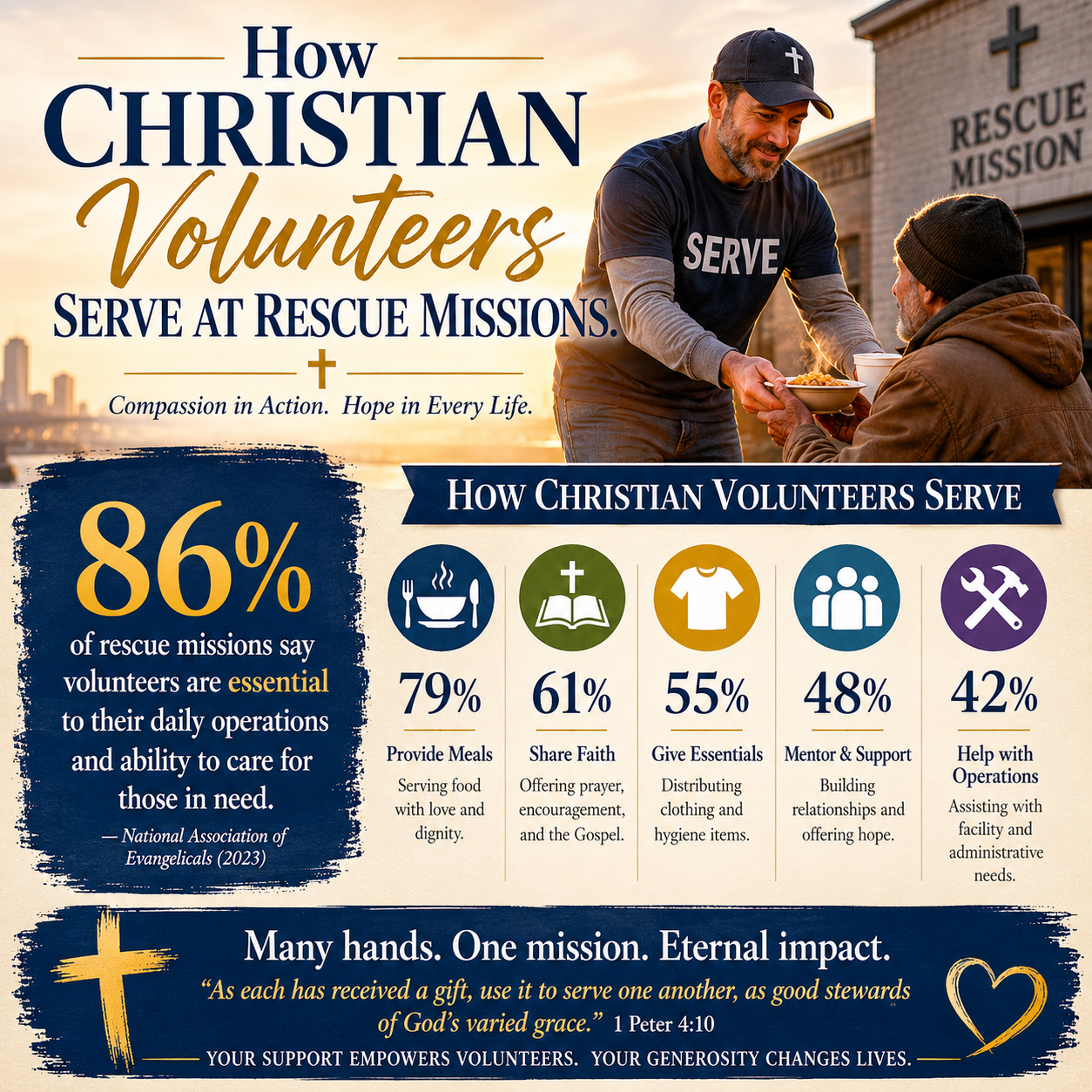
Many donors assume the most “spiritual” volunteer work is the most dramatic. In reality, some of the most consequential service is ordinary and repetitive: serving meals, laundering linens, cleaning dorms, sorting donations, driving shuttle routes, or staffing reception desks. These tasks keep a mission operational, protect health and safety, and free trained staff to focus on case management and clinical partnerships.
In well-run missions, volunteer roles are designed around risk management and program integrity. Volunteers usually do not conduct counseling, make intake decisions, or handle sensitive records. That separation is not bureaucratic caution; it is a form of love that reduces harm.
Program support roles reinforce long-term change
Many missions now operate more like comprehensive human services ministries than emergency shelters alone. Volunteers may support job-readiness classes, GED tutoring, children’s programming for families in shelter, mentoring for residents in a structured recovery program, or practical workshops such as budgeting and cooking. When these roles are done well, they reinforce long-term stability rather than creating dependency.
For donors considering where to invest, it is worth observing whether volunteer roles are integrated into a coherent theory of change. A mission with strong programming can articulate why a particular volunteer position exists and how it supports measurable outcomes.
- Meals and hospitality: serving, greeting, dishwashing, dining-room cleanup
- Operations: laundry, facilities care, donation sorting, basic administration
- Program assistance: tutoring, childcare support, job coaching under staff oversight
- Community engagement: church volunteer coordination, event support, prayer teams
- Skill-based service: pro bono legal clinics, medical clinics, counseling referrals, IT support where appropriate
Safety, trauma, and boundaries are not secondary concerns
Trauma-informed practice protects dignity
Many guests at rescue missions carry deep trauma—childhood abuse, intimate partner violence, combat exposure, exploitation, or the accumulated trauma of life on the street. Volunteers who have not been trained can unintentionally trigger shame or fear through interrogation, unsolicited advice, or sudden emotional intensity.
Trauma-informed practice is not a trendy add-on; it is basic neighbor-love. It means prioritizing choice, consistency, and respectful communication. It also means understanding that a guest’s distrust may be a survival skill, not a personal insult.
Boundaries are part of Christian integrity
Christians genuinely disagree about how strict missions should be. Some argue that strict rules can feel coercive. Others note that without rules, the most vulnerable guests—especially women and children—pay the price. The better question is whether boundaries are clear, consistently applied, and ordered toward safety and restoration rather than control.
Volunteers are often the first to feel this tension. A guest asks for money, a ride, a personal phone number, or a private meeting off-site. Healthy missions train volunteers to say no without contempt and to route requests through staff. Donors should view that training as evidence of maturity, not coldness.
Volunteer labor can either strengthen or distort a mission’s effectiveness
Free labor is not automatically wise stewardship
Many donors love volunteerism because it feels efficient: “More work done, fewer dollars spent.” Yet the field has had to learn that volunteer labor can be expensive when it is poorly managed—requiring supervision, rework, and risk mitigation. A mission that relies on volunteers for core functions without appropriate training and accountability may be under-resourced rather than “lean.”
This is one reason the “Overhead Myth” conversation has mattered for serious philanthropy. In 2013, Charity Navigator, GuideStar, and BBB Wise Giving Alliance warned donors that focusing narrowly on overhead ratios can undermine nonprofit effectiveness by pressuring organizations to underinvest in infrastructure and evaluation Charity Navigator.
When helping hurts is a real risk in homelessness outreach
The When Helping Hurts framework, articulated by Steve Corbett and Brian Fikkert, has shaped many Christian ministries’ approach to poverty alleviation. Its core warning is not against help, but against forms of help that unintentionally communicate superiority, reduce agency, or create dependency. Rescue missions face that risk whenever volunteers serve in ways that center the volunteer’s experience rather than the guest’s long-term well-being.
What this means in practice is that effective missions build volunteer culture around humility, mutual respect, and disciplined consistency. They do not ask volunteers to “fix” guests; they invite volunteers to participate in an ordered ministry where trained staff shepherd the process of change.
Donors who want to understand how a mission handles these tensions often benefit from the broader context offered in Rescue Missions and Homeless Outreach, where the central strategic and theological questions are easier to see together.
What donors should look for when a mission highlights volunteers
Volunteer stories should never replace verifiable evidence
Volunteer testimony can be sincere and still incomplete. A mission’s social media feed may feature enthusiastic groups serving dinner, but the deeper questions remain: Are guests safer? Are people moving into stable housing? Are relapse and recidivism addressed with sobriety supports and clinical partnerships? Are spiritual claims made carefully, without manipulating vulnerable people?
Across our verification work at Most Trusted, we find that ministries worthy of confidence tend to pair strong volunteer engagement with clear governance, sober financial controls, and transparency about outcomes and limitations. We evaluate ministries against The Most Trusted Standard, a 15-criteria framework spanning faith foundation, financial integrity, governance and leadership, and transparency and effectiveness. Volunteer enthusiasm is a gift, but it is not a substitute for accountable leadership.
Questions that reveal operational and spiritual health
Serious donors do not need a mission to be perfect, but they should expect a mission to be honest. The following questions tend to clarify whether volunteerism is strengthening the work or masking fragility:
Volunteer formation: Is training required, including safety and trauma awareness? Are background checks used where children or vulnerable adults are involved? Are there clear rules about photos, social media, and confidentiality?
Program integrity: Are volunteers integrated into a defined program model, or are they deployed ad hoc based on availability? Who supervises volunteers, and what is the ratio of staff to volunteers in sensitive contexts?
Partnership ecology: Does the mission coordinate with local Continuums of Care and public services, or does it function as an island? HUD describes Continuums of Care as the community-wide planning bodies designed to coordinate housing and services for people experiencing homelessness U.S. Department of Housing and Urban Development.
Spiritual care: How is the gospel shared—through chaplains, church partners, voluntary chapel services, and pastoral counseling? How does the mission ensure that guests are not pressured to make religious claims in exchange for food, shelter, or program access?
Donors who want to compare volunteer models across ministries often benefit from browsing the wider context of Volunteering in Homeless Outreach Ministries, where differences in supervision, safety practice, and program design are easier to evaluate.
FAQs for How Christian volunteers serve at rescue missions
Do rescue missions require guests to attend chapel in exchange for shelter or meals?
Practices vary. Some missions offer voluntary chapel and pastoral care alongside services; others integrate spiritual programming into longer-term residential discipleship programs while still providing emergency services without religious requirements. Donors should ask directly how participation is handled, how informed consent is ensured, and whether guests can receive essential services without coercion.
How can donors evaluate whether volunteer-led efforts are helping rather than creating dependency?
Dependence risk is lower when volunteer roles are aligned with a mission’s long-term outcomes: stable housing placement, recovery supports, employment pathways, and reunification where appropriate. Donors can ask for clear program descriptions, safety policies, and outcome reporting, and can look for evidence that volunteers serve under staff leadership rather than operating independently with vulnerable guests.
Serving well requires both compassion and verification
Rescue missions ask the church to bring the mercy of Christ into places of real complexity, where trauma and sin, courage and relapse, gratitude and anger may sit at the same table. Christian volunteers serve best when they embrace disciplined humility: doing ordinary tasks faithfully, honoring boundaries, and submitting to accountable leadership.
For donors, the corresponding obligation is serious stewardship. We commend volunteer-rich missions that pair hospitality with safety, spiritual care with integrity, and inspiring stories with transparent evidence. In a field where sincerity is common but maturity is not automatic, careful verification is not cynicism; it is love expressed in truth.



