

What prison ministry funding pays for is rarely a single line item. It is the quiet, persistent work that makes Matthew 25 visitation possible in a system built for custody rather than communion. For Christian donors, the question is not whether the Church should remember those behind bars. The question is whether our gifts are sustaining a ministry model that is lawful, accountable, spiritually serious, and demonstrably serving people who bear God’s image.
Across prison and reentry ministries, spending decisions are shaped by constraints many donors never see: volunteer access rules, background-check requirements, limits on materials, restricted communications, and the real costs of serving people who often have no transportation, no identification, and no stable housing on release. Wise funding also resists two equal errors. One is the sentiment that treats prison ministry as merely inspirational. The other is a reductionist metric mindset that treats human transformation as a simple output.
1. Access is expensive because the system is restrictive
Prisons are not churches with locked doors. They are tightly regulated environments where every program depends on institutional permission, staff cooperation, and compliance with policy. When donors ask why it takes money to “just show up and preach,” the most honest answer is that ministries must build and sustain a legitimate presence that will not be shut down by avoidable errors.
Clearance, compliance, and coordination
Funding commonly covers volunteer screening, orientation, and ongoing training, including facility-specific rules that change over time. Many ministries also carry liability insurance and maintain formal memoranda of understanding with departments of corrections or local jails. These are not cosmetic expenses; they are part of loving our neighbor with order and integrity, rather than improvisation.
We also see meaningful administrative costs in scheduling and coordination. In many states, a single facility can have hundreds or thousands of incarcerated people and only a handful of approved program hours each week. When the state shifts count times, lockdown patterns, or staff assignments, ministries must adapt without losing continuity for participants. That continuity matters because frequent disruption is part of the incarcerated experience.
Security-conscious materials and communications
Even modest program materials must be tailored to security constraints. In some facilities, staples, spiral bindings, certain inks, or even specific paper types are restricted. Communication with participants may require monitored phone systems, approved mail processes, or digital platforms designed for correctional settings. Funding supports the procurement and distribution channels that can function lawfully inside those limits.
When donors want a broad view of the field, we point them toward Prison and Post-Prison Ministries, where the practical realities of access and trust-building are easier to evaluate across multiple organizations.

2. Discipleship in prison requires trained people and durable tools
Christian prison ministry is not primarily about delivering information. It is about making the ordinary means of grace credible in a context where manipulation, trauma, and survival strategies are common. That does not disqualify incarcerated people from the gospel; it does mean that discipleship requires patient, well-trained shepherding.
Program leaders and pastoral care
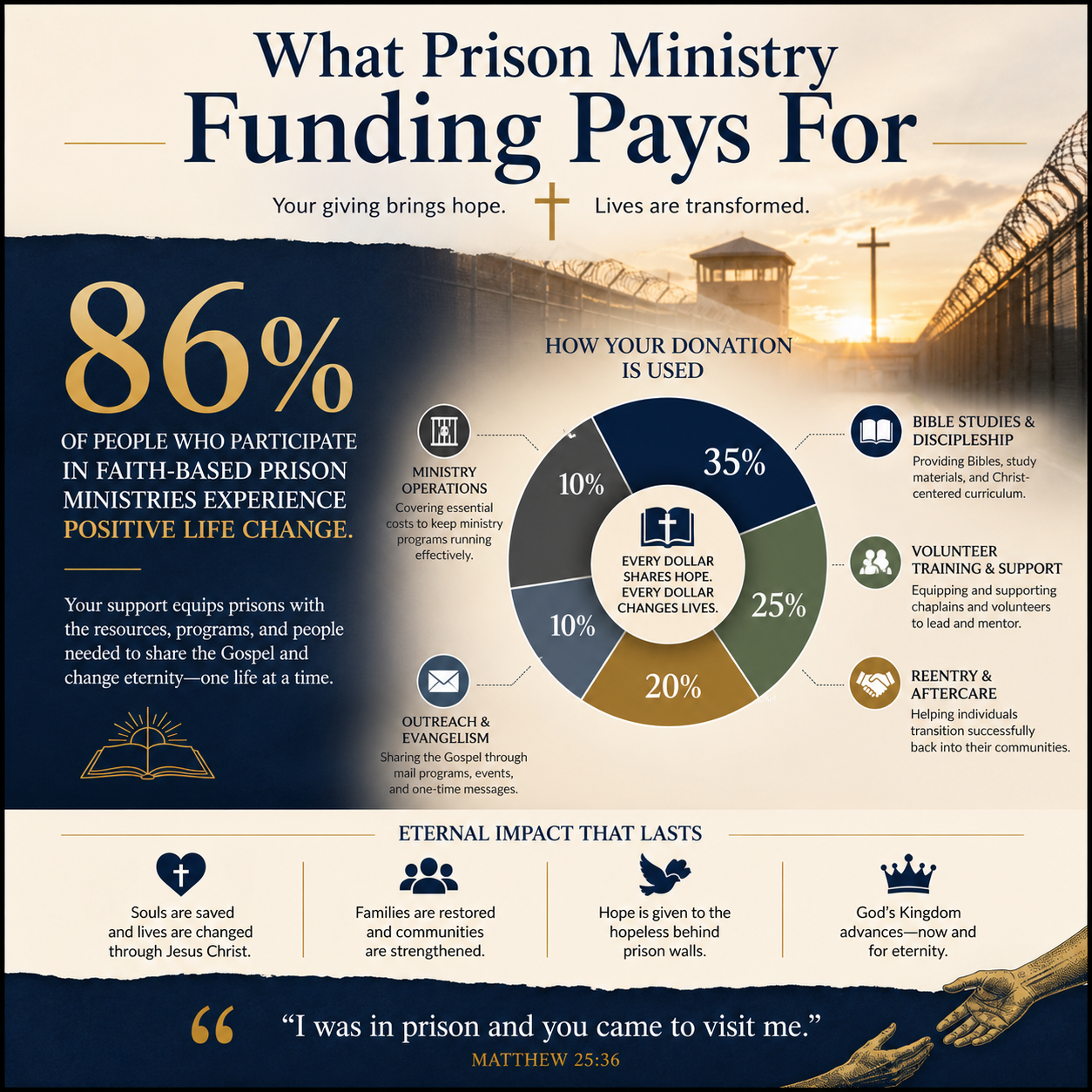
Funding often supports chaplains, program directors, and trained facilitators who can sustain long-term spiritual formation, not only episodic events. Volunteer-driven models can be faithful and effective, but even strong volunteer teams usually require professional coordination, theological oversight, and consistent safeguarding practices.
Many ministries also invest in trauma-aware training. A large share of incarcerated people have histories of victimization, substance use disorders, and family rupture. Addressing those realities well is part of pastoral responsibility. The goal is not therapeutic substitution for the local church, but discipleship that takes the whole person seriously.
Bibles, curriculum, and sacramental life
Donors often assume “Bibles are free.” In practice, durable, facility-approved Bibles and study materials still cost money to acquire, store, and deliver at scale, and to replace when lost during transfers. Some programs also provide structured curricula for literacy, biblical counseling, addiction recovery, or fatherhood formation, with careful attention to what can be used inside a facility.
Scripture names prison visitation alongside feeding the hungry and clothing the naked (Matthew 25:36). But that visitation becomes spiritually thin if it does not include clear teaching, repentance, reconciliation, and a path toward mature Christian life. Funding pays for the people and tools that make that path real rather than aspirational.
3. Reentry work is practical mercy with long timelines
The hardest season for many participants begins after release. Reentry is where good intentions most often collide with bureaucratic complexity, depleted social networks, and the weight of a criminal record. Funding that stops at the prison gate can leave a person spiritually encouraged but practically stranded.
Identification, transportation, and immediate stability
Many returning citizens need basic documents and logistical help before they can work, rent housing, or even open a bank account. Ministries commonly fund case management time, transportation assistance, and limited emergency support. These are not “extras”; they are often prerequisites for stability.
We also encourage donors to understand the scale of need. The United States incarcerates and supervises more people than most Americans realize, and reentry is a constant flow rather than a rare event. The Bureau of Justice Statistics provides baseline context for jail and prison populations and correctional supervision in the United States (Bureau of Justice Statistics).
Employment pathways and relational supports
Some ministries run job readiness programs, transitional employment, or partnerships with employers willing to hire people with records. Others build mentoring models that connect returning citizens to church communities and accountable friendships. What this means in practice is that funding pays for staff hours spent on relationships that cannot be rushed: employer conversations, landlord advocacy, mentoring supervision, and coordination with parole requirements.
Donors sometimes ask for a simple “cost per life changed.” Reentry work does not offer that kind of neat accounting. It offers a serious commitment to perseverance, where setbacks are common and the time horizon is measured in years.
4. Safe, effective ministry avoids the starvation cycle and the overhead myth
Christian donors often want to know how much of a gift goes “directly to the mission.” The impulse is understandable. Yet the field has had to reckon with a pattern that punishes precisely the ministries trying to build strong internal controls and measured effectiveness.
Why low overhead can be a warning sign
Fundraising narratives that celebrate extremely low administrative spending can incentivize what Stanford Social Innovation Review has described as the “nonprofit starvation cycle,” where organizations underinvest in the very capacities that make outcomes durable: staff development, evaluation, and financial systems (Stanford Social Innovation Review).
There is also broad consensus in the charity research sector that overhead ratios are a poor proxy for impact. Charity Navigator, Candid (formerly GuideStar), and the BBB Wise Giving Alliance issued a joint statement rejecting the idea that administrative costs alone indicate effectiveness (Charity Navigator). Prison ministries face this tension acutely because compliance, training, and supervision costs are non-negotiable if a program is to be safe and sustainable.
What responsible capacity looks like
In our work at Most Trusted, we look for ministries that can explain their spending with clarity and spiritual seriousness. Mature organizations typically fund:
- Volunteer screening, training, and safeguarding protocols
- Staff oversight for facility relationships and participant care
- Financial controls, audits or reviews where appropriate, and transparent reporting
- Program materials that meet facility requirements
- Outcome tracking that is honest about limits and avoids inflated claims
Christians genuinely disagree about how much measurement is appropriate for spiritual work. We do not need to reduce sanctification to a dashboard. But we should expect ministries to demonstrate basic stewardship: defined programs, responsible budgets, and truthful communication about what can and cannot be attributed to a given intervention.
5. The question donors should ask is whether funding supports integrity and fruit
Some giving decisions turn on emotion: a testimony, a moving letter, a dramatic conversion story. Those accounts can be true and genuinely encouraging. But prison ministry funding should also be examined through the lens of integrity. That is not suspicion; it is stewardship.
Funding that aligns with The Most Trusted Standard
Most Trusted evaluates Christian nonprofits against The Most Trusted Standard, a 15-criteria framework spanning faith foundation, financial integrity, governance and leadership, and transparency and effectiveness. For prison and reentry ministries, that framework presses donors to ask grounded questions. Does the ministry have clear theological commitments and accountable leadership? Are financial statements accessible and coherent? Are safeguarding practices credible, particularly where vulnerable people and power imbalances are present? Are results described with modesty and evidence rather than marketing certainty?
These questions do not diminish the gospel; they protect it from being used as cover for disorder, exaggeration, or preventable harm.
Funding that strengthens the local church’s long obedience
Many prison ministries operate in the gap between incarceration and congregational life, and their best work often culminates in connection to a healthy local church. Donors can ask whether a ministry is building those pathways: equipping churches to receive returning citizens, preparing participants for ordinary discipleship, and supporting families strained by incarceration.
For donors who want to understand common spending categories across the sector, How Prison Ministries Use Donor Gifts offers a comparative lens that often clarifies what is essential, what is optional, and what may be a red flag.
FAQs for What prison ministry funding pays for
Should prison ministries spend donor money on administration and staff?
Yes, within reason and with transparency. Access coordination, compliance, volunteer supervision, and safeguarding are not peripheral in correctional settings. The more serious question is whether administrative spending is tied to clear responsibilities and accountable oversight, rather than vague bureaucracy. Donors should expect ministries to explain staffing and administrative costs plainly and to provide financial reporting that supports the explanation.
What outcomes are realistic to expect from prison and reentry ministries?
Some outcomes can be described and tracked: program completion, Bible study participation, mentoring engagement, church connection after release, employment steps, and housing stability. Claims about reduced recidivism require special caution because definitions vary and causality is difficult to establish without rigorous methods. Donors should welcome humility here. A trustworthy ministry will report what it can know, distinguish spiritual fruit from social outcomes, and avoid implying that a single program “solves” the complex realities that surround incarceration.
Stewardship that honors both mercy and truth
Prison ministry funding pays for access that is lawful, discipleship that is credible, and reentry support that is patient enough to withstand setbacks. It also pays for the unglamorous capacities that keep ministry honest: training, safeguards, financial controls, and clear reporting. Christian donors do not need to choose between compassion and rigor. We can give as those who remember the prisoner, and also as those who insist that Christ’s name be served with integrity.



