

How prison ministry volunteers are trained and supported is not a secondary operational question; it is a moral question with pastoral, legal, and spiritual dimensions. In Matthew 25, Jesus placed going to those in prison alongside feeding the hungry and visiting the sick, which means the church’s presence behind bars must be both compassionate and disciplined.
For Christian donors, volunteer training can feel like “overhead” until something goes wrong: an avoidable security incident, a volunteer who oversteps a chaplain’s authority, spiritual manipulation masked as zeal, or a well-meaning relationship that becomes emotionally entangled and unsafe. Serious prison ministries treat training and ongoing support as part of their ministry to incarcerated men and women, to volunteers, and to the institutions that carry legal responsibility for every person on the yard. Across our verification work at Most Trusted, the ministries that meet The Most Trusted Standard tend to treat volunteer preparation as an extension of discipleship, not as a check-the-box compliance task.
1 Training begins with a theology of presence and limits
Prison ministry attracts Christians with a strong impulse to help. That impulse is often faithful; it can also be unformed. Effective training starts by clarifying what the volunteer is there to do and what the volunteer is not there to do. The point is not to dampen compassion, but to anchor it in humility, order, and the God-given boundaries that protect the vulnerable.
Calling is real, but so are constraints
Incarcerated people live under a structure of authority that volunteers do not control. A wise ministry trains volunteers to honor the chaplaincy, custody staff, and facility policies even when they feel inconvenient. Romans 13 is not a blanket endorsement of every institutional decision, but it does establish that Christians are not free to disregard lawful authority whenever they believe their intentions are righteous.
Practically, this means volunteers are trained to avoid contraband risks, to follow movement rules, to submit required paperwork, and to refrain from private problem-solving that undermines institutional procedures. When ministries ignore these realities, they place future access at risk not only for themselves but also for other faith groups.
Volunteers are not therapists, lawyers, or saviors
Many prisons hold people with extensive trauma histories, serious mental illness, or acute addiction dynamics. Training should clearly distinguish spiritual care from clinical care and from legal advocacy. Volunteers can listen, pray, teach Scripture, and encourage repentance and faith. They should not attempt diagnosis, promise outcomes, or step into roles that require licensure or formal authorization.
Donors sometimes worry that this sounds “cold.” The deeper reality is that boundaries are a form of love. They prevent spiritual care from becoming coercive, confusing, or exploitative.

2 Screening and preparation protect the incarcerated and the volunteer
Because prisons are coercive environments, ministries have a heightened duty of care. The power dynamics are complicated: incarcerated people have restricted choices, and volunteers hold a kind of social and spiritual influence. Training therefore begins before anyone enters a facility.
Selection standards should be explicit
Responsible ministries do not treat volunteer recruitment as “anyone with a pulse.” They define eligibility: church involvement, character references, maturity, and a willingness to submit to policies. Many also require background checks, not as a statement that volunteers are presumed guilty, but as a prudent safeguard in a high-risk context.
At the system level, prisons themselves often impose screening requirements, including background checks and clearances. The Federal Bureau of Prisons, for example, outlines volunteer eligibility expectations and security-related rules for religious and other volunteers in its policy materials and institutional procedures Federal Bureau of Prisons.
Preparation includes emotional and spiritual realism
Training should name what volunteers will encounter: manipulation attempts, grief, anger, conversion language that may or may not reflect lasting change, and the slow pace of institutional life. Christians genuinely disagree about how to interpret “jailhouse religion,” and simplistic cynicism is as unhelpful as naïve optimism. A credible ministry prepares volunteers to rejoice in genuine fruit while refusing to treat dramatic stories as proof of spiritual maturity.
For donors trying to understand what is happening with their gifts, this is also where “impact” becomes harder than a tally. A ministry may be faithful and effective without being flashy.
3 Security and ethics training are forms of pastoral care
Some ministries treat security training as a necessary evil required by the prison. The stronger ministries treat it as neighbor love. When volunteers respect security rules, they reduce harm risks for incarcerated people, staff, and other volunteers.
Clear ethical rules prevent predictable failures
Volunteer codes of conduct should address prohibited behaviors plainly: no contraband, no money transfers, no gifts outside approved channels, no romantic or sexual contact, no promises about legal outcomes, and no “special relationships” that create dependency. It is appropriate for donors to ask whether these rules are written, trained, and enforced.
In many jurisdictions, correctional agencies publish volunteer handbooks that make these expectations concrete. For example, state departments of corrections commonly provide volunteer guidance and facility rules on their official websites Vera Institute of Justice. Donors should not assume every ministry aligns with these standards unless the ministry can show its training content and compliance processes.
Confidentiality has limits and those limits must be taught
Christian volunteers often assume that spiritual conversations are fully confidential. In prison settings, confidentiality is both ethically significant and legally constrained. Ministries should train volunteers on mandatory reporting requirements, institutional monitoring realities, and appropriate documentation channels. Volunteers must know what to do if someone reports abuse, self-harm risk, threats, or coercion.
Good training protects the incarcerated person from false promises and protects the volunteer from improvised decisions under pressure.
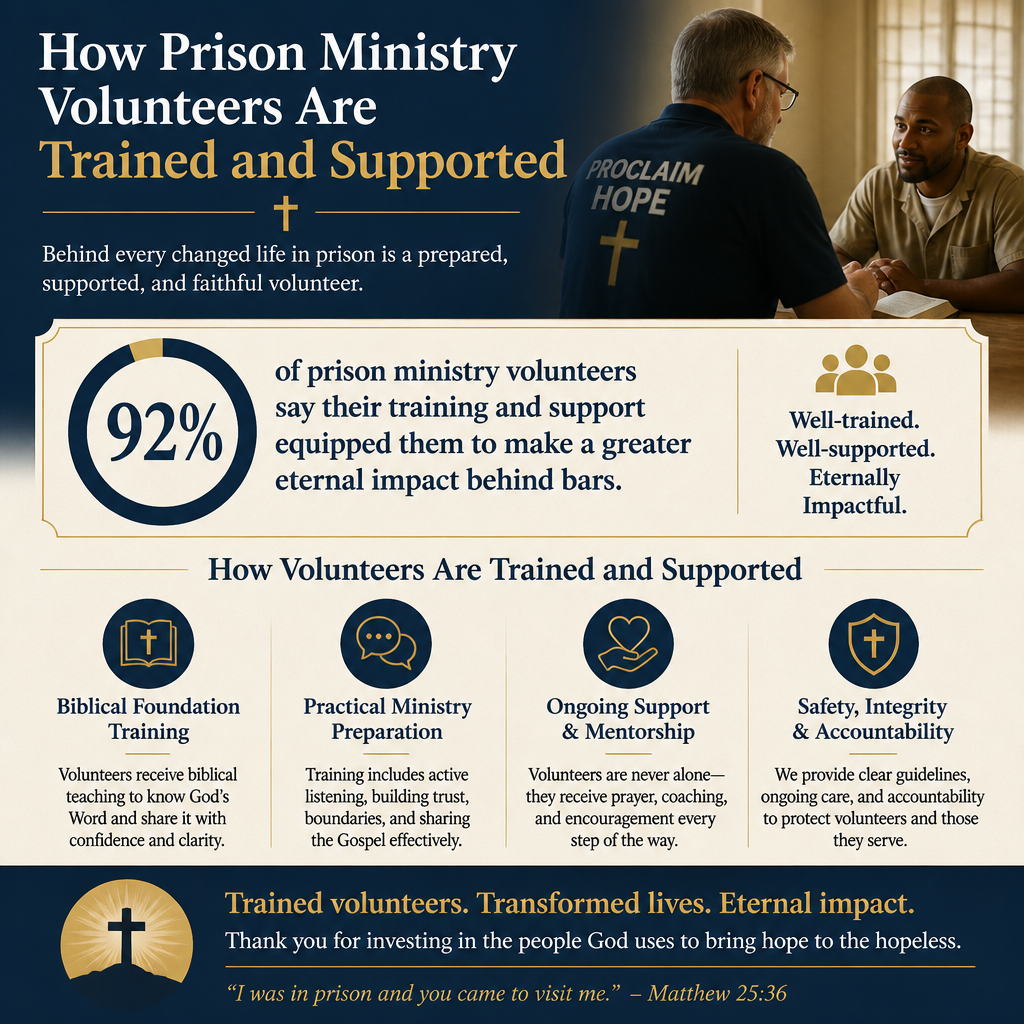
- Role clarity: what volunteers may and may not do in the facility
- Security compliance: contraband, movement rules, and staff coordination
- Ethical boundaries: gifts, money, relationships, and communications
- Spiritual care skills: listening, Scripture handling, prayer, and de-escalation
- Reporting pathways: safety concerns, abuse allegations, and crisis response
4 Ongoing support is where many ministries quietly succeed or fail
Initial training matters. Ongoing support matters more. Prison ministry exposes volunteers to stories of violence, abandonment, addiction, and moral injury. Without sustained care, volunteers burn out, grow cynical, or begin operating as independent agents inside a highly sensitive system.
Supervision, not just scheduling
A ministry that “supports volunteers” does more than fill slots on a calendar. It provides supervision: a point person who receives reports, resolves conflicts with institutions, and ensures that the ministry’s theology and ethics are consistently practiced. This is also where donors can see whether a ministry has the governance maturity to manage risk rather than simply react to it.
Across the wider field of nonprofit practice, donors have been urged not to overvalue low overhead and underinvest in the very systems that prevent harm. The joint “Overhead Myth” statement from sector leaders made this point: effectiveness and accountability require appropriate investment in administration and infrastructure Candid GuideStar.
Spiritual care for volunteers is part of stewardship
Volunteers need pastoral care because prison ministry can awaken fear, anger, and despair. Ministries commonly provide debrief meetings, prayer support, and access to counseling referrals when needed. The goal is not to treat volunteers as fragile, but to keep them spiritually rooted and emotionally stable so that their presence behind bars is patient and non-reactive.
This is one reason we encourage donors to view volunteer support as a direct ministry expense, not an administrative afterthought. If volunteers become unstable, the incarcerated person will carry the cost.
Donors who want to understand this landscape more broadly may find it helpful to read Most Trusted’s coverage of Prison and Post-Prison Ministries, where we address both institutional realities and gospel priorities without romanticizing either.
5 What donors should look for when funding volunteer-based prison ministry
Christian donors often ask a fair question: how can we distinguish careful ministries from ministries that simply have access to facilities and compelling stories? The answer is not a single metric. It is a pattern of verifiable practices that show the ministry can be trusted with vulnerable people, volunteer labor, and donor funds.
Evidence of training and accountability
In our evaluation work, we look for ministries that can show written policies, training materials, and a repeatable process for onboarding. We also look for leadership that can explain how incidents are handled, how volunteers are disciplined when necessary, and how the ministry coordinates with chaplains and correctional administrators.
Training that exists only in someone’s memory is fragile. Training that is documented can be improved, audited, and taught consistently.
Alignment with The Most Trusted Standard
The Most Trusted Standard evaluates ministries across Faith Foundation, Financial Integrity, Governance and Leadership, and Transparency and Effectiveness. For volunteer-based prison ministry, those criteria converge in practical ways: a clear statement of faith that shapes teaching; governance that treats safeguarding as a board-level responsibility; financial reporting that is timely and credible; and transparency that does not exploit incarcerated people’s stories for fundraising.
Donors can also benefit from understanding how ministries describe the use of donor funds in this space. Our reporting on How Prison Ministries Use Donor Gifts addresses common expense categories—training, chaplain coordination, curriculum, transportation, follow-up care—and the accountability questions that follow each one.
FAQs for How prison ministry volunteers are trained and supported
Do prison ministry volunteers need specialized training if they are already mature Christians?
Yes. Spiritual maturity is essential, but prisons add constraints and ethical risks that do not exist in ordinary church settings. Specialized training clarifies security rules, role boundaries, communication limits, and crisis procedures. It also helps mature believers apply wisdom in a context where power dynamics and institutional authority are unavoidable.
Should donors fund volunteer training, or should that be covered by a ministry’s general budget?
Donors can fund volunteer training with confidence when the ministry can show what training entails and how it reduces harm and improves consistency. Training is not merely administrative; it is part of delivering spiritually faithful, ethically sound ministry in a high-risk environment. The key is transparency: written policies, clear outcomes, and credible oversight.
A faithful presence requires formed volunteers
Prison ministry is one of the most explicit works of mercy Jesus named, and it is also one of the most easily damaged by good intentions without discipline. When volunteers are trained and supported with seriousness—spiritually, ethically, and operationally—the ministry becomes more credible to institutions, safer for incarcerated people, and more sustainable for the church. Donors who fund that formation are not paying for bureaucracy; they are underwriting a faithful presence that can endure.



