

Questions about how prison ministries use donor gifts are ultimately questions about stewardship and truth. Jesus named going to those in prison alongside feeding the hungry and clothing the naked (Matthew 25:36), and his church has never had the luxury of treating incarceration as someone else’s problem. Donors are right to ask how money is handled in a place where public systems are complex, access is restricted, and spiritual work often happens out of sight.
Prison and post-prison ministry has a particular accountability challenge: much of the work cannot be photographed, many partners cannot be publicly identified, and outcomes are difficult to measure with the simplicity donors sometimes want. That does not reduce the need for financial integrity; it increases it. Mature ministries learn to document what they can, tell the truth about what they cannot, and build internal controls strong enough to stand up to scrutiny.
Donor gifts underwrite presence, not programs on paper
Prison ministry is frequently described as “Bible studies” or “discipleship classes,” but in practice donor gifts primarily sustain consistent Christian presence. The most fruitful ministries are rarely those with the most innovative curriculum. They are those that keep returning, keep listening, and keep serving—week after week—inside institutions built to restrict movement and minimize risk.
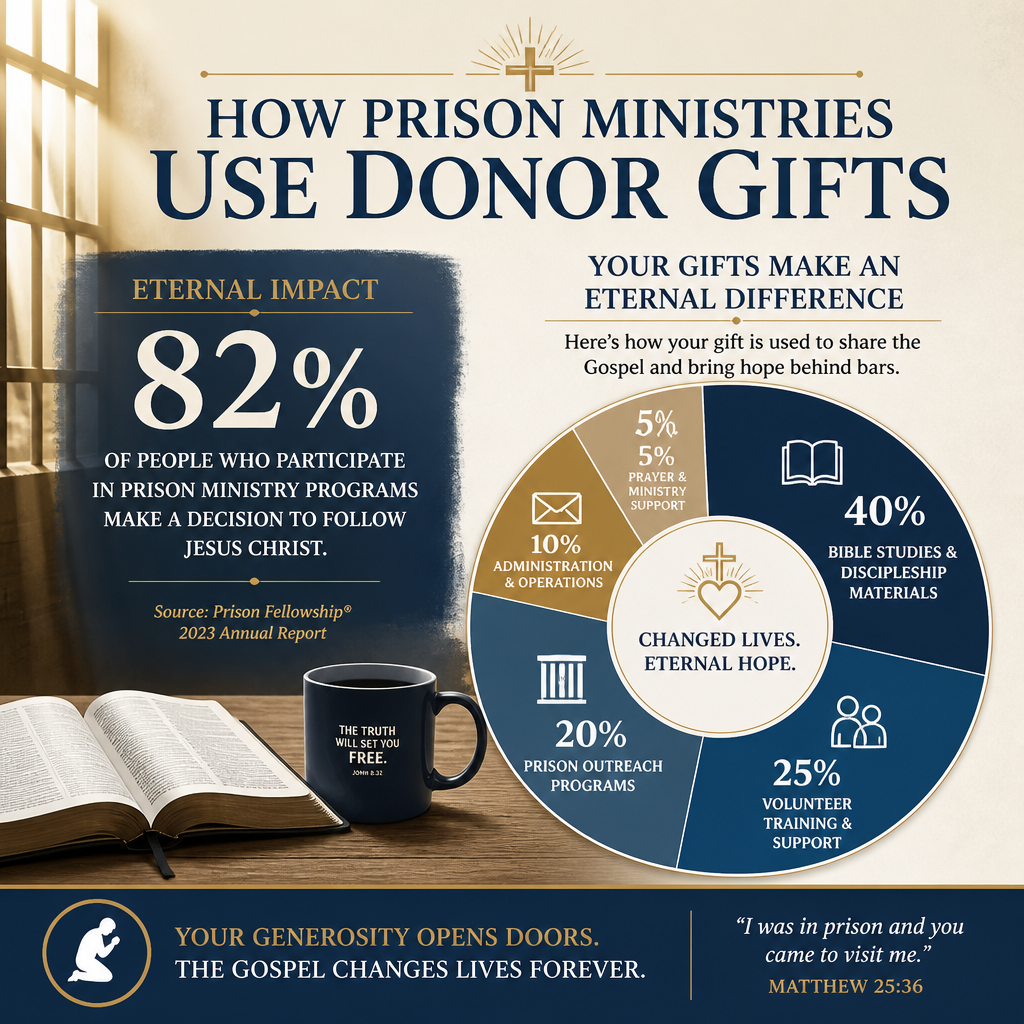
That kind of presence has predictable costs. Gifts fund the administrative backbone that makes access possible: background checks, scheduling, volunteer clearance processes, insurance, training, credentialing, and the staff time required to communicate with wardens, chaplains, and facility coordinators. Donors sometimes react strongly to “overhead,” but the sector has learned that underfunded infrastructure does not produce virtue; it produces fragility. The broader philanthropic field has been explicit on this point in the “Overhead Myth” letter led by GuideStar (now Candid), Charity Navigator, and the BBB Wise Giving Alliance (Candid).
Inside the walls, access itself is a ministry expense
Security requirements change without notice. Facilities lock down. Program rooms become medical overflow. Volunteer access can be suspended for reasons unrelated to ministry conduct. Gifts that fund staff who can maintain relationships, comply with shifting policies, and patiently re-open doors are not “indirect” to the mission; they are often the only way the mission remains possible.
Materials are real, but they are rarely the biggest line item
Bibles, study guides, and printed lessons matter, especially where digital access is restricted. Yet the largest costs in reputable prison ministries tend to be people and systems: staff coordinators, volunteer care, travel, and compliance. When donors ask, “How much of my gift buys Bibles?” a responsible ministry can answer plainly—without implying that the ministry’s effectiveness rises or falls on unit cost per book.
Continuity is part of pastoral ethics
Incarcerated men and women are accustomed to abandonment: fractured families, revolving staff, changing policies, and broken promises. When a ministry enters a facility and then disappears because funding was episodic, the harm is not only operational. It is pastoral. Monthly donor support often functions as an ethical commitment to continuity, not merely a budgeting preference.

Gifts often flow through partnerships, and donors should understand the risks
Many prison ministries operate in partnership with prison chaplains, state departments of corrections, local churches, and reentry coalitions. These partnerships can extend donor impact, but they also introduce shared-risk environments where the ministry does not control every variable. Wise donors do not demand total control; they demand transparent governance, clear agreements, and verifiable safeguards.
We advise donors to think in terms of roles. Chaplains provide institutional legitimacy, coordinate faith access in a pluralistic environment, and often vet programming. Independent ministries bring volunteers, discipleship pathways, and post-release connections that chaplain offices frequently cannot staff at scale. When these roles are confused, programs can become either performative or adversarial. When roles are clear, the partnership can be a genuine extension of the local church’s presence.
Memorandums of understanding and boundaries are not bureaucracy
Strong ministries use written agreements—sometimes formal MOUs, sometimes facility-specific documentation—to define who supervises volunteers, what materials can be distributed, and how incidents are reported. Donors may never see these documents publicly, since security policies can restrict disclosure, but a ministry can still describe its controls: volunteer codes of conduct, reporting channels, and how disciplinary decisions are made.
Data limitations are real, but basic accountability is still possible
Prisons are not research labs. Privacy restrictions, transfers, and parole decisions make longitudinal tracking difficult. Donors should be skeptical of ministries that promise clean, universal metrics. At the same time, donors should expect competent program monitoring: attendance logs, volunteer reporting, chaplain feedback, and documented follow-up after release where feasible. The goal is neither PR-friendly numbers nor cynicism, but a truthful account of what is being done and what is being learned.
Theologically, partnership is part of the doctrine of the church
Prison ministry exposes a practical ecclesiology question: is the incarcerated believer part of the church in a meaningful way, or a mission field kept at arm’s length? Partnerships that connect incarcerated Christians to local congregations, pastors, and small groups are often where donor dollars bear the most durable fruit. Hebrews calls the church to remember those in prison “as though in prison with them” (Hebrews 13:3). Financial support that strengthens this spiritual kinship is not sentimental; it is doctrinally coherent.
Training and support protect the vulnerable and strengthen credibility
Volunteerism is a gift to ministries, but it is not “free.” One of the clearest ways donor gifts are used is to train and support volunteers so that ministry inside prisons remains safe, respectful, and aligned with the gospel. Poorly trained volunteers can endanger themselves, compromise facility access, or harm incarcerated people through spiritual manipulation, inappropriate relationships, or careless disclosure.
Responsible training covers boundaries, security protocol, trauma awareness, and theological clarity. It also prepares volunteers for disappointment. Fruit in prison ministry is often slow and partially hidden. Donors who care about integrity should care about volunteer formation, because formation is what keeps a ministry from becoming an episodic emotional experience rather than a disciplined work of mercy.
Trauma and mental health realities shape the cost of faithful ministry
Incarcerated populations have high rates of prior trauma, addiction, and mental illness. Ministries do not need to medicalize discipleship, but they do need to understand the environment they are entering. The Bureau of Justice Statistics has reported high levels of diagnosed mental health conditions among people in state and federal prisons (Bureau of Justice Statistics). Training that helps volunteers recognize crisis indicators, refer appropriately, and avoid simplistic counsel is a direct use of donor funds that protects human beings made in God’s image.
Safeguarding is not optional even when the setting is adult and regulated
Prisons are controlled environments, yet misconduct still occurs—by incarcerated people, staff, and outsiders. A ministry’s safeguarding policies should be explicit: two-person rules where required, restrictions on personal contact, communication boundaries after release, and mandatory reporting practices. Donors should not accept vague assurances. A mature ministry can describe its controls clearly without sensationalism.
Care for volunteers is part of ethical stewardship
Secondary trauma and spiritual discouragement are not theoretical. Volunteers can carry heavy stories home, and they can also over-identify with an incarcerated participant in ways that cloud judgment. Gifts that provide volunteer debriefing, supervision, and pastoral support reduce preventable burnout and keep ministries stable over time. The alternative is the quiet churn of volunteers who mean well, disappear, and leave the incarcerated person to absorb another loss.
Financial accountability in prison ministry requires more than a low overhead ratio
Christian donors rightly want to avoid funding mismanagement. Yet prison ministry is one of the areas where simplistic tests—like “How low is the overhead?”—most reliably mislead. The better question is whether the ministry can demonstrate disciplined stewardship across governance, reporting, and outcomes it can actually verify.
Across our verification work at Most Trusted, the ministries that meet The Most Trusted Standard tend to share several marks: independent board governance with documented oversight, clean financial statements and consistent reporting practices, clear conflict-of-interest policies, and transparent communication that avoids exaggerated claims. Donors do not need perfection; they need evidence that the ministry can be trusted with money and with truth.
Donors should know what costs are normal and which are warning signs
Normal costs include staff who coordinate facility relationships, travel to rural prisons, training materials, insurance, and audit or review expenses. Warning signs include heavy related-party transactions, vague “program expense” categories without explanation, unusually high fundraising costs without clear donor acquisition strategy, and leadership compensation that is either hidden or defended with rhetoric rather than data. Donors can request a Form 990, audited financials if available, and a plain-language explanation of major expense lines.
Effectiveness should be described with humility and specificity
Some ministries cite reductions in recidivism as a proof text for donor impact. Recidivism itself is a contested measure: definitions vary, follow-up periods differ, and many factors beyond ministry influence outcomes. Even the U.S. Sentencing Commission’s recidivism work emphasizes the complexity of measuring reoffending and the importance of careful definitions (United States Sentencing Commission). Mature ministries may report reentry outcomes when they have credible tracking, but they will not treat a single percentage as the whole story.
More reliable indicators often include retention in post-release discipleship, connection to a local church, completion of accredited life-skills programs, stable housing placements through partners, and documented pastoral follow-up. These are not always easily aggregated, but they are closer to what donors actually care about: whether men and women are being loved well, taught faithfully, and supported toward a stable life.
Year-round giving aligns with the ministry timeline
Prison ministry runs on calendars donors rarely see: facility approvals, seasonal volunteer availability, lock-down cycles, and release dates that can change abruptly. Year-round support allows ministries to keep staff, retain access, and respond to pastoral needs that do not arrive on a neat fundraising schedule. It also reduces the temptation to raise money through emotional spikes that simplify the work and overpromise outcomes.
Giving that honors the gospel is both generous and discerning
Christian donors can honor Christ in prison ministry giving by refusing two equal errors: romanticizing the work and mistrusting it by default. The church is called to visit those in prison, and donors are called to give with wisdom. The question is not whether prison ministry deserves support, but whether a specific ministry demonstrates the character, governance, and financial discipline that make support responsible.
For donors evaluating ministries in this space, we recommend starting with the broader context of Prison and Post-Prison Ministries, then asking concrete questions: What does access cost? How are volunteers formed and supervised? What controls exist for safeguarding and finances? What outcomes can be documented without exaggeration? When those answers are clear, donor gifts are not merely funding activities. They are sustaining faithful presence in a place Jesus explicitly named.



