
How pregnancy resource centers support fathers is one of the most practical questions Christian donors can ask about pro-life ministry. If we believe every child is made in the image of God, then we cannot treat a father’s presence as optional to a family’s future; we should expect ministries to pursue both parents with clarity, dignity, and truth.
The public story about unplanned pregnancy often narrows to a mother and her choices. That focus is understandable, but it can become reductive. Many pregnancy resource centers have learned that a father’s engagement—or his absence—materially shapes safety, stability, and the likelihood that a mother will feel she has real alternatives. The harder question is how a center can invite fathers into responsibility without excusing coercion, minimizing trauma, or pressuring a mother to remain in an unsafe relationship.
Fathers are not an accessory to the mission
The biblical frame is responsibility and protection
Scripture presents fatherhood as more than biology. It is moral responsibility before God. “If anyone does not provide for his relatives, and especially for members of his household, he has denied the faith” (1 Timothy 5:8). That text does not reduce fatherhood to income, but it does refuse a spirituality that avoids concrete duty. In pregnancy ministry, that duty begins with presence, truthful counsel, and practical provision.
Centers that take this seriously do not merely “include men.” They treat father engagement as part of a coherent theology of family: mothers should not be left to carry what God designed to be shared, and children should not be deprived of the protection and nurture fathers can provide. Where reconciliation is possible and safe, it is worth pursuing. Where it is not, the ministry’s responsibility is to safeguard the vulnerable without romanticizing “family unity” at any cost.
The social reality is sobering, but not deterministic
Family instability is not a talking point; it is a measurable reality with long consequences. In the United States, roughly 40% of births are to unmarried women, a proxy indicator of how frequently families begin without the legal and often relational stability marriage can provide (Centers for Disease Control and Prevention, National Center for Health Statistics). Donors do not need inflated numbers to see the pastoral implications: many fathers are unprepared, disconnected from church life, or simply absent.
What this means in practice is that fatherhood ministry must be both evangelistic and formative. A class that assumes stable employment, prior church formation, and relational maturity will miss many of the men a center meets. Effective programs begin where men are, but they do not leave them there.

What father support actually looks like in a high-integrity center
Men need a clear pathway from crisis to responsibility
Across our verification work at Most Trusted, we observe that the healthiest pregnancy resource centers build a defined set of services for men that is integrated with case management rather than treated as an add-on. The objective is not to produce a “better vibe” at the center. It is to move a father from fear and avoidance toward consistent, verifiable responsibility.
In many communities, men arrive with a mixture of shame, anger, and confusion. Some are open to counsel but lack a model of fatherhood. Others are resistant and need firm boundaries. Mature centers use structured intake, written expectations, and a staged process that includes education, accountability, and referral when needs exceed the center’s scope.
Common services that strengthen fathers and protect families
The specific package varies by local context, but the most credible programs tend to include several of the following elements:
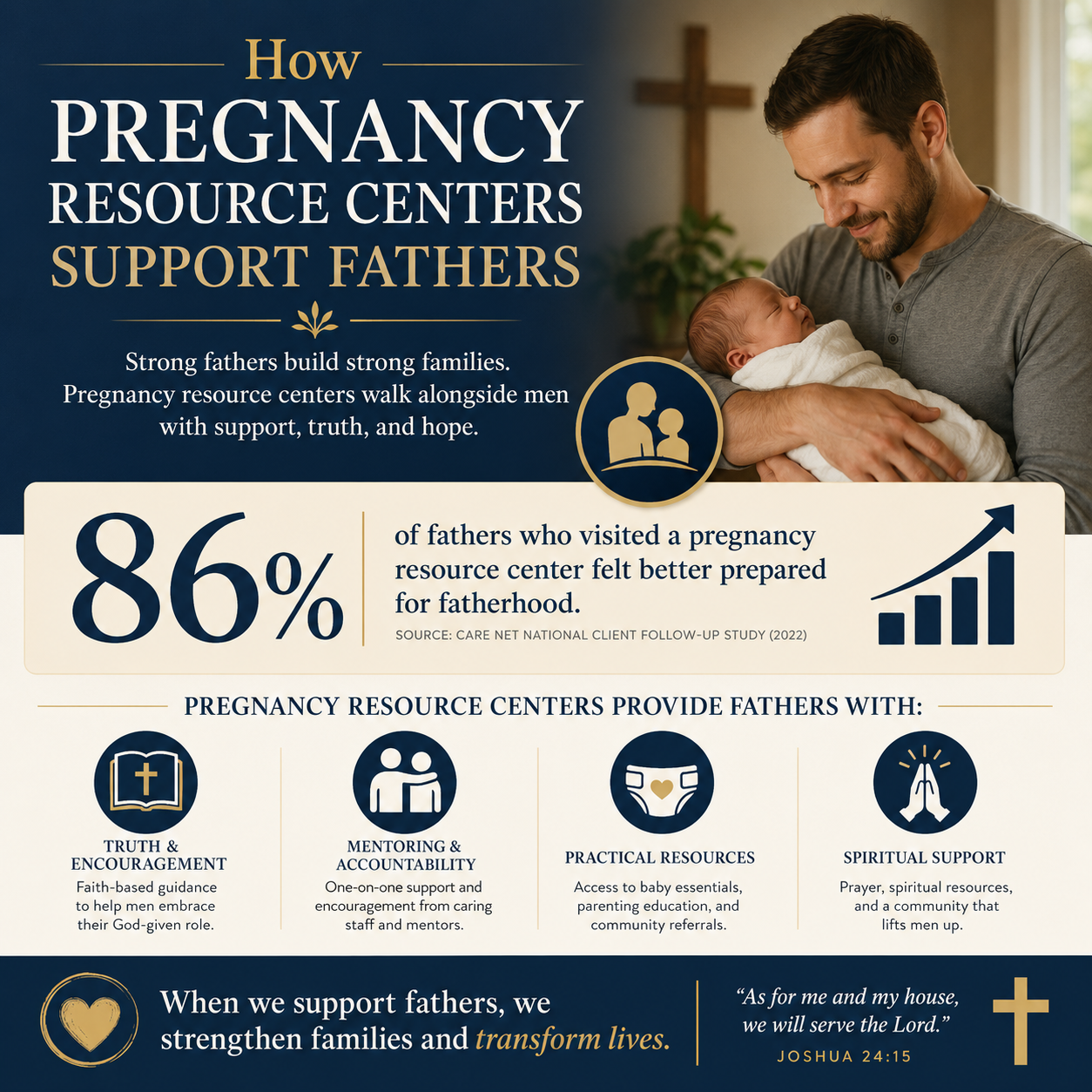
- Evidence-informed fatherhood education on child development, attachment, and co-parenting
- Mentoring by vetted men who can model stability and spiritual maturity
- Employment readiness support, including budgeting, interview preparation, and referrals
- Legal and child-support orientation with clear encouragement toward compliance and integrity
- Relationship skills training that emphasizes consent, communication, and noncoercive behavior
Donors should notice what is not on that list: vague motivational content without accountability, or relational pressure that treats marriage as a quick fix. A center can be pro-marriage and still recognize that rushed commitment can intensify instability rather than relieve it.
Safeguarding women while engaging men is a real tension
Trauma awareness and safety planning are nonnegotiable
Christians genuinely disagree about how quickly to pursue reconciliation in strained relationships. Yet the moral obligation to protect a mother from harm is not optional. A center that engages fathers responsibly will have explicit safety protocols: separate appointments when needed, clear confidentiality practices, documented screening for coercion, and referral relationships with domestic violence services.
Donors should be wary of programs that treat father engagement as an ideological checkbox. Coercion can present as “support.” The ministry’s duty is to pursue the good of the child and mother without enabling control. For many women, the most loving act a center can do is to help establish boundaries and support systems that do not depend on a father’s cooperation.
What healthy engagement requires from staff and volunteers
Male-focused ministry can expose staff to manipulation, hostility, and high-conflict situations. Centers that operate with integrity invest in training and supervision. They also resist the temptation to promise more than they can deliver. A volunteer mentor is not a therapist. A parenting class is not a substitute for substance-abuse treatment. Donors should expect ministries to name their limits plainly and to refer out appropriately.
For readers considering the broader landscape of programs and models, we maintain an editorial overview of Pregnancy Resource Centers that frames the mission with the seriousness it deserves.
What Christian donors should verify before funding father-focused work
Good intentions do not replace credible governance
Pregnancy resource centers operate in an environment of scrutiny, contested narratives, and real legal complexity. That is one reason verification matters. Most Trusted exists to help donors give with confidence by evaluating ministries against The Most Trusted Standard, a 15-criteria framework across Faith Foundation, Financial Integrity, Governance and Leadership, and Transparency and Effectiveness. The question is not whether a center says it supports fathers. The question is whether its leadership, finances, and outcomes reporting warrant trust.
Verifiable evidence suggests donors are increasingly attentive to whether ministries can document their work beyond anecdotes. The same is true in father-focused programs. A center does not need sophisticated social-science infrastructure, but it should be able to describe what it does, why it does it, and how it tracks participation and follow-through.
Practical signals of a trustworthy fatherhood program
We recommend looking for several concrete markers:
Clear boundaries and safety protocols: Written policies that prioritize maternal safety and address coercion.
Training and supervision: Documented preparation for staff and volunteers working with men in crisis.
Partnership maturity: Referral relationships with churches, workforce programs, counselors, and DV services.
Financial clarity: Transparent reporting that distinguishes restricted funds, program costs, and overhead without manipulating ratios. The “Overhead Myth” letter signed by GuideStar, Charity Navigator, and the BBB Wise Giving Alliance remains a useful corrective against simplistic overhead policing (Candid GuideStar).
Outcome humility: Honest reporting about what can be measured and what remains pastoral and long-term.
These criteria are not distractions from ministry. They are how donors honor the biblical call to stewardship. When Jesus commends faithfulness with resources, he commends faithfulness with reality, not with slogans.
Father support strengthens the center’s witness in the community
Public credibility follows consistent care
Pregnancy resource centers often face suspicion that they care about birth but not about family flourishing. Some of that suspicion is ideological, but some of it is earned by shallow models that offer material support without durable relational pathways. A serious commitment to fathers is one of the clearest ways to demonstrate that a center’s ethic is holistic: life, responsibility, and long obedience in the same direction.
This does not require politicized messaging. It requires consistent service, transparent operations, and partnerships that outlast media cycles. When a father becomes dependable—showing up to appointments, providing materially, learning to co-parent with respect—the community sees something difficult to caricature.
The church’s role is formation, not just referral
Many centers are para-church ministries that depend on local congregations for volunteers, mentors, and downstream discipleship. A fatherhood class can open the door, but the church must often provide the long-term formation that teaches a man to love his family, repent of sin, and grow in self-control. Donors can strengthen this ecosystem by funding not only the center’s direct services but also its coordination work with local churches.
For donors wanting a deeper frame for this mission area, our coverage of The Faith-Based Mission of Pregnancy Resource Centers addresses why Christian conviction must be matched by credible practice.
FAQs for How pregnancy resource centers support fathers
Do pregnancy resource centers pressure couples to marry?
Healthy centers encourage stability and responsibility without treating marriage as a transactional requirement for assistance. Christian teaching honors marriage, but credible ministries also recognize that rushed commitments can worsen instability or endanger a woman when coercion is present. Donors should look for programs that combine pro-marriage conviction with clear safety protocols and voluntary participation.
What outcomes can a fatherhood program reasonably measure?
Most centers can track participation and completion rates for classes, mentoring engagement, and referrals completed, and they can document concrete steps such as employment placement support or parenting plan compliance when clients choose to share it. Long-term outcomes—relationship stability, child well-being, sustained church involvement—are harder to measure and often unfold over years. Trustworthy ministries are specific about what they can document and careful not to imply more certainty than the data supports.
Why father support belongs in faithful, careful giving
Supporting fathers is not a secondary concern for pregnancy resource centers; it is one of the most direct ways a ministry can embody a pro-life ethic that extends beyond a single moment of crisis. Christian donors should fund this work with both compassion and discernment, prioritizing centers that engage men with clarity, protect women with seriousness, and demonstrate the governance and transparency that faithful stewardship requires.



