
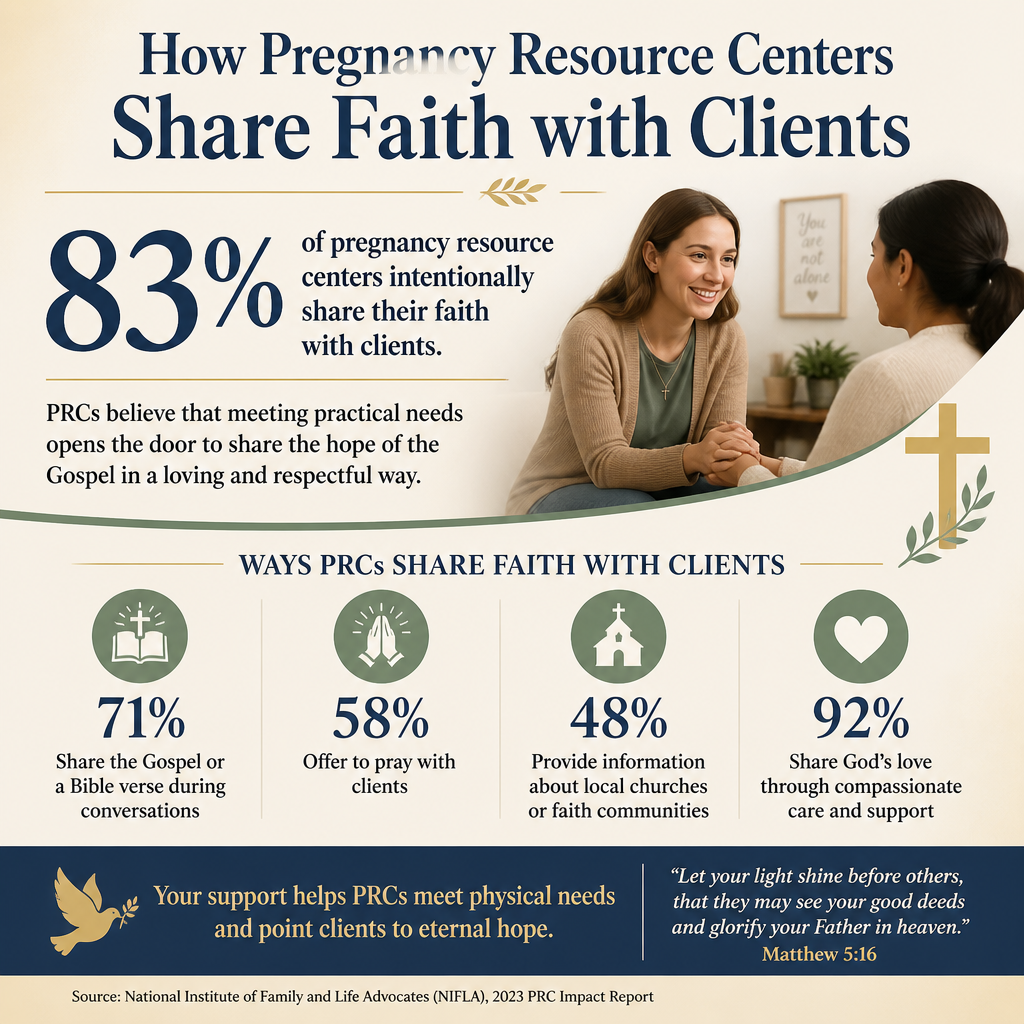
How pregnancy resource centers share faith with clients is one of the most misunderstood questions in pro-life ministry. Christian donors often assume the choice is binary: either a center is “gospel-centered” and overt, or it is “client-centered” and quiet. In practice, faithful centers work inside a set of ethical, legal, pastoral, and trauma-informed constraints that require more maturity than slogans can carry.
For donors, the deeper stewardship question is not whether a center ever mentions Jesus. It is whether the ministry’s witness is truthful, non-coercive, and integrated with excellent care for women and families made in God’s image (Genesis 1:27). The aim is not religious pressure. The aim is love of neighbor expressed through competent service and a credible invitation to the hope of the gospel.
Faith sharing is shaped by consent, vulnerability, and trust
The client relationship is not a neutral power dynamic
Clients usually come to pregnancy resource centers with high stakes: fear, time pressure, relational instability, financial anxiety, and a sense of isolation. The center holds information, resources, and relational support that can feel indispensable in the moment. That asymmetry is precisely why responsible Christian witness requires explicit respect for consent.
Christian ethics does not treat vulnerability as an opportunity. It treats it as a call to protection. Jesus’ pattern in the Gospels is neither manipulation nor distance; it is presence, truth-telling, and mercy. When centers share faith well, they communicate: “You are not a project. You are a person. We will serve you whether or not you agree with us.”
Many centers separate services from spiritual conversations
Across the field, a common approach is to keep core services—pregnancy testing, ultrasound referrals where permitted, material support, parenting education—clearly available regardless of a client’s spiritual interest. Faith conversations are offered, not assumed. A client can decline prayer, Scripture, or a pastoral conversation and still receive the help the center provides.
Donors sometimes worry that this is compromise. The harder question is whether it is integrity: refusing to attach spiritual conditions to material care mirrors the logic of grace. That does not make the gospel optional; it makes the gospel uncoerced.

What faithful evangelism looks like in a clinical-adjacent setting
Prayer and Scripture are offered, not imposed
Most pregnancy resource centers are not churches. They operate in offices that feel partly clinical and partly pastoral. In that environment, faith is often shared through small, explicit invitations: “Would you like prayer?” “May we share why we do this?” “Would you like to speak with a spiritual mentor?” The tone matters. The goal is to honor agency, not to win an argument.
Centers that do this well also distinguish between witnessing and debating. A client may hold convictions shaped by trauma, ideology, or misinformation. Patient listening can itself be a form of Christian witness, particularly when it is paired with truthful information about parenting, adoption, and the physical realities of pregnancy.
Discipleship often happens through referral and relationship
In many communities, the most sustainable form of discipleship is not housed inside the center’s programs. It happens through warm handoffs to local churches, women’s Bible studies, recovery programs, and Christian counseling. A center may be the first safe doorway; the church is often the long-term home.
That relationship between center and church can be a point of strength or a point of risk. When church partnerships are healthy, they create continuity of care for mothers and fathers beyond the pregnancy decision. When they are poorly governed, they can drift into pressure tactics or confidentiality failures. Wise donors ask how the center vets partners and protects clients.
Integrity requires clarity on what the center is and is not
Transparency is part of Christian witness
Some controversy in the sector exists because of confusion about services. The most defensible centers are explicit about what they provide and what they do not: they are typically not abortion providers, not emergency rooms, and not a substitute for ongoing prenatal care. Clear communication is not merely a compliance concern; it is a credibility concern for the gospel.
That commitment to transparency extends to the ministry’s faith identity. A center should not hide that it is Christian, but it also should not blur the line between pastoral counsel and medical care. Donors who want a deeper understanding of the wider landscape can review Pregnancy Resource Centers as a field, including the practical questions that shape day-to-day client care.
Legal and regulatory constraints shape how faith is expressed
Pregnancy resource centers operate under state laws that vary widely, including regulations about medical licensure, advertising, and the use of medical terms. Even when a center is fully compliant, it may choose conservative practices to avoid confusing clients about the nature of its services.
Those constraints do not eliminate evangelism, but they do change its form. Faith is more likely to be shared in counseling rooms than on signage, in conversations than in scripts, and through voluntary spiritual mentoring rather than as a default part of every appointment.
What donors should evaluate when a center claims to be gospel-centered
Five questions that reveal whether faith and ethics are integrated
Christian donors have a legitimate concern: a ministry can use religious language while practicing coercion, or it can provide competent services while slowly losing theological clarity. The most responsible centers are explicit about both. The following questions tend to separate mature ministry from branding:
- Does the center clearly state that services are available regardless of a client’s faith, and is that practiced consistently?
- How does the center define informed consent, confidentiality, and documentation in client interactions?
- Are staff and volunteers trained in trauma-informed care and spiritual care boundaries appropriate to the setting?
- Does the center have a clear statement of faith and a responsible church partnership policy?
- Is there a mechanism for client feedback and complaint resolution that the board oversees?
These are not abstract governance concerns. They are the practical outworking of the command to “speak the truth in love” (Ephesians 4:15). In a ministry serving vulnerable people, truth without love becomes brutality, and love without truth becomes sentimentality.
Verification should include governance and transparency, not only program stories
Pregnancy resource centers often communicate impact through testimonials and baby item counts. Those narratives can be real and moving, but mature donors also look for verifiable indicators: independent audits or financial reviews when appropriate, board independence, conflict-of-interest policies, and clear reporting. The modern philanthropic environment rewards marketing; Christian stewardship requires discernment.
At Most Trusted, our role is to help donors give with confidence by evaluating ministries against The Most Trusted Standard, a 15-criteria framework spanning Faith Foundation, Financial Integrity, Governance and Leadership, and Transparency and Effectiveness. When a center meets that standard, the donor can have greater confidence that faith is being shared without compromising ethics, and that compassion is being offered without drifting from Christian conviction.
The real tension is not faith versus care, but witness versus pressure
Christians genuinely disagree about the proper level of explicitness
Some donors believe a center should verbally present the gospel in every client relationship. Others believe the center should primarily offer compassionate care and trust that spiritual conversations will emerge naturally. The disagreement is not trivial, and it is shaped by differing assumptions about evangelism, institutional trust, and the nature of crisis counseling.
What this means in practice is that donors should not evaluate faithfulness by volume alone. A quiet offer of prayer that honors a client’s dignity can be more faithful than a scripted presentation that ignores her stated boundaries.
The credibility of the gospel is at stake in contested public space
Pregnancy centers operate under intense scrutiny from media, advocacy groups, and regulators. Some critiques are ideologically driven and unfair. Others expose genuine failures that the field must reckon with: inadequate training, unclear medical claims, or weak governance. When these failures occur, they do not only harm clients; they also weaken public credibility for Christian witness.
For that reason, donors who care about evangelism should care about compliance, documentation, and humility in public claims. A ministry does not honor Christ by overpromising. It honors Christ by serving truthfully, protecting the vulnerable, and refusing to confuse persuasion with love.
Within The Faith-Based Mission of Pregnancy Resource Centers, the strongest examples we see are ministries that treat faith sharing as a form of discipleship practiced under authority: accountable to Scripture, accountable to ethical standards, and accountable to boards that take oversight seriously.
FAQs for How pregnancy resource centers share faith with clients
Do pregnancy resource centers require clients to participate in religious activities?
Practices vary, but many centers explicitly state that services are provided regardless of a client’s faith commitment. Donors should look for written policies and consistent client-facing language that distinguishes between required intake procedures and optional spiritual supports such as prayer, Scripture reading, or pastoral conversations.
How can donors tell whether a center’s faith sharing is ethical and non-coercive?
We recommend examining whether the center has clear consent practices, trauma-informed training, confidentiality safeguards, and board oversight of complaints. Ethical faith sharing is typically characterized by voluntary spiritual conversations, transparent communication about services, and documented policies that protect clients from pressure.
Christian witness is strongest when it is both explicit and accountable
How pregnancy resource centers share faith with clients should be evaluated by more than religious vocabulary. The mature question is whether a center’s gospel claims are matched by practices that honor consent, protect the vulnerable, and tell the truth about what the center provides.
For Christian donors, this is not merely reputational risk management. It is a stewardship obligation. When faith is shared with humility and excellence, it strengthens both the client’s trust and the church’s public credibility, and it reflects the character of the One we proclaim.



