

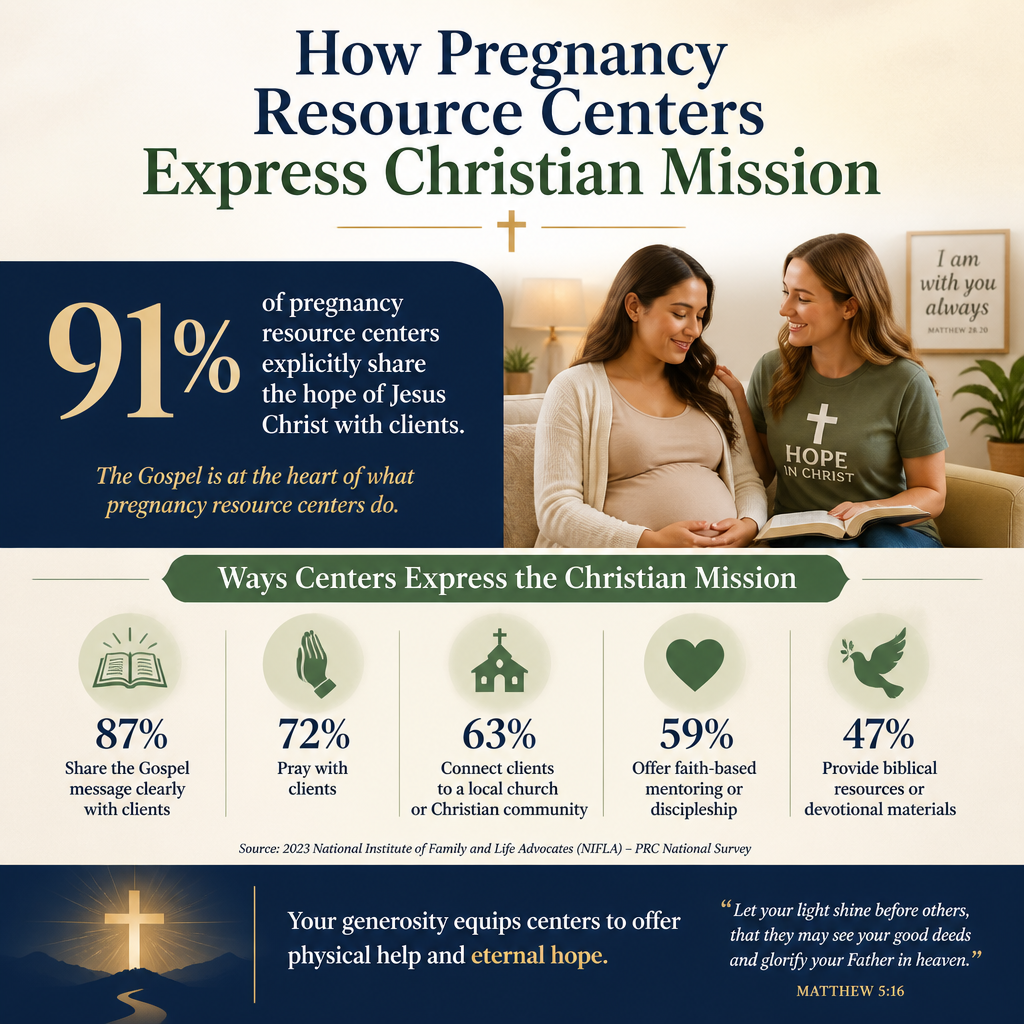
How pregnancy resource centers express Christian mission is not primarily a question of branding or even of program design. It is a question of what kind of neighbor-love the church believes is faithful when a woman faces a pregnancy she did not plan, does not feel prepared for, or fears she cannot carry. Donors tend to sense the stakes immediately: if the gospel is true, then crisis cannot be met with slogans, and vulnerable people cannot be treated as instruments for a cause.
The public debate around pregnancy is emotionally charged, and pregnancy resource centers operate in that pressure. Christians genuinely disagree about policy strategy, rhetoric, and the boundaries of church and state. Yet the heart of Christian mission is not contested: God meets people in their need with truth and mercy held together, and he commands his people to do the same. When donors ask whether a pregnancy resource center is “faithful,” we find it more useful to ask whether its life together resembles the moral shape of the gospel it proclaims.
Christian mission begins with the image of God and the reality of embodied vulnerability
Personal dignity is not an abstraction in a counseling room
Pregnancy resource centers do their work at the intersection of theology and embodied life. Scripture’s insistence that every person bears the image of God (Genesis 1:27) is not merely a pro-life premise; it is a directive for how a frightened client is received, listened to, and protected. In practice, mission is expressed when centers treat women as moral agents made for truth, not as problems to be managed or marketing to be captured.
This is also where Christian donors can misread the moment. The first need in many appointments is not argument; it is safety. A center can believe firmly that unborn life is sacred and still understand that coercion, manipulation, or shame contradict the God who “will not break a bruised reed” (Isaiah 42:3). That biblical posture is not softness about moral claims; it is seriousness about how God handles human frailty.
Compassion is credible when it is costly and proximate
Mission shows itself in what a center is willing to carry. The credible expression of Christian conviction is time-consuming care: unhurried counseling, follow-up after appointments, and practical support that does not evaporate when the client declines a preferred decision. This is where donors can look for the difference between persuasion and accompaniment.
Across our verification work at Most Trusted, ministries that meet The Most Trusted Standard tend to describe their “success” with moral clarity and pastoral restraint. They are more willing to document what they actually did for families over time than to promise results they cannot control.

The best centers integrate truth-telling with mercy in ways clients can actually experience
Informed consent is a theological issue, not only a legal one
Truth is not optional in Christian mission. When a center offers pregnancy testing, ultrasound services, or referrals, the moral burden is accuracy, clarity, and a refusal to exaggerate. This matters ethically because a woman in crisis is not in a neutral decision-making environment; fear and time pressure can compress her sense of agency. If she later discovers she was misled, the center’s message about Christ will be heard as one more attempt to control her.
This is one reason sophisticated donors ask about training, medical oversight, and written protocols. It is also why we encourage donors to understand the regulatory environment. Ultrasound and medical services are governed differently by state, and the details vary, but a center’s posture toward professional standards is still observable in governance decisions and in how it communicates limitations.
Mercy includes material support and relational stability
Mission is also expressed in the tangible. Diapers and car seats are not sacraments, but they can be acts of mercy. What this means in practice is that many centers function as a bridge between a moment of crisis and a longer arc of stability—connecting clients to prenatal care, housing support, parenting classes, adoption agencies, or church communities that can sustain relationship.

Donors should not romanticize this work. The needs are complex, and the outcomes are mixed, especially when poverty, domestic violence, addiction, or housing instability are present. The strength of a center is often measured less by a dramatic story and more by whether it has built steady partnerships with local clinics, social services, and churches.
Centers express Christian mission through a holistic ethic of life beyond the pregnancy decision
Love that endures after birth tests a center’s integrity
Pregnancy is a threshold, not the finish line. A center’s mission is more fully expressed when it stays present after the baby arrives: postpartum check-ins, parenting education, material support, and referrals for mental health and family stability. This is not merely a strategy for retention; it reflects a Christian conviction that neighbor-love is measured in endurance.
In the United States, maternal health outcomes remain a sober reality. The U.S. maternal mortality rate was 18.6 deaths per 100,000 live births in 2023, according to the Centers for Disease Control and Prevention CDC. Pregnancy resource centers are not hospitals, and donors should not expect them to substitute for clinical care, but mission-shaped centers will take maternal well-being seriously through referral networks, education, and appropriate safeguards.
Adoption, parenting, and family preservation require moral nuance
Christians genuinely disagree about how pregnancy resource centers should speak about adoption, particularly in cultures where economic pressure can distort consent. A faithful center will treat adoption as a serious, regulated legal process that requires informed, voluntary decisions and professional counsel. It will not frame adoption as a simplistic “solution” to moral complexity.
Likewise, “supporting life” is not limited to one decision. It includes protecting women from abusive partners, encouraging men toward responsibility, and connecting families to community resources. The field has learned that when fatherhood is addressed with clarity and care, family stability can improve. But this must be done with discernment: safety planning and trauma-informed practice matter, and centers should be candid about what they can and cannot provide.
Public credibility is a moral asset, and it rises or falls on transparency and governance
Donors should evaluate more than intentions
Pregnancy resource centers often receive intense scrutiny, and not all criticism is fair. Still, Christian mission is compromised when organizations resist accountability. The credibility of the gospel is implicated in the credibility of the institution that claims to serve in Christ’s name. That is why mature donors examine governance, financial reporting, and leadership practices with the same seriousness they apply to theological alignment.
At Most Trusted, our work is to help donors give with confidence by evaluating ministries against The Most Trusted Standard, a 15-criteria framework spanning faith foundation, financial integrity, governance and leadership, and transparency and effectiveness. This kind of evaluation does not reduce ministry to metrics; it protects ministry from avoidable moral failures and from the donor cynicism that follows.
Transparency is part of truth-telling
Clear communication about services is a recurring fault line. Centers should describe what they do, what they do not do, and what credentials their staff hold. They should avoid language that blurs the line between medical services and counseling when those functions are distinct. Where they claim outcomes, they should be able to document them responsibly without exploiting client stories.
Donors can also resist a common mistake: treating “low overhead” as a spiritual virtue. The “Overhead Myth” statement, signed by major charity evaluators, argued that overhead ratios are a poor measure of nonprofit performance and can incentivize underinvestment in systems and staff Candid GuideStar. In pregnancy ministry, underinvestment can mean inadequate training, weak safeguards, and poor documentation—failures that harm clients and damage the witness of the church.
For Christian donors, wise partnership means funding practices that reflect the gospel’s moral shape
What to look for when mission is authentic
Christian donors are not only underwriting a service menu; they are strengthening a moral ecology around vulnerable families. That is why we encourage donors to ask questions that get beneath promotional language and into operational reality. The strongest centers tend to be unembarrassed about Christian conviction and equally unembarrassed about professional excellence.
- Clear Christian identity that informs staff formation, counseling posture, and partnership choices without weaponizing Scripture.
- Accurate service descriptions with written policies on informed consent, confidentiality, and referrals.
- Competent governance with an active board, conflict-of-interest practices, and documented oversight.
- Financial transparency that provides accessible reporting and demonstrates stewardship beyond fundraising appeals.
- Aftercare commitment that reflects endurance: parenting support, material assistance, and reliable community connections.
How to give without inflaming the culture war
Some donors worry that giving to pregnancy resource centers necessarily ties them to combative public rhetoric. The harder question is whether donors can fund a form of witness that is both courageous and peaceable. Many centers serve quietly, building trust with local clinics, churches, and social service partners. Others are more publicly engaged. Donors can support the former without condemning the latter, but wise giving requires clarity about what is being funded.
For readers seeking a broader view of the landscape, we track patterns and verification considerations across Pregnancy Resource Centers work nationally. The goal is not to homogenize ministries but to help donors distinguish between Christian conviction expressed as patient care and Christian conviction expressed as mere activism.
FAQs for How pregnancy resource centers express Christian mission
Do pregnancy resource centers have to provide medical services to be authentically Christian?
No. Christian mission is not measured by whether a center offers ultrasound or other clinical services. It is measured by whether the center’s truth-telling, compassion, and care for vulnerable neighbors reflect the character of Christ. Some centers serve primarily through counseling, material support, parenting education, and referrals, and they do so faithfully when they maintain accuracy, confidentiality, and strong partnerships with medical providers.
What is the most common red flag donors should watch for?
Misrepresentation. If a center’s marketing implies services it does not provide, blurs clinical and non-clinical roles, or uses fear-based claims it cannot substantiate, donors should pause. Strong centers can name limits plainly, describe credentials accurately, and still speak with moral clarity. For related considerations about faith-based identity and accountability, see The Faith-Based Mission of Pregnancy Resource Centers.
Mission that can be trusted
Pregnancy resource centers express Christian mission most convincingly when they hold together convictions many institutions separate: truthful speech and patient presence, moral seriousness and gentleness, compassion for women and protection for unborn life, local partnership and institutional accountability. Donors serve the church well when they fund that integrated witness—work that can withstand scrutiny because it is anchored in both the gospel’s claims and the gospel’s character.



