
When Christian donors ask what services pregnancy resource centers fund most, they are rarely asking for a budget spreadsheet alone. They are asking whether a local ministry’s work is both faithful and competent: whether it protects mothers and children, whether it speaks truthfully, and whether it offers the kind of steady care that makes choosing life plausible when fear, pressure, and isolation are loud.
Pregnancy resource centers vary widely in scope. Some are volunteer-heavy storefront ministries. Others operate medical clinics with licensed staff. Many sit somewhere between. What they share is a mission anchored in a Christian conviction about the dignity of life, expressed through practical help. The question for donors is how that conviction becomes funded services, and how to discern whether those services are delivered with integrity.
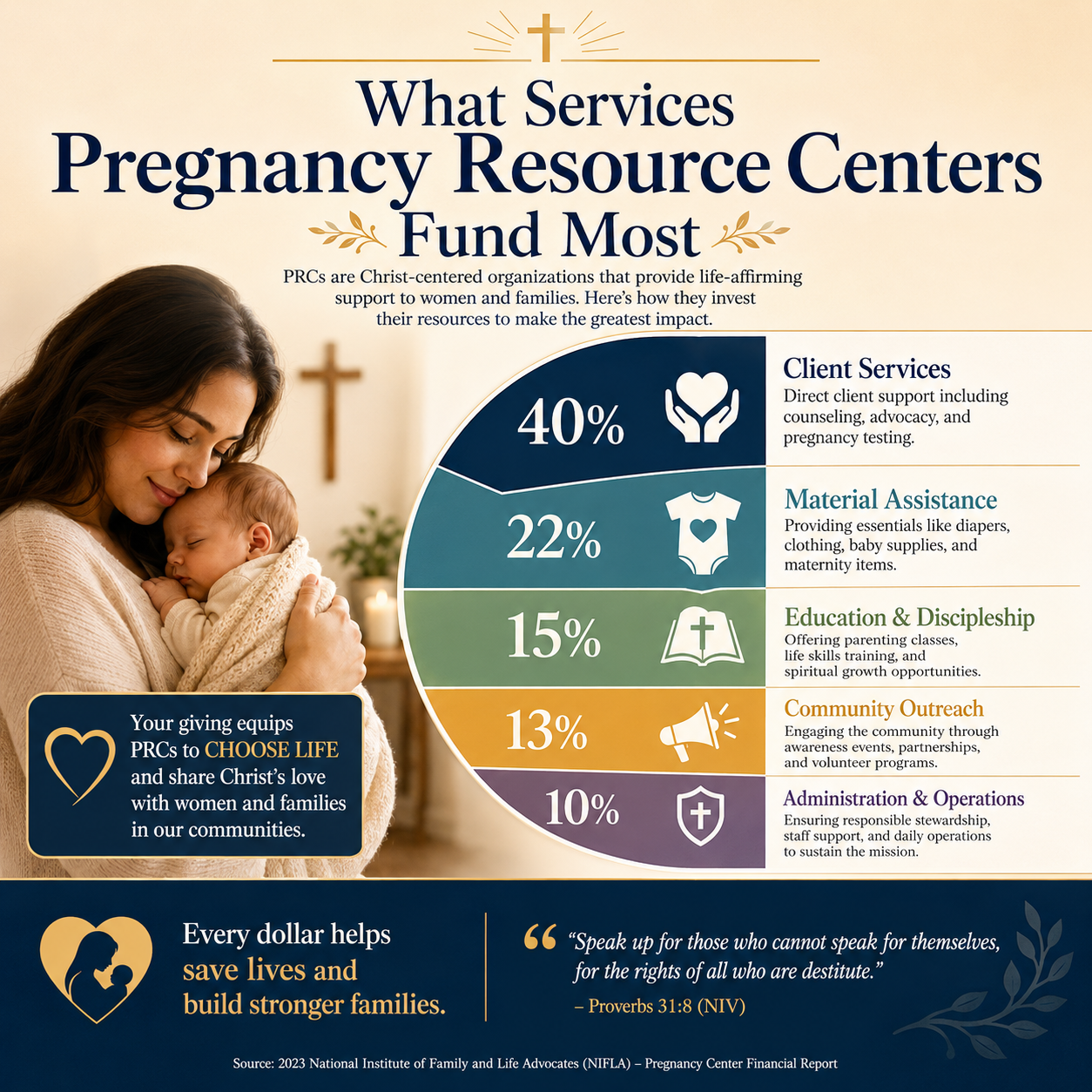
1 Direct client care usually draws the largest share of program spending
Across the sector, the most visible expenses are the ones closest to a client: staffing, supplies, and the infrastructure required to offer consistent, confidential care. Centers that provide medical services face higher fixed costs than purely educational ministries, because licensed clinical care requires credentialed personnel, medical oversight, and compliance.
What this means in practice is that donors should expect a meaningful share of giving to fund staff time, not only “items.” A center can distribute diapers at scale, but it cannot walk a frightened woman through options counseling, safety planning, or a complicated relationship without trained, accountable people.
Staffing and supervision are not secondary costs
In mature centers, staffing includes client advocates, nurses where applicable, program directors, and training for volunteers. Supervision matters because pregnancy decisions often intersect with trauma histories, domestic coercion, and mental health concerns. Donors sometimes resist funding “people,” but Scripture’s call to wise care assumes skilled shepherding, not only material aid.
Facilities and confidentiality are part of ministry
Safe spaces—private rooms, secure data systems, and clear policies for confidentiality—are ministry expenses, not luxuries. They protect clients from shame and from real risk. In a culture where personal information is easily mishandled, donors should treat privacy practices as a moral concern, not a technical one.

2 Material support is common because it keeps help concrete and immediate
Many pregnancy resource centers fund material assistance heavily because it meets tangible needs and reduces immediate pressures. Diapers, wipes, car seats, formula, maternity clothing, and infant clothing are ordinary goods with extraordinary significance when a woman is choosing between rent and a pack of diapers.
Material support is also a point where Christian donors can misunderstand the purpose. The aim is not to “purchase” a decision, nor to create a transactional relationship. The aim is to express mercy in ways that stabilize a household and open space for better choices.
Earn while you learn models are widespread
A common approach ties material items to participation in parenting classes or life-skills education. This structure can dignify clients by emphasizing growth and preparation, but it requires careful handling. If the system becomes punitive or humiliating, it contradicts the very compassion it is meant to convey.
One short list of material categories donors typically underwrite
- Diapers and wipes
- Infant clothing and blankets
- Car seats and pack-and-plays
- Formula and feeding supplies
- Maternity clothing
These categories are not exhaustive, but they capture the core. Donors should ask whether material distribution is paired with relational care and clear policies that prevent favoritism, coercion, or unsafe practices.

3 Education and coaching shape long term outcomes more than donors often assume
Pregnancy is often the doorway into a wider set of vulnerabilities: unstable relationships, fragile finances, and lack of supportive family systems. Many centers therefore fund parenting education, mentoring, and coaching as central services rather than add-ons.
This is where the field has had to reckon with a real tension. Christians genuinely disagree about how much a pregnancy resource center should function as a crisis-response ministry versus a longer-term family strengthening ministry. The best centers tend to be clear about their scope and referral networks, rather than trying to be everything for everyone.
Parenting education and fatherhood engagement
Parenting curricula, mentorship, and support groups cost money: curriculum licensing, staff time, childcare, and follow-up. Some centers also fund programming aimed at fathers, recognizing that stable father involvement is a protective factor for children and mothers. Even when fathers do not remain involved, a center’s willingness to engage men can signal a serious view of family responsibility.
Spiritual care is often funded quietly, and should be evaluated carefully
Many centers fund chaplaincy, Bible studies, prayer support, or discipleship relationships. Donors who share the center’s theological commitments often celebrate this, and rightly so. Yet spiritual care should be offered in a way that respects client dignity and avoids manipulation. A credible ministry can articulate how it invites spiritual conversation without conditioning material help on religious participation.
For donors trying to think more broadly about the ecosystem of care, our coverage of Pregnancy Resource Centers addresses common models and the questions they raise for Christian stewardship.
4 Medical services are funded where offered and they carry heightened responsibility
Not every pregnancy resource center is a medical clinic. Where medical services are provided, however, they frequently represent a significant portion of funded services because they require licensed personnel, training, equipment, malpractice coverage, and medical oversight.
At their best, medical services help confirm pregnancy status, provide accurate information, identify red flags for ectopic pregnancy, and connect women to appropriate prenatal care. At their worst, clinical language can be used to imply medical authority where none exists. Donors should be sober about this distinction.
What medical services commonly include
Many clinics provide pregnancy testing and limited obstetric ultrasound. Donors should ask how the center describes what it does and does not provide, and whether that description is consistent across its website, printed materials, and client intake process.
For context, the U.S. Food and Drug Administration warns that at-home pregnancy tests are accurate when used correctly, but accuracy depends on timing and proper use; confirmatory testing and medical follow-up still matter in many cases U.S. Food and Drug Administration.
Compliance and medical governance are donor concerns
Medical ministries must address HIPAA where applicable, informed consent, recordkeeping, and clinical protocols. These are not optional administrative burdens; they are safeguards for vulnerable people. When donors evaluate a medical center, it is appropriate to ask about medical director involvement, credential verification, and how adverse incidents are handled.
5 Operating support and communications are often the most misunderstood uses of funds
Many donors assume that the “best” pregnancy resource center is the one with the lowest overhead. That assumption has been repeatedly challenged in the broader nonprofit sector. The Overhead Myth letter—signed by major evaluators and accountability organizations—argues that fixation on overhead can starve organizations of the infrastructure required for effectiveness Charity Navigator.
In pregnancy resource work, underfunded infrastructure can produce predictable failure modes: high volunteer turnover, poor training, inadequate data security, weak governance, and messaging that damages credibility. A center may be sincerely pro-life and still be poorly led. Donors should not confuse low administration with high trustworthiness.
Communications and community education are part of public witness
Centers spend money on websites, search visibility, print materials, and community partnerships because women in crisis must be able to find help quickly. This is ethically complex. Christians want truthful communication that does not mislead. Donors should expect messaging to be clear about services offered, limitations, and referral practices, especially around medical claims.
How we encourage donors to evaluate spending decisions
At Most Trusted, we verify Christian nonprofits against The Most Trusted Standard, a 15-criteria framework spanning faith commitments, financial integrity, governance and leadership, and transparency and effectiveness. In this category, we pay close attention to whether spending aligns with a clearly stated mission, whether leadership oversight is real, and whether a center is candid about what it can and cannot provide.
For a closer look at donor-relevant spending patterns and the accountability questions they raise, see How Pregnancy Resource Centers Use Donations.
FAQs for What services pregnancy resource centers fund most
Do pregnancy resource centers typically spend more on diapers or on counseling and staff?
Many centers distribute significant material aid, but staff time often represents a larger and more consistent expense, especially where centers provide coaching, mentoring, or medical services. Material support is highly visible; staffing and supervision are less visible but frequently determine whether care is safe, competent, and consistent.
Should donors prefer centers that are medical clinics rather than nonmedical centers?
Not necessarily. Medical clinics can offer valuable services, but they also carry higher regulatory and governance demands. Nonmedical centers can be effective when they are transparent about their scope, provide high-quality education and coaching, and maintain strong referral relationships. The donor’s task is to evaluate clarity, accountability, and integrity rather than assuming one model is always superior.
What wise funding asks for
Pregnancy resource centers fund the services that make a pro-life ethic credible to a woman under pressure: direct care, material support, education, and—where offered—medical services, all sustained by governance and operational infrastructure. Christian donors serve mothers and children best when giving is both compassionate and discerning, honoring truthfulness, competence, and the long obedience required for faithful care.



