
How pregnancy resource centers spend donations is not a peripheral question for Christian donors. The answer shapes whether our giving protects vulnerable women, honors the unborn, and reflects the character of God who draws near to those in distress.
Most pregnancy resource centers are small, locally rooted ministries. That reality carries a strength—proximity to real needs—and a risk—uneven governance, limited financial capacity, and wide variation in transparency. Wise generosity neither assumes the worst nor funds on sentiment alone. Scripture commends openhanded mercy, and it also commends careful stewardship: “Moreover, it is required of stewards that they be found faithful” (1 Corinthians 4:2).
What donors usually mean by spending well
Direct services are not only ultrasounds
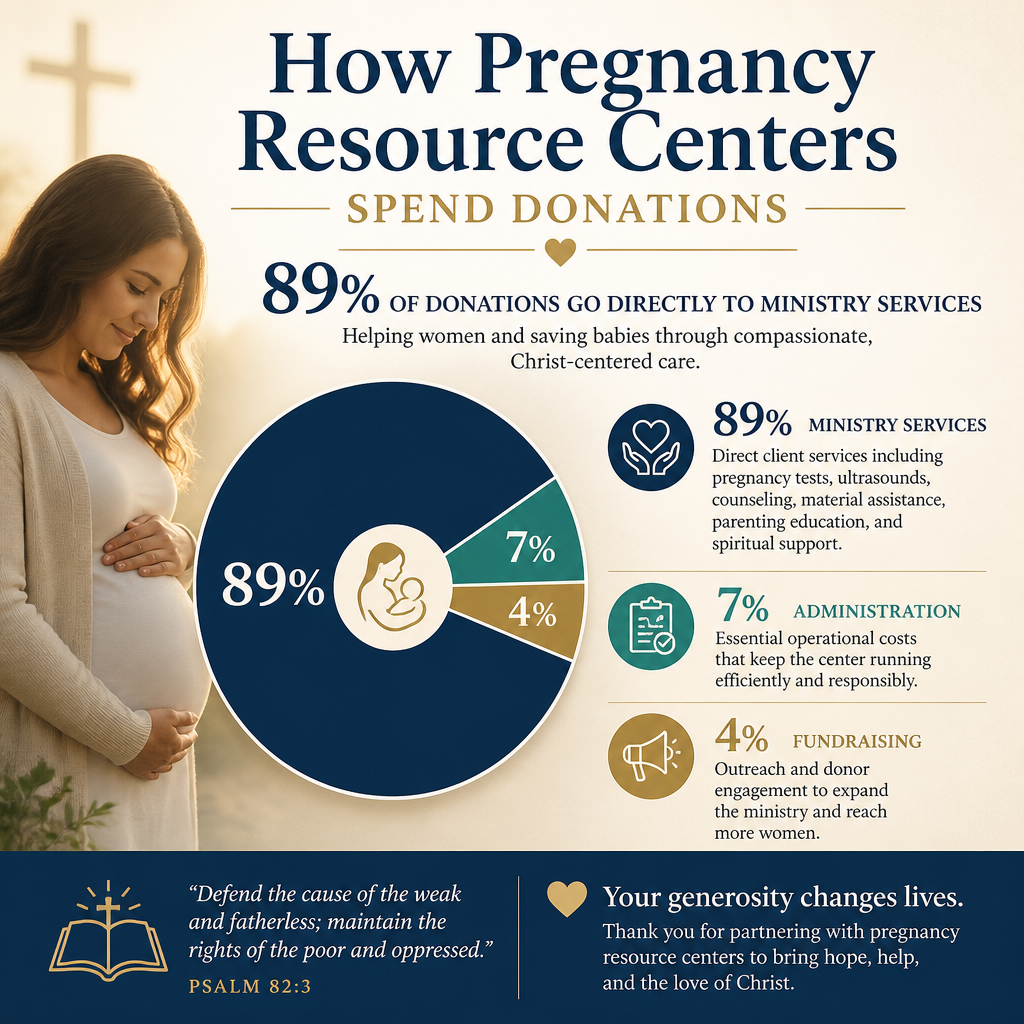
Donors often ask whether a center spends “most of it” on client care. That is a good instinct, but the category of client care is broader than a single service line. Many centers spend donations on a mix of pregnancy testing, limited obstetrical ultrasound (where medically licensed), options counseling, parenting education, material assistance, and referrals to community resources. Some also provide post-abortion support, sexual risk avoidance education, and case management for clients facing housing or domestic violence instability.
Because centers differ in scope, “good spending” is better evaluated by verifiable outcomes tied to mission. A medically licensed center will have higher clinical costs; a non-medical center may emphasize mentorship, material aid, and referral networks. Christian donors should not force every center into the same template but should expect clarity about what the ministry actually does and what it measures.
Overhead is not the enemy of mercy
Christian giving has sometimes absorbed an unbiblical suspicion of “overhead,” as if administrative expense were necessarily waste. The broader philanthropic field has corrected this over the past decade. Charity Navigator, Candid (formerly GuideStar), and BBB Wise Giving Alliance jointly warned donors that judging a charity primarily by overhead can “do more harm than good” by pressuring organizations to underinvest in capacity, evaluation, and staff development Charity Navigator.
What this means in practice is that faithful spending may include professional accounting, secure data systems, staff training, and compliance work. Those costs do not replace ministry; they protect it. Especially in a ministry that serves women in crisis, poor systems can become a form of negligence.

The main cost centers in a credible pregnancy resource center
Personnel and training
In many centers, the largest portion of a budget is people—nurses, client advocates, educators, program directors, and administrative staff. Even volunteer-heavy centers usually require paid leadership for stability and accountability. Training is not optional; it is central to competence. Trauma-informed care, mandated reporting, confidentiality practices, and de-escalation are not “nice to have” topics when clients disclose abuse, coercion, or homelessness.
Centers that meet mature standards typically show that staff and volunteer training is planned, documented, and refreshed, not improvised. Donors should ask whether training includes medical oversight where services are clinical, and whether spiritual care is offered ethically—never as a condition for receiving practical help.
Medical services and clinical compliance
Where centers provide limited medical services, donations may fund ultrasound machines, medical supplies, and clinical supervision. These centers also carry compliance obligations: HIPAA-adjacent privacy practices, infection control, equipment maintenance, and licensure requirements that vary by state. The National Conference of State Legislatures tracks the state-by-state landscape of ultrasound and pregnancy center policy, highlighting how regulatory environments differ across jurisdictions National Conference of State Legislatures.
Donors should not assume that “medical” automatically means “better,” nor that “non-medical” means “less serious.” The question is whether the center is candid about what it offers, clinically competent where it claims medical capacity, and appropriately supervised.
How sound centers handle material aid and client assistance
Material assistance can bless or quietly distort
Diapers, formula, car seats, maternity clothes, and infant supplies are tangible expressions of neighbor-love. They also introduce stewardship tensions: inventory can become a warehouse problem; “earn while you learn” models can drift into transactional dynamics; and material aid can inadvertently crowd out deeper care if a center becomes primarily a distribution point.
The most careful centers treat material support as part of a holistic plan—linked to education, mentorship, and concrete next steps for stability. They also document the value of in-kind donations, track inventory, and set boundaries that protect dignity. Christian donors should welcome compassionate generosity while asking whether the program design encourages responsible agency rather than dependency.
Common spending patterns donors should expect to see explained
A well-run center can explain, in plain terms, how donations support its client pathway. In our verification work at Most Trusted, the ministries that align most consistently with The Most Trusted Standard tend to describe spending in ways that connect budgets to actual services, safeguards, and measurable outputs.
- Client services staffing and volunteer coordination
- Training and clinical oversight where applicable
- Program materials for parenting education and life skills
- Material assistance procurement and inventory controls
- Facilities, security, and privacy protections for client visits
- Data systems for outcomes tracking and donor reporting
Donors are not asking for perfection. We are asking for coherence: spending that fits the ministry’s stated mission, and controls that reduce the risk of harm.
Governance, transparency, and the questions donors should press
Financial statements should match the story
Pregnancy resource centers are often trusted because they are local and relational. Yet relational trust is not a substitute for financial clarity. A center should be willing to share basic financial information, including a budget summary and recent financial statements, and to explain major line items without defensiveness. If it files a Form 990, that document is a baseline for transparency. The IRS provides public guidance on nonprofit reporting and Form 990 requirements Internal Revenue Service.
For donors, a practical test is whether the center’s fundraising claims align with what the financials show. If an appeal emphasizes medical services, but the budget suggests little clinical capacity, that gap deserves an explanation. If the center promotes large-scale impact, but tracks few outputs beyond anecdotes, the reporting may not be mature enough for the claims being made.
Board oversight protects both clients and donors
Because this work touches vulnerable people, governance is not bureaucratic. A functioning board provides accountability for leadership, conflict-of-interest discipline, and policy oversight on confidentiality, client safety, and complaint handling. Donors should ask whether the board is engaged beyond fundraising and whether there is documented review of key risks, especially where medical services are offered.
Christians genuinely disagree about how centers should engage policy, public messaging, and community partnerships. Those disagreements are not resolved by slogans. They are addressed by transparent governance: clear boundaries, accurate claims, and consistent accountability. The credibility of a ministry is not measured by whether it avoids criticism, but by whether it is prepared to answer serious questions with verifiable evidence.
For readers exploring the broader landscape, we maintain coverage of Pregnancy Resource Centers as a category of Christian ministry, including the recurring strengths and recurring governance challenges our team evaluates.
How Most Trusted evaluates spending without reducing it to a ratio
The Most Trusted Standard connects money to mission
Most Trusted exists to help Christian donors give with confidence. Our evaluations use The Most Trusted Standard, a 15-criteria framework that examines faith commitments, financial integrity, governance practices, and evidence of transparency and effectiveness. The aim is not to punish ministries for complexity, but to reward clarity, accountability, and faithful outcomes.
When we assess how a pregnancy resource center spends donations, we do not treat a single percentage as the final word. A “low overhead” ministry can still be unsafe, misleading, or poorly governed. A ministry with higher administrative costs can be investing responsibly in staff competence, client privacy, and program evaluation. The test is whether spending is reasonable, disclosed, and disciplined by oversight.
What responsible donors can ask before giving
Donors do not need to interrogate a ministry as if it were guilty until proven innocent. But Christian stewardship does require questions that honor the weight of the work. We recommend asking for clear answers to a few practical items: what services are offered, who provides them, what safeguards are in place, what outcomes are tracked, and what financial reporting is available.
For a more detailed view of common categories of spending and donor due diligence in this field, see our coverage of How Pregnancy Resource Centers Use Donations.
FAQs for How pregnancy resource centers spend donations
Should Christian donors prioritize centers with the lowest overhead?
No. Low overhead can be a sign of efficiency, but it can also signal underinvestment in compliance, staff development, and basic financial controls. The philanthropic field has warned against using overhead ratios as a primary measure of effectiveness because it can pressure charities into unhealthy under-spending on capacity Candid. Donors should prioritize transparent reporting, credible governance, and spending that clearly supports the ministry’s stated services and outcomes.
What is a reasonable way to evaluate a center if it is small and local?
Small does not excuse opacity, but it does change what “mature” reporting looks like. A reasonable expectation is a clear description of services, basic financial statements or budget summaries, accountable board oversight, documented client safeguards, and honest outcome tracking appropriate to scope. If a center cannot explain how funds are used or resists basic accountability, donors should treat that as a meaningful risk, even when the mission resonates.
Giving that strengthens rather than merely signals
Pregnancy resource center work is sacred and contested at the same time: sacred because it touches mothers and children made in God’s image, contested because the surrounding cultural and legal environment is charged and often unforgiving. Donations should therefore purchase more than activity. They should purchase competence, protection, honesty, and endurance.
When donors insist on transparent spending, disciplined governance, and measurable service tied to mission, we are not withholding compassion. We are directing compassion into channels that are less likely to harm the vulnerable and more likely to bear faithful fruit over time.



