
How pregnancy resource centers measure impact is not a cosmetic question for Christian donors. It is a stewardship question: whether our giving is translating into faithful presence, competent care, and durable outcomes for women, men, and children made in the image of God.
The difficulty is that pregnancy decisions are rarely a single moment. They unfold across medical uncertainty, family pressure, housing instability, relational conflict, and spiritual isolation. A center can be compassionate and busy, yet still struggle to demonstrate that its work is effective. And a center can report impressive “numbers served” while failing to show whether those services were safe, truthful, and truly helpful. Mature generosity requires more than sentiment; it requires verifiable evidence and moral clarity.
Impact begins with clarity about what the center is responsible for
Outputs, outcomes, and faithfulness are not the same
Pregnancy resource centers generally track three layers of impact. The first is outputs: appointments scheduled, pregnancy tests administered, ultrasounds completed, parenting classes delivered, material assistance distributed, or referrals made. Outputs are measurable, and they matter, but they are not the same as changed lives.
The second layer is outcomes: what changed for a client because the center intervened. Outcomes can include earlier access to prenatal care, increased parenting competence, reduced isolation, more stable housing, or strengthened relational supports. Outcomes are harder to measure, and they require more disciplined follow-up.
The third layer is faithfulness: whether the ministry’s posture and practices reflect Christian moral commitments, including truth-telling, mercy, and respect for persons. Scripture consistently treats integrity as part of obedience, not an optional add-on. “Whoever walks in integrity walks securely” (Proverbs 10:9). For donors, this is not merely a compliance concern; it is the center’s witness.
Define the sphere of responsibility without inflating it
Centers should not claim credit for what they cannot reasonably control. A client’s final decision, long-term economic stability, or the father’s engagement may be influenced by the center, but not owned by it. The strongest measurement frameworks make this explicit: they document what the center did, what changed in the near term, and what remains outside its control.
This protects donors from exaggeration and protects clients from becoming statistics. It also allows a ministry to tell the truth about hard cases, relapse into abusive relationships, or continuing instability without implying failure or hiding inconvenient realities.

Good measurement protects clients before it impresses donors
Quality and safety are impact categories
For pregnancy resource centers, “effectiveness” cannot be separated from safety. If a center provides medical services, donors should expect evidence of appropriate licensure, supervision, and standards of care. If it does not provide medical services, donors should still expect clear boundaries, accurate claims, and responsible referral practices.
Impact measurement should therefore include quality indicators such as staff training, adherence to written protocols, and appropriate handling of medical information. Where applicable, centers should be able to describe privacy safeguards consistent with health-information norms and state law. These measures are not bureaucratic distractions. They are part of loving one’s neighbor with competence.
Truthfulness and transparency are part of public credibility
Pregnancy resource centers operate in a contested public environment. Christians genuinely disagree about tactics, messaging, and the relationship between advocacy and direct service. In that setting, clear documentation matters. Donors should look for centers that can articulate what they do and do not provide, how they explain options to clients, and how they avoid coercion.
As a verification organization, Most Trusted evaluates ministries against The Most Trusted Standard, including criteria tied to transparency and effectiveness. In our review work, we find that credible impact reporting is rarely flashy. It is specific, consistent over time, and supported by policies that protect clients even when there is no spotlight.
Core metrics that signal real outcomes in a complex decision environment
Track meaningful next steps, not only counts
Centers frequently report counts because counts are easy. A more mature approach asks whether clients took substantive next steps that reduce risk and increase stability. These are often “proximal outcomes”—early, observable changes that correlate with longer-term wellbeing.
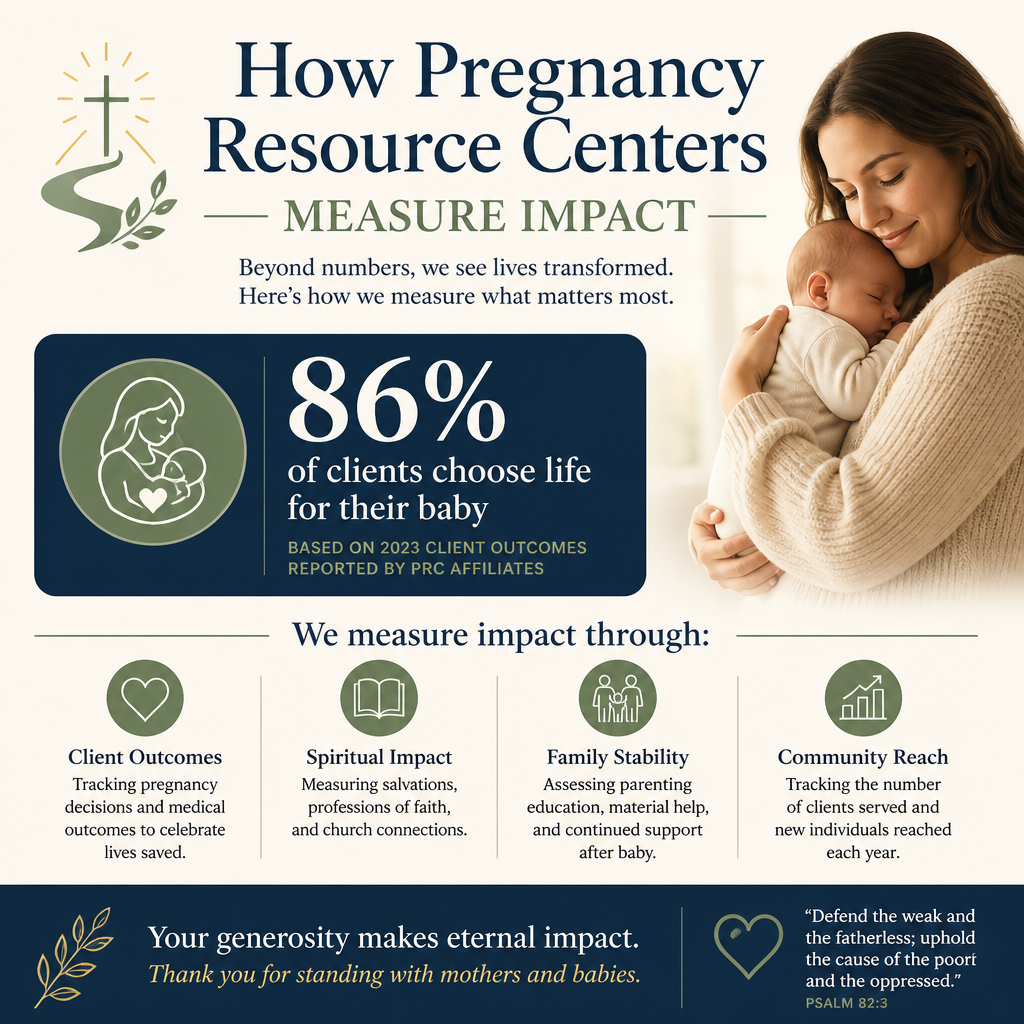
A limited set of outcome indicators is usually more trustworthy than a long list that no one can maintain. For many centers, the most meaningful near-term outcomes include:
- Confirmed connection to prenatal care or a primary-care provider when appropriate
- Enrollment in benefits or community supports when eligible
- Completion of parenting education modules with demonstrated learning
- Documented safety planning and referral for clients facing domestic violence
- Concrete father-engagement steps when a father is willing and it is safe
These measures can be tracked without claiming to control the entire trajectory of a client’s life. They also help donors understand what “help” means in practice beyond a single appointment.
Use validated tools sparingly and wisely
Some centers incorporate brief pre- and post-assessments for parenting confidence, material hardship, depression screening, or social support. When used, the tool should be appropriate to the setting, administered by trained personnel, and interpreted with care. The goal is not to turn a ministry into a research lab; the goal is to avoid self-congratulation and to identify where clients are not improving.
Centers should also be honest about data limitations. Follow-up rates can be low because clients move, change phone numbers, or disengage. Reporting should name the follow-up rate and avoid presenting partial data as comprehensive.
Accountability requires governance and financial signals that align with outcomes
Programs that work are usually backed by disciplined leadership
Impact is not only a program question. It is a governance question. Boards that ask for clear reporting, review risk, and insist on policy compliance tend to produce more credible outcomes over time. Donors should expect to see board oversight reflected in written minutes, documented program goals, and consistent financial controls.
Financial integrity also matters for measurement. If a center cannot produce timely financial statements, maintain appropriate separation of duties, or demonstrate responsible restricted-gift practices, its impact claims become harder to trust because the basic stewardship architecture is missing. The Most Trusted Standard treats these as integrated concerns: faith foundation, financial integrity, governance and leadership, and transparency and effectiveness belong together because ministry is one moral act, not four disconnected ones.
Avoid simplistic overhead arguments
Some donors still treat low administrative costs as the primary proof of faithfulness. The nonprofit field has pushed back on that assumption for years. The “Overhead Myth” statement—signed by Charity Navigator, GuideStar, and the BBB Wise Giving Alliance—argues that overhead ratios alone are a poor measure of performance and can even incentivize harmful underinvestment in capacity.Charity Navigator
For pregnancy resource centers, underinvestment can mean inadequate training, weak documentation, or poor client follow-up—each of which directly undermines effectiveness. Faithful stewardship does not mean starving the systems that protect vulnerable people.
What strong reporting looks like when donors want both compassion and evidence
Tell the truth about the funnel and the hard cases
One mark of credibility is the willingness to report “drop-off” honestly. How many people asked for help? How many came in? How many returned for a second visit? How many completed a course? The numbers will rarely be tidy. Reporting that admits friction points generally signals a ministry that is learning rather than marketing.
Centers also serve clients in crisis: homelessness, substance use, coercive relationships, and untreated mental illness. Donors should expect sober language about what the center can and cannot do, and clear referral partnerships for what it should not attempt alone.
Connect impact to the actual use of donations
Christian donors often ask a straightforward question: what did our gifts make possible? The best centers answer with a transparent linkage between spending and outcomes. If a center invested in an additional nurse sonographer, did appointment capacity increase, and did wait times decrease? If a center invested in fatherhood curriculum, did retention among fathers improve? If a center expanded material assistance, did it do so in a way that supported, rather than replaced, longer-term stability planning?
This is where donors benefit from a broader view of the field. Within How Pregnancy Resource Centers Use Donations, we consistently look for ministries that can describe not only what they purchased, but what changed as a result, and what evidence supports that claim.
For donors seeking to place a pregnancy resource center in context, Pregnancy Resource Centers offers a wider lens on the ministries, models, and accountability questions that shape this work.
FAQs for How pregnancy resource centers measure impact
Should a pregnancy resource center report how many abortions it prevented?
Some centers report “abortion-minded” clients served or “decisions for life.” Those categories can be meaningful only if they are defined carefully, documented ethically, and presented with humility. Donors should be cautious of claims that imply certainty about a counterfactual outcome (“this abortion would have happened”) without clear criteria. Stronger reporting tends to focus on what the center directly did—medical verification, counseling sessions, concrete supports, follow-up steps—and then describes client-reported decisions as one part of a broader picture.
What should donors ask for if a center’s impact report is mostly testimonials?
Testimonials can reflect real gratitude, but they are not a measurement system. Donors can ask for a small set of consistent metrics reported over time: client retention rates, completion rates for educational programs, referral follow-through, and documented quality safeguards. Where medical services are involved, donors can ask about licensure, supervision, and written protocols. Mature ministries usually welcome these questions because they know credibility is part of their witness.
Stewardship asks for measurable care, not merely measurable activity
Pregnancy resource centers serve at one of the most vulnerable intersections of body, conscience, family, and future. Donors honor that weight when they expect impact measurement that is both compassionate and rigorous: clear definitions, client-protective standards, outcome tracking that resists exaggeration, and governance that treats truth as a ministry obligation. That combination does not reduce ministry to numbers. It treats ministry as accountable love.



