
Why pregnancy resource centers build referral networks is not a secondary operational question; it is a moral and practical necessity. A pregnant woman’s needs rarely arrive in a single category, and the church’s witness is tested in whether care is coordinated, competent, and sustained.
Christian donors often give because they want a consistent ethic of life expressed in concrete mercy. Referral networks are one of the most tangible ways pregnancy resource centers translate conviction into durable help, especially when the most urgent needs—housing, medical care, legal protection, trauma counseling, job stability—sit outside a center’s four walls.
Referral networks are an extension of the Christian duty of neighbor love
Complex needs require coordinated care
Pregnancy decisions are shaped by pressures that are medical, economic, relational, and spiritual at the same time. A center may offer pregnancy testing, ultrasound services where legally permitted and clinically appropriate, options counseling, parenting education, and material support. Yet many women also need a licensed clinician for prenatal care, a shelter bed tonight, a restraining order, childcare next week, or a pathway to stable employment.
Scripture’s command is not merely to feel compassion, but to practice it in ways that are credible. James warns against blessing a person with words while withholding the goods necessary for embodied help (James 2:15–17). Referral networks are one means of refusing that hollow form of mercy. They are not outsourcing love; they are organizing it.
Partnership is part of how the body functions
Christian donors are rightly cautious about fragmentation: one ministry funds diapers, another offers counseling, another manages housing, and the mother is left to navigate a maze. The better centers treat referral relationships as part of discipleship in service—bearing one another’s burdens through reliable coordination (Galatians 6:2), not through a pile of phone numbers handed across a desk.
This is also an ecclesial question. The body of Christ is given many gifts for a reason (1 Corinthians 12). A referral network can reflect that theology when it is built on clarity about roles, boundaries, and shared responsibility.

Networks protect clients by setting standards for safety and competence
Trustworthy referrals require vetting, not good intentions
Some critics assume that any referral is beneficial. Others assume referrals are a liability, since the center cannot control what happens next. Both instincts miss the central issue: referrals are only as ethical as the discernment behind them. Responsible centers identify which needs require licensed professionals, which agencies can handle crisis situations, and which programs have a track record of treating clients with dignity.
In our verification work at Most Trusted, we find that ministries that meet The Most Trusted Standard tend to handle referral relationships with written expectations and documented follow-through. They do not treat partnerships as informal favors. They treat them as part of the ministry’s duty of care.
Confidentiality and consent are not optional
A referral network can easily drift into sharing too much information or applying pressure in moments of vulnerability. Mature centers build policies that protect confidentiality, obtain informed consent before any data is shared, and document what was offered and what was accepted. This is not merely legal prudence; it is a matter of honoring a woman’s agency and image-bearing dignity.
Donors should also recognize a sober reality: pregnancy resource centers operate in contested public space. Public criticism, regulatory scrutiny, and litigation risk are part of the landscape. Thoughtful referral practices—clear documentation, careful boundaries, and appropriate professional handoffs—are one way a center reduces harm to clients and strengthens its credibility in the community.
Referral networks turn isolated services into durable pathways
Crisis intervention is not the same as long-term stability
A pregnancy test or a single counseling appointment can be a crucial turning point, but it rarely resolves the underlying conditions that make pregnancy feel impossible. Durable care looks more like a pathway than an event: prenatal care, stable housing, income, mental health support, healthy relationships, parenting skill-building, and sometimes addiction recovery or legal advocacy.
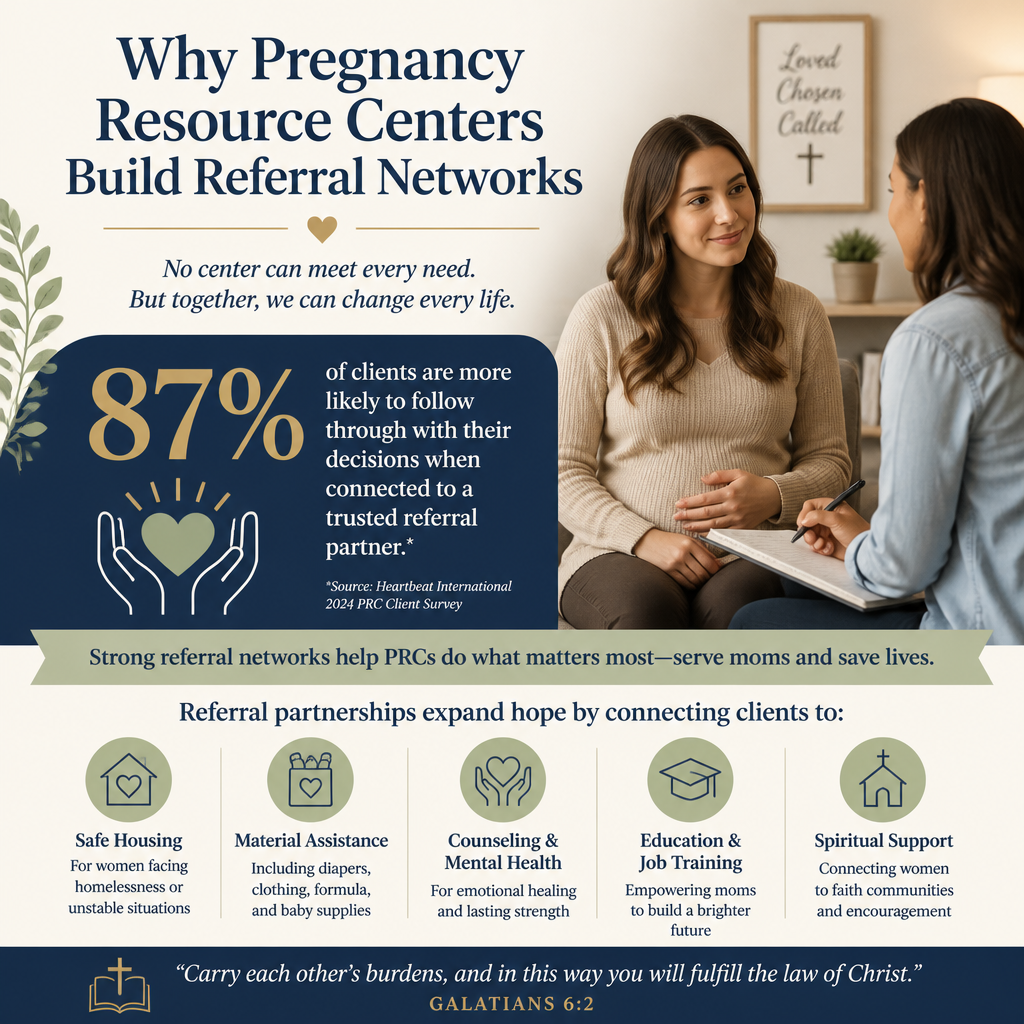
What this means in practice is that effective centers build a small number of dependable relationships rather than a large directory of uncertain options. The objective is a high-trust handoff: “We know this provider. We can call with you. We will check in after your appointment.” That is the difference between a referral network as paperwork and a referral network as pastoral care.
Collaboration reduces duplication and improves stewardship
Christian donors often ask whether funding is going to direct care or to unnecessary overhead. The more mature question is whether the ministry is organized to produce outcomes that can be honestly described and verified. The “Overhead Myth” open letter—signed by GuideStar (now Candid), BBB Wise Giving Alliance, and Charity Navigator—warned donors against using overhead ratios as a proxy for effectiveness, urging attention to transparency and results instead (GuideStar/Candid).
Referral networks are one way centers steward donor resources without pretending they can do everything. A center can focus on what it is equipped to do well—often relationship-based support and practical help—while partnering for specialized services that require credentials, capacity, or 24-hour coverage.
For donors, referral networks are a window into governance and integrity
Healthy partnerships usually reflect healthy leadership
Donors who care about mission integrity should pay attention to how a center talks about partnerships. Inflated claims—“we serve everyone’s needs”—often conceal the absence of systems. Clear claims—“we provide these services directly and coordinate these referrals”—usually indicate stronger governance and more honest reporting.
Across Pregnancy Resource Centers, we see that referral networks often reveal whether a ministry can collaborate without surrendering its convictions. A center that maintains theological clarity while working constructively with medical providers, social services, and churches is often a center with disciplined leadership and a stable board culture.
Questions donors should ask about referral networks
Referral networks are not uniformly virtuous; they can be superficial, disorganized, or ideologically incoherent. A few targeted questions can clarify what kind of network a center has built:
- Does the center have written referral protocols, including consent and documentation?
- Are partners vetted for safety, competence, and alignment with the center’s duty of care?
- Does the center track whether clients successfully connect to the referred service?
- How does the center handle situations involving abuse, coercion, or trafficking concerns?
- Which needs does the center provide directly, and which are referred out—and why?
These questions map closely to what donors typically mean by “trustworthy”: not perfection, but clarity, accountability, and a demonstrated commitment to protect vulnerable people.
Networks deepen a community’s capacity to welcome life
Churches are often the missing infrastructure
Pregnancy resource centers are frequently most effective when they are not treated as substitutes for the local church’s responsibilities. Churches can provide mentoring, meals, transportation, baby showers, prayer, and a durable relational community that no office-based ministry can replicate. Yet churches often need coordination to move from goodwill to sustained practice. Referral networks can supply that coordination, helping congregations serve within clear expectations and appropriate safeguards.
In How Pregnancy Resource Centers Build Community Partnerships, we emphasize that the strongest community ecosystems tend to include both professional services and congregational care. The center becomes a connector: not the savior of the system, but a stabilizing node that helps mothers avoid falling through cracks.
Public trust is earned through consistency and humility
Christians genuinely disagree about the best policy approaches to pregnancy and family support. Even where there is broad agreement on the moral status of unborn life, communities differ on how to structure public programs, what accountability should look like, and how to evaluate outcomes. Pregnancy resource centers that build referral networks well do not resolve these disagreements. They respond to them with a quieter kind of credibility: measurable care, transparent boundaries, and a willingness to partner where partnership is wise.
For donors, this matters because reputation shapes access. Medical providers, shelters, and county agencies are more likely to accept calls, return messages, and coordinate services when they have seen a center handle clients ethically and competently over time. Referral networks become both a fruit of trust and a means of protecting it.
FAQs for Why pregnancy resource centers build referral networks
Do referral networks mean a pregnancy resource center is not equipped to help?
No. Referral networks usually indicate the opposite: a center understands its scope and refuses to promise what it cannot safely deliver. Competent care often requires licensed medical providers, specialized counselors, legal advocates, or housing programs. A wise center provides direct services within its capacity and coordinates referrals for needs that require different expertise.
How can donors evaluate whether a center’s referral network is credible?
Donors can look for written protocols, consent practices, evidence of partner vetting, and follow-up tracking. It is also reasonable to ask how the center documents referrals and protects confidentiality. At Most Trusted, our evaluations against The Most Trusted Standard attend to governance, transparency, and effectiveness—factors that often show up clearly in how a ministry builds and maintains referral relationships.
A mature referral network is a form of faithful stewardship
Pregnancy resource centers build referral networks because the work is larger than any single organization, and because love of neighbor demands more than isolated interventions. When networks are built with discernment—clear boundaries, credible partners, careful documentation, and consistent follow-through—they help women receive real help rather than symbolic support. For Christian donors seeking ministries worthy of trust, referral networks are not a public-relations accessory. They are a practical expression of truthfulness, humility, and competence in the service of life.



