
What fundraising approaches help pregnancy resource centers is not merely a tactical question. It is a stewardship question for Christian donors who want their giving to protect life, serve families with dignity, and remain above reproach in a contested public square.
Pregnancy resource centers operate where compassion and controversy intersect. Some Christians question the most effective blend of crisis intervention and long-term support; others worry about politicized narratives or inconsistent standards across the movement. The best fundraising approaches are those that fit the center’s mission, tell the truth about outcomes and limitations, and build durable community relationships that do not depend on crisis-driven spikes.
1. Begin with a clear ministry model and a disciplined case for support
Fundraising works when donors can understand what the center actually does, for whom, and why it matters. Pregnancy resource centers often offer a mix of pregnancy testing, ultrasound, material support, mentoring, parenting classes, post-abortion support, and referral pathways. Clarity about the service model prevents a center from drifting into messaging that is emotionally compelling but operationally vague.
Define the center’s promise to clients and to the church
The most persuasive case for support is specific: what services are provided, what standards govern them, and what the center will not do. Mature donors are not looking for inflated claims. They are looking for principled restraint, appropriate scope, and a credible plan for serving women and families without coercion, manipulation, or bait-and-switch religious pressure.
Scripture provides the moral frame: truthfulness, justice, and mercy belong together. The church’s defense of life is compromised when our institutions communicate in ways that obscure costs, overstate results, or treat suffering people as a means to an advocacy end.
Anchor the ask in real costs and measurable commitments
Practical donors respond to budgets that connect to services: staff training, medical oversight, facility costs, client follow-up systems, and partnerships that reduce duplication. The center should be able to explain why certain roles are necessary (for example, client advocates, a nurse manager, development staff) and how these roles protect quality and continuity.
Centers that align program commitments with financial reality are less likely to fall into the starvation cycle described in Stanford Social Innovation Review, where underinvestment in infrastructure produces fragile results and burnout (Stanford Social Innovation Review).

2. Build fundraising around long-term relationships, not episodic appeals
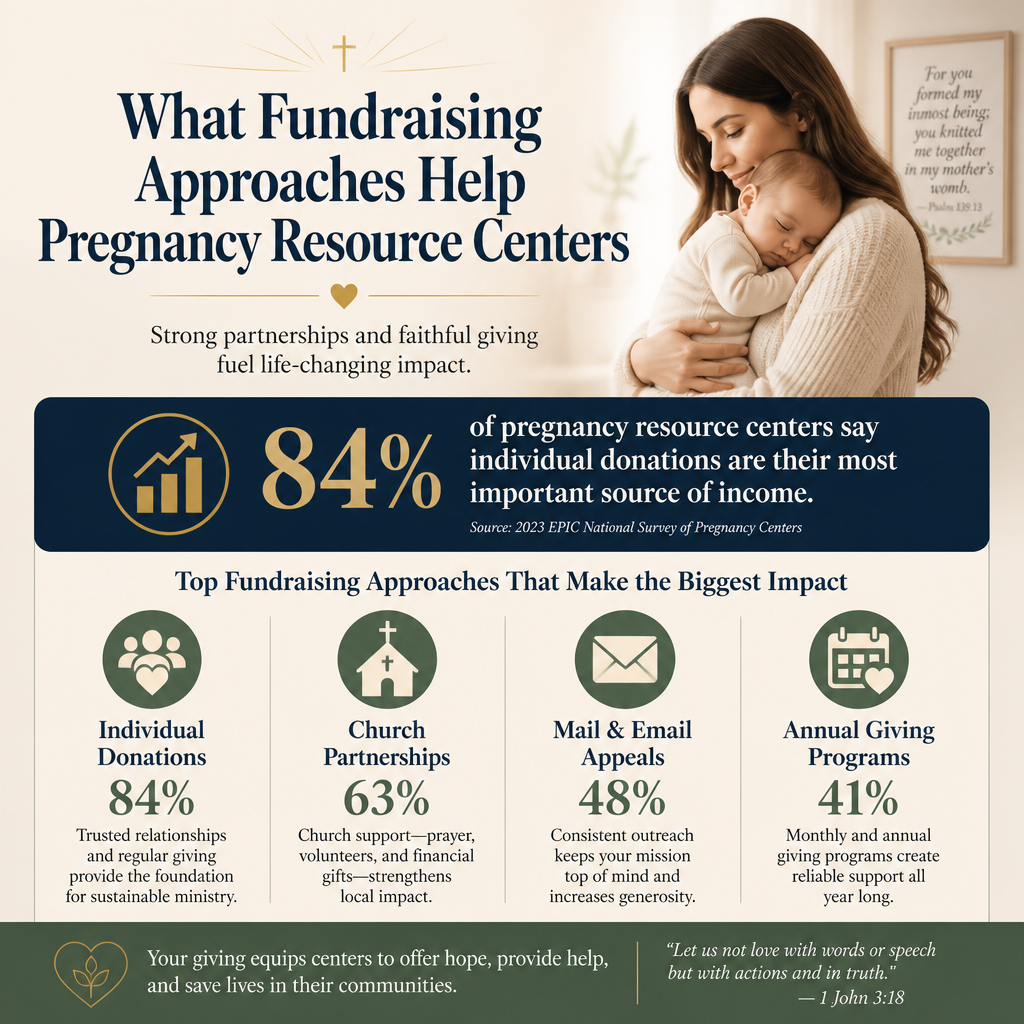
Pregnancy resource centers are often funded through a combination of church support, individual giving, events, and occasional grants. The consistent pattern we observe across ministry fundraising is that sustained donors are formed through trust over time, not through urgent messaging alone. This is especially important in ministries where public scrutiny is high.
Prioritize monthly giving as a stability engine
Monthly donor programs are not glamorous, but they are the closest thing to financial resilience most centers can build. Predictable giving allows the center to retain staff, plan training, maintain consistent hours, and follow up with clients beyond a single appointment. It also reduces the temptation to overstate numbers during fundraising season.
What this means in practice is simple: treat monthly giving as a pastoral invitation to shared responsibility, not as a transactional subscription. Explain what stability makes possible for mothers and families, and report back with sober, verifiable metrics.
Use events with discipline and an honest cost lens
Banquets, walks, and baby bottle campaigns can help when they serve relationship-building and broad awareness. They can also consume staff time, encourage short-term thinking, and reward emotional story selection over truthful representation. A disciplined center evaluates events by net revenue, new donor retention, and the quality of relationships formed, not by attendance alone.
Many donors have absorbed simplistic assumptions about “low overhead” as the primary sign of faithfulness. The Overhead Myth letter signed by Charity Navigator, BBB Wise Giving Alliance, and GuideStar argues that focusing on overhead ratios can mislead donors and punish healthy investment in staff and systems (Charity Navigator).
3. Fundraise with credibility under public scrutiny
Pregnancy resource centers serve vulnerable clients, handle sensitive data, and often operate in politically charged environments. That combination requires a higher, not lower, commitment to governance, compliance, and transparent communication. Donors should expect it, and centers should fund it.
Invest in training, medical oversight, and clear policies
Where centers provide medical services, donors should ask about licensure requirements, medical director relationships, ultrasound training, and quality assurance. Where centers do not provide medical services, donors should ask how staff communicate the limits of what they offer and how referrals are managed.
Across our verification work at Most Trusted, the ministries that meet The Most Trusted Standard tend to treat policies as a form of neighbor-love. Clear boundaries, documentation, and supervision protect clients from harm and protect staff from pressure to perform results they cannot ethically promise.
Tell stories that honor clients without exploiting them
Fundraising in life-issues ministry can drift into crisis pornography: vivid detail, selective storytelling, and implied guarantees of transformation. Responsible centers obtain informed consent, protect privacy, and present stories with humility about what is known and what is not. They resist framing clients as props in a culture-war argument.
For donors, the question is not whether stories are moving. The question is whether they are truthful, non-coercive, and consistent with the center’s stated commitments to confidentiality and dignity.
4. Strengthen community partnerships that reduce duplication and increase care continuity
Many pregnancy resource centers are strongest when they are embedded in a web of local partners: churches, health clinics, social service agencies, housing networks, adoption and foster care organizations, and job training programs. Fundraising is more credible when it reflects this shared ecosystem of care rather than an isolated hero narrative.
Translate partnerships into fundable pathways
Donors fund outcomes when they can see the pathway. For example: a client advocate completes an intake, a nurse confirms pregnancy, a counselor provides options counseling, and then a warm handoff connects the client to prenatal care, housing stabilization, or parenting support. Partnership is not a press release; it is an operational plan with named relationships and clear referral protocols.
When a center can show that it is part of How Pregnancy Resource Centers Build Community Partnerships, its fundraising gains credibility because it is rooted in coordinated care rather than duplicative programming.
Equip churches for meaningful participation
The local church is often the most important long-term partner, but “partnering with churches” can become a vague slogan. Effective centers offer specific lanes of involvement: mentoring, material support teams, car repair networks, childcare during classes, hosting parenting groups, and sustained prayer teams that are accountable and discreet.
- Church liaison roles with clear expectations and training
- Defined volunteer pathways that match risk level to oversight
- Emergency assistance funds with documented criteria
- Client resource networks for housing, employment, and transportation
- Postpartum and parenting support that extends beyond the first visit
When churches participate in concrete ways, fundraising becomes less about episodic rescue and more about durable community responsibility.
5. Invite donors into verification-minded stewardship
Donors who give to pregnancy resource centers often carry two burdens at once: a desire to defend life and a concern that the movement’s reputation can be harmed by weak governance or careless claims. Mature fundraising does not dismiss those concerns as cynicism. It answers them with documentation and verifiable transparency.
Report outcomes with theological sobriety and methodological honesty
Pregnancy decisions are complex, and centers should be cautious about attributing outcomes to a single intervention. Some measures are still important: number of clients served, repeat visits, class completions, referral follow-through, and client satisfaction. The point is not to prove moral worth by numbers. The point is to show that the ministry is attentive, learning, and accountable.
Research on U.S. religious life also underscores why centers should not assume cultural Christianity will sustain donor pipelines. Pew Research Center reports that the share of U.S. adults identifying as Christian has declined over the past decades, affecting the giving environment and the church’s institutional capacity (Pew Research Center).
Use external verification as a trust-building practice
Independent evaluation is not a substitute for spiritual discernment, but it can strengthen it. At Most Trusted, we evaluate Christian nonprofits against The Most Trusted Standard, a 15-criteria framework spanning faith foundation, financial integrity, governance and leadership, and transparency and effectiveness. When a pregnancy resource center welcomes scrutiny, documents policies, and communicates plainly, it treats donor trust as something to be earned and protected.
For donors, engagement with Pregnancy Resource Centers is strongest when it is rooted in both compassion and due diligence: compassion for women and families in hard circumstances, and due diligence that insists ministries operate with integrity worthy of the name of Christ.
FAQs for What fundraising approaches help pregnancy resource centers
Should pregnancy resource centers focus more on major donors or on churches?
Both can be appropriate, but the mix should match the center’s mission model and local context. Churches often provide breadth of support and volunteer capacity, while major donors can fund staff, training, and program expansion. The healthier approach is not choosing one audience, but building a diversified base so the center is not pressured to alter messaging or services to satisfy a narrow funding constituency.
What should donors ask to assess whether a center’s fundraising is credible?
Donors should ask for clear financial statements, board governance practices, privacy and consent policies for storytelling, and outcome reporting that distinguishes activity counts from demonstrated impact. Donors should also ask how the center handles referrals, medical oversight where relevant, and staff training. Credible fundraising invites these questions and answers them with documentation rather than reassurance.
A wiser standard for funding life-affirming care
Pregnancy resource centers do their best work when fundraising is an extension of their ethics: truthful, transparent, and oriented toward long-term care rather than momentary emotion. Christian donors are not only funding a set of services; we are funding the credibility of the church’s mercy in a skeptical age. The approaches that endure are those that treat trust as sacred, clients as image-bearers, and stewardship as a discipline that can be verified.



