
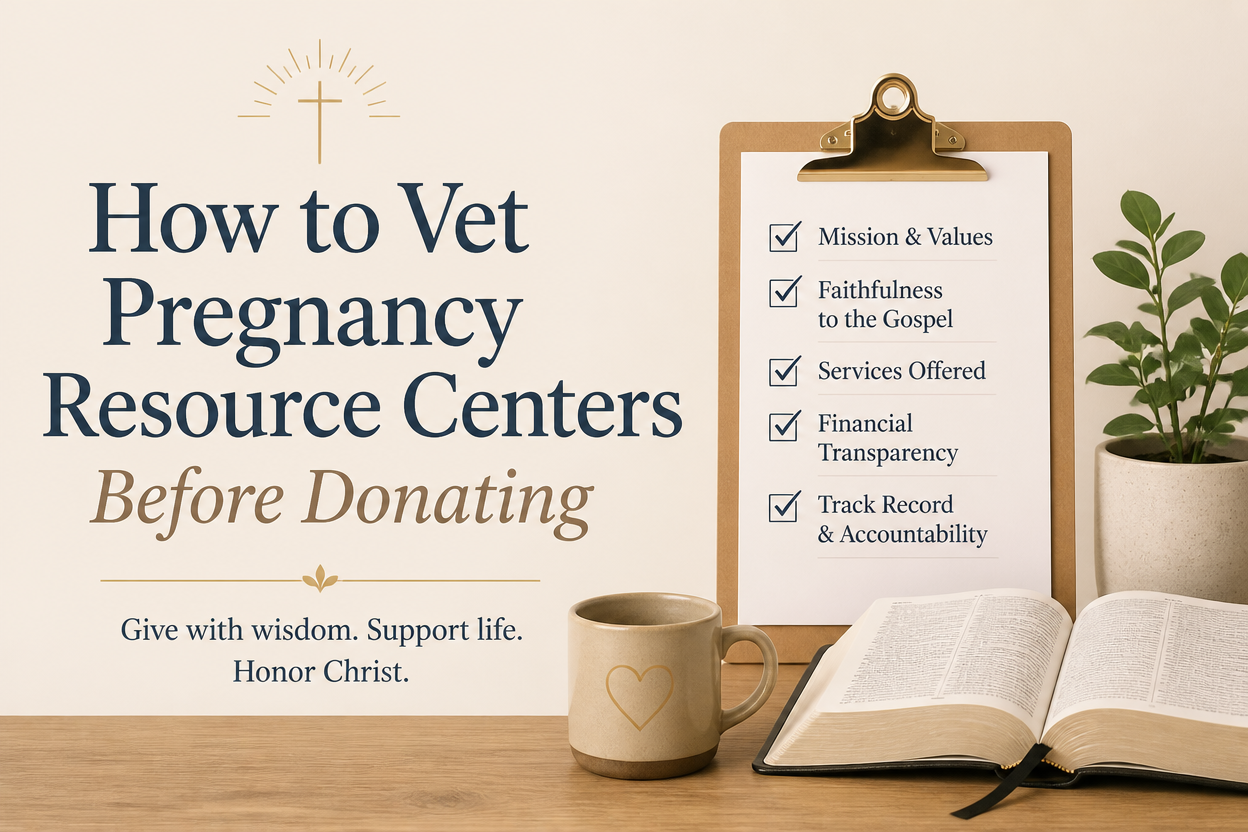
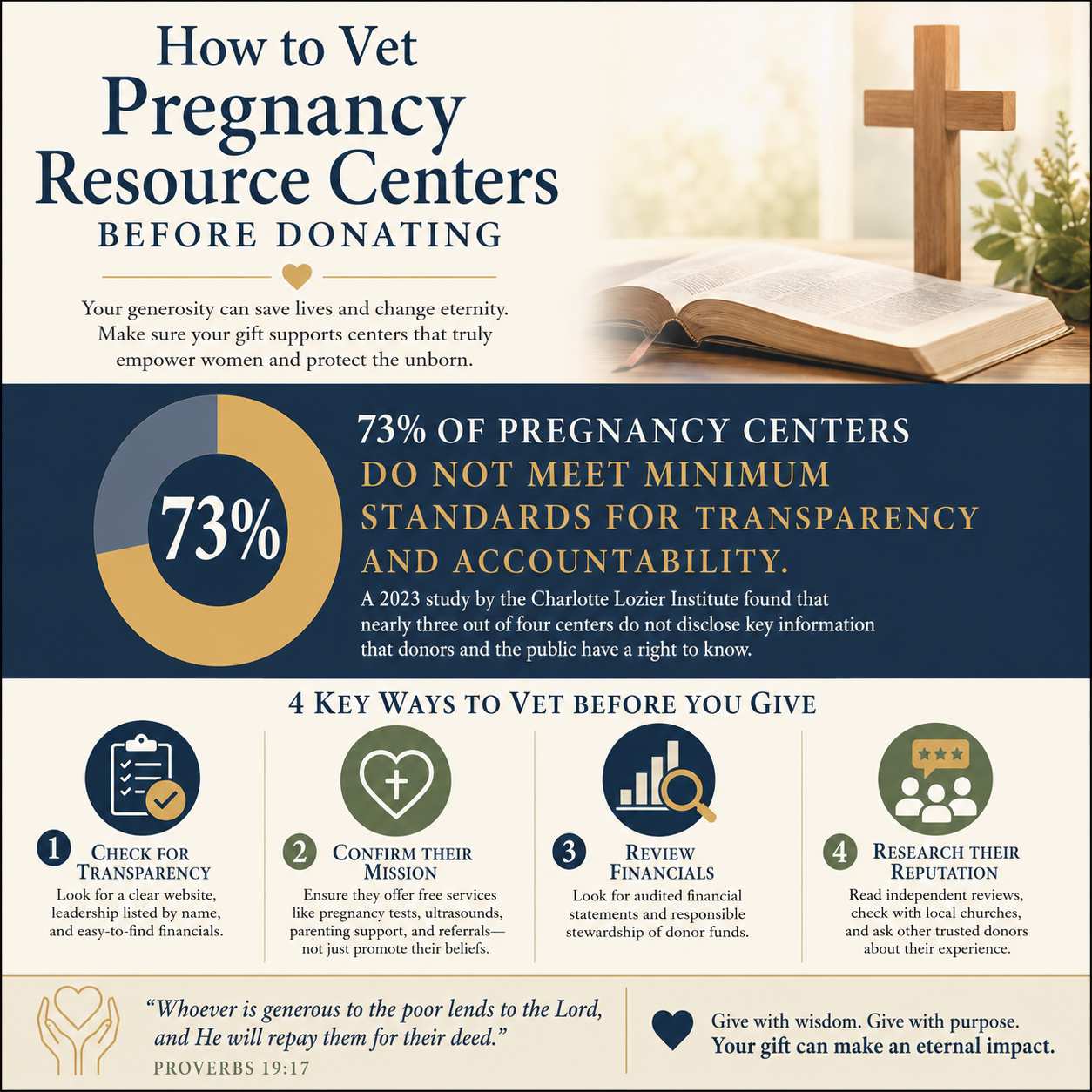
How to vet pregnancy resource centers before donating is not a peripheral question for Christian donors; it is a stewardship question with moral weight. The work touches frightened mothers, vulnerable fathers, and unborn children, and it often operates at the intersection of pastoral care, medical questions, and public controversy.
Christians genuinely disagree about tactics, messaging, and the relationship between charity and politics. Yet Scripture leaves little ambiguity about our obligation to protect the vulnerable and to practice honesty in our dealings. “Unequal weights are an abomination to the Lord, but a just weight is his delight” (Proverbs 11:1). Donors who give in faith should be able to expect just weights: truthful claims, sober governance, and outcomes that can be examined.
Start with mission clarity and the limits of what the center claims to provide
Distinguish pastoral ministry, social services, and medical care
Pregnancy resource centers exist on a spectrum. Some provide primarily spiritual counsel and practical support (material aid, parenting classes, housing referrals). Others operate licensed medical clinics providing pregnancy tests, limited ultrasound services, or STI testing under clinical oversight. The first step in vetting is ensuring the center’s public claims match the level of service it is actually authorized and equipped to deliver.
When a center presents itself as a medical provider, donors should expect appropriate licensing, clinical protocols, and a clear delineation of what services are and are not offered. When it presents as a ministry of counsel and care, donors should expect pastoral integrity: truthful speech, trauma-informed compassion, and a refusal to manipulate women in crisis. The credibility of the pro-life witness suffers when ministries blur these categories.
Ask whether the center’s theory of care is coherent
Centers that serve families well usually articulate a straightforward theory of care: what crisis they address, what services they provide directly, what they refer out, and what “success” means over time. A coherent approach will acknowledge that some clients need immediate stabilization (food, diapers, safe housing), some need relational support, and some need long-term accompaniment after birth.
What this means in practice is that a donor should not be satisfied with mission language alone. A mission statement may be orthodox and still function as a veneer over weak operational discipline. We recommend asking for a program overview that names concrete services, referral partners, and boundaries.

Look for verifiable integrity in financial reporting and fundraising claims
Require basic financial documents and plain explanations
Many pregnancy resource centers are small nonprofits with limited staff. That reality does not excuse opaque finances. At a minimum, a donor should be able to obtain recent financial statements, a current budget, and the most recent Form 990 if the organization files one. If the center is a church-integrated ministry that does not file a 990, the expectation shifts to alternative transparency: board-approved budgets, internal financial reviews, and clear reporting to supporters.
Donors should also read fundraising language carefully. If an appeal implies that a specific gift will guarantee a specific outcome, the center should be able to explain how those funds are tracked and how outcomes are measured. The Christian duty to “speak the truth in love” (Ephesians 4:15) applies as much to donor communications as it does to counseling rooms.
Resist simplistic overhead thinking and evaluate spending in context
Christian donors often want a single ratio that settles the question of stewardship. The sector has repeatedly cautioned against that impulse. The “Overhead Myth” letter—signed by leaders from BBB Wise Giving Alliance, GuideStar, and Charity Navigator—argues that administrative and fundraising percentages are poor proxies for effectiveness and can create harmful incentives for nonprofits to underinvest in accountability and capacity Charity Navigator.
For pregnancy resource centers, the relevant question is not “How low is overhead?” but “Does spending align with the mission and with responsible safeguards?” Clinical services require qualified staff, supervision, and compliance costs. Long-term client support requires follow-up systems and partnerships. A center that spends almost nothing on training, oversight, and reporting may not be lean; it may be unsafe.
Evaluate governance and leadership with an eye toward accountability
Board independence and real oversight
Governance is where many donor disappointments begin. Centers that endure over time typically have boards that can exercise genuine oversight rather than functioning as honorary supporters. Donors should ask whether the board meets regularly, approves budgets, reviews executive performance, and has conflict-of-interest policies that are actually enforced.
Independence matters. A board composed mostly of close friends, family members, or employees can struggle to confront problems early. In work as sensitive as pregnancy counseling and medical services, early intervention is often the difference between a correctable weakness and a public scandal.
Staff training, safeguarding, and counsel quality
Donors should ask what training staff and volunteers receive, especially those who counsel clients. Crisis pregnancy conversations can involve coercion from partners, past sexual trauma, domestic violence, and acute fear. A credible center can describe how it trains personnel to recognize danger, document concerns, and refer appropriately.
We recommend looking for written safeguarding policies, including background checks for those who work with minors, mandatory reporting awareness, and clear boundaries on volunteer roles. The more a center claims to do, the more the donor should expect documented processes rather than informal assurances.
Insist on transparency and effectiveness without demanding the impossible
Outcomes that can be stated without manipulation
Effectiveness in this field is contested because the work is human and complex. A center may offer counsel that is faithful and compassionate, and a client may still choose an outcome the ministry grieves. Donors should not force ministries into simplistic success metrics that incentivize pressure tactics.
Still, credible centers can report meaningful indicators. These often include counts of client visits, material assistance distributed, parenting class completion, referrals to prenatal care, and documented follow-up touchpoints after birth. If a center reports dramatic claims, donors should ask what records support those claims and how privacy is protected.
Client dignity, privacy, and truthful communications
In pregnancy ministry, confidentiality is not optional. Donors should ask how client records are stored, who has access, and whether the center follows HIPAA where applicable. When a center is not a medical provider, it should still treat client information as sacred trust.
Public credibility also depends on truthful speech. If the center addresses sensitive topics such as abortion procedures, fetal development, or mental health outcomes, it should cite medical authorities accurately and avoid sensationalism. Donors can ask what sources are used for educational materials and whether a licensed clinician reviews medical claims where relevant.
Use a structured verification lens and know what questions to ask
A donor due diligence checklist that fits real life
Most donors do not have time to conduct an audit. The goal is a disciplined set of questions that surfaces red flags and clarifies strengths. Across our verification work at Most Trusted, the ministries that meet The Most Trusted Standard tend to welcome scrutiny, provide documents promptly, and correct unclear claims rather than defending them.
- Can the center provide recent financial statements and a current budget, with plain explanations of major spending categories?
- Is there an active board with documented meetings, conflict-of-interest policies, and clear oversight of leadership?
- Are services described with precision, including what is medical, what is educational, and what is spiritual counsel?
- What safeguarding and training protocols exist for anyone who counsels clients or handles sensitive information?
- Can the center report outcomes and activity indicators without resorting to exaggerated or unverifiable claims?
Where Most Trusted fits and what verification can and cannot do
Independent verification is not a substitute for discipleship or for the local church’s pastoral wisdom. It is, however, an aid to stewardship. Most Trusted evaluates Christian nonprofits against The Most Trusted Standard, a 15-criteria framework spanning faith foundations, financial integrity, governance and leadership, and transparency and effectiveness. For donors supporting pregnancy ministry, this framework helps distinguish between centers that are earnest but undisciplined and centers that have built structures worthy of long-term trust.
Verification also has limits. It cannot guarantee that every volunteer will act wisely or that every client story will resolve well. It can, however, establish whether a center has the governance, financial controls, and truthfulness practices that make faithful care more likely and preventable harm less likely.
Donors who want a broader view of the field can review Pregnancy Resource Centers with attention to how models differ across communities and regulatory environments. For donors focused specifically on disclosure and candor, Accountability and Transparency in Pregnancy Resource Centers names the standards that best protect both clients and the credibility of Christian witness.
FAQs for How to vet pregnancy resource centers before donating
Should donors prioritize centers that offer medical services?
Not necessarily. Medical services can be a meaningful part of care, but they also require higher compliance, clinical oversight, and clear boundaries. Donors should prioritize integrity and competence: the center should offer only what it is licensed and equipped to provide, and it should refer promptly to appropriate medical providers for prenatal care. A non-medical center can serve with deep faithfulness if it is transparent about its scope and disciplined about referrals.
What is the most common red flag donors miss?
Vague claims presented with great confidence. When a center cannot produce basic documents, cannot explain who governs it, or cannot describe how it trains counselors and protects privacy, donors should pause. Earnest intent is not the same as trustworthy operations. In a ministry context, that distinction is not cynical; it is a form of neighbor love for clients and for the wider church.
Giving that is both courageous and careful
Pregnancy resource centers ask donors to carry a burden many prefer not to see: the fragility of human life, the complexity of crisis, and the high cost of compassionate presence. Christian giving in this space should be courageous enough to support difficult work and careful enough to require verifiable integrity. When donors insist on truthful claims, accountable governance, and transparent reporting, they honor both the mother in front of the counselor and the God who delights in honest weights.



