
The faith-based mission of pregnancy resource centers is not a secondary branding layer applied to social services. It is the stated reason many centers exist: to bear witness to the dignity of human life, to practice mercy toward mothers and fathers in crisis, and to offer material and relational support shaped by Christian conviction. For Christian donors, the question is rarely whether compassion matters. The harder question is whether a center’s compassion is disciplined by truth, expressed with humility, and governed in a way that protects both clients and the Church’s public witness.
Most pregnancy resource centers operate at an intersection where moral theology, trauma-informed care, public controversy, and donor stewardship meet. Christians genuinely disagree about strategy and language, and there are legitimate debates about how closely services should be integrated with explicit evangelism. Still, Scripture gives a stable center of gravity: God’s regard for the vulnerable, the call to love our neighbor, and the Church’s responsibility to commend the gospel not only with words but with conduct.
Christian mission begins with the imago Dei and the ethics of neighbor love
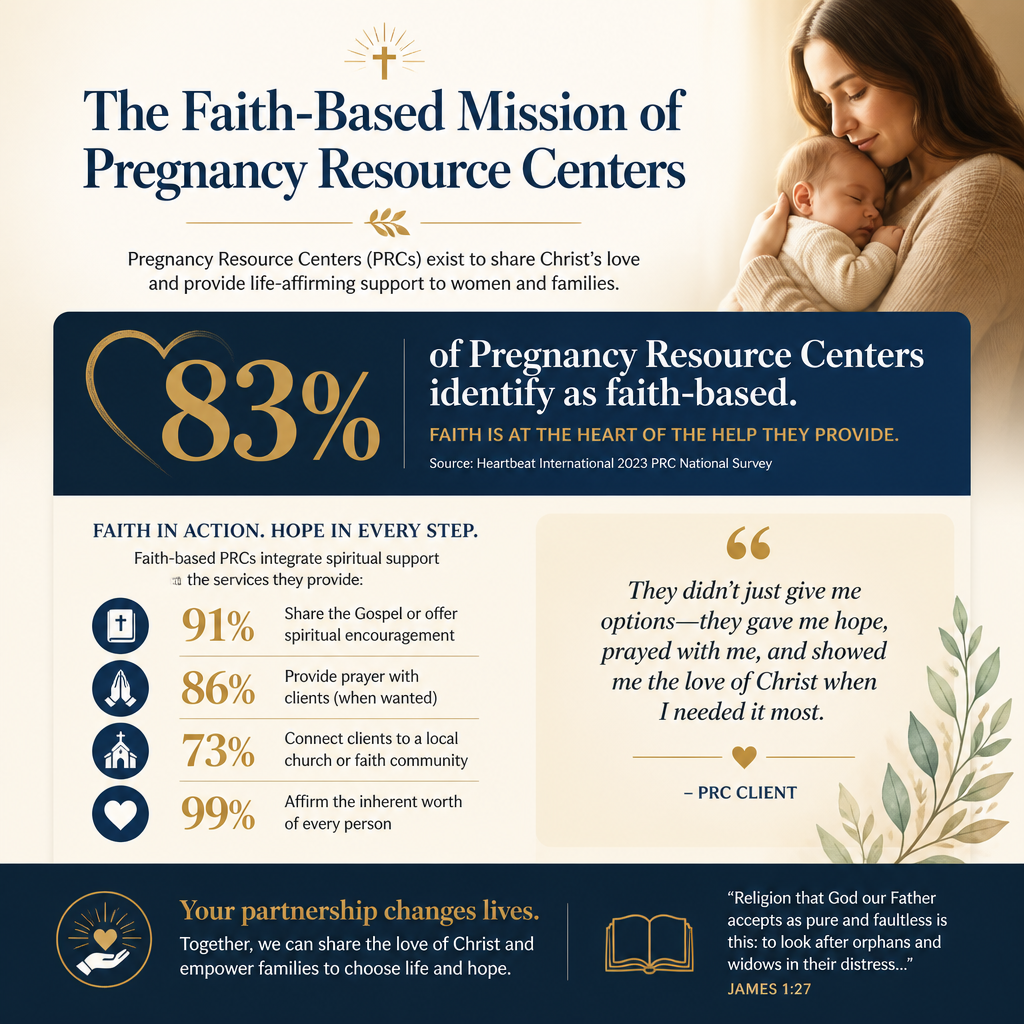
Pregnancy resource centers commonly describe their mission in terms of affirming life and supporting families. Theologically, that claim rests on the imago Dei: human beings are created in God’s image and therefore possess dignity that is not earned by circumstance, maturity, or social usefulness. This conviction presses Christian ministry beyond political alignment and into moral obligation. If the unborn child has dignity, then the mother and father in crisis do as well, and the Church’s care cannot be selective.
The Old and New Testaments repeatedly frame true piety as the defense of those with limited power. James’ description of “pure and undefiled religion” is not an abstraction; it is a test of whether a community’s faith translates into costly care (James 1:27). Pregnancy resource centers are one expression of that care, especially when they serve women facing economic pressure, relational instability, or coercion. The point is not to make a center a substitute for the local church, but to treat it as a specialized ministry that can extend the church’s hands into complex situations.
Mercy ministry must address both the child and the parent
It is possible to speak passionately about protecting unborn life while remaining indifferent to the mother’s housing insecurity, the father’s immaturity, or the couple’s isolation. That posture cannot be justified by Scripture’s consistent pattern: God’s protection of the vulnerable includes practical provision and justice. When centers offer diapers, formula, parenting education, referrals for medical care, and consistent mentorship, they are embodying a pro-life ethic that is recognizably Christian rather than merely ideological.
Truth-telling is part of Christian charity
Christian charity does not excuse exaggeration, manipulation, or ambiguity. A center’s moral claims about abortion, sexuality, and family life should be stated plainly, but also responsibly and accurately. Donors who care about faithful witness should expect the center to distinguish carefully between what it can verify clinically, what it believes theologically, and what it advocates morally. The Church’s credibility is not strengthened by cleverness; it is strengthened by integrity.
Public controversy is not proof of faithfulness
Some centers are criticized simply because they are Christian. Others are criticized for specific practices, including marketing, client communication, or medical representations. Donors should not assume that opposition automatically means righteousness. In a polarizing environment, the discipline of self-examination becomes a form of Christian maturity. Faithfulness includes a willingness to correct what is misleading and to strengthen what is weak.

How centers share faith without coercion or confusion
The spiritual dimension of pregnancy resource center work raises a genuine ethical question: how should explicitly Christian ministry relate to clients who may be anxious, economically dependent, or spiritually skeptical? Centers that are most compelling over time tend to hold two commitments together. They do not apologize for their Christian identity, and they also refuse to treat clients as projects whose needs create an opening for pressure.
Many donors support pregnancy resource centers precisely because they want the gospel to be present in places where fear and shame are common. That desire can be wise and biblically grounded. But it must be governed by the biblical ethic of love: patient, not self-seeking, and not insisting on its own way (1 Corinthians 13). A client’s vulnerability imposes responsibilities on the ministry, not opportunities for spiritual conquest.
Clear disclosure is a spiritual and ethical obligation
Christian donors should expect upfront clarity about what a center is and is not. If a center is explicitly Christian, it should say so plainly. If it is not a medical clinic, it should not imply otherwise. If it offers limited ultrasound services, it should describe them accurately. This is not merely legal prudence; it is moral formation. Truthfulness is not a tactic but a Christian virtue.
Voluntary spiritual conversations preserve dignity
Faith-sharing at its best is invitational: offered, not imposed. Centers commonly provide prayer upon request, access to chaplains or trained mentors, and optional Bible studies. Donors can ask whether spiritual conversations are clearly optional, whether staff are trained to recognize coercive dynamics, and whether the ministry keeps client needs at the center rather than staff agendas.
Trauma-informed care belongs in a Christian center
Many clients carry complex histories: abuse, prior abortions, sexual trauma, addiction, or profound distrust. A Christian center should be serious about trauma-informed practice—attentive to triggers, careful with language, and able to refer to licensed counseling or community services when appropriate. This is a way of honoring the person, not just the position. The U.S. Substance Abuse and Mental Health Services Administration has provided widely used guidance on trauma-informed approaches in human services, which has influenced many nonprofit training programs (SAMHSA).
What mature donors should look for in governance, accountability, and measurable care
Christian donors are increasingly aware that good intentions do not guarantee good outcomes. Compassion ministries can drift into improvisation, personality-driven leadership, or opaque financial practices. Pregnancy resource centers also face unique pressures: intense political scrutiny, volunteer-heavy staffing models, and high emotional stakes. Those factors make governance and transparency not peripheral but essential.
Most Trusted exists to help donors give with confidence by evaluating ministries against The Most Trusted Standard, a 15-criteria framework covering Faith Foundation, Financial Integrity, Governance and Leadership, and Transparency and Effectiveness. This framework matters because the credibility of a life-affirming mission can be undone by preventable failures in oversight or honesty.
Financial integrity is a discipleship issue, not a technicality
Christian giving is an act of worship, and ministries that receive those gifts should be managed accordingly. Donors should be able to find current financial statements, a clear explanation of major revenue sources, and policies that protect against conflicts of interest. For larger organizations, independently audited financials and a functioning board with documented oversight are standard indicators of maturity.
Donors also need to resist simplistic evaluation shortcuts. The nonprofit sector has repeatedly warned against treating overhead ratios as a proxy for impact; leading charity evaluators have argued that low overhead can reflect underinvestment in staff capacity, data systems, and internal controls (Charity Navigator). A pregnancy resource center that invests appropriately in training and supervision may be better positioned to serve clients well over time.
Client dignity requires policies, training, and supervision
A center’s mission is only as credible as its daily practice. Donors should ask how volunteers are screened, what training is required, how counseling conversations are supervised, and how the ministry handles mandatory reporting and confidentiality. These questions are not hostile; they are protective. Mature ministries often welcome them because they understand that safeguarding is part of Christian love.
Effectiveness should be defined with honesty and restraint
Pregnancy resource centers sometimes feel pressured to report dramatic “saves” or to claim outcomes they cannot responsibly verify. Donors should be wary of metrics that sound spiritually impressive but cannot be audited. Better indicators include the number of clients served, repeat engagement, completion rates for parenting education, follow-through on referrals, and postnatal support continuity—paired with clear definitions and sober acknowledgment of what is unknown.
The field also benefits from engaging best-practice thinking in Christian relief and development. The When Helping Hurts framework, articulated by Steve Corbett and Brian Fikkert, has pushed many ministries to examine how assistance can unintentionally create dependency or harm dignity when it is not relational and empowering. That framework can apply to material support in pregnancy ministries as well: generosity should strengthen agency and community, not merely distribute goods.
The mission is strengthened when churches and centers understand their distinct callings
Pregnancy resource centers often function as connective tissue between churches and families in crisis. But a healthy relationship requires clarity about roles. The local church is the ordinary home of discipleship, worship, and long-term pastoral care. A center is typically a specialized ministry with focused services, training, and community referral networks. When those distinct callings are honored, women and men are more likely to receive sustained care rather than a short burst of attention.
Church partnerships can also correct weaknesses that centers cannot solve alone. A church can provide meal trains, mentoring, childcare, job connections, and relational community that a stand-alone nonprofit struggles to maintain. Conversely, a well-run center can provide training to churches on pregnancy decision coaching, post-abortion care, and appropriate boundaries, strengthening the broader pro-life witness.
Support for fathers is part of a credible pro-life ethic
Many centers have expanded programming for fathers: parenting classes, employment readiness, mentorship, and coaching on co-parenting. This work is not optional window dressing. It reflects a biblical seriousness about responsibility, repentance, and the long-term flourishing of children. Donors who want to reduce abortion demand should care about the social realities that make women feel alone, including male abandonment and relational instability.
Volunteer culture signals theological depth
Volunteer-heavy ministries can drift into activism without formation. Mature centers tend to be explicit about what volunteers commit to: confidentiality, humility, nonjudgmental posture, adherence to medical and counseling boundaries, and alignment with the center’s Christian confession. Donors can ask how volunteer formation is sustained over time, not just at onboarding.
For donors exploring the broader landscape of Pregnancy Resource Centers, the most constructive approach is rarely to ask whether a center is “faith-based” in name. The better question is whether faith has produced a ministry culture marked by truthfulness, dignity, accountability, and patient care for families beyond the crisis moment.
What a faithful mission requires from those who fund it
The faith-based mission of pregnancy resource centers asks donors for more than a sympathetic response to a contested issue. It asks for wise stewardship: funding ministries that tell the truth, protect clients, care for mothers and fathers with seriousness, and submit their work to meaningful oversight. The goal is not the appearance of righteousness but the reality of it—work that withstands scrutiny because it is grounded in Christian conviction and expressed in practices worthy of the gospel.



