
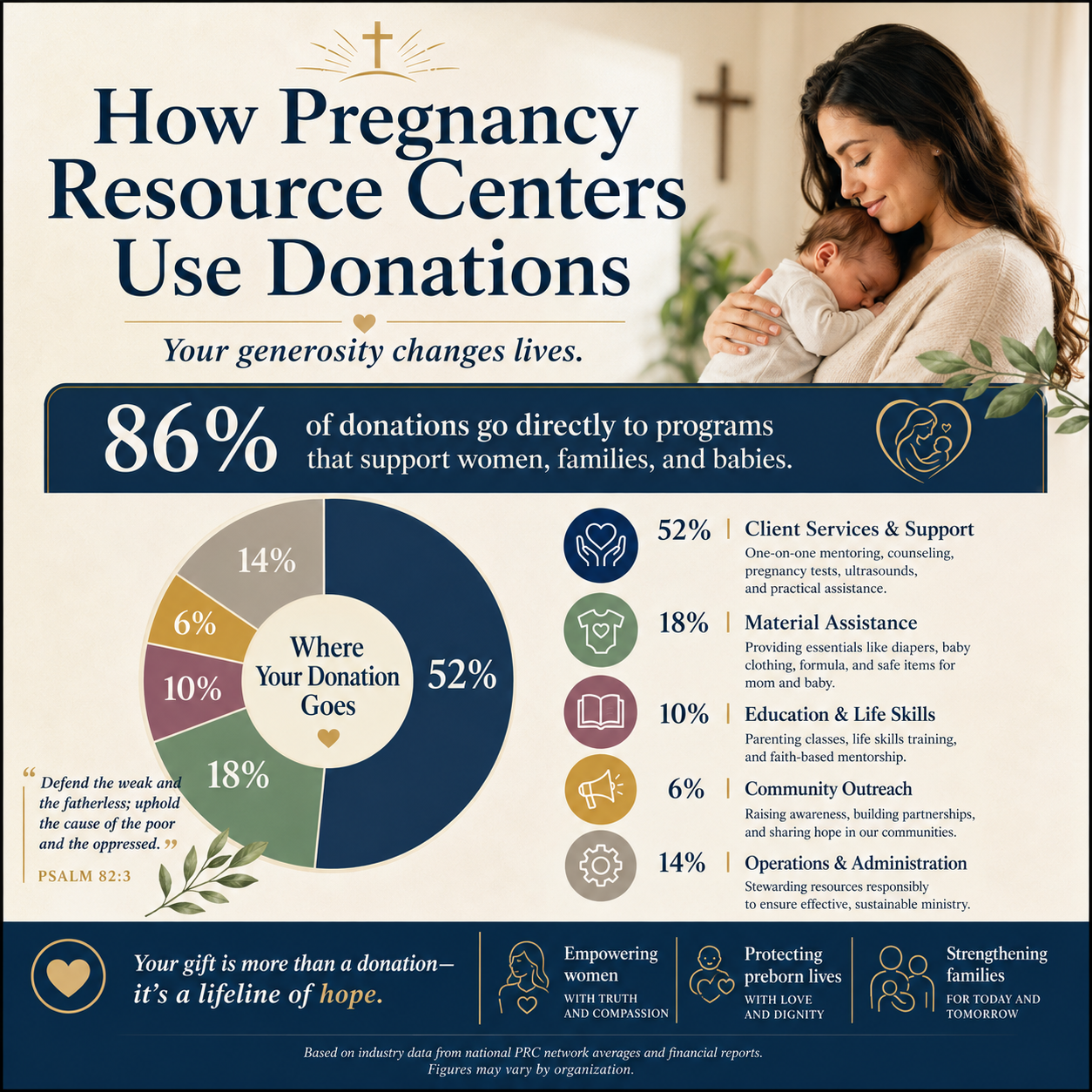
How pregnancy resource centers use donations is not a peripheral question for Christian donors. It is a stewardship question with moral weight, because the work sits at the intersection of poverty, sexual ethics, medical complexity, and the spiritual care of women and families under pressure.
Most pregnancy resource centers are small nonprofits operating close to the ground: rent is due, staff turnover is costly, volunteers need training, and local hostility or misunderstanding can rise quickly. Donors often ask for a simple ratio—“How much goes to the mission?”—but mature giving asks a better set of questions: What is the center actually providing? Is the care competent and lawful? Is the gospel witness clear and non-coercive? Are finances and governance accountable? Those are the categories that determine whether a gift strengthens life-affirming ministry or merely funds activity.
1) Donations fund people and presence before they fund programs
A pregnancy resource center’s first “program” is often availability: a safe, consistent place where a woman can be heard, assessed, and supported without being rushed. That requires staff, training, scheduling, and facilities. In practice, many centers budget more like counseling and social-service organizations than like event-driven ministries.
Staffing and training are mission-critical costs
Donations frequently support a small core team: an executive director, client services staff, a nurse manager (where medical services exist), and an administrative or development role. Volunteer hours are vital, but volunteer-dependent models still require professional oversight—especially when a center provides medical services, handles sensitive client information, or navigates mandated reporting.
Training typically includes trauma-informed care, healthy boundaries, confidentiality practices, and how to communicate truthfully about pregnancy and parenting options without manipulation. Many centers also train peer advocates to recognize domestic violence risk factors and refer appropriately. These are not “overhead” in any meaningful sense. They are the ordinary costs of protecting clients and honoring the Christian command to love our neighbor with competence.
Facilities, privacy, and basic operations carry spiritual implications
Rent, utilities, insurance, IT, and security may sound mundane, but they shape whether a woman feels safe enough to disclose what is actually happening. A center that cannot guarantee privacy or maintain predictable hours will struggle to serve clients consistently. Donors sometimes press for minimal administrative spending; the harder truth is that under-resourcing administration can become a form of unreliability, which is especially damaging for clients already experiencing instability.
This is one reason many charity evaluators have pushed back against simplistic overhead benchmarks. The “Overhead Myth” letter—signed by major nonprofit information organizations—argues that administrative and fundraising costs can be necessary for effectiveness and that donors should focus on results, transparency, and governance rather than a single ratio (Charity Navigator).

2) Donations most often fund a mix of material aid and long-term care
Pregnancy resource centers vary widely. Some are medical clinics offering limited ultrasound services under licensed oversight; others focus on material assistance, mentoring, and parenting education; many do a combination. Christian donors sometimes assume a center’s primary work is a single moment—preventing an abortion decision. Many centers do care in that moment, but substantial funding goes toward what comes after: supporting women and families toward stability.
Material support is tangible, but it is rarely the whole model
Donations regularly fund diapers, wipes, formula, car seats, maternity clothing, and baby clothing. In many communities, these items bridge a real gap while a family enrolls in WIC, secures safe housing, or rebuilds after a crisis. The material aid is also relational: it draws clients into ongoing contact where mentoring, education, and spiritual care can occur with dignity.
It is also worth naming a tension sophisticated donors recognize. Material aid can drift into transactional charity if it becomes a substitute for true accompaniment. The most credible centers treat material assistance as one part of a broader pathway: coaching, referrals, and support that strengthens a mother’s agency rather than creating dependency. The When Helping Hurts framework, articulated by Corbett and Fikkert, has helped many Christian ministries think more carefully about relief versus development and the long-term effects of well-intentioned giving (The Chalmers Center).
Parenting education, coaching, and mentoring require consistent funding
Many centers fund evidence-informed parenting curricula, classes, and one-to-one mentoring. These programs usually require childcare coordination, volunteer training, and follow-up systems. Centers also refer clients to housing agencies, Medicaid enrollment support, domestic violence services, adoption professionals, and church-based benevolence.
For Christian donors, theologically, this is where James’s insistence on practical love matters: “If a brother or sister is poorly clothed and lacking in daily food… what good is that?” The test is not sentiment, but whether care reaches the ordinary needs of life. Many centers aim to do that without presenting the gospel as a price tag attached to help, which is both ethically necessary and consistent with Christian witness.
Medical services bring higher compliance and insurance costs
Where a center provides medical services—commonly limited ultrasound—donations may support medical liability insurance, equipment maintenance, clinical supplies, HIPAA-aligned data handling, and professional supervision. These costs can be substantial, and they must be borne even when patient volume fluctuates. Donors should expect a verified center to be clear about what is medical, what is non-medical, and what licenses and protocols govern each.
3) The most sensitive spending categories are the ones donors should ask about
Pregnancy resource centers operate in a contested public environment. That reality does not excuse poor practice; it raises the stakes for integrity. The most important questions for donors often concentrate in a few spending areas where errors can harm clients, compromise witness, or expose the ministry to legal jeopardy.
Communications and marketing require truthfulness, not just effectiveness
Donations may fund website updates, search listings, local advertising, and community outreach. Because some women find centers in moments of panic, marketing must be carefully truthful about services provided and not provided. The goal is never to win a search result at the cost of deception. A life-affirming ministry should be able to state plainly: what services are offered, whether services are medical, and what a client should expect at a first visit.
Donors should also ask whether communications are aimed at shaming or at support. Christian conviction about the sanctity of life is not inconsistent with gentleness; it requires it. The gospel does not need manipulation to be persuasive.
Client data and confidentiality systems are not optional
Centers increasingly rely on client management systems to schedule appointments and track services. Donations may fund secure software, staff training, and policies that control access. Because centers deal with sensitive information—sexual history, family dynamics, sometimes abuse allegations—weak data practices can be spiritually and materially devastating.
For donors, the question is not simply “Do they keep records?” but “Do they have a written confidentiality policy, a retention schedule, and clear controls?” Even in non-medical settings, best practice is to treat client information with a level of seriousness that reflects the vulnerability of the people being served.
Legal counsel and security are increasingly part of prudent ministry
In some regions, donations fund legal review of policies, HR practices, and facility security. This is not a sign of mission drift. It can be a sign of realistic governance in a polarized environment. Christians may disagree about certain policy debates; fewer disagree that ministries serving women in crisis must safeguard staff and clients and operate within the law.
4) What trustworthy financial stewardship looks like in pregnancy resource centers
Christian donors deserve more than assurances. Trustworthy stewardship is visible in documents, decisions, and patterns over time. Across our verification work at Most Trusted, the ministries that meet The Most Trusted Standard tend to display the same traits: clear faith commitments that shape practice; disciplined financial controls; accountable leadership; and transparency that does not feel curated only for fundraising.
Budget clarity and restricted gift discipline
Centers often receive both unrestricted gifts (usable for general operations) and restricted gifts (designated for a purpose such as ultrasound equipment, a mobile unit, or client material aid). Donors should look for evidence that restricted gifts are tracked and used as designated, and that the center does not quietly cover operating gaps with restricted funds. That discipline is a mark of integrity, even when it is financially inconvenient.
Many centers also rely on in-kind donations. The best practice is to document how in-kind gifts are received, valued, and distributed, and to avoid overstating “services provided” in ways that blur financial reality.
Governance that is more than a name on letterhead
Centers with strong stewardship typically have an engaged board, documented conflict-of-interest practices, and financial review processes appropriate to their size. They also tend to separate duties in cash handling and accounting so that no single person controls an entire financial workflow.
Donors should not be embarrassed to ask for a recent annual report, a Form 990 (where applicable), and a plain explanation of how the center evaluates results. A ministry that welcomes scrutiny is usually a safer place to invest, because it understands that stewardship is accountable before God and neighbor.
Impact measurement that respects the complexity of the work
Some outcomes are countable: number of client visits, classes completed, material items distributed, ultrasound appointments provided. Other outcomes are ethically and practically harder to measure: the strength of a mother’s support network, progress toward stable housing, trauma recovery, or long-term parenting confidence. Donors should be cautious about centers that promise precision they cannot support, and equally cautious about centers that report nothing but activity.
Wise reporting distinguishes outputs from outcomes, avoids inflating numbers, and acknowledges limitations. In Christian terms, it resists the temptation to bear false witness in fundraising, even subtly. The work is serious enough to tell the truth about what can and cannot be proven.
For donors who want to place pregnancy center giving within a broader framework of due diligence, we maintain research on Pregnancy Resource Centers and apply The Most Trusted Standard to help Christian givers evaluate faith alignment, financial integrity, governance, and transparency with the seriousness these ministries deserve.
Giving that strengthens life-affirming ministry
Pregnancy resource centers use donations to sustain presence, provide material and clinical support where appropriate, and walk with women and families beyond a single appointment. The most responsible centers spend to protect clients, train staff and volunteers, maintain truthful communications, and build governance that can withstand pressure. Christian donors do not honor life merely by funding activity; we honor life by funding faithful, competent care that can be examined in the light.



