
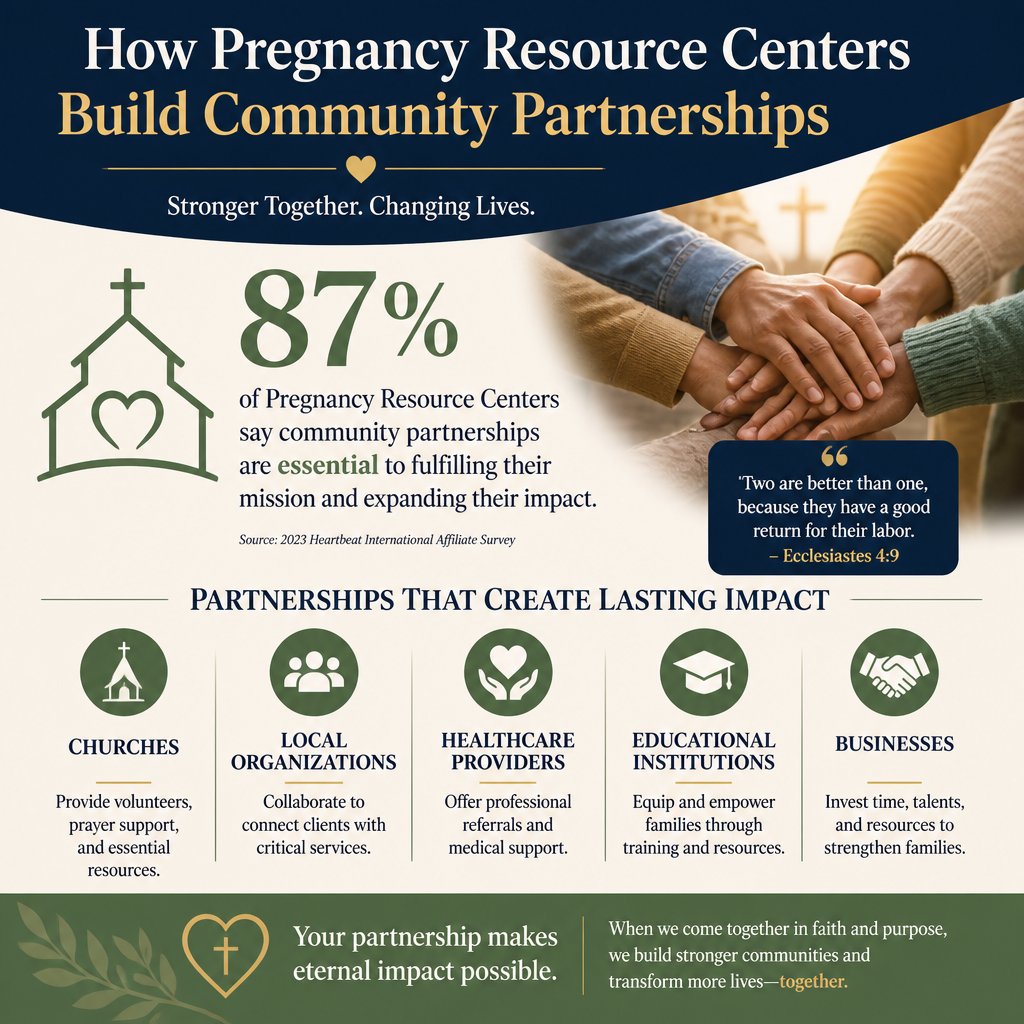
How pregnancy resource centers build community partnerships is not a secondary question for Christian donors; it is one of the clearest indicators of whether a center can provide durable care beyond the first appointment. A pregnancy decision is rarely only medical, only financial, or only spiritual. It is a convergence of fear, relationships, housing, work, and long-term stability, and a credible center must be able to connect a woman and her family to a web of support that will still be present months later.
Christians also rightly ask what kind of partnership is faithful partnership. Scripture’s call is not simply to offer momentary relief, but to pursue neighbor-love marked by truth, integrity, and endurance. The early church’s care for vulnerable people was organized, accountable, and relational, not improvised (Acts 6:1–7). Modern pregnancy resource centers face different structures and regulations, but the underlying moral demand is similar: build partnerships that protect people, honor conscience, and make help measurably accessible.
Partnerships are a care system, not a public relations strategy
Pregnancy resource centers operate at the intersection of public controversy and private crisis. That combination tempts some organizations to treat partnerships as reputational cover or fundraising momentum. Mature centers treat them as infrastructure: the practical network that makes it possible to offer comprehensive, dignified care without pretending to be a full-service social agency.
What this means in practice is that partnerships should be designed around the client’s pathway. A woman may need confirmation of pregnancy, a safe place to talk, material support, parenting education, housing stability, legal counsel, trauma-informed mental health care, and spiritual community. No single center can provide each component with excellence. A serious partnership strategy recognizes limits and then builds referral reliability across those limits.
Church partnerships should clarify roles, not blur them
Churches are often a center’s most natural allies, but the relationship can become vague in ways that weaken both. Healthy partnerships specify what the church will do well: volunteers trained for material support distribution, a benevolence process for emergency needs, mentoring for young parents, transportation help, or hosting parenting classes. Churches also provide spiritual community without making it conditional upon receiving services, which protects the integrity of both the gospel and client care.
For donors, a key question is whether the center has a disciplined approach to church engagement. Are churches asked to provide what they can reliably sustain, or is the center building a fragile program on volunteer enthusiasm that fades? Sustainable partnership is not a sentimental ideal; it is a planning requirement.
Healthcare collaboration must be clinically careful and ethically transparent
Centers that work with healthcare providers face legitimate scrutiny. The field has had to reckon with distrust from some medical professionals and public officials, and not every criticism is made in good faith. Still, donors should expect clarity. If a center offers medical services, the standards for licensure, supervision, documentation, and client consent are not optional. If a center does not offer medical services, it should not present itself as if it does.
Formal relationships with local clinics, OB/GYN practices, federally qualified health centers, or hospital systems are difficult to secure, but even informal patterns matter: a clear referral protocol, a list of trusted prenatal care providers, and a documented process for urgent medical situations. Centers that respect clinical boundaries tend to earn more durable respect in the community over time.
Referral networks are only as strong as their follow-through
A referral list is not a partnership. The difference is follow-through: warm handoffs, shared expectations, feedback loops, and problem solving when a client falls through the cracks. A center’s credibility grows when partners can say, “When we refer someone there, we know what will happen next.”
Donors can ask whether the center tracks referral outcomes in a basic, privacy-respecting way: How many clients accepted a referral? How many completed an intake with the partner organization? What barriers prevented follow-through—transportation, childcare, paperwork, fear, or cost? Even limited measurement, handled carefully, signals seriousness about effectiveness.

Trust requires governance clarity and documented boundaries
Partnership work exposes a center to reputational and legal risk, and it can expose clients to harm if boundaries are unclear. The center that is “connected everywhere” but disciplined nowhere becomes vulnerable to mission drift, inconsistent practices, and conflicts of interest. For Christian donors, the deeper issue is moral credibility: a center must be able to say what it does, what it does not do, and why.
Across our verification work at Most Trusted, we observe that the ministries that meet The Most Trusted Standard tend to treat partnerships as an extension of governance, not an informal social network. Board oversight, written policies, and consistent disclosures do not make a ministry cold; they make it safe and trustworthy for clients and supporters alike.
Written agreements protect clients and partners
Not every partnership needs a complex contract. But partnerships that include shared programs, shared space, data sharing, or clinical referrals generally require written terms. The purpose is not bureaucracy for its own sake; it is clarity: who is responsible for what, what confidentiality rules apply, and how problems are escalated.
For example, if a center partners with a licensed counselor, donors should expect clarity about supervision, credential verification, fees, mandatory reporting requirements, and documentation. If a church hosts a diaper distribution, expectations about client privacy and non-coercion should be explicit. In contested public terrain, written boundaries are often the difference between a partnership that endures and one that collapses under pressure.
Financial integrity shapes the credibility of partnership claims
Many centers raise funds by describing a broad spectrum of care. The ethical question is whether those claims are supported by actual capacity and honest accounting. Donors should look for financial statements that make it possible to understand program costs, fundraising expenses, and administrative support without resorting to simplistic ratios. The broader nonprofit sector has cautioned against judging quality primarily by overhead percentage; the widely cited “Overhead Myth” letter from GuideStar, Charity Navigator, and BBB Wise Giving Alliance explains why overhead can be a misleading proxy for effectiveness https://www.guidestar.org.
That caution is not permission for opacity. Effective partnership work requires staff time, training, and coordination. If a center claims to coordinate complex networks but budgets almost nothing for program staff or case management, donors should ask how the work is actually being done.
Transparency must include contested areas
Pregnancy resource centers live in a space where Christians and neighbors genuinely disagree about law, public policy, medical ethics, and rhetoric. Donors should be wary of ministries that pretend there is no controversy and equally wary of ministries that build their identity on controversy. Trustworthy centers publish clear statements about the services they offer, what clients can expect, and how confidentiality is handled. They also communicate respectfully about those who disagree.
Partnerships with civic agencies, social service coalitions, or schools will often require careful language and mutual respect. A center does not have to dilute its convictions to be transparent. But it does need to be consistent and verifiable.
The strongest partnerships are built around client pathways
Community partnerships are easiest to evaluate when they are tied to concrete client outcomes rather than general goodwill. A center that understands the client pathway can name its most common needs, its most frequent barriers, and its most reliable partner responses. This is where donors can move from admiration to discernment.
Centers differ in scope. Some emphasize pregnancy testing and education. Others offer medical services, fatherhood programs, long-term mentoring, or post-abortion support. Partnership strategy should match that scope. What donors should not accept is an aspirational list of relationships presented as if they were active pathways of care.
Healthcare and prenatal care pathways
Even when a center offers limited medical services, prenatal care generally requires external providers. Strong centers maintain updated referral protocols, confirm partner availability, and help clients overcome access barriers. Transportation and childcare are often decisive. A referral that assumes stable work schedules, reliable cars, and flexible childcare is not actually a referral for many clients.
Centers with deeper partnerships sometimes coordinate with community health workers, nursing programs, or local clinics to reduce friction. Where this is possible, it often depends on consistent professionalism and documented consent practices. For donors, it is reasonable to ask whether the center has a process for verifying that partners remain reputable and responsive.
Housing, employment, and material stability pathways
Pregnancy-related vulnerability often intersects with housing instability and economic pressure. Nationally, homelessness remains a persistent reality; the U.S. Department of Housing and Urban Development’s annual point-in-time count provides a baseline measure of the scale of need https://www.hud.gov. A center does not need to become a housing agency, but it should know which agencies can respond quickly and what documentation they require.
Material assistance—diapers, formula, car seats—can be a meaningful expression of care, but it is rarely sufficient on its own. Thoughtful partnership work places material support within a broader plan: budgeting help, job readiness connections, GED programs, childcare resources, and mentoring. Donors should look for evidence that these connections are current and that clients can realistically access them.
Pastoral referral pathways and spiritual care
Pastors are often asked to respond to crisis disclosures with very little time. The question “When should a pastor refer?” is practical, but it is also pastoral theology. A wise referral protects the congregant from isolation, provides specialized support, and preserves pastoral care rather than replacing it.
Centers that partner well with churches typically offer a clear pastoral referral process: who to call, what information is appropriate to share, how confidentiality is handled, and what the church should continue to do. When those pathways are clear, pastors can respond quickly without improvising under pressure, and congregants experience a unified care network rather than a handoff into the unknown.
For donors, the relevant point is not whether a center “sounds connected,” but whether its connections function under real conditions. A crisis pregnancy often involves fear, time constraints, and relational complexity. Partnership strength is tested there, not at a luncheon.
What donors should look for when evaluating partnership strength
Christian donors are often asked to fund pregnancy resource centers through banquets, mail appeals, and church presentations. Those settings can make partnership claims feel compelling but difficult to verify. A disciplined donor approach asks for evidence that is concrete enough to withstand scrutiny without pressuring a center to violate client privacy.
In our work at Most Trusted, we encourage donors to evaluate partnership strength through the same moral lens that Scripture applies to stewardship: truthfulness, accountability, and care for those who bear the greatest risk. Partnership rhetoric is easy. Partnership reliability is costly, and it shows up in policies, staffing, and the quiet work of follow-up.
Questions that surface reality without cynicism
- Which partnerships are active pathways of care? Ask the center to name a small number of key partners and describe the typical referral process and timeframe.
- How do you track whether referrals succeed? The goal is not intrusive data collection, but responsible follow-through.
- What training do volunteers receive before serving clients? Partnership work often depends on volunteer conduct that protects dignity and confidentiality.
- What are your escalation protocols? Ask how the center handles suspected abuse, suicidal ideation, domestic violence, or urgent medical concerns.
- How do you communicate your services publicly? Clarity builds trust with clients, partners, and the broader community.
Donor events should reflect mission rather than substitute for it
Fundraising banquets and church presentations can be legitimate tools, but they can also distort priorities if the center’s public footprint is larger than its care capacity. The research on fundraising effectiveness tends to emphasize disciplined donor stewardship and trust-building over time rather than event-driven hype; the broader philanthropic field has repeatedly highlighted donor trust and transparency as central to sustainable giving, including in reporting by the Chronicle of Philanthropy https://www.philanthropy.com.
For donors, the evaluative question is straightforward: do events accurately represent what the center can do, and do they strengthen the partnerships that make care durable? Events that primarily trade in emotional urgency can damage long-term credibility, especially in a contested ministry environment.
Verification strengthens giving and strengthens ministries
Because pregnancy resource centers often operate under scrutiny, donors sometimes default to either unquestioning loyalty or instinctive suspicion. Neither posture honors Christian stewardship. Verification offers a third way: careful, fair evaluation grounded in evidence and aligned with biblical integrity.
Most Trusted exists to help donors give with confidence by evaluating ministries against The Most Trusted Standard, a 15-criteria framework covering Faith Foundation, Financial Integrity, Governance and Leadership, and Transparency and Effectiveness. Partnership claims touch each of these areas. A center that partners well typically shows it in doctrinal clarity, board oversight of risk, truthful communications, and measurable follow-through.
For readers assessing Pregnancy Resource Centers, partnership strength is one of the most practical indicators of whether compassion is organized into real care.
Partnerships are a test of love and a measure of readiness
Pregnancy resource centers build community partnerships because love of neighbor requires more than a sympathetic conversation and a bag of supplies. It requires the steady work of coordination, the humility to admit limits, and the courage to be transparent in a contested field. When partnerships are real, a center becomes not merely a place someone visits, but a doorway into a community capable of sustaining life and walking with families over time.
For Christian donors, the aim is not to fund a brand, a controversy, or a moment. The aim is to support ministries whose care is truthful, accountable, and durable, so that vulnerable neighbors encounter help that is both compassionate and reliable.



