
How pastoral support ministries approach moral failure and restoration is not an abstract question for Christian donors. It is where theology, institutional trust, victim care, and stewardship converge—often under public scrutiny and intense emotion. When a pastor’s sin becomes visible, the church must pursue truth and mercy without confusing them, and donors must decide whether a ministry’s restoration work is trustworthy enough to support.
Christians genuinely disagree about how quickly leaders should return to public ministry, what “restoration” entails, and how to weigh a leader’s gifting against the damage done. Yet the New Testament is not silent about the stakes. Jesus requires truthfulness and repentance (John 8:32), and Paul warns that some sins disqualify a man from oversight because the office itself requires “above reproach” character (1 Timothy 3:1–7). Pastoral support ministries serve the church best when they refuse both moral cynicism and sentimental haste.
1. Moral failure is a spiritual crisis with institutional consequences
Sin is personal, but the pastoral office is public
Pastoral moral failure is not only the collapse of a private life. It is a breach of trust within a covenant community. The pastoral office carries delegated authority—preaching, counsel, discipline, and spiritual care—and Scripture treats that authority with sobriety. James warns that teachers will be judged with greater strictness (James 3:1). When the one entrusted to guard souls becomes the source of harm, the damage ripples through marriages, staff teams, budgets, and congregational faith.
Pastoral support ministries that understand this will speak about repentance in moral terms and about restoration in ecclesial terms. They will not treat a fallen pastor as merely a “leader who had a rough season,” nor will they treat the church as an obstacle to a leader’s comeback. They will take seriously the public nature of the office, the vulnerability of congregants, and the particular dynamics of spiritual abuse that can accompany moral failure.
The donor’s question is not only compassion but credibility
Donors often carry a dual burden in these moments. Many want to support restoration because they believe the gospel is for sinners, including leaders. Many also fear funding a process that minimizes victims, manipulates outcomes, or returns someone to influence without real fruit of repentance. Those concerns are not cynicism. They are a form of stewardship.
Across our verification work at Most Trusted, we observe that the most credible pastoral support ministries make room for grief and anger without turning them into the final word. They also resist the opposite temptation: using “grace” language to bypass consequences. The more public the failure, the more structured and independently accountable the path forward must be.

2. A trustworthy restoration pathway starts with clarity, not urgency
Repentance is more than confession
Most pastoral support ministries will say they believe in repentance. The harder question is how repentance is assessed and evidenced over time. Biblically, repentance includes confession, forsaking sin, making restitution where possible, and submitting to correction (Proverbs 28:13; Luke 3:8; 2 Corinthians 7:10–11). In cases involving sexual misconduct, financial wrongdoing, or patterns of deception, repentance also includes transparency with appropriate authorities and truthful disclosure to those harmed, within wise boundaries.
Many ministries have had to reckon with the difference between remorse and repentance. Remorse can be intense and still self-protective. Repentance is often quieter, slower, and willing to accept lasting consequences, including the possibility that a man may never return to pastoral office.
Time is not a loophole, but it is a test
In American evangelical culture, there is recurring pressure to move quickly: to manage headlines, stabilize congregations, and preserve donor confidence. Yet spiritual formation rarely follows public-relations timelines. Pastoral support ministries that approach moral failure with integrity tend to insist on extended seasons of observation. That is not punitive; it is diagnostic. Patterns—humility, truth-telling, willingness to be unknown, and submission to oversight—surface over time.
When donors ask how long restoration should take, the most responsible answer is that it depends on the nature of the sin, the presence of criminal conduct, the depth of deception, the impact on victims, and the leader’s long-term pattern of accountability. A ministry that promises quick restoration should raise concern, not hope.
3. Victim care and congregational repair are not optional add-ons
Restoration that ignores victims is not Christian restoration
Some moral failures are primarily self-destructive; others are directly predatory. In either case, there are usually people harmed—spouses, staff, congregants, and sometimes minors. The church’s credibility is damaged when victim care is treated as secondary to restoring the leader’s platform. Scripture repeatedly ties righteousness to the protection of the vulnerable and the refusal to pervert justice (Isaiah 1:17; Micah 6:8).
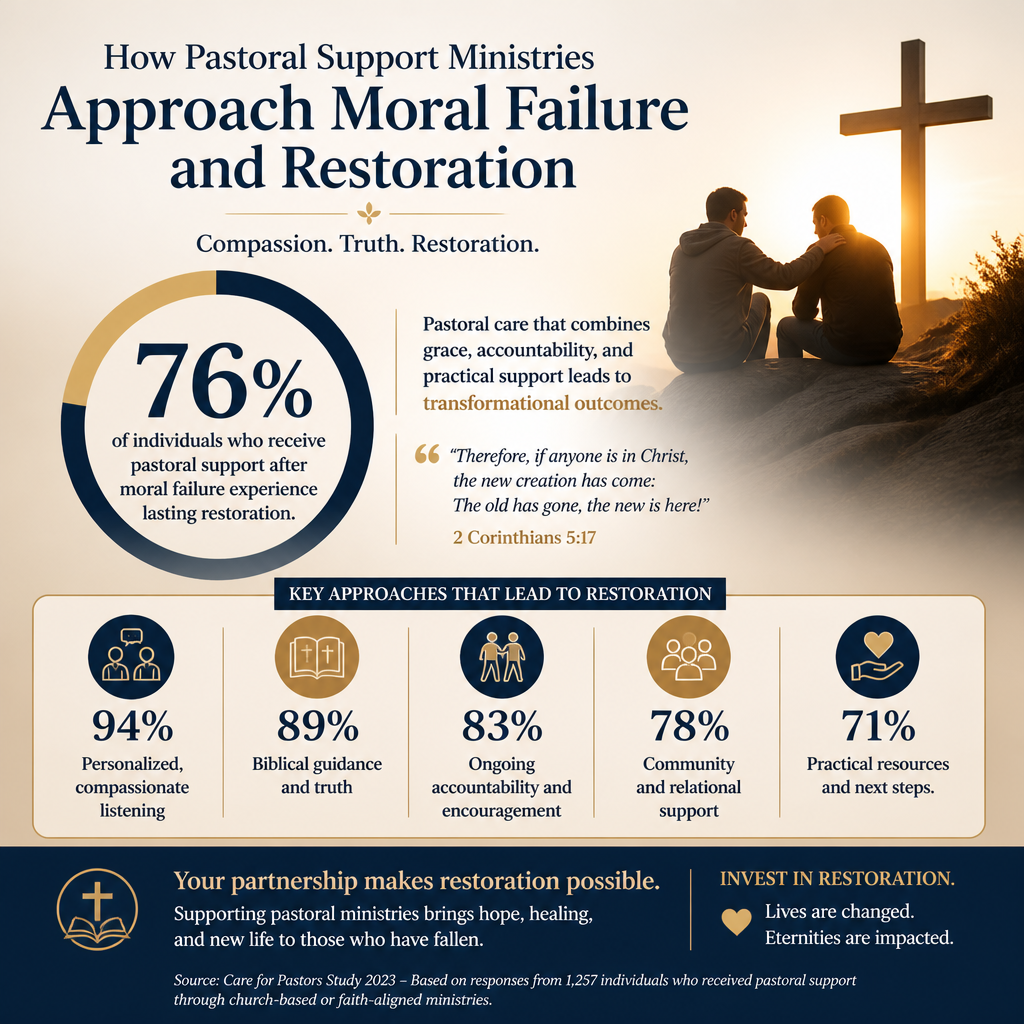
Pastoral support ministries that are worthy of donor trust will have explicit practices for victim advocacy, referral to trauma-informed counseling, and cooperation with legal authorities when crimes may have occurred. Donors should not accept euphemisms in place of safeguards. “We handled it internally” is not a virtue when the situation requires mandated reporting or law enforcement involvement.
Independent investigations often serve truth better than internal reviews
When allegations involve abuse, coercion, or financial misconduct, the credibility of an internal investigation is limited by conflicts of interest. That is one reason many churches and networks now rely on independent third-party investigations. The field has debated their costs, their varying quality, and the potential for adversarial dynamics. Yet independent review can protect victims, clarify facts, and remove incentives to manage the narrative.
Public confidence in institutional self-policing is weak across sectors, not only churches. In the corporate world, trust in business has fluctuated sharply in recent years; for example, the Edelman Trust Barometer reported that trust is fragile and closely tied to perceptions of competence and ethics (Edelman Trust Barometer). Churches and ministries should not presume they will be treated as exceptions. A pastoral support ministry that understands this will treat transparency and third-party oversight as part of faithful witness, not as capitulation to skepticism.
4. Governance and accountability determine whether restoration is credible
Accountability must be real, not symbolic
When a pastor falls, the question of “who has authority” becomes unavoidable. A credible restoration process typically includes separation from former power structures, clear restrictions, defined milestones, and external accountability that cannot be overridden by friends, donors, or a charismatic leader. In the healthiest models, the restoring body is not financially dependent on the leader being restored, and it does not treat a successful return to the pulpit as the primary metric of success.
This is where donors should pay attention to governance, conflicts of interest, and reporting. The ministries that meet The Most Trusted Standard tend to document how decisions are made, how boards function, how related-party transactions are handled, and what safeguards exist when leaders are in crisis. Good intentions are common. Verifiable structures are rarer.
What donors can reasonably look for
Donors do not need access to private counseling notes to evaluate whether a pastoral support ministry operates with integrity. What this means in practice is asking for public signals of seriousness:
- Clear written policies on misconduct, reporting, and cooperation with civil authorities
- Evidence of independent governance, including a board not controlled by insiders
- Defined restoration processes that include victim care and congregational repair
- Financial transparency consistent with best practices for Christian nonprofits
- Boundaries on platform access, publicity, and fundraising during restoration
These are not bureaucratic hurdles. They are part of loving the church well. For donors who support ministries in this domain, we recommend reviewing organizations within the broader ecosystem of Pastoral Support Ministries to compare how they frame accountability, victim care, and leadership formation.
5. Donor support can strengthen restoration when it is wisely targeted
Funding outcomes versus funding processes
Restoration work can be expensive: clinical counseling, trauma care, legal consultation, independent investigations, and long-term mentoring structures require resources. Yet donor support can unintentionally reward the wrong outcomes if it is tied to public relaunches rather than to faithful processes. The church has sometimes confused “back on stage” with “made whole.” Pastoral support ministries that deserve donor partnership tend to define success in terms of truth, protection of the vulnerable, reconciliation where possible, and long-term discipleship—even if that results in permanent removal from vocational ministry.
Christians also disagree about whether “restoration” should ever include return to pastoral office after certain categories of failure. Some traditions argue that sexual sin or sustained deception permanently disqualifies a man from oversight; others allow for carefully bounded return after extended time and demonstrable fruit. Donors should not demand unanimity, but they should insist on theological clarity and consistent application. A ministry that changes its standard based on the leader’s influence is signaling a deeper problem.
Due diligence that reflects Christian stewardship
Serious donors often ask what due diligence is appropriate without becoming suspicious or intrusive. The standard is neither naïveté nor cynicism. Scripture commends wise testing (1 Thessalonians 5:21) and warns against partiality (James 2:1). In practice, donors can ask whether a ministry is aligned with what is increasingly recognized as good nonprofit practice: transparency, independent oversight, and measurable follow-through.
For donors evaluating where to give in this space, it is often helpful to situate a ministry within the wider field of Pastoral Support Ministries for Counseling and Crisis Care, where differences in philosophy, governance, and disclosure standards become clearer.
FAQs for How pastoral support ministries approach moral failure and restoration
Should donors fund a pastor’s restoration process directly?
Direct funding is sometimes appropriate, but it carries risks. When money flows straight to the leader, it can unintentionally reduce accountability or create incentives to accelerate a return to visibility. Many donors choose to fund independent pastoral support ministries that provide structured counseling, assessment, and oversight, or they designate gifts specifically for victim care and congregational repair. The more serious the misconduct, the more important it is that financial support strengthens independent accountability rather than bypassing it.
What is a reasonable level of transparency about a leader’s moral failure?
Reasonable transparency tells the truth without turning repentance into spectacle. Churches and restoration ministries should disclose enough for those affected to understand what happened, what safeguards are in place, and how leadership is being held accountable. They should also protect sensitive details that could further harm victims or expose confidential counseling information. When misconduct may involve criminal behavior, transparency must include cooperation with civil authorities and should not be limited to internal statements.
A credible restoration ministry serves both mercy and truth
Pastoral support ministries are most faithful when they resist the church’s recurring temptation to choose between compassion and accountability. The gospel creates hope for real repentance and change. The same gospel calls the church to protect the vulnerable, tell the truth, and treat the pastoral office with sobriety. Christian donors can participate in that work with confidence when they support ministries whose theology is clear, whose governance is independent, and whose restoration pathways are structured enough to withstand the pressures that moral failure inevitably brings.



