
How to give stock to pastoral support ministries is often less complicated than donors assume, but it does require precision. When the gift is handled well, it can increase the ministry’s net benefit, reduce your tax exposure, and place your stewardship on a more durable footing than writing a check after year-end pressures.
Pastoral support is also a category where donors routinely carry quiet burdens: concern for ministerial burnout, a desire to honor those who preach and shepherd faithfully, and uncertainty about whether funds will be governed with the sobriety Scripture requires. These ministries can do profound good, and they can also be structured in ways that make due diligence unusually important.
Why stock is often a strong way to fund pastoral support
Stewardship and clarity about what you are giving
Appreciated publicly traded stock can be one of the most tax-efficient assets for charitable giving in the United States. In many cases, donating appreciated shares held longer than one year allows you to claim a charitable deduction for the fair market value and avoid capital gains tax on the appreciation. The Internal Revenue Service describes these rules and the governing limitations in its guidance on charitable contributions of property and capital gain property; donors should review the details with their tax advisor because individual circumstances vary. See IRS Publication 526 and related IRS guidance at irs.gov.
What this means in practice is that the gift’s “cost” to you may be materially lower than the amount the ministry receives. That difference is not a trick; it is a policy choice embedded in tax law to encourage charitable giving. Donors should still resist the temptation to let tax efficiency become the primary motive. The New Testament places the moral weight on love, integrity, and cheerful generosity, not on financial engineering.
Pastoral support is a legitimate, biblical object of generosity
The Christian tradition has long recognized that supporting ministers is not charity in the shallow sense, but a shared obligation in the life of the church. Paul’s argument in 1 Corinthians 9 grounds material support for those who proclaim the gospel. That theological grounding does not remove the need for governance and accountability; it heightens it. The closer a ministry is to spiritual authority, the more carefully it should be structured to avoid conflicts of interest and to model financial integrity.

What to confirm before you transfer shares
Verify the recipient’s capacity to receive and liquidate stock
Not every pastoral support ministry is operationally ready to receive securities. Many smaller ministries do not maintain a brokerage account in the organization’s name, or they rely on a fiscal sponsor or a third-party donor platform to process stock gifts. There is nothing inherently wrong with those arrangements, but you should understand who will receive the shares, who will sell them, how quickly they will be liquidated, and what fees will be charged along the way.
Ask for written stock transfer instructions on the ministry’s letterhead (or the letterhead of its authorized agent), including DTC number, brokerage firm, account name, and account number. Confirm that the account name matches the legal entity you intend to support. If the ministry cannot provide clear instructions, that is a solvable operational gap, but it is also a reason to slow down until the process is clear.
Confirm the legal entity, tax status, and receipting practices
Pastoral support takes many forms: direct support for pastors, retirement assistance, counseling and sabbatical funds, emergency relief, and leadership development. Those activities can be conducted within a church, a denominational structure, a 501(c)(3) public charity, or in some cases a related entity. Your tax deduction hinges on the recipient’s status and on how the gift is structured. The IRS maintains the Tax Exempt Organization Search tool for verifying an organization’s status at irs.gov.
Receipts for noncash gifts should typically describe the donated property without stating a value, because valuation is the donor’s responsibility. For publicly traded securities, your brokerage documentation usually supplies what you need for your records. If the ministry promises to “value your stock for you,” insist on correct practice. Good ministries protect both donors and the organization by handling receipting with care.
The mechanics of giving stock in a way that protects both donor and ministry
A disciplined process for the transfer
A stock gift is usually completed through an electronic transfer from your brokerage to the ministry’s brokerage using the Depository Trust Company system. Some donors also give through a donor-advised fund, which can simplify recordkeeping and timing. The best approach depends on your assets, your time horizon, and whether you are combining support for multiple ministries.
Across our verification work at Most Trusted, we observe that ministries with strong financial controls tend to have a written gift acceptance policy, clear segregation of duties, and prompt, accurate acknowledgment letters. Those practices are not bureaucratic embellishments; they are part of how a ministry demonstrates trustworthiness with resources offered to God.
Decide whether to give directly, through a donor-advised fund, or through a foundation
Each route carries trade-offs:
- Direct stock gift to the ministry: often simplest, but requires the ministry to have operational readiness and strong internal controls.
- Donor-advised fund: can consolidate gifting and sometimes accepts complex assets, but introduces timing and policy constraints based on the sponsor.
- Private foundation: offers control and long-term strategy, but carries administrative burden and strict compliance obligations.
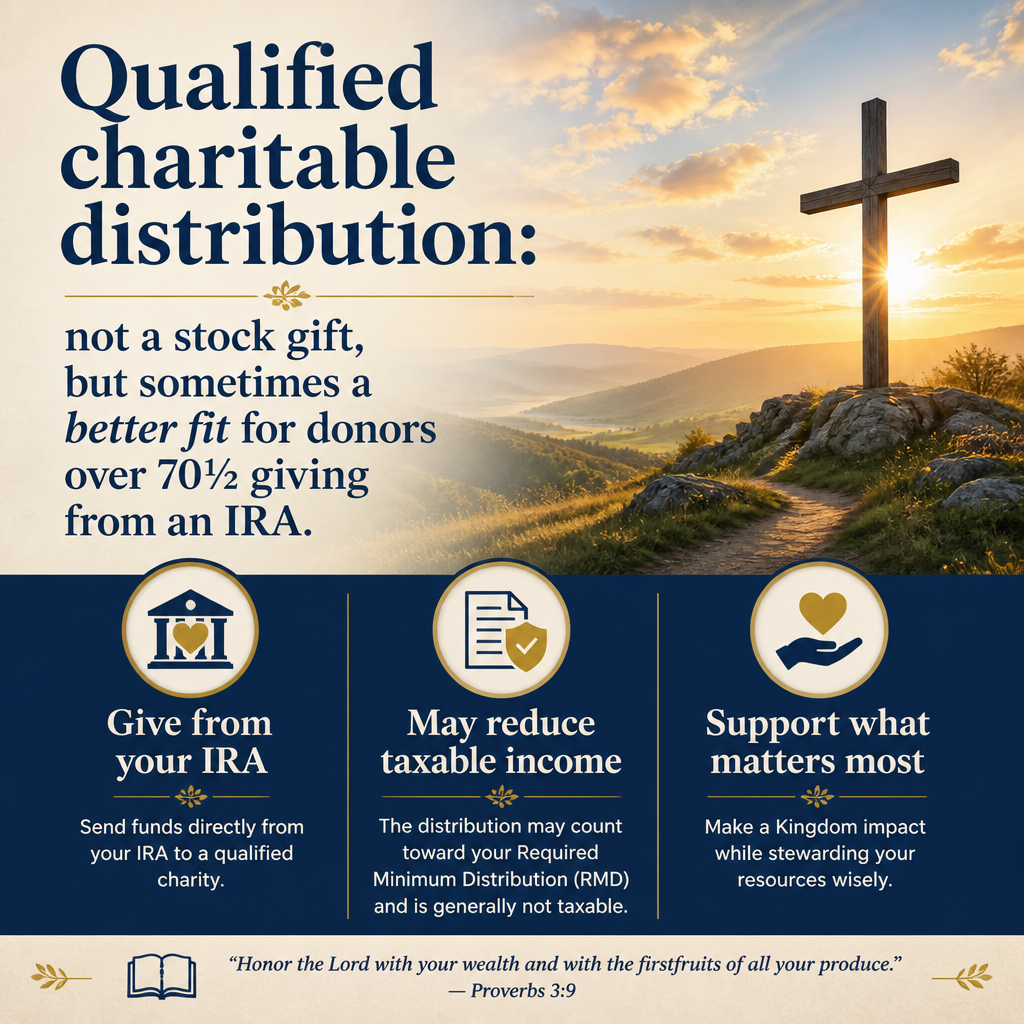
- Qualified charitable distribution: not a stock gift, but sometimes a better fit for donors over 70½ giving from an IRA.
- Planned giving: for highly appreciated holdings, charitable remainder trusts or other structures may be appropriate, though they require specialized counsel.
Christians genuinely disagree about how much structure is prudent before generosity becomes anxious control. Yet prudence is not unbelief. Scripture commends wise stewardship, and donors have a responsibility to ensure their gifts do not unintentionally subsidize poor governance or opaque practices.
Due diligence that fits pastoral support ministries
Common risk areas in pastoral support
Pastoral support can involve direct assistance to individuals, which raises legitimate privacy concerns and can limit what a ministry can disclose publicly. That does not excuse opacity. It simply means donors should look for evidence of controls: written eligibility criteria, oversight by an independent board, conflict-of-interest policies, and an audit trail that can be reviewed by qualified parties.
Pay particular attention when the ministry’s leaders are also the primary beneficiaries of the ministry’s programs, or when compensation decisions are concentrated among friends, family members, or handpicked insiders. A mature ministry will welcome governance safeguards rather than treating them as mistrust.
How Most Trusted approaches verification
Most Trusted exists because many donors want more than inspiring stories; they want verifiable confidence. We evaluate Christian nonprofits against The Most Trusted Standard, a 15-criteria framework across Faith Foundation, Financial Integrity, Governance and Leadership, and Transparency and Effectiveness. For donors focusing on pastoral support, this kind of framework helps distinguish between ministries that are simply sincere and ministries that are structurally trustworthy over time.
For broader context on how this category fits within Christian giving, see Pastoral Support Ministries. For donors comparing practical giving methods and constraints across organizations, How to Give to Pastoral Support Ministries provides additional framing that can help you choose the right channel for your gift.
Gift design that strengthens pastors without weakening the church
Aim for support that is accountable, not merely generous
The harder question is not whether pastors deserve support, but what kind of support builds health rather than dependence or quiet distortion. Some ministries provide emergency assistance; others fund counseling, retreats, or continuing education; others underwrite retirement gaps created by low compensation over decades. Each can be faithful. Each can also drift if it becomes a substitute for local church responsibility or if it rewards unhealthy ministry cultures that treat exhaustion as virtue.
Donors can ask constructive questions: Does this ministry encourage sustainable pastoral life, including rest and family care? Does it collaborate with churches and denominations rather than bypassing them? Does it measure outcomes that matter—retention, restored health, reduced crisis incidents—without turning human shepherding into a simplistic metric exercise?
Consider timing, concentration, and communication
Stock gifts often arrive in larger amounts than routine checks. That can be a blessing and a stressor for a small ministry. Some donors choose to notify the ministry in advance, especially if the gift is significant, so the organization can plan responsibly and handle receipting promptly. Others prefer anonymity. Both can be appropriate; what matters is that the gift does not create informal influence or expectations that compromise leadership integrity.
Donors should also avoid over-concentrating their giving in a single personality-driven organization without independent oversight. Pastoral support is emotionally compelling, and gratitude toward a beloved teacher can be sincere. Yet mature giving resists the subtle temptation to treat a leader’s charisma as a substitute for institutional accountability.
FAQs for How to give stock to pastoral support ministries
Should we donate stock directly to a pastoral support ministry or sell the stock and give cash?
For appreciated publicly traded stock held longer than one year, donating shares directly is often more tax-efficient than selling and giving cash, because it can avoid capital gains tax and still allow a charitable deduction for fair market value, subject to IRS limits. The relevant rules and limitations are described in IRS guidance on charitable contributions and capital gain property at irs.gov. Because deductions and limitations depend on your facts, confirm the best approach with a qualified tax advisor.
What documentation should we expect after giving stock?
You should expect a written acknowledgment from the ministry describing the donated property (for example, “X shares of ABC Corporation”) and the date of receipt, without assigning a dollar value. Your brokerage statement typically provides the information needed to determine fair market value for your tax records. For noncash gifts above certain thresholds, additional IRS reporting requirements can apply; see IRS guidance at irs.gov.
A closing word on confidence and faithfulness
Giving stock to pastoral support ministries can be a disciplined act of worship: honoring those who labor in preaching and care, and doing so with prudence worthy of the trust involved. The best gifts combine generosity with clarity—clear transfer instructions, clear receipting, and clear governance—so that the ministry’s attention remains where it belongs: on sustaining faithful shepherds for the long work of the church.



