

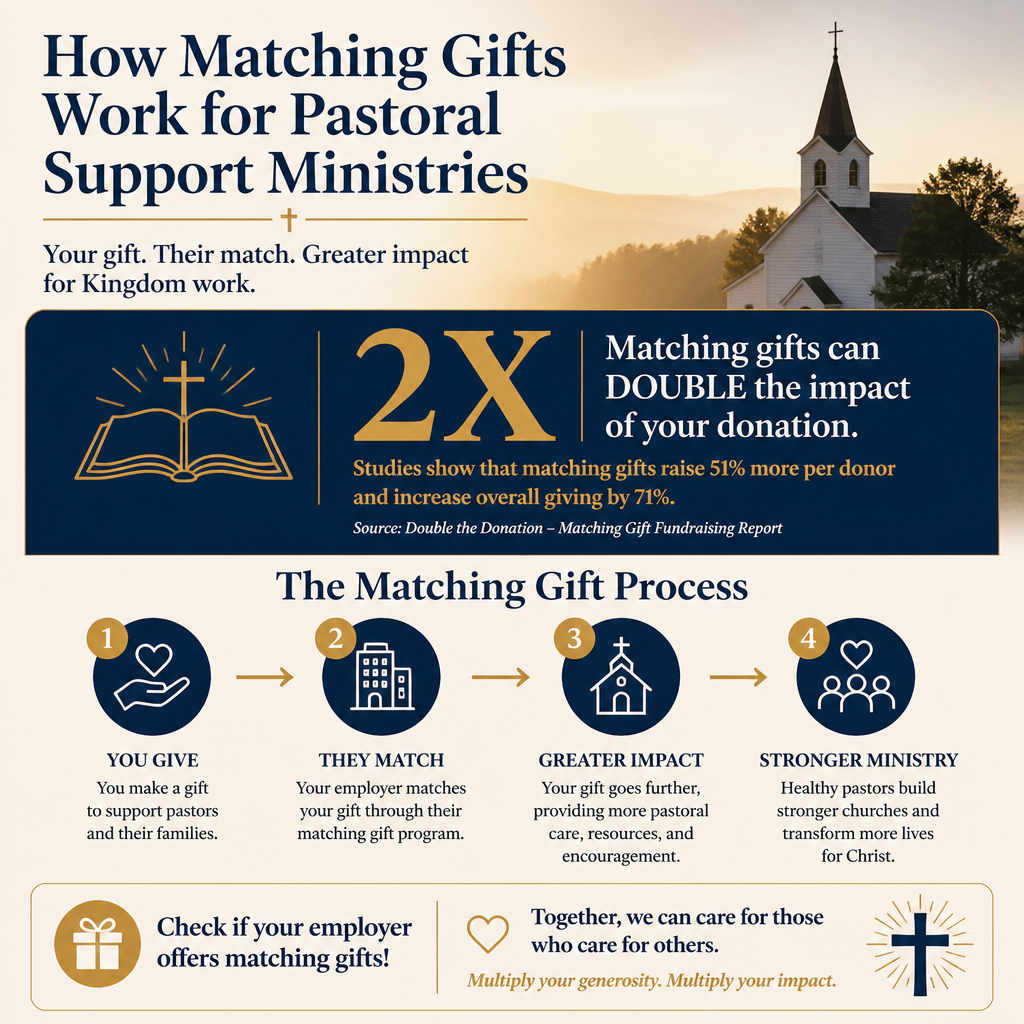
How matching gifts work for pastoral support ministries is straightforward in concept and often misunderstood in practice. A matching gift is typically an employer benefit that multiplies an employee’s charitable donation, increasing the total support a ministry receives without increasing the donor’s out-of-pocket cost.
For Christian donors who care about the health of pastors and their families, matching gifts can be a disciplined way to strengthen long-term ministry capacity. The more serious question is whether a particular pastoral support ministry is administratively ready to receive matches promptly, record them accurately, and communicate about them with integrity. These are not secondary matters; Scripture repeatedly links faithfulness with trustworthy handling of resources (Luke 16:10).
Why matching gifts matter for pastoral support ministries
Pastoral care is often quiet work with measurable consequences
Pastoral support ministries tend to operate behind the scenes: counseling, retreats, spiritual direction, crisis care, coaching, sabbatical support, and marriage and family strengthening. Donors often feel the urgency because they have watched a gifted pastor labor under chronic strain or have seen a congregation destabilized by a leader’s moral failure, burnout, or family collapse.
While causes of pastoral attrition are contested and vary by context, the weight is not imagined. Barna has reported that a substantial share of pastors have considered quitting full-time ministry in recent years, with stress and discouragement named among leading factors (Barna).
Matching gifts align with Christian stewardship
Matching gifts do not replace sacrificial generosity; they can strengthen it. A donor who gives to pastoral care because Christ calls us to bear one another’s burdens (Galatians 6:2) may view a match as a providential means for doing more of that burden-bearing with the same personal giving.
What this means in practice is that a donor’s decision is not merely about “getting more dollars.” It is about whether additional resources can be stewarded to strengthen shepherds who, in turn, strengthen churches.

The mechanics of a matching gift from donation to deposit
Most matching gifts follow a predictable workflow
Employer matching programs vary, but the general flow is consistent: an employee donates to a qualified nonprofit, then submits a match request through the employer’s portal or a matching-gift platform. The employer verifies eligibility and sends a matching contribution directly to the nonprofit.
Matching ratios and limits differ by company. Some match 1:1, some 2:1, and many cap annual matched amounts. Some employers restrict eligible organizations or exclude gifts directed to individuals, and some exclude certain religious activities. Donors should read the company policy rather than assume.
Timing is rarely immediate
Even when a donor submits the request quickly, matches can take weeks or months to arrive, depending on employer review cycles and payment batching. Ministries should avoid representing a match as guaranteed revenue until it is received. For donors, this is a reason to ask how the ministry tracks match requests and how it reports revenue recognition.
If a ministry’s budgeting depends heavily on matches, it should be able to explain cash-flow implications without evasion. Mature transparency here is a marker of seriousness.
What donors should verify before counting on a match
Eligibility and designation questions can be decisive
Many matching gift programs require that the receiving organization be a 501(c)(3) public charity in good standing. Pastoral support ministries often meet that standard, but donors should still verify the legal entity that will receive the gift. Programs may also restrict gifts that are “for the benefit of a specific individual,” which can affect pastor-specific care funds or directly designated benevolence.
When donors support pastoral care, a common desire is to help a particular pastor. Yet matching gift rules may require that funds be used for the organization’s general charitable purposes rather than a named individual. A ministry that communicates this carefully is protecting both donor intent and compliance.
Administrative capacity is part of faithfulness
Across our verification work at Most Trusted, we observe that administrative details often reveal deeper governance and stewardship realities. A ministry can have a sound theology of care and still mishandle documentation, acknowledgments, or restricted-fund accounting. Donors should not confuse administrative discipline with secular bureaucracy; it is part of honoring what has been entrusted.
Prudent donor questions include:
- Does the ministry clearly explain matching gift steps and timing?
- Can it confirm whether gifts can be restricted and still be eligible for a match?
- Does it issue accurate receipts that include required tax language?
- Does it track match requests and follow up when needed?
- Does it distinguish pledged matches from received matches in reporting?
For donors who want a wider view of the ministry landscape and what healthy pastoral care can include, see Pastoral Support Ministries for context on models, risks, and indicators of integrity.
Common pitfalls and ethical tensions in matching gift fundraising
Overpromising and implied guarantees
One recurring risk is language that implies a match is automatic: “Your gift will be doubled” without qualification. In reality, a match depends on the donor’s employment status, the company’s rules, timely submission, and employer approval. Responsible ministries use careful wording: “may be eligible for a match” and “subject to your employer’s program terms.” This is not legalism; it is truthful speech.
Another risk is treating matches as a marketing device rather than as stewardship. If a ministry uses matching language to create urgency while minimizing what the ministry will actually do with increased funds, sophisticated donors should slow down. Christian fundraising should be marked by clarity about purpose, not manufactured pressure (2 Corinthians 9:7).
Restricted gifts, designated care, and donor intent
Pastoral support ministries frequently manage sensitive funds: counseling subsidies, emergency assistance, retreat scholarships, and restoration processes. Donors often want assurance that money will not be redirected casually, while ministries need enough flexibility to respond to actual needs.
Matching gift programs can complicate this further because the employer’s contribution often cannot be restricted in the same way the donor’s gift can. Ministries that handle this well do three things: they define restrictions precisely, they disclose when matches must be treated differently, and they maintain internal controls so that compassion does not become financial informality.
Those controls are part of what The Most Trusted Standard evaluates across faith commitments, financial integrity, governance and leadership, and transparency and effectiveness. Donors should expect a ministry to treat money and care with equal seriousness, because pastoral care failures are often downstream of long-term formation and accountability problems.
How strong ministries communicate matching gifts with transparency
Clear instructions without exaggeration
Healthy pastoral support ministries do not assume donors know how matching works. They provide simple instructions, but they do not oversimplify. They name typical timelines, they clarify whether the ministry is eligible under common corporate policies, and they explain what information a donor may need to submit (EIN, address, and program description).
They also make it easy to reach a real person who can confirm receipt of the original gift and, later, confirm receipt of the match. For donors accustomed to careful stewardship, this level of responsiveness signals a ministry that understands the fiduciary nature of charitable giving.
Reporting that respects reality
Transparency includes how a ministry reports outcomes and finances. If matching gifts represent a meaningful share of revenue, donors should be able to see whether matches are reported as a distinct line item or meaningfully explained. This is especially important when a ministry launches a matching campaign, because donors may assume the campaign met its target when in fact matches are pending or unapproved.
When donors are considering where to give, we recommend reviewing the ministry’s public disclosures and governance practices through the lens of How to Give to Pastoral Support Ministries. Giving decisions are moral decisions; they should be informed by verifiable evidence and mature discernment, not only by proximity or emotional appeal.
FAQs for How matching gifts work for pastoral support ministries
Do matching gifts apply to donations that support a specific pastor?
Sometimes, but donors should not assume it. Many employer programs exclude gifts that are designated for the benefit of a specific individual, even if the receiving organization is a qualified nonprofit. If a donor’s intent is to support a named pastor’s counseling costs or sabbatical, it is wise to ask the ministry how it will receipt the gift, how it will treat restrictions, and whether the employer match—if approved—will be allocated to a general pastoral care fund rather than the named individual.
How long does a matching gift usually take to arrive at the ministry?
Timelines vary by employer and platform. Some matches are processed within a few weeks; others take several months due to verification steps and payment batching. The donor can usually track status in the employer portal, and a well-run ministry can confirm when the match is received and recorded. A ministry should be cautious about budgeting against expected matches until funds are actually deposited.
A faithful way to treat matching gifts
Matching gifts can be a providential means of strengthening the church’s care for those who shepherd it. They are not magic money, and they should not be used to inflate claims or obscure administrative realities. The best pastoral support ministries treat matching gifts as they should treat all giving: with truthfulness, careful accounting, and a clear account of how resources serve the spiritual and relational health of pastors, their families, and the congregations they lead.



