
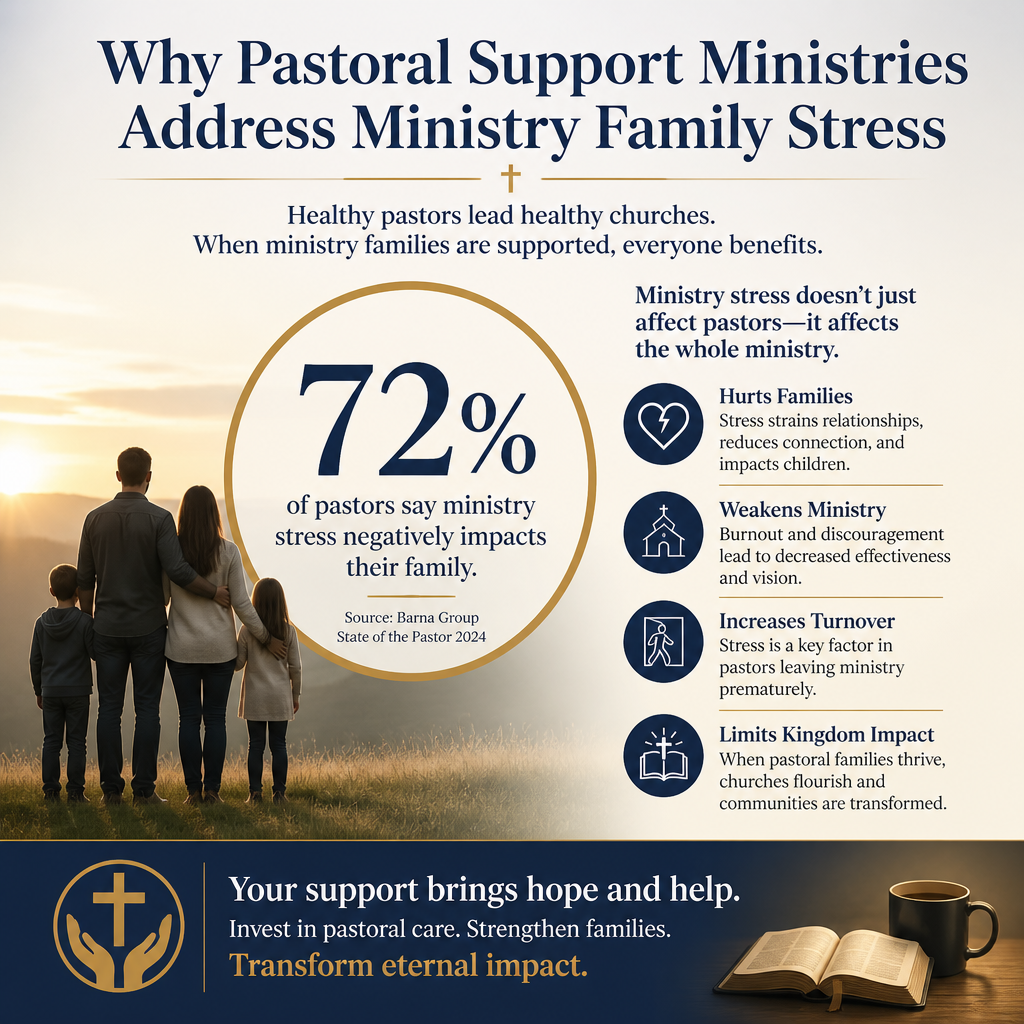
Pastoral support ministries address ministry family stress because the pastoral calling places ordinary human limits under extraordinary expectations. When a church’s shepherd is stretched thin, the strain does not remain in the study or the pulpit; it follows the pastor home. For Christian donors, this is not a sentimental concern. It is a stewardship question: whether the leaders entrusted with the care of souls are themselves being cared for in ways that sustain faithful, long-term ministry.
The New Testament holds together two truths that donors sometimes feel as a tension. Pastors are called to a life of costly service, and the church is commanded to provide material and practical support for those who labor in preaching and teaching (1 Timothy 5:17–18). The stress that accumulates in ministry families is not proof of weak faith; it is often the predictable result of a vocation that combines spiritual warfare, emotional labor, public scrutiny, and blurred boundaries. Pastoral support ministries exist to make that burden more bearable without lowering the seriousness of the calling.
Ministry family stress is not incidental to pastoral leadership
The pastor’s home becomes part of the congregation’s emotional ecosystem
Pastoral work is unusually relational. In many occupations, a difficult day ends when one leaves the office. Pastors often remain tethered to congregational crises at all hours: hospital calls, marital breakdowns, conflicts between members, funerals, addiction relapses, and the quiet emergencies that never become public. Over time, this produces cumulative strain that can settle into a household’s rhythms—missed meals, interrupted vacations, children who internalize church conflict, and spouses who carry an unspoken share of the pastoral load.
We also recognize that ministry families often experience a distinctive form of visibility. Even in healthy churches, the pastor’s spouse and children may be treated as informal staff, expected to attend everything, behave flawlessly, and offer emotional availability to the congregation. When stress rises, the family can feel both watched and alone, which is a potent combination for isolation.
The financial and vocational dynamics are frequently fragile
Many donors assume clergy are protected by stable institutional structures. In reality, pastoral employment can be precarious, particularly in smaller congregations. A resignation, conflict-driven termination, or denominational disruption can bring abrupt income loss, forced relocation, and a damaged vocational identity. When ministry is also the family’s social world, the cost can include the loss of friendships and community alongside the loss of a job.
We do not need a torrent of statistics to see the pattern; donors who have walked closely with churches have observed it. What matters is the implication: pastoral care for the pastor’s household is not an auxiliary ministry. It is part of a church’s capacity to endure in faithful witness over decades, rather than lurching from crisis to crisis.

Burnout, moral failure, and departure rarely begin as headlines
Most collapses start with ordinary depletion
When pastoral failure becomes public, commentary often simplifies the story into a single moment of sin or a single bad decision. Scripture does not excuse sin, but it does teach us to take seriously the formation of the inner life and the pressures that can erode vigilance. Elijah’s despair in 1 Kings 19, after extraordinary spiritual confrontation, came with exhaustion, isolation, and fear. God’s response included correction, but also sleep, food, and companionship—practical mercies that restored capacity for obedience.
Pastoral support ministries operate in that same moral terrain. They do not treat rest and counsel as a substitute for repentance or spiritual discipline. They treat them as part of the ordinary means by which God preserves his servants.
The cost of pastoral turnover falls on congregations and communities
Clergy transition is sometimes necessary and even healthy. Yet frequent or traumatic turnover can destabilize congregational life, fracture trust, and weaken outreach in the broader community. Pastoral support ministries address ministry family stress not because pastors are fragile celebrities, but because the church’s mission suffers when shepherds and their households are chronically depleted.
For donors, this means that funding pastoral care is often preventive. It is the kind of giving that rarely produces an immediate public metric, yet it can avert outcomes that are spiritually and financially devastating for a local church.
What pastoral support ministries provide that churches often cannot
Confidentiality and distance that protect integrity
Even the best-intentioned church can struggle to care well for its pastor’s family, simply because the relational web is too tight. A pastor’s spouse may hesitate to share honestly with church friends for fear of gossip, political repercussions, or the perception of disloyalty. Children often learn early what cannot be said. Pastoral support ministries can offer confidential counseling, coaching, and crisis support with enough distance to make candor possible.
That distance also guards integrity. When support is mediated through a structure with clear policies, trained counselors, and careful referral networks, care becomes less dependent on personalities and more resilient over time.
Specialized competence for ministry-specific pressures
Pastoral families face pressures that general counseling services do not always understand: spiritual authority dynamics, sermon feedback as a form of evaluation, congregational conflict that masquerades as theological dispute, and the spiritual intensity of caregiving in situations of grief and trauma. The best pastoral support ministries train counselors and coaches who understand church systems, vocational theology, and the real-world constraints of pastoral schedules.
What this means in practice is that the ministry can address both the spiritual and the practical. It can help a pastor set boundaries without treating the congregation as an enemy. It can help a spouse name loneliness without abandoning commitment. It can help children process the ways church life shaped their adolescence without turning them into cynics.
- Confidential counseling for pastors, spouses, and children
- Coaching on boundaries, workload, and sustainable rhythms
- Peer cohorts that reduce isolation without undermining local church loyalty
- Emergency care pathways for moral failure, addiction, or acute mental health crises
- Retreats and respite programs that restore capacity for ministry
Donors can learn more about the broader landscape of Pastoral Support Ministries as they discern where their giving can strengthen the church’s long-term health.
Healthy support avoids both celebrity culture and neglect
Christians disagree about where responsibility should sit
Some Christians argue that pastoral care should be handled primarily through local congregations and denominational structures, not through specialized nonprofits. Others contend that the complexity of modern ministry, especially in independent church networks, requires third-party organizations with dedicated expertise. We find that the strongest ecosystems often combine both: the local church provides love and ordinary support; denominational bodies provide accountability and resourcing; and pastoral support ministries provide specialized care and confidential intervention.
The harder question is how to fund such work without creating a subtle form of clergy exceptionalism. Pastors are not above the flock. Yet Scripture does assign elders a unique responsibility, and it calls the church to honor and support those who labor for the Word and the people. Wise pastoral support ministries keep that balance: they dignify the office without idolizing the officeholder.
Support must be accountable to real standards
Because these ministries often handle sensitive situations—mental health crises, marriage breakdown, allegations of abuse, and confidential counseling—donors should insist on clear governance, professional standards, and transparent policies. Compassion without accountability can become enabling. Accountability without compassion can become punitive. Donors should look for organizations that have both clinical competence and theological clarity, with clear referral protocols and safeguarding practices.
Across our verification work at Most Trusted, we observe that ministries that meet The Most Trusted Standard tend to treat confidentiality as a stewardship obligation, not as a marketing point. They describe what they do in plain terms, disclose leadership and oversight structures, and show how they evaluate outcomes without violating privacy or turning personal crises into donor narratives.
Donor discernment for pastoral care giving is a stewardship act
What mature evaluation looks for
Pastoral support ministries often do work that resists simple measurement. A healthy marriage preserved, a suicidal ideation episode interrupted, a pastor who stays faithful through a season of congregational conflict—these outcomes are real and significant, but they are not easily quantified. That does not mean donors should accept vagueness. It means donors should evaluate fit-for-purpose evidence: policies, professional qualifications, safeguarding practices, theological commitments, and credible accounts of program delivery.
When donors are deciding whether to fund pastoral support, we recommend asking questions that reflect the moral seriousness of the work:
- Does the ministry have clear safeguarding policies for counseling, minors, and abuse allegations?
- Are counselors and coaches appropriately credentialed, supervised, and accountable?
- Is there theological clarity about repentance, restoration, and disqualification where Scripture requires it?
- Does the ministry show financial transparency appropriate to its size and complexity?
- Are there boundaries that prevent conflicts of interest, especially when leaders counsel peers?
How Most Trusted fits into donor confidence
Most donors are not positioned to conduct a full governance and financial review of every organization they support. That is why our work at Most Trusted focuses on independent verification against The Most Trusted Standard, a 15-criteria framework across Faith Foundation, Financial Integrity, Governance and Leadership, and Transparency and Effectiveness. Our aim is not to replace prayerful discernment, but to reduce preventable risk and help donors give with confidence.
As donors explore How Pastoral Support Ministries Serve Pastor Families, the central question remains practical and spiritual: whether a ministry’s care is both compassionate and credible, and whether it strengthens the church without compromising biblical accountability.
FAQs for Why pastoral support ministries address ministry family stress
Should donors prioritize pastoral support over direct ministry programs?
Some donors will, and some should not. Scripture does not set up care for leaders as a rival to care for the poor or the lost; it presents the church as an interdependent body. Funding pastoral support can be a form of long-term stewardship when it stabilizes leadership, reduces preventable crises, and sustains faithful preaching and shepherding. Many donors find that a balanced portfolio is wisest: direct ministry outcomes alongside the less visible work of sustaining those who lead.
How can donors evaluate impact when confidentiality limits reporting?
Confidentiality is often appropriate in pastoral care, but it should not become an excuse for opacity. Donors can look for evidence such as documented program delivery, clear intake and referral processes, credentialing and supervision of counselors, safeguarding policies, and audited or professionally reviewed financials where appropriate. Strong governance and transparent operations are themselves indicators of effectiveness in ministries that handle sensitive personal crises.
A durable church requires durable pastoral households
Pastoral support ministries address ministry family stress because the church’s mission is carried by embodied people with finite strength. God often preserves his servants through ordinary means: counsel, rest, wise boundaries, and timely intervention. For donors, supporting this work is not indulgence. It is a sober investment in the health of the church, pursued with the same seriousness we apply to any ministry entrusted with sacred responsibilities.



