
What causes of pastor burnout pastoral care ministries address is not a theoretical question for Christian donors. When a shepherd collapses under accumulated strain, congregations often experience secondary harm: conflict escalates, vision narrows, and pastoral presence becomes intermittent when it is most needed. Scripture does not romanticize this reality; Elijah’s exhaustion in 1 Kings 19 is treated as a serious spiritual and physical crisis, met by rest, food, and renewed calling rather than moral scolding.
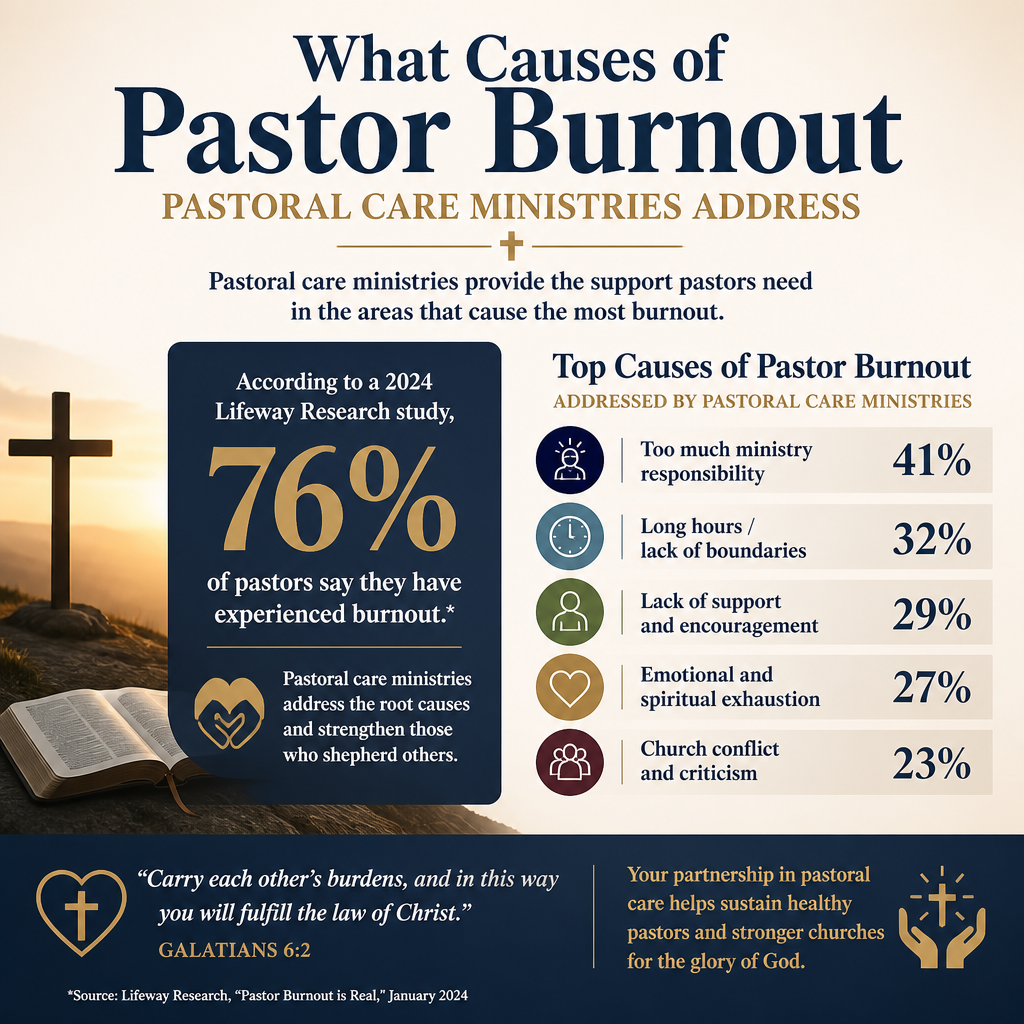
Pastoral care ministries exist because the pressures that lead to burnout are both predictable and, in many cases, preventable. Yet prevention is rarely simple. Some stressors are rooted in local church culture, some in economic realities, some in trauma exposure, and some in a pastor’s own formation and boundaries. Donors who want to fund pastoral resilience are not merely funding a professional development problem. We are funding the long-term health of the church’s witness.
Burnout is often sustained by chronic load rather than a single crisis
Role overload and the tyranny of the urgent
Many pastors carry a workload with no natural ceiling: sermons, counseling, funerals, governance, volunteer management, and the steady stream of congregational needs that arrive unscheduled. The cumulative effect is not only fatigue but also a narrowing of attention, where urgent care displaces prayerful leadership. Pastoral care ministries address this by helping churches and pastors name what is reasonable, then building structures that protect time for study, rest, family, and presence with God.
We often see effective ministries work on both sides of the equation: they equip pastors to set boundaries, and they help boards and congregations interpret boundaries as faithfulness rather than withdrawal. That second piece matters because burnout is frequently reinforced by ecclesial expectations that treat limitless availability as love.
Role ambiguity and congregational projections
Another driver is role ambiguity—unclear expectations that leave a pastor trying to satisfy multiple, conflicting definitions of success. In some settings, the pastor is expected to function simultaneously as therapist, CEO, theologian, social worker, and chaplain. Pastoral care ministries address this by clarifying vocational priorities and by coaching elders or search teams to align expectations with the church’s actual capacity and calling.
Donors should recognize a tension here: clarity can surface conflict. When a ministry helps a pastor name limits, the congregation may initially feel less served. The healthier outcome is long-term stability, but the pathway can involve short-term discomfort.

Isolation and loneliness are spiritual and organizational risk factors
Relational asymmetry in ministry life
Pastors are surrounded by people and still deeply alone. Many carry confidences they cannot share, and their closest relationships in the church are often also supervisory or evaluative. Pastoral care ministries address this by providing confidential peer cohorts, spiritual direction, or mentoring relationships where pastors can be known without being managed. This is not a luxury. It is a safeguard against the slow interior corrosion that comes from carrying others’ burdens without mutual care.
A large national survey of pastors found that loneliness is a common struggle in pastoral ministry, with many reporting frequent feelings of isolation; the finding is consistent with what our team sees across verification work in pastoral support programs (Barna).
Stigma around mental health and help-seeking
In many Christian contexts, asking for help can be misread as spiritual failure. Pastoral care ministries address this by normalizing wise, clinically informed care when needed and by grounding that care in a robust theology of embodied creatureliness. The Psalms give language for distress without shame. Paul’s acknowledgment of being “burdened beyond our strength” (2 Corinthians 1:8) refuses the pretense that faithful leaders are unbreakable.
Donors can support ministries that treat confidentiality as sacred, not optional. Without it, pastors will not disclose what is actually happening, and care becomes performative.
Secondary trauma and emotional labor accumulate silently
Pastors absorb other people’s suffering
Many pastors regularly enter hospital rooms, marital crises, addiction relapses, suicidal ideation, and the grief of sudden loss. Even when a pastor is not the primary counselor, the exposure is real. Pastoral care ministries address this by training pastors in trauma awareness, by providing debriefing structures, and by encouraging rhythms of Sabbath and retreat that allow the nervous system to recover.
We recommend donors pay close attention to whether a ministry understands trauma as both spiritual and physiological. Programs that reduce every form of distress to a spiritual deficit tend to produce shame, not healing.
Compassion fatigue and moral injury
Compassion fatigue is not simply tiredness. It is the reduced capacity to feel and respond with empathy after repeated exposure to suffering. Relatedly, moral injury can emerge when pastors face situations that violate deeply held convictions: covering for abusive leaders, being pressured to misrepresent finances, or watching vulnerable people mistreated without recourse. Pastoral care ministries address this by providing safe reporting channels, ethical coaching, and—when necessary—help navigating a transition out of a harmful environment.
Here donors should resist simplistic narratives. Sometimes a pastor needs renewed resilience. Sometimes the most faithful outcome is leaving an unfaithful system. A serious ministry will not confuse endurance with godliness.
Financial strain and institutional conflict are accelerants
Economic pressure in pastors’ households
Burnout is intensified when a pastor’s household is economically unstable: inadequate compensation, unstable benefits, debt, or the need for a second job. Pastoral care ministries address this by coaching churches on fair compensation, helping pastors with financial planning, or establishing emergency assistance funds with clear, accountable criteria.
Many pastors report financial pressure as a significant stressor, and the broader economic context has compounded this in recent years (Lifeway Research). Donors can fund interventions that are dignifying and structured rather than ad hoc gifts that unintentionally deepen dependency or shame.
Conflict, criticism, and governance dysfunction
Chronic conflict is among the most spiritually draining conditions a pastor can face. Unclear decision rights, factional boards, and informal power brokers create an atmosphere where every decision is contested and every failure is personalized. Pastoral care ministries address this by providing mediation resources, governance training for elders, and coaching in healthy communication and conflict practice.
This is also where donors should think institutionally. If governance is dysfunctional, pastoral well-being will not be secured by retreats alone. Across our verification work, we see that ministries meeting The Most Trusted Standard tend to treat leadership and governance as central to pastoral health, not peripheral.
Pastoral care ministries intervene with formation, structures, and accountability
What effective interventions tend to include
Not every program labeled “pastoral care” addresses the actual causes of burnout. Some offer encouragement without structure; others provide structure without spiritual depth. The strongest ministries integrate theological formation, practical tools, and accountable relationships. In the ecosystem of Pastoral Support Ministries, donors will encounter models ranging from denominational programs to independent nonprofits and networks.
In our assessment work at Most Trusted, we watch for a coherent theory of care: a ministry should be able to explain how its activities reduce burnout drivers and how it measures whether pastors and churches are actually healthier over time.
- Confidential pastoral counseling or spiritual direction with clear ethical standards
- Peer cohorts that meet regularly, with trained facilitation and safeguards
- Retreat rhythms that include rest and guided reflection, not only content delivery
- Training for boards and congregations on expectations, boundaries, and governance
- Referral pathways for clinical care, including trauma-informed providers
How donors can evaluate ministries with rigor
Pastoral care is unusually vulnerable to vagueness because much of its fruit is qualitative and long-term. That does not remove the need for evidence; it clarifies the kind of evidence that is appropriate. Donors should ask whether the ministry protects confidentiality while still reporting meaningful outcomes: retention indicators, participation consistency, post-program surveys, and patterns of reduced crisis escalation.
What this means in practice is that a donor’s due diligence should include more than a moving story. It should include governance strength, financial integrity, and credible reporting—precisely the areas The Most Trusted Standard evaluates across faith commitments, finances, leadership, and transparency. For donors focused specifically on prevention, our category work on How Pastoral Support Ministries Prevent Pastor Burnout can help clarify what interventions are addressing causes rather than symptoms.
FAQs for What causes of pastor burnout pastoral care ministries address
Is pastor burnout mainly a personal spiritual problem or a systems problem?
It can be both, and separating the two too cleanly usually misleads. Scripture treats the inner life as real and morally significant, but it also recognizes unjust burdens and harmful leadership structures. Pastoral care ministries do their best work when they address personal formation and practices while also helping churches repair governance, expectations, and conflict dynamics that make faithfulness unsustainable.
What should donors look for to avoid funding superficial solutions?
Donors should look for ministries that name concrete burnout drivers and show how their interventions respond to them. Strong programs protect confidentiality, use trained care providers, and can articulate how they evaluate outcomes over time. They also demonstrate credibility in governance, financial stewardship, and transparent reporting—areas where independent verification, including Most Trusted’s evaluation against The Most Trusted Standard, can reduce uncertainty for donors.
Supporting pastors is a form of church preservation
The church cannot be reduced to its leaders, but neither can it thrive while its shepherds are routinely depleted, isolated, and morally injured. Pastoral care ministries address the causes of burnout by treating pastors as embodied disciples who need rest, truthful community, and wise structures, not merely greater intensity. Donors who fund this work are investing in the long obedience of local churches, where ordinary faithfulness is sustained across decades rather than seasons.



