
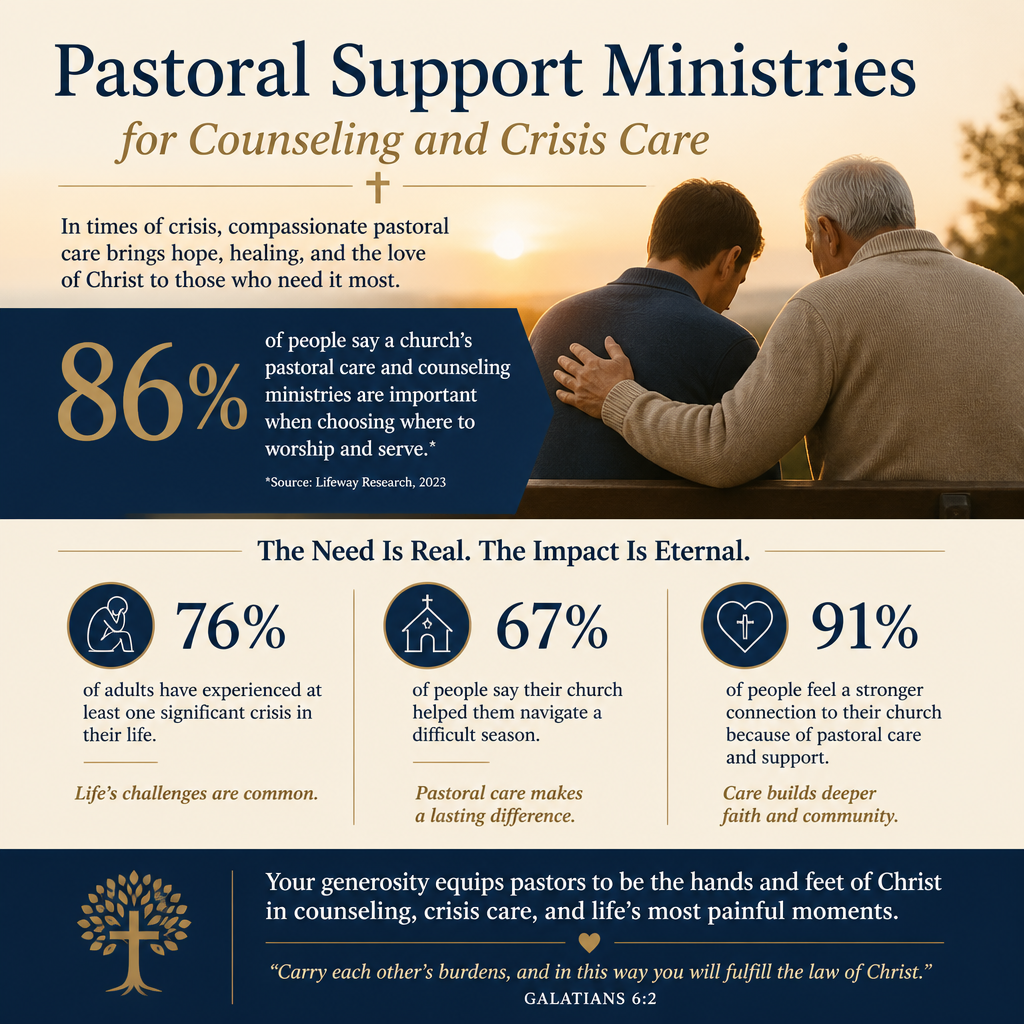
Pastoral support ministries for counseling and crisis care exist because spiritual leadership carries distinctive pressures, and the cost of untreated strain rarely stays contained to one individual. Donors who fund this work are not underwriting a private benefit for pastors; they are protecting congregations, marriages, children, and the public witness of the church when stress, trauma, depression, anxiety, or moral compromise meets the realities of leadership.
Scripture is candid about both the weight of oversight and the vulnerability of those who bear it. Paul describes ministry as a continual “pressure” and “anxiety for all the churches” (2 Corinthians 11:28), and James warns that teachers will be judged with greater strictness (James 3:1). Wise pastoral support ministries translate those theological realities into credible clinical pathways, careful confidentiality, and accountable governance so that care is both compassionate and safe.
Why this category of ministry matters for donors
Pastoral counseling and crisis care sit at an intersection donors often find difficult: the church’s spiritual responsibilities and the legitimate insights of clinical practice. Healthy ministries refuse the false choice between “just pray” and “just therapy.” They treat spiritual care as essential without treating it as a substitute for medical or psychological treatment when those are needed.
For donors, the stakes are high. The fruit of this work is often less visible than program metrics in other sectors, and confidentiality properly limits public storytelling. That means a donor must judge quality by the integrity of the system: the ministry’s theology, its professional standards, its safeguards, and its accountability. At Most Trusted, we evaluate ministries against The Most Trusted Standard, examining their Faith Foundation, Financial Integrity, Governance and Leadership, and Transparency and Effectiveness—not as abstractions, but as indicators of whether a ministry can be trusted with people in acute vulnerability.
Crisis care is not a niche service
The church has had to reckon with the reality that pastors experience depression, trauma, and burnout at meaningful rates, and that they can face suicidal ideation like any other population. Because suicide is a leading cause of death in the United States, pastoral support ministries must be prepared to respond with urgency, referral competence, and risk protocols rather than informal counsel alone (Centers for Disease Control and Prevention).
In practice, crisis care can include rapid triage, emergency safety planning, coordination with local resources, and support for spouses and elders who are often destabilized by a pastor’s crisis. When done well, it prevents escalation and reduces the likelihood that desperate leaders will hide, self-medicate, or implode publicly.
Counseling is not merely problem-solving
Pastoral counseling in these ministries typically aims at durable restoration: spiritual formation, emotional regulation, relational repair, and vocational sustainability. The best programs do not treat a pastor as a “client to fix” but as a whole person with a calling, a family system, and a congregation that will feel the consequences of either healing or continued deterioration.
Donors should expect these ministries to be clear about what they do and do not offer. Counseling can be short-term stabilization or longer-term therapy. It can be individual, marital, or family-based. It can address acute crisis or chronic patterns. Clarity is a form of protection for the pastor and for the people who fund the work.

How mature pastoral counseling programs work
Pastoral support ministries have evolved substantially over the last several decades. Christians genuinely disagree about where the boundary sits between “biblical counseling” and licensed clinical practice, but many of the most trustworthy ministries have learned to integrate the strengths of both. They take Scripture seriously as the church’s normative authority while also recognizing that trauma, addiction, major depression, and other conditions require competencies that extend beyond informal pastoral care.
Sound triage and appropriate referral
Effective ministries begin with intake that distinguishes between pastoral care, clinical counseling, psychiatric needs, and immediate crisis. Triage is not bureaucracy; it is stewardship of risk. A pastor in panic and insomnia may need counseling and rest; a pastor with active suicidal intent may require emergency services; a pastor experiencing psychosis may need medical intervention. A reliable program states clearly how it assesses risk and how it escalates care when necessary.
This is one reason donors should not reward ministries that present themselves as able to handle everything “in-house.” Humility is a safety practice. The most responsible organizations build referral networks with licensed providers, physicians, inpatient programs, and denominational leaders where appropriate.
Why many ministries use licensed Christian counselors
Licensure is not a guarantee of spiritual wisdom, but it is a public accountability mechanism. Licensed counselors operate under defined ethical codes, mandated reporting requirements, supervision norms, and continuing education expectations. For ministries serving pastors, those guardrails matter because the counselee is often a public figure with complex power dynamics, reputational risk, and potential legal exposure for the church.
Many donors also want to ensure counseling is spiritually congruent. A well-run pastoral support ministry can provide licensed Christian counselors who are clinically competent and theologically grounded, while remaining honest about scope: counseling is not ecclesial discipline, and therapy is not sacramental care. The integration must be explicit rather than assumed.
Confidentiality that is real and rightly limited
Confidentiality is essential for pastors who fear that seeking help will end their ministry. Yet confidentiality must never become a mechanism for hiding abuse, criminal conduct, or imminent danger. Strong ministries explain confidentiality in writing, including the limits: threats of harm, abuse of minors, and other mandated reporting triggers. They also clarify who owns the record, how notes are stored, and how information is shared, if at all, with denominational authorities or church boards.
Donors can legitimately ask: does the ministry’s confidentiality model reflect both compassion and lawful, ethical boundaries? A program that promises secrecy without exceptions is not courageous; it is reckless.
Safeguards donors should expect in crisis and restoration work
Pastoral support ministries that handle moral failure and restoration operate in a terrain where naiveté harms people. Some failures are primarily personal and spiritual; others involve coercion, abuse of power, or criminal actions. The church’s desire for restoration is biblical, but it does not erase justice, protection for the vulnerable, or the long-term consequences of disqualification from office.
Donors should not fund restoration narratives that bypass accountability. Scripture’s call to gentleness (Galatians 6:1) never negates the call to protect the flock (Acts 20:28–30). The responsible ministry holds both in view and builds systems that make shortcuts harder.
Clear boundaries between care and adjudication
One recurring failure pattern in church crises is collapsing multiple roles into one person or one office. A pastoral support ministry can provide counseling and stabilization, but it should not be the sole investigator, judge, and restoration authority—especially when allegations involve abuse of power or sexual misconduct. Credible programs coordinate with denominational processes, independent investigators, and legal counsel when needed. They do not promise outcomes; they promise fidelity to process.
Written protocols for misconduct and abuse allegations
Donors should look for explicit policies: mandated reporting, cooperation with law enforcement when appropriate, trauma-informed care for victims, and guidance for churches on immediate protective steps. Many churches have improved their policies in the last decade, but the work is unfinished. Research has shown that a large share of Protestant churchgoers report their church has not discussed steps to prevent sexual abuse—an indicator of ongoing prevention gaps (Lifeway Research).
In this context, pastoral support ministries should be part of the church’s maturation, not an escape hatch from consequences. A program can care for an accused pastor without becoming an advocate against victims or a shield against transparency.
Rest and rehabilitation that are structured, not sentimental
When restoration is appropriate, it should be structured: defined phases, measurable commitments, supervised counseling, and clear criteria for any return to ministry. Many programs include spiritual direction, marriage counseling, relapse prevention plans, and peer accountability. The aim is not image repair but repentance, healing, and a sober re-evaluation of calling and capacity.
Donors should expect candor about outcomes. Some pastors will not return to vocational ministry. A ministry that treats that possibility as failure may be more invested in a story than in truth.
How donors can evaluate pastoral support ministries with confidence
Because confidentiality reduces public detail, donors need evaluation questions that do not require private case files. The most meaningful indicators are structural: governance quality, financial clarity, professional standards, and transparent communication about what the ministry does. This is where independent verification becomes especially valuable.
Faithfulness that is explicit and accountable
Pastoral support ministries should state their doctrinal commitments and articulate how those commitments shape their counseling approach. Donors should also ask how the ministry handles theological diversity across denominations. The strongest organizations are clear about essentials while showing restraint on secondary issues that do not need to become gatekeeping.
We also watch for whether theology is used to suppress legitimate clinical care. If a ministry’s model implies that faithful Christians should not need medication, trauma treatment, or psychiatric evaluation, donors should pause. That posture can place pastors at risk and can burden families with preventable suffering.
Financial integrity and governance that can bear weight
Pastoral crisis care often includes urgent travel, subsidized counseling, retreats, and sometimes multi-month support. That financial profile can invite both mission drift and quiet mismanagement. Donors should look for audited or independently reviewed financials, a functioning board with real oversight, conflict-of-interest policies, and transparent reporting on how donor dollars are used.
In our verification work at Most Trusted, the ministries that meet The Most Trusted Standard tend to treat financial integrity as part of pastoral ethics, not a separate administrative task. They can explain cost structures without defensiveness and can demonstrate that restricted gifts are honored.
Transparency that respects confidentiality
Transparency does not require violating privacy. It does require publishing clear policies, describing the care model, naming leadership qualifications, and reporting outcomes in aggregate where possible. When a ministry will not share any meaningful information—no policies, no leadership bios, no financial statements—it asks donors to fund a black box. That is an avoidable risk.
Donors who want a broader frame for evaluating organizations in this space can begin with Pastoral Support Ministries, then apply the same disciplined questions to counseling and crisis-care programs: Who holds authority? What safeguards exist? How are conflicts handled? What happens when leaders fail?
Supporting care that strengthens the church
Pastoral support ministries for counseling and crisis care are at their best when they combine theological seriousness with professional competence, and compassion with accountability. Donors are right to ask hard questions here, because these ministries serve people in moments when clarity is scarce and consequences are lasting.
Funding this work is an act of stewardship toward the church’s long-term health. When counseling is competent, confidentiality is rightly bounded, and restoration is disciplined rather than sentimental, donors help sustain leaders, protect congregations, and honor Christ through truthfulness in the difficult places.



