
How to give to pastoral support ministries is not primarily a question of technique. It is a question of whether our giving will strengthen the spiritual care of Christ’s people without distorting the pastor’s calling or the church’s witness. Pastors carry burdens that are rarely visible: sustained emotional labor, unending crisis response, and the moral weight of shepherding souls. Done well, pastoral support giving is a form of fellowship in the gospel—material partnership that protects ministry integrity and helps pastors endure.
Scripture makes the basic obligation plain. “Let the one who is taught the word share all good things with the one who teaches” (Galatians 6:6), and “those who proclaim the gospel should get their living by the gospel” (1 Corinthians 9:14). At the same time, the New Testament warns that money can warp ministry, either through greed, favoritism, or the quiet pressure to please donors rather than God (1 Timothy 3:3; 1 Peter 5:2). The harder question is how donors give in ways that remain accountable, wise, and theologically honest about the risks.
Begin with a clear theology of pastoral care and support
Pastoral support is not charity in the narrow sense. It is a ministry investment in the ordinary means God uses to sustain the church: preaching, prayer, sacraments, counsel, discipline, and presence. In many traditions, it also includes chaplaincy, church planting, rural ministry, and care for pastors in seasons of burnout, illness, or transition.
Christians genuinely disagree about what forms of support are most faithful. Some emphasize direct salary support through the local church as the most biblically grounded and least complicated approach. Others point to the reality that many pastors serve in under-resourced contexts, and that outside support can prevent premature exit from ministry. Both instincts can be faithful. The central principle is that support should strengthen the pastor’s calling and accountability rather than replace them.
Support the office without cultivating celebrity
Pastoral ministry can become vulnerable when donors attach giving to personality, platform, or public visibility. The internet has made it easy to fund “ministry leaders” who have no meaningful ecclesial oversight. Donors should ask whether the pastor is accountable to a local body of elders, a denomination, or another credible structure with real authority. Where those structures are absent, donors effectively become the oversight, which is a role donors are not designed to play.
Separate compassion from control
Support can become coercive when it carries implicit expectations: preferred sermon topics, access to the pastor, special treatment, or influence in decisions. A mature donor gives without purchasing authority. When support is needed for a specific hardship—medical bills, counseling, sabbatical—clear boundaries and independent administration protect both the pastor and the donor from an unhealthy dynamic.
Decide what you are funding
Pastoral support ministries vary widely. Some provide direct financial grants. Others provide counseling referrals, spiritual direction, training, peer cohorts, or emergency relief. Donors should name the category: “We are funding crisis relief for pastors,” or “We are funding ongoing formation and resilience,” or “We are funding salary supplementation for underserved congregations.” Clarity about what the ministry actually does is the first defense against confusion and disillusionment.

Evaluate trustworthiness with evidence, not sentiment
Donors often arrive at pastoral support with genuine gratitude for faithful shepherds, and gratitude can make us less discerning. A moving story is not the same as a credible organization. The more direct the financial support to individuals, the more a ministry must demonstrate strong governance, documented policies, and careful controls.
At Most Trusted, we evaluate Christian nonprofits against The Most Trusted Standard, a 15-criteria framework spanning Faith Foundation, Financial Integrity, Governance and Leadership, and Transparency and Effectiveness. Pastoral support ministries that meet a high bar tend to be structurally modest and operationally rigorous: clear eligibility rules for aid, consistent documentation, financial review, independent oversight, and humble communication that honors privacy.
Insist on meaningful governance
A credible pastoral support ministry should have an active board with genuine independence, regular meetings, and documented oversight of the executive leader. Donors should be cautious when a ministry is effectively a personality-driven operation with minimal external constraint. Governance is not paperwork; it is a ministry protection. It guards against favoritism in grant decisions, prevents misuse of funds, and provides a mechanism for correction.
Read the financial signals without fixating on ratios
Christians have been trained to obsess over “overhead,” but the sector has repeatedly warned that overhead ratios are a poor proxy for impact. Charity Navigator, Candid (GuideStar), and the BBB Wise Giving Alliance jointly argued that “overhead” can mislead donors and pressure nonprofits into underinvesting in systems that protect mission delivery (Charity Navigator). A pastoral support ministry that provides counseling, training, or complex grantmaking will need competent staff and adequate systems; low overhead is not automatically virtuous.
What this means in practice is that donors should look for audited financials when appropriate, clear explanations of major expense categories, and policies that address conflicts of interest. If a ministry is small and not audited, it should still demonstrate disciplined bookkeeping, board review, and transparency proportionate to its size.
Require transparent reporting that does not violate privacy
Pastoral support work often involves confidential needs: marital crises, mental health concerns, addiction, financial collapse, or moral failure. A faithful ministry will protect personal details and still report honestly. The goal is not to satisfy donor curiosity. It is to demonstrate that funds are distributed fairly, eligibility is enforced, and outcomes are tracked in appropriate ways (for example, number of pastors served, types of services provided, retention in ministry after a defined period, or completion of a restoration process).
Choose the giving method that matches the ministry’s work
Different ways of giving create different pressures on a pastoral support ministry. A one-time emergency gift is not the same as an ongoing commitment to sustain a program. A donor-advised fund is not the same as a credit-card donation. Mature donors choose the instrument that fits the ministry’s cash-flow needs, administrative capacity, and accountability requirements.
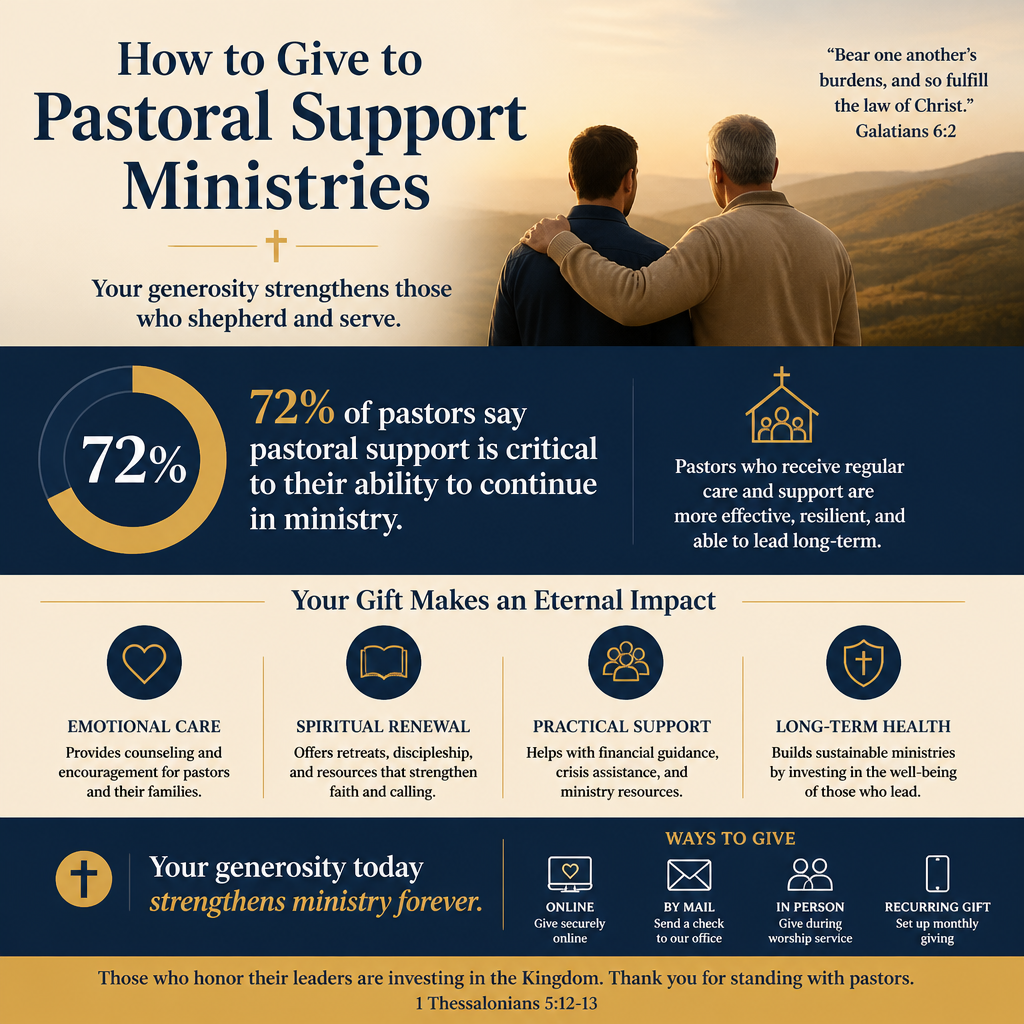
One-time gifts for defined needs
Emergency relief and special projects are often best served by one-time giving. Donors should still ask for clear eligibility standards and documented decision-making. When the need is acute—medical expenses, temporary housing, counseling support—outside administration matters. Directly giving money to an individual pastor may be appropriate in some circumstances, but it can complicate tax deductibility, create expectations, and expose both parties to misunderstanding. A ministry-administered relief fund generally provides clearer accountability and cleaner boundaries.
Monthly giving for stability and care continuity
Monthly giving can be especially fitting for pastoral support ministries because many forms of care require continuity: counseling sessions, cohort programs, ongoing coaching, or a structured sabbatical pathway. Recurring donations allow a ministry to plan responsibly and to offer support before a pastor reaches crisis.
Monthly giving also disciplines the donor. It places pastoral care in the category of long obedience rather than episodic sympathy. Donors should confirm that recurring gifts can be adjusted or paused and that the ministry has a clear statement of how unrestricted monthly funds are prioritized.
Stock, donor-advised funds, and complex gifts
For donors with appreciated assets, giving stock can increase the gift’s value while potentially avoiding capital gains taxes, depending on a donor’s circumstances. Pastoral support ministries vary in their capacity to receive non-cash gifts; some work with brokers or third-party platforms, others cannot. Donors should ensure the ministry has a documented process for receiving and liquidating assets promptly and ethically.
Donor-advised funds can be an efficient way to support pastoral care while consolidating giving and recordkeeping. The trade-off is timing: grants from DAFs can lag, and some ministries experience unpredictability when donors change recommendations. A donor’s commitment should match the ministry’s expectations; programs that require multi-month support should not be funded primarily through uncertain, irregular distributions.
Matching gifts can be constructive when used carefully, but donors should be alert to perverse incentives. A matching campaign can pressure ministries into urgency-driven fundraising or storytelling that violates privacy. Matching also tends to reward ministries that already have donors with access to large match funds, which can disadvantage smaller, faithful efforts. Donors should prioritize integrity over optics.
Give in ways that strengthen the pastor and the church
Pastoral support should not implicitly undermine the local church’s responsibility to care for its shepherds. Some donors give because they are disillusioned with church budgets or skeptical of denominational systems. Those concerns may be understandable, but bypassing the church can create a parallel economy of pastoral care that lacks ecclesial accountability. When possible, donors should ask how the ministry coordinates with churches, elders, or denominational structures rather than replacing them.
Ask the ministry how it avoids dependency
Financial support that becomes permanent without a plan can diminish resilience and obscure the underlying issue: a congregation that cannot sustain its pastor, an unsustainable ministry model, or a lack of shared responsibility. Wise ministries typically provide time-bound support, coaching for financial health, and pathways toward sustainability. Donors can honor pastors without normalizing chronic fragility.
Watch for warning signs that harm both pastor and donor
Certain patterns should slow a donor down: vague descriptions of how funds are distributed; reliance on private, unverifiable stories; excessive focus on a single leader; lack of published leadership information; refusal to answer basic governance questions; or fundraising that trades on outrage and fear. Pastoral pain is real, but it is not a license for poor stewardship.
Practice generous restraint
Some of the most faithful support a donor can offer is quiet and consistent: funding counseling access, underwriting sabbatical structures, paying for cohort facilitation, or supporting a well-governed relief fund. Not every gift needs a personal relationship with the recipient. The New Testament vision of generosity is both personal and orderly—love expressed through trustworthy structures.
For donors seeking a broader view of credible ministries in this category, our work in Pastoral Support Ministries emphasizes verifiable governance, financial integrity, and theological clarity, because pastors deserve support that does not create new burdens.
Faithful pastoral support is accountable generosity
Christian donors give to pastoral support ministries because the church cannot afford to treat shepherds as disposable. Pastors are called to watch over souls, and Scripture expects the people of God to share materially in that labor. The gift becomes truly faithful when it is given with clear purpose, careful verification, and humility about the ways money can shape ministry.
Accountable generosity protects the pastor, the church, and the donor. It honors the gospel by refusing both cynicism and sentimentality, and by insisting that compassion and integrity belong together.



