

How pastoral support ministries serve pastor families is ultimately a question of ecclesiology and stewardship: what responsibilities belong to the local church, what needs require specialized care, and what kind of support protects a family without quietly disqualifying a shepherd. Donors often sense the stakes intuitively. When a pastor’s home frays, the effects rarely stay private; the spiritual and institutional costs tend to surface later in a congregation’s health, its witness, and its long-term stability.
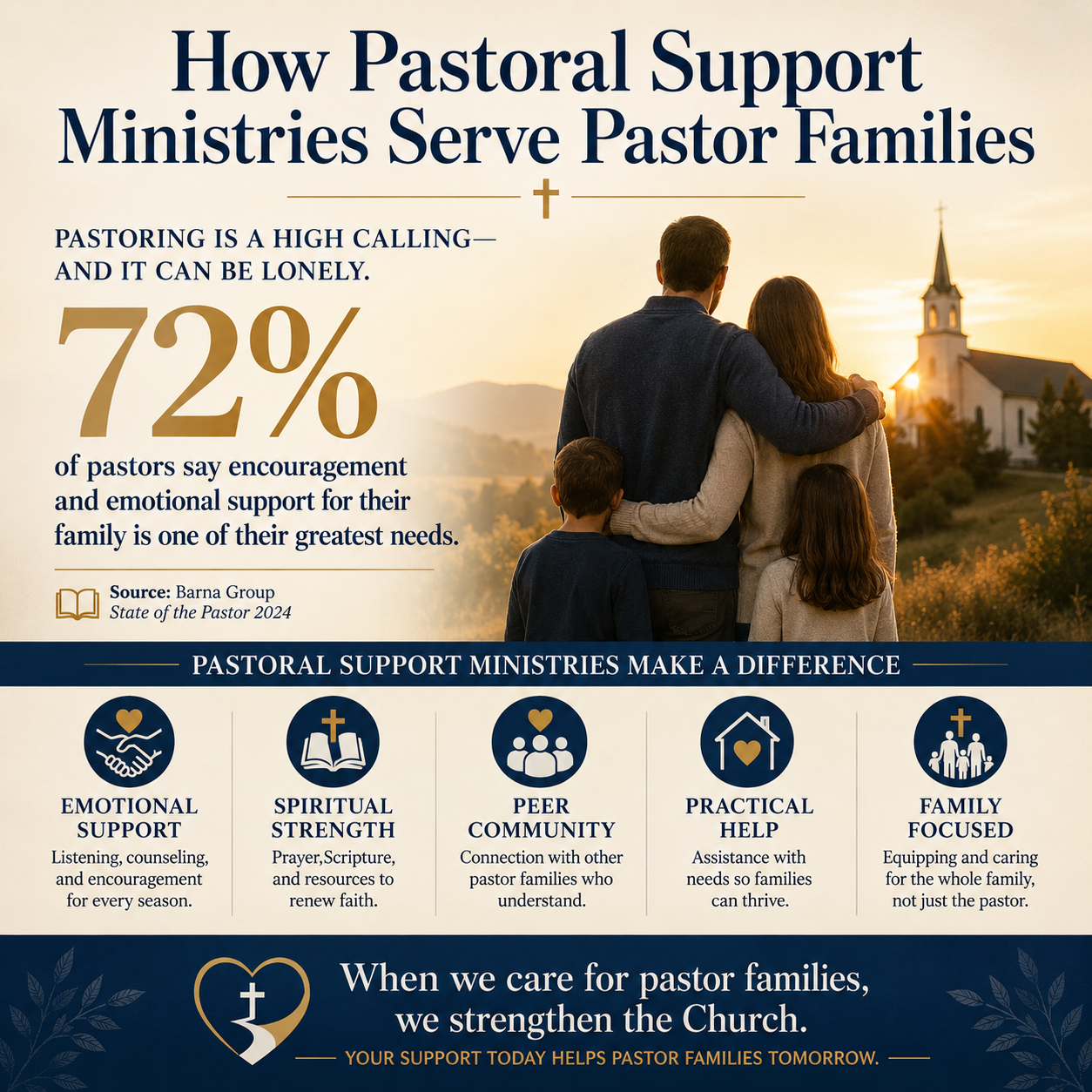
Scripture does not romanticize ministry life. Paul describes pressure, anxiety for the churches, and seasons of weakness that become a theater for Christ’s power (2 Corinthians 11:28–30). Pastors and their families are not exempt from ordinary human limits; they are often exposed to extraordinary expectations. Pastoral support ministries exist to strengthen what is too frequently treated as an unlimited resource: the emotional, relational, and spiritual capacity of the household that lives in the public eye.
Pastor families carry a public calling with private costs
Pastor families often live with a dual burden: high visibility and low permission to struggle. Many congregations want a pastor who can empathize with suffering while appearing untroubled by his own. That tension is not merely cultural; it is also theological confusion. The New Testament calls leaders to be “above reproach,” but it does not require them to be invulnerable (1 Timothy 3:2). When “above reproach” is interpreted as “never needy,” families learn to manage appearances rather than seek help.
The ministry family system is not the same as the ministry job
Pastoral work tends to blur boundaries that other professions maintain: evenings, weekends, emergencies, and a persistent sense that “someone’s crisis is always waiting.” The family experiences that blur as lost rhythms and ambiguous loyalties. The pastor’s spouse may carry unpaid emotional labor for the congregation, and children may experience church as a place where their parent is always partially absent, even when physically present. These dynamics are difficult to quantify, but donors recognize them because they resemble other caregiving vocations: the family bears the vocational load alongside the worker.
Stress is not the same as scandal, but it can become it
The Christian community has learned, sometimes painfully, that preventable breakdowns often begin as ordinary fatigue, isolation, or untreated conflict. Donors sometimes hesitate to fund “care” because it can feel less urgent than direct mission. Yet preventative care is often the most stewardship-minded investment available. The difference between a supported family and an unsupported one can be measured in years of faithful service, reduced churn, and fewer congregations forced into emergency transitions.
Why donors should resist simplistic narratives
Christians genuinely disagree about how much responsibility a congregation should assume for a pastor’s family needs. Some argue that the church should provide all necessary care internally; others recognize that small churches rarely have the expertise or confidentiality structures required for complex situations. The field has also had to reckon with abuses of power—cases where “support” becomes a way to protect an institution rather than pursue truth and healing. Wise donors fund ministries that strengthen families without insulating wrongdoing, and that treat accountability as a form of care rather than a threat to it.

What effective pastoral support looks like in practice
Pastoral support ministries serve pastor families through a range of interventions, from ordinary encouragement to clinical-level care coordination. The strongest programs share a common posture: they treat the family as a ministry unit with legitimate needs, not as an accessory to the pastor’s role. They also understand that confidentiality is not optional; it is a prerequisite for honesty.
Care for pastor spouses as full persons, not supporting characters
Support for spouses often includes peer cohorts, spiritual direction, mentoring, counseling referrals, and periodic respite. Healthy programs avoid pressuring spouses into a single template of “pastor’s wife” or “pastor’s husband.” Instead, they honor the spouse’s own vocation, limits, and spiritual needs. Donors should look for ministries that protect agency: the spouse is not recruited as free staff for church needs, and participation is not treated as a test of loyalty.
In more intensive cases, ministries may provide subsidized counseling with licensed clinicians, especially when the family faces depression, anxiety, grief, addiction in the extended family system, or chronic conflict. The crucial question is not whether counseling is “spiritual enough,” but whether it is competent, ethically accountable, and integrated with Christian conviction. Programs can be theologically serious and clinically responsible at the same time.
Support for pastors’ children that respects their particular vulnerabilities
Pastors’ children often grow up under a mild but persistent scrutiny. They can internalize a sense that their behavior represents the gospel, the church, and the family’s livelihood. Effective ministries create spaces where children are not “examples” but sons and daughters. This might include age-appropriate retreats, camps, mentoring, or family systems counseling when appropriate.
Donors should also recognize the trade-offs: a “kids program” that is too public can unintentionally increase visibility. The best ministries prioritize privacy, consent, and long-term relational continuity over one-off events that generate publicity but provide little sustained support.
Respite and retreats that rebuild relationships rather than entertain
Pastor family retreats can be profoundly helpful when they are structured around rest, pastoral counseling, and reconnection. The aim is not luxury; it is recovery of normal human life: sleep, unhurried conversation, shared meals, and the ability to worship without performing. Some ministries include guided marriage intensives or facilitated family conversations, recognizing that chronic ministry stress often shows up in relational patterns rather than in a single “crisis moment.”
How pastor families access support and why barriers persist
Many pastor families do not access support because they do not know it exists, cannot afford it, or fear the reputational consequences. Others have tried to seek help and found programs that were either overly generic or subtly coercive: “support” conditioned on compliance, silence, or institutional protection. Donors can serve the field by funding ministries that reduce these barriers without lowering ethical standards.
Common access points and what they signal about a ministry
Pastor families typically find support through denominational networks, trusted peers, counselor referrals, or a recommendation from an elder board. Some ministries work directly with churches; others serve families independently. Neither model is automatically superior. Church-connected programs can improve continuity and accountability, but independent programs may offer stronger confidentiality, especially in small communities where everyone knows everyone.
When donors evaluate a ministry’s access model, the practical questions matter: Is the intake process dignified? Are there clear policies for mandated reporting and abuse allegations? Does the ministry provide triage for urgent situations and referrals for needs it cannot address? Mature ministries do not pretend to be a complete solution; they are clear about scope and referral pathways.
The financial barrier is real, and it is not only about salary
Even when a church pays a reasonable salary, many pastors hesitate to spend on counseling, retreats, or travel for support cohorts. Some fear appearing self-indulgent. Others worry it will be interpreted as weakness. Donor-funded subsidies can function as permission as much as provision. When support is clearly designated and privately administered, families can receive care without an additional layer of congregational politics.
We also advise donors to avoid simplistic “overhead” assumptions. Competent care requires qualified staff, safeguarding practices, and administrative rigor. The sector has increasingly recognized that starving infrastructure undermines outcomes. The Overhead Myth statement—endorsed by major evaluators and philanthropic institutions—has helped donors see that effectiveness is not measured by minimizing administrative cost alone.
Why confidentiality and accountability must be held together
The hardest question is how ministries protect privacy without enabling harm. In pastoral contexts, the risk is not theoretical. Programs should have clear protocols for safety issues, legal reporting requirements, and situations involving spiritual abuse or sexual misconduct. Donors should not fund ministries that treat “protecting the pastor” as the highest good. The highest good is the truth lived out in love, with particular care for the vulnerable (Ephesians 4:15).
What donors should look for when funding pastor family care
Donors are not only funding services; they are funding a theology of pastoral life. The best pastoral support ministries honor the call to shepherd God’s people while acknowledging that shepherds are embodied, finite, and susceptible to isolation. They treat care as a means of sustaining faithful ministry, not as a reward for success or a quiet exit ramp for those who can no longer perform.
Alignment with a clear Christian anthropology and ecclesiology
Effective ministries speak plainly about sin and suffering, responsibility and limits, repentance and rest. They do not collapse every problem into either “spiritual warfare” or “mental health,” as if Scripture and wise clinical practice were competitors. Donors can ask: Does the ministry affirm the authority of Scripture and a robust doctrine of the church? Does it respect the local church’s role while recognizing when specialized care is necessary?
Governance, safeguards, and the integrity of the care model
Because pastoral support work can involve vulnerable people and sensitive disclosures, governance and safeguards are not bureaucratic details; they are moral commitments. Donors should look for clear board oversight, conflict-of-interest policies, safeguarding training, and transparent handling of complaints. When a ministry offers counseling, donors should verify that clinicians are appropriately licensed and supervised, and that the ministry’s policies are consistent with professional ethics and mandatory reporting requirements.
This is one reason many donors use independent verification. At Most Trusted, we evaluate ministries against Pastoral Support Ministries using The Most Trusted Standard, a 15-criteria framework across Faith Foundation, Financial Integrity, Governance and Leadership, and Transparency and Effectiveness. The aim is not to replace relational discernment, but to give donors a disciplined way to test whether a ministry’s public claims align with verifiable practice.
Evidence of real care and clear boundaries
Outcomes in pastoral support are sometimes difficult to quantify without violating confidentiality. Still, donors can seek meaningful indicators: retention of participants over time, repeat engagement that suggests trust, documented referral networks, and anonymized feedback processes. Ministries should be able to explain what they do, who it is for, what they will not do, and how they respond when the presenting issue exceeds their competency.
Donors should also ask how a ministry handles power. Any program that depends on celebrity pastors, opaque spiritual authority, or discretionary “favor” is structurally vulnerable. Ministries that distribute power through accountable teams, clear policies, and ordinary means of grace tend to be safer over time.
Funding pastor family support as long-term stewardship
Supporting pastor families is not a sentimental cause. It is an investment in the ordinary faithfulness that sustains congregations: marriages that endure, children who do not quietly disappear from the church, leaders who can repent and receive care before a crisis becomes public damage. Donors who fund pastoral support ministries are participating in a form of church strengthening that is rarely visible but often decisive.
The field still faces real tensions—between confidentiality and accountability, between local responsibility and specialized intervention, between compassion and the necessity of truth. Donors serve the church best when they fund ministries that hold those tensions with integrity, and when they require verifiable evidence that care is both theologically grounded and operationally trustworthy.



